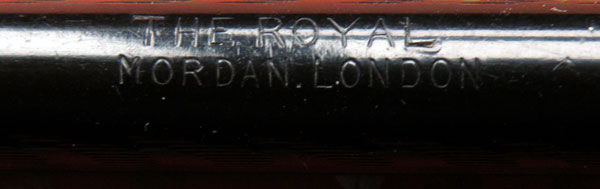
The Mordan Royal

The firm of Sampson Mordan is best known for the wonderful silver mechanical pencils they produced throughout the nineteenth century and into the first half of the twentieth century, until the company’s premises were bombed in the Blitz in 1941. They did also occasionally make pens, but not many, with the result that Mordan pens are very rare today.

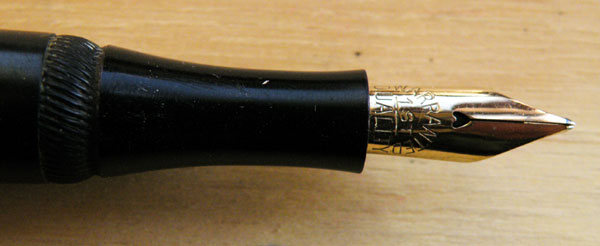
The Royal is an eyedropper filler. It’s a little hard to date. It has a slip cap which suggests it’s early, as does the large, plain 14ct nib. It doesn’t have an over-and-under feed but a slightly more modern type and the tapered section suggests later rather than earlier. If I was forced to guess I’d opt for the mid-teens, possibly just on the eve of the First World War.
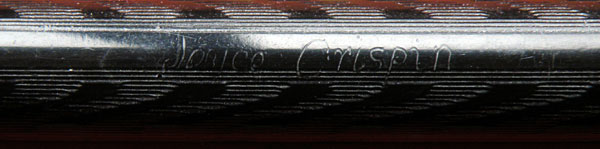
It has a discreet little personalisation. It’s as if Joyce Crispin wanted the world to know this was her pen, but only in a whisper. I thought that was quite an unusual name and went searching to see if I could discover the pen’s owner. There are many Joyce Crispins, though, several of them on Facebook. I suspect that they’re not our Joyce who has probably been kicking up the daisies for a few decades now.

Though the rest of the pen is in remarkably good condition, the nib has lost the tipping material from one tine. It would be my guess that that won’t matter much, as this pen will never be used again, given its rarity, and it is destined for a collector’s cabinet.

W. H. Smith’s “The Strand” Fountain Pen.

W. H. Smith and Sons, Stationers, sold their own-brand pens over a very long period. Still do, I believe. With no pen production facility of their own they contracted out manufacture such companies as Conway Stewart and Langs.


This “The Strand” pen was a Langs product. Despite the name, intended to evoke the large mansions and town-houses of the City of Westminster*, The Strand was a lower-cost pen than Smith’s Seal Pen. That said, it’s as handsome and well made as any of Lang’s output with its chased finish and tear-drop clip, the only evidence of its lesser value being the comparatively small warranted nib. I say comparatively because this isn’t a tiny nib like those found in some Wyverns of this period. It’s just a bit smaller than the nib you’d find in, say, a Summit 125.


This was a wartime pen, one of three, along with the Savoy and the Regent, that Lang Pen Co. Ltd. were licensed by the government to make. At the same time Curzons Ltd. (virtually Langs by another name) was licensed to make two Summit models. Though there doubtless was some shortage of materials, manufacturing capacity was in even shorter supply, and most pen companies were being restricted to economical models that were efficient to turn out, so that the rest of their factory space and equipment could be devoted to the manufacture and assembly of such things as aircraft instruments, engine parts and munitions.


My Strand pen is well-worn, to the point where the chasing has disappeared in parts. That’s a sign of a good pen that found constant employment for many years. Though it may have no great following among collectors, the Strand is a worthy pen with an honourable history.


*Both the Savoy Hotel and the Savoy Theatre are in The Strand, and the district of Savoy abuts it. Regent’s Park is at no great distance. Langs knew which side their bread was buttered on, and London references would sell pens for this Liverpudlian firm.

The Redipen No 2

I bought this pen more from curiosity than anything else. It was announced by the seller to be “A very rare Redipen no. 2 by Brown & Bigelow”.

Brown and Bigelow are a publishing company in the USA. They produce all sorts of promotional products, including pens. They’ve been around a long time and they may well have turned out promotional fountain pens at the time that this pen was made. However, so far as I’m aware, they had no presence in Britain and it was clear, even from the photographs, that this was a British pen. At first glance you might have taken it to be a Summit or a Stephens. It looks to me like a pen made by Langs.


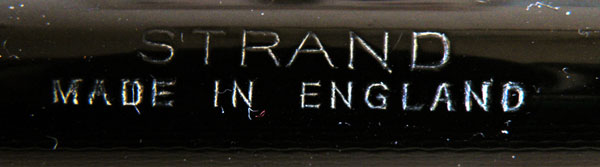
When the pen arrived, sure enough:


It’s a stretch, but I suppose that there is a slender chance that Brown & Bigelow did make this pen, or have it made for them, but the most telling fact against that is that their name isn’t on it and nor is anyone else’s. It’s not a promotional pen and that’s the only kind that Brown & Bigelow produce. No, I think some other, British, company made this pen. It isn’t entirely unique. A little judicious searching turned up a Redipen 44 that had been sold on eBay some time ago, and other Redipens mentioned in the sales lists of auction houses.

So who made the Redipen?

The Esco Ideal Eyedropper Filler

I picked up this interesting eyedropper a couple of weeks ago and ever since I’ve been trying to find out something about it, but with no success. It’s a mystery and if any of you know about it, please pass on the knowledge.

It’s a large pen in all its dimensions; quite chunky and nearly 17cm posted. One consequence of that is that you wouldn’t be refilling very often. The black hard rubber hasn’t faded at all and the chasing is as crisp and strong as it was on the day this pen was made.

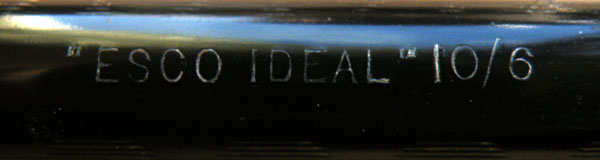
When was that day? Well, it’s a slip cap, so likely to be before 1915. The chasing is of a pattern that you don’t see on later pens. The very concave section is an early feature too.  I suspect that 10/6 is a model number rather than a price!

Also, that collar looks decidedly early. I remembered seeing it on 1890s Swans that I’ve had, and on consulting many trade advertisements, all the other pens with that type of collar dated to the 1890s too. The simple feed and small nib the pen has now fit well enough, but I suspect that they’re replacements and that this pen originally had an over-and-under feed with whatever nib it had then. So it looks like this is an older pen that had been modernised – nearly a hundred years ago, perhaps.

A Burge, Warren & Ridgley Website

Mike Bryan made me aware that there is a web site devoted to Burge Warren & Ridgley here:

http://www.neptunefountainpen.com

There’s a lot of information on the pens and stylos there and there’s also a book, authored by Mike Bryan and Stephen Hull, entitled The Neptune Pen: A History of Burge, Warren and Ridgley.

It’s heartening to find yet another site on a British pen company. It puts information where we need it, on the web and available to everyone. It can only be good for the hobby.

Burge, Warren & Ridgley Neptune

Burge, Warren and Ridgley may sound like a partnership of shady lawyers but in fact they were one of the pioneers of British fountain pen making. They’re largely forgotten today because they ceased to trade in 1929 but at one time they had a wide range of fountain pens and stylos on offer.

Perhaps best known was their Neptune fountain pen which started life in 1892 as an eyedropper filler, was repeatedly improved and became a lever-filler in 1922. The version above is an eyedropper, No 210. I don’t have a production date but the style suggests that it was made between 1912 and 1920.

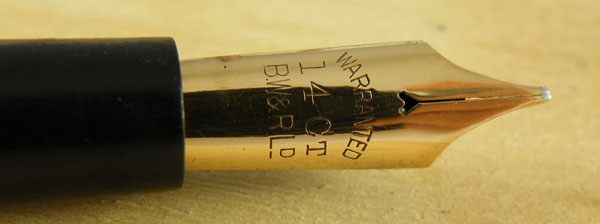
The high-shouldered Burge, Warren and Ridgley nib is a beauty and it has notable flexibility, too.

BW&R was probably taken over by the Jewel Pen Company and disappeared except for a period during World War II when the company’s name was used to obtain a pen manufacturing license from the government – just a ploy to increase output, probably.

Never especially innovative, the company nonetheless produced some unusual colours in hard rubber, terracotta, sage green and purple among them. Much as I would like to find a purple Neptune, I’m happy to settle for this black chased hard rubber No 210. They don’t appear all that often.

The Jewel No 44

I could have sworn I wrote about the Jewel Pen Co. Ltd before, but looking through the blog it seems not.

Jewel is one of the oldest British pen companies. It was founded in 1884 by John Calton as an import company for John Holland pens and Mackinnon stylos. As John Holland produced “Jewel” pens in America this is where the name doubtless came from. Within a few years the company was making its own stylos and fountain pens. Neither a great innovator nor a market leader, Jewel nevertheless kept up a steady stream of profitability until 1939, when it was bought by British Pens Ltd. It continued in a semi-autonomous fashion bringing out the occasional new model but declining in market share until 1951, when Jewel closed down.

They were an interesting company that produced a wide range of pens. Probably the biggest outsize pen I’ve had was a Jewel, and I had a tiny, Dinkie-sized pen as well. They covered the whole range of cost, too, from quite rudimentary steel-nibbed school pens like the Ritewell, to very handsome jade and lapis lazuli lever-fillers like the Nos 63 and 83. Like Macniven & Cameron in that respect, Jewel defies the simple-minded classifiers to assign it to a “tier”.


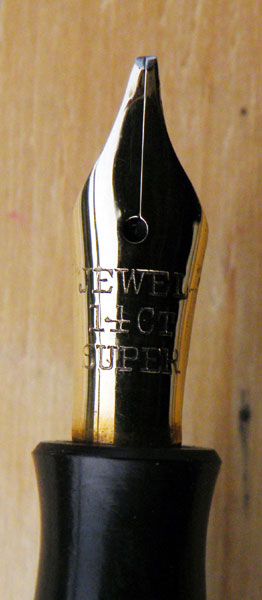
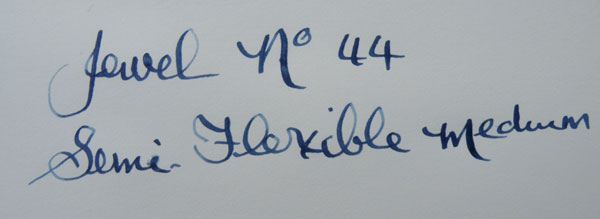
This is a No44, made during the Second World War. Made in black hard rubber with gold-plated trim, it’s not an exceptional pen in any way but it is well made and the plating has survived in excellent condition.


The “Jewel 14ct Super” nib is semi-flexible and somewhat stubbish. In general shape, the pen is quite similar to a pre-war Swan, an impression enhanced by the inserted clip.


Perhaps not the last pen to be made by Jewel, but very close to it, the No 44 shows that the company was capable of turning out a very acceptable pen to the end.

The Pitman’s Fono Deluxe

If you’ve come across a Pitman’s Fono pen you may have wondered about its strange name, and whether there is a connection with Sir Isaac Pitman, famous for several things but mostly for his system of shorthand which was adopted worldwide.

Indeed there is a link and it’s pretty direct. Sir Isaac was, for the most part, a publisher, though he took an interest in many matters of language and orthography. The publishing house he built up in the Victorian period, Sir Isaac Pitman & Sons Ltd, continued as the family business long after his death and remnants of it remain even today, subsumed within Longman Publishing, itself a part of Pearson Education.

A large part of the firm’s publishing was concerned with Pitman’s shorthand system and around 1930 the company began to make – or have made for them – pens which could be regarded as the best type to use for shorthand. The “fono” part of the name relates to Sir Isaac’s fonotypy, a rationalised method of spelling which he developed.

What of the pen itself? Well, it comes in several models with a very modest increase in trim between one and another. This one is the Deluxe version with a medium cap ring and rather good plating. The nib is warranted and semi-flexible. The pen sits well in the hand and is almost weightless, a feature much appreciated by those who wrote all day at work, though many people unaccountably prefer a heavy pen these days.

Though a very good pen, it isn’t really exceptional in any way. Pens like the Conway Stewart Scribe 330, issued around the same time, or some of the lower-priced Swans would have done the same job in the same way, and they probably claimed a bigger market share. Sales were evidently high enough for the pen to remain in production for a few years though and it is by no means a rare pen these days. In any given year around a dozen will appear in eBay and they’re well worth snapping up, both because they’re great writers and for their unusual history.

The De La Rue Pen

I can generally estimate the age of a De La Rue Onoto fairly closely, but I confess I’m all at sea with their non-Onoto pens.


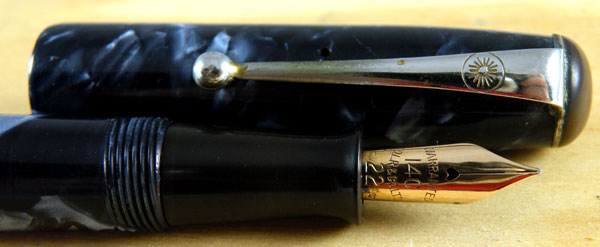
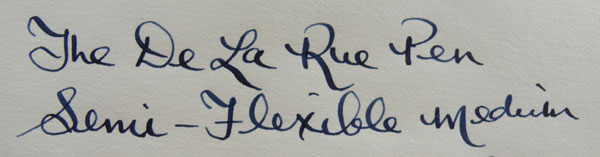
This is The De La Rue Pen and it’s my guess that it’s immediately post-war, but I could be wrong. I say that because I have it in the back of my mind that De La Rue made these pens with black ends before WWII too. I must have read it somewhere but the source is long gone.


These pens with black ends are among the best of the non-Onoto output. They’re really well made, and so they’re a pleasure to restore. This one needed a new sac and a polish. That was it, and ready to go again. The black ends are memorable, in that the one at the base of the barrel is a piece of black celluloid grafted on to the patterned barrel, in much the way that Waterman and Mentmore did. Waterman’s and Mentmore’s examples generally ended in disaster with the ends cracking, fragmenting and falling off. I’ve never seen that happen to a De La Rue Pen. The other end, the top of the cap, is a shallow-domed clip screw made out of black hard rubber. Most have faded to brown now, so the black ends effect is a little spoiled.


The worst failing in De La Rues – Onotos too – is poor plating and this one’s no exception. A tiny vestige of gold clings to the clip just above the ball end, but the underlying metal polished up well.

These pens make a decent price, but they’re much cheaper than the Onotos. What’s in a name? After all, quite a few later Onotos are lever fillers too, and despite having something different engraved on the nib, they write the same – that is, superbly! If you care about the plunger filler, or if the name means a lot to you, then you have to have the Onoto. Otherwise, you might decide to settle for the De La Rue Pen – a splendid and beautiful pen in its own right – and have all the value and quality of its more prestigious brother for half the price.

The Clipfill Pen

Today’s post is unusual in that pen I’m writing about is an American one and also in that the pen itself is quite technically unusual.


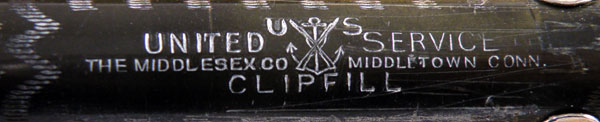
The cap imprint reads, ”US United Service The Middlesex Co Middletown Conn Clipfill”

All but the last word tells you who ordered the pen, not who made it. The US United Service organisation exists to provide morale and recreational services for serving soldiers, sailors and airmen. This may well have been a give-away pen for the organisation. “Clipfill” describes how the pen works but it doesn’t take us very far. Another example of this pen was discussed some time ago in Fountain Pen Network, where George Kovalenko refers to the 1913 patent for this type of filler. He believed that it might have been made by or licensed to Duryea, a company that is little known now but made contributions to various aspects of fountain pen development. George also refers to a discussion on similar pens in Lion & Pen where, on 29 June 2008, Pavlo Shevelo posted a picture of an Aiken Lambert matchstick filler that appears identical in every respect, except for the removable clip. (I believe the picture may have originated here: http://www.pen-site.com/vintagepens1.html ) Both my pen and the pen shown in FPN have an ALCo (Aiken Lambert) nib. Frankly, I believe we need look no further. Whatever the reason for the different name, I think this is an Aiken Lambert pen.


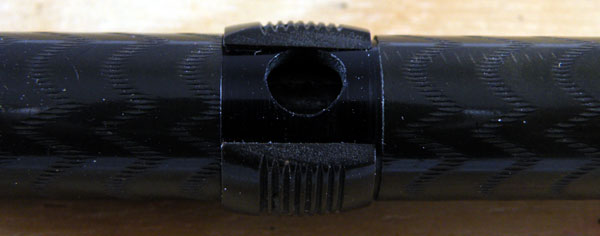
In case you miss the idea behind this pen, you turn the protective cover in the middle of the barrel to expose a hole through which you can see the pressure bar. You detach the clip, which slides off easily yet would hold the pen clipped to a pocket, and use the ball end to depress the pressure bar, to fill the pen. A matchstick filler for the non-smoker, perhaps!


So – flat top, deep-cut chasing, very concave section, tapering barrel? Before 1920, I’d say. In addition, I’d say that this is a very high quality pen, looking at the precision machining and enjoying the feel of the pen. The ALCo nib is a fine semi-flexible one, with enough flex to allow for a swashbuckling flourish, whenever the need or the urge arrives. I’m delighted with this pen. It will join my small collection of keepers.