Conway Stewart 85 and 85L

I’ve spent a lot of time trying to make sense of the Conway Stewart numbering system. I’m aware that this is a futile exercise; there’s neither sense nor logic to numbers they assigned to their pens. Other collectors have warned me that this will end in tears. I can’t let it go, though. I keep trying, in the hope that one day all will become clear.

Surely if two pens have almost the same number they must have a close relationship? I’m thinking of the 85 and 85L, two pens that the company created in the mid fifties to exploit the new range of colours and patterns they had developed. They come in black, too, and here they are:
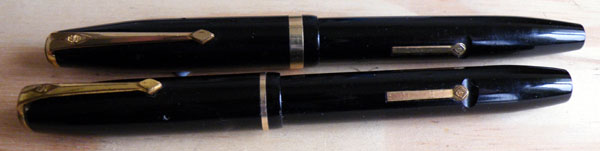
At first glance they do appear quite similar. The 85L is a little longer and thereby gives the impression of being slimmer. One might be the big brother of the other, but almost instantly one notices the broader cap band of the 85L.
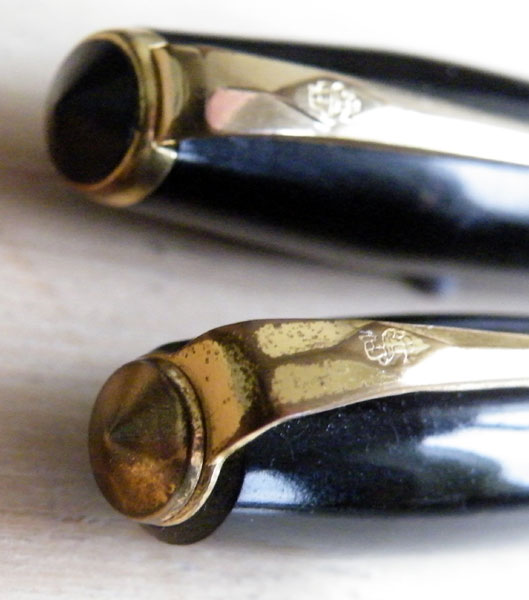
Then the eye drifts to the top of the cap and it becomes clear that they are entirely different. The 85 has a simple washer-clip held by a metal stud, whereas the 85L has a cowl over the clip, all held in place by a black plastic stud. In fact, in the medium cap band, cowl clip and black plastic stud, the 85L resembles the 84, not the 85!

There may be a sensible explanation. These pens – with the odd exception – share the same colour range. The 84 came first in 1952. The 85 was introduced in 1956, perhaps as a cheaper version of the 84, with its simpler design and narrow cap band. It only remained in production for a year, however, which suggests that sales may have been poorer than expected. Conway Stewart decided, it seems, that it was not a less expensive pen that the market required. Exactly the opposite: it was a larger, more expensive pen that was needed to fill that slot – hence the 85L.

So the 85 was a mistake, really, and the 85L is actually big brother to the 84.

Or that’s my story, anyway.

Five Black Conway Stewarts

Following on from yesterday, Tradera, the Swedish auction site, has had the offending link to this blog removed. Kudos to them!

Sometimes this must seem like a Mabie Todd blog. Partly, that’s because of my own fondness for their products. Also, Swans, Blackbirds and Jackdaws are favoured by my customers, so I buy a lot of them. That doesn’t mean that I’m not fond of other pens – I am – and Conway Stewart is near the head of the list of other pens I like.

As I’ve said elsewhere, obliques and full flexes are much less commonly found among Conway Stewarts than Swans, but line variation isn’t everything. Conway Stewart’s slogan for many years was “The pen with the wonderful nib” and that’s true. If you like a firm nib or a soft semi-flex, look no further. Conway Stewart put a lot of effort into ensuring that when the nib was applied to paper, the customer would be satisfied. All these years later, their pre-war and post-war pens are among the very best writers there are.

I restored five this week. All black and nothing particularly outstanding among them, though there’s a single-band 386 among them which isn’t often seen. Most importantly, they’re all great writers.

They’re At It Again!

Once again, someone is referencing this blog to help them sell something without having asked my permission (not that they would get it, anyway!).

http://www.tradera.com/Pennset-fran-50-talet-Dinkie-Conway-Stewart–auktion_302522_142130552

It’s a Swedish auction site, and doubtless quite respectable, but they do make it very difficult to contact them without first logging in to their site, which I have no wish to do.  In the end, I had to go to their Facebook page to ask them to remove the offending link.

As the site is Swedish, I can’t really tell what it is that they hope to achieve by linking to my post but I assume that it’s an attempt to validate their item by comparing it with mine, which is completely inexcusable.  The photo, apart from anything else, is so poor that you could be bidding on anything, but even if it was perfectly depicted and described, my blog does not exist to validate other people’s sales.

In a sense this doesn’t matter to me because I don’t think that I have any realistic legal exposure, here.  However, I don’t want anyone who knows this blog to make a purchase that they would regret because they believe that in some way I am standing behind it.

I’m not.  No reference you will ever see to my blog in any sale that doesn’t bear my eBay name (redripple52) has anything to do with me.

Blackbird BB205B/45

In the late 1930s Mabie Todd made a range of small pens with stepped clips – or rather, two ranges of pens, because there was the Swan SM range and the Blackbird BB range which were practically identical, except for imprints and nibs. The only other difference was that, so far as I know, the Swans were self-coloured or snake or lizard-skin and the Blackbirds were marbled.

This is an example of the Blackbird version, but one that has been used well and has had a repair or two. The clip is a replacement, and it has a Swan No 1 nib instead of the Blackbird original. I could set this pen aside and wait for the correct clip and nib to come along in the fullness of time, as they undoubtedly will. However, I’m going to sell it as it is. These pens don’t fetch a particularly high price even in perfect condition because they’re small. The alterations that have been made obviously don’t affect the pen’s writing characteristics, which are very good. The Swan nib is an upgrade, after all.

It’ll make a fine daily writer for someone. Sometimes a pen is just a thing to write with…

Grey Striated Waterman

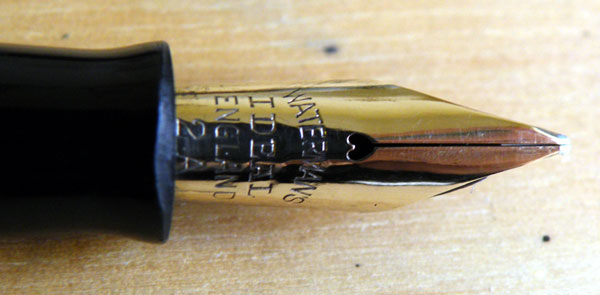
When I bought this pen I assumed that it was an English W3. It’s the same style and size but it’s actually an American pen. Not being well up on the lesser US Watermans, I don’t know what it is, and the barrel imprint is worn, so that doesn’t help. To complicate matters further it has an English 2A nib, probably a replacement.

In Britain, Waterman was using the combination of that clip type with the striated plastic in the mid to late forties, and I’m assuming that this pen also will date from that time. It was an unfortunate period for Waterman. Quality was not what it had been and it shows in this example. The nickel plating is worn on the clip, showing the brass beneath. There are a few scratches and some wear on the plastic, which is quite soft.

Actually, though, none of that matters at all. The pen’s sound and it’s fitted with a nib to die for. I’ve had much fun practicing my curlicues with it this morning.

The Mabie Todd Swan Safety Pen

There appears to have been renewed interest in eyedropper fillers after World War II. Macniven & Cameron made one and so did Mabie Todd, and there may have been others. I vaguely remember that there was a Conway Stewart version and think there may have been a Burnham. There are various theories for the reappearance of these primitive filling systems. Some believe that it was because of a wartime shortage of rubber. That may well be so but it doesn’t explain their continued production long after the war. It seems likely that they were made primarily for export to tropical and equatorial countries where sacs perished quickly in the heat, and a small market was found for them here in Britain too.

The Swan version was known as The Swan Safety Pen and went into production as early as 1942, and remained on sale until 1956. This is a later example in the torpedo shape, with no cap ring and and a black section.

A Swan image is imprinted in white on the cap. It’s a bit more wild than the usual sedate Mabie Todd Swan – in fact it’s a little like a dragon!

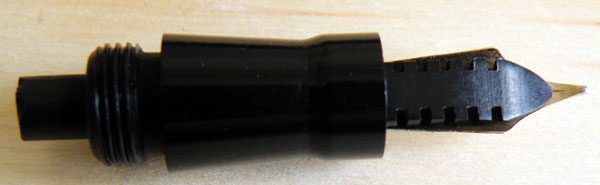
It works in the same way as a traditional eyedropper, but Swan have been quite bold with the design. The thread that seals the barrel full of ink is barely a third as long as a First World War eyedropper’s would have been, but to compensate those threads are extremely deeply cut. It works; the pen is completely ink-tight. All in all, though it’s an example of Swan’s last production, it’s a well-made pen.

These pens are not common but they do turn up now and again. There’s more than a hint of End of Empire about them, and with hindsight we know that they represent the sad end of the great house of Mabie Todd Swan, too.

Preparation

I photographed the pens for sale yesterday. Whenever possible, I use natural light, and yesterday was bright, but with a high haze that diffused the light. Perfect conditions, so the photographs are quite good. Clear, anyway, which is what I need. Today, I described the pens. I enjoy doing the descriptions. It’s technical and exact – dimensions, condition, performance of nib. When I began doing this, I used to write descriptions so detailed that you would be able to envisage the pen without a photo. It can be done, but it’s unnecessary and now I just use the description to add the detail that the photos cannot give.

It’s interesting, because you’re addressing a wide audience in eBay. Most of my potential buyers will know what a Conway Stewart 475 is, for instance, but the questions that are sometimes asked make it clear that not everyone does. You’d expect that; there are people new to the hobby coming along all the time. They’re the future. Descriptions, then, need to be comprehensive but not overkill. My descriptions generally run to 100 – 150 words which I believe is enough to give a good idea of the pen without sending the buyer into an impenetrable jungle of information. After all, the photographs are the important thing, and if I’ve left anything out, someone is sure to ask.

Tomorrow I’ll list the pens in eBay, and we’ll see how they will fare. These will be the first I’ve listed since April.

The Future of Old Pens

The pens that I’m restoring this week are all over sixty years old. The SF2 is at least 90 years old, the Lapis No-Name is a little younger and the Conway Stewart and the other Swan are 1940s pens. The BHR pens are a little faded and the Lapis one has a tiny bit of discolouration. That’s their past, but what of their future?

Nothing lasts forever. Even the Pyramids are crumbling, but in practical terms I see no reason why these pens and others like them should not be around and available to write with indefinitely. Yes, you hear the odd horror story of disintegrating celluloid but it’s actually a pretty stable substance, when it has been cured properly, as was mostly the case. Black Hard Rubber may discolour but it’s durable. Sacs are easily obtained once again, so when one wears out it can be replaced. The nibs have plenty of tipping material, the threads are good and the levers are sound.

Fountain pens aren’t used the way they once were – all day every day. None except the most eccentric among us does that now, so these old pens will accrue wear much more slowly than they did when in the hands of their first owners. Also, new owners, whether collectors or users, have a different attitude to these pens. First time around they were working tools. The first purchaser might well appreciate the quality and beauty of the pen, but it was there to get a job done, first, last and always. Nowadays buyers respect these pens for their age as well as their beauty and quality of construction. They reflect the virtues and values of an earlier age. They have become objects of desire and are well looked after.

You will, occasionally, read those harbingers of doom who would have you believe the we are drinking in the Last Chance Saloon, and that our collections will turn to dust before our very eyes any day now. I don’t believe them. The evidence just isn’t there to support their thesis. Yes, some casein pens are crumbling, though by no means all. There’s evidence that those that show the worst cracking were exposed to moisture early on. Pens that have been kept in boxes in drawers are fine. Some forties Watermans are subject to celluloid rot, but the material was not cured properly. Most celluloid is as good as the day it was machined.

They will outlive us, these pens, and probably our children too. It will be a long time in the future before a Swan SF1 or a Conway Stewart 475 only exists as a picture in a book.

Restoring Again

I picked four pens at random to be my first restoration projects now that I’ve begun to recover. Normally I would aim to restore around twenty pens a week, but I’m starting small, as I still tire easily.

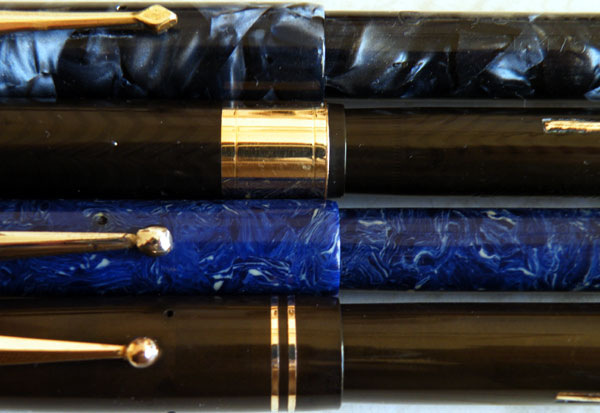
These are a black hard rubber Swan 3261 from the nineteen-forties, with a medium oblique stub nib, a blue marbled Conway Stewart 475, a No-Name Lapis Lazuli pen, and another Swan, a rather special SF2 with a broad gold cap band and cap end. So far, I’ve re-sacced them and given them a good clean-up. Next will come extensive write-testing, then photographing, followed by writing descriptions and listing. I hope to put them up for sale on Sunday.

It’s good to have a challenge again, to be using tools and returning pens to as close to their original condition as possible, both as writers and cosmetically.

Yet Again…

Just returned from hospital yet again!  Sparing you the gory details, I was admitted as an emergency  a week ago, but I’ve improved by leaps and bounds since then.  This is the best I’ve felt since the operation nearly six weeks ago.  If things continue like this, it won’t be long before I’m restoring pens and blogging again.