The Conway Stewart Universal 476 (Among Others!)

If you want to really mangle your head, spend a morning trying to make sense of Conway Stewart Universals. The one we all know and love is the 479, usually presented in black with some of the best engine-chasing on celluloid there is. Beyond that, though, there’s (at my last rather shaky count and in no order except how I found ’em) the 476, the 467, the 466, the 480, the 486, the 464, the 470, the 466M, the 470M, the 479M, and, in a whole other range of numbers, the 356. Phew!

They’re all in the lower to middle price range for a full size pen. Some have cap rings, some don’t. Some of these were earlier pens that died out by the end of the thirties but a confusing variety still remained. At that time they cost five shillings and sixpence or more, a substantial amount. I wonder if even the clued-up buyer ever had any idea of what the full Conway Stewart range on offer to him was. How did one decide between, say, a Universal 479, with its wide array of colours and a Universal 356, with a different selection of colours that were unique to that pen alone?

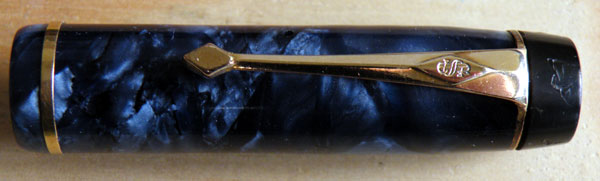
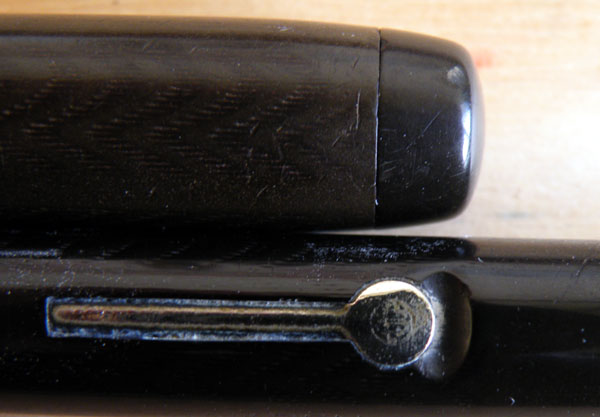
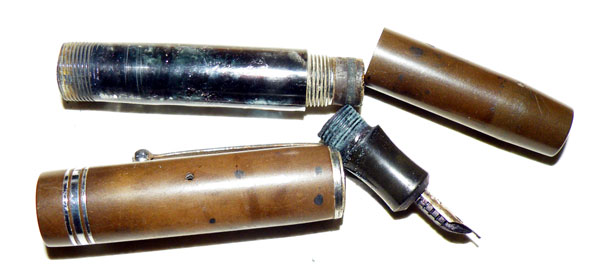
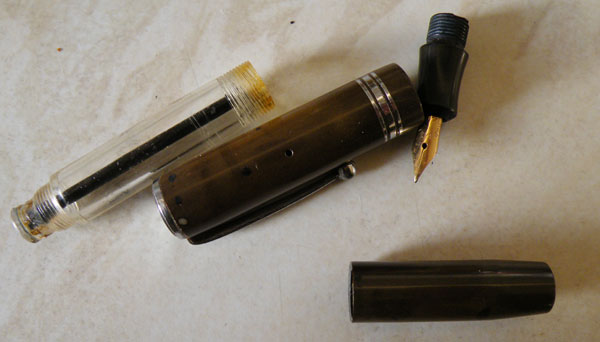
Well, what you did was bought a Universal 476 instead. At least that’s what one discerning buyer did somewhere between 1935 and 1938. Then he took it home, placed it carefully in a drawer and never disturbed it again, judging by the freshness of its condition today:

The gold plating is absolutely perfect and the barrel imprint is about the sharpest I’ve ever seen on an old pen. The only fault is a scratch or two on the clip screw, otherwise the pen’s as new.

This blue marble is a wonderful pattern. Jonathan Donahaye assigned names to the various patterns. They have no authority; they’re not what Conway Stewart called the patterns on the rare occasions that they called them anything at all. Nonetheless, Jonathan’s pattern names are perfect. He called this one Marbled Slate-Grey Blue and that’s what it is. Exactly.

Of Bulb Fillers And National Security

And by National Security I don’t mean police with sub-machine guns and big, watchful men at airports. I mean the wonderful pens sold by British Carbon Papers, about which I’ve written here: http://wp.me/p17T6K-6C. More on that anon.

You remember that thing about “it never rains but it pours?” Well, after lamenting that I’d only restored one bulb filler this year, I find myself in possession of two more. One’s a National Security and it’s already back in working order. That’s the one I’ll be discussing today. The other, a beautiful red and black hard rubber No-Name pen is clearly made by the same hands as the National Security, but it’s in rather worse condition and repair will take a little longer.

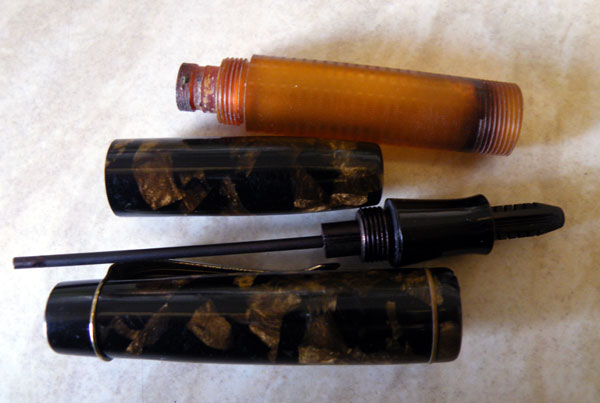
So here’s the National Security Vis-A-Tank after disassembly and cleaning. The amber barrel has come up well.

These extra channels in the feed connect up to the breather tube, and they help to create a highly efficient filling system.

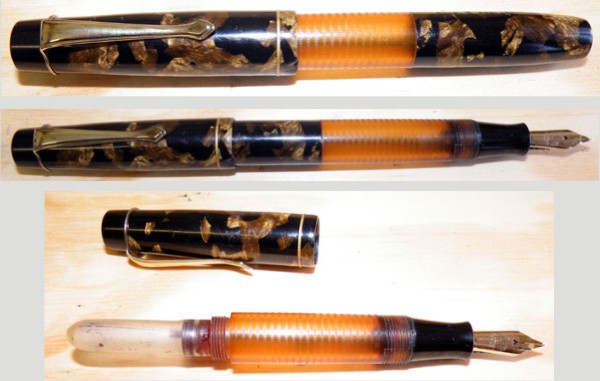
The repair was absolutely straightforward, and here’s the pen reassembled and ready to write. I love the subtlety of this very dark brown/black marble, which I think is unique to National Security pens. National Security produced the most astonishing range of pens, all the way from this slightly eccentric and very beautiful bulb filler to the most traditional pen imaginable:

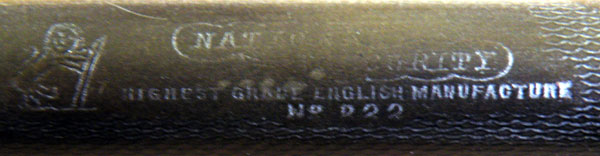
This black hard rubber lever filler is about as plain as a pen gets, but its saving grace lies in the imprint

which includes the National Security logo of the Lion & Pen, which they employed on their pens all too rarely. It’s quite worn here, and I’ve been unable to reproduce it in as detailed a form as I’d like, but take my word for it, he’s a charming, smiley lion. Quite unlike those scary men at the airport…

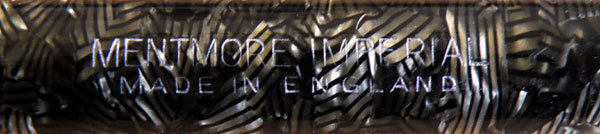
Mentmore Imperial


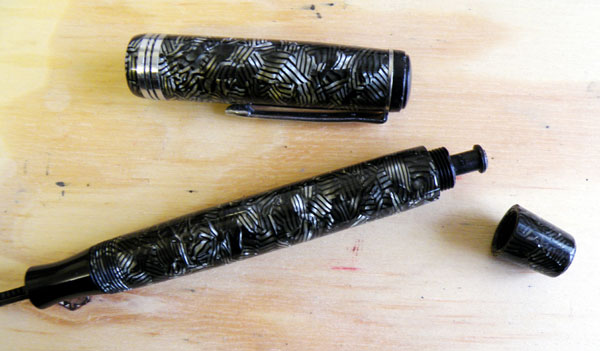
I’m guessing that this is a post-war pen. Though the beautiful hatched celluloid (which almost every company used) was around in the thirties, it became much more commonly employed after the war. The flat clip looks like an early fifties design to me, as do the closely set medium/narrow/medium cap rings.


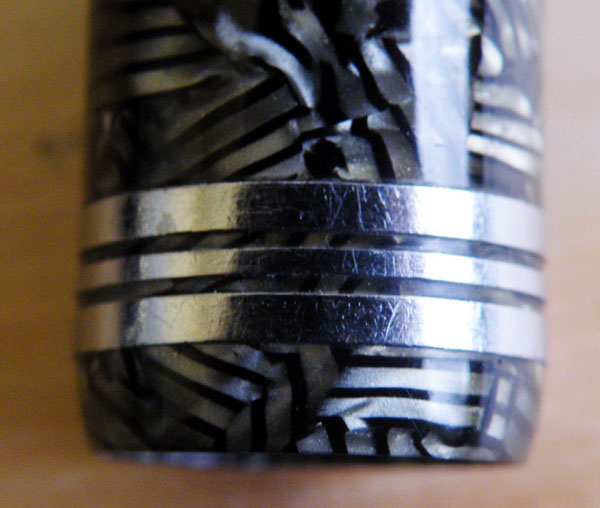
At first glance I took this to be the quite common arrangement of a single broad cap ring incised and painted to look like three, but no, this is the real thing, as the picture shows. The use of aluminium in the clip and (quite possibly) the cap rings seems like a late development for the company too.

Though they made many lever fillers and even a bulb filler (so I’m told) Mentmore excelled at making very efficient button fillers. The usual brass button has here been replaced by a screw-in plastic one which was novel enough when this pen was made to require a patent of its own, as is recorded in tiny embossed printing on the end of the button.

It is often the case that things become most dear to us when we’re on the point of losing them. If my dating is right, and this is an early fifties pen, the British Empire was well down the long slide to dissolution as emerging nations booted us out left, right and centre, but the company chose, perhaps defiantly, to call this “The Mentmore Imperial”.

Though Mentmore was soon about to be quietly allowed to die while Platignum took over, this pen shows no sign of the company’s imminent decline. The substitution of base metal for gold plating in the trim may well be an aesthetic decision rather than a cost-saving. The cap and barrel are machined from the rod, instead of being made from wrapped celluloid, a saving that many companies were making at this period. Everything fits together beautifully and the well-machined threads remain unworn today, even on the blind cap which gets used frequently. Mentmore were still making fine writing instruments at this point.

Boxed Crox 2

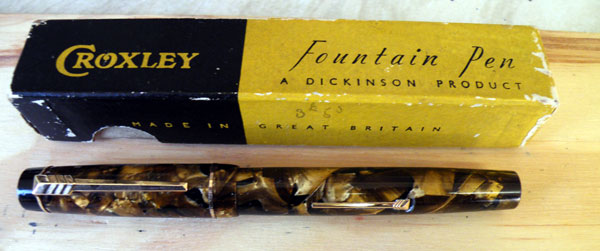
Sometimes it never rains but it pours – but in a good way. A few posts back I was complaining about most Croxleys being black (http://wp.me/p17T6K-dy) and here I find another, colourful, in excellent condition and complete with box.

I love this black/brown/gold/russet marbled mixture. It isn’t quite as bright as the gold/brown marble that Mentmore had around the same time (see here: http://wp.me/p17T6K-dQ) but it has great depth and glorious shades of colour. You could lose yourself in this pen.

According to the graffiti on the box, this pen first belonged to Kenneth Purnell, and judging by the writing, Kenneth was about eleven at the time. That was long ago, though, and if Kenneth is still with us, I would guess that he will be on the high side of sixty now.

The box contains the filling instructions and warranty. It’s advised to use Croxley ink. I didn’t know that there was such a thing, and I’d love to find a bottle of it. You are warned that fitting any parts other than Croxley ones to the pen will void the guarantee. Sadly, it doesn’t answer the question I still have: did Dickinson make those said parts – and indeed the whole pens – themselves, or were they supplied by a contractor? There are many pen mysteries that I feel sure will always remain unresolved, but I think I might find the answer to this one, one of these days.

A Well-Worn Conway Stewart 356

As you may be aware from my earlier ramblings, well-worn pens and pens that have personalisations and other engravings hold an especial fascination for me. They’re more interesting – though obviously less valuable – than the pristine New Old Stock examples that occasionally turn up. Though those worn pens don’t have a history we can recount, they’ve clearly seen a lot of use and haven’t spent the bulk of the twentieth century in the back of a drawer.

This black hard rubber Conway Stewart 356 has a wonderful soft shine from much handling. The 356 came out in 1932 and at three shillings and ninepence was probably the company’s cheapest full-size pen at the time. It was produced in some delightful colours but the company which bought this one settled for chased hard rubber.

Judging by the tiny shield on the lever, this is one of the earliest ones. The chasing is shallower than it once was but it’s still there. The pen has no clip, and it doesn’t look like it ever had one – Conway Stewart made quite a feature of the “with or without clip” prices, and even of the fact that their clips could be easily removed.

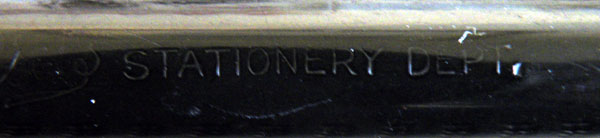
It’s clear that it was a company pen because the faint imprint “Stationery Dept.” can be seen in this enhanced photo (Thank you, Photoshop). I suppose it was available for everyone to fill out their stationery requisitions – a far cry from today’s attitudes, where it’s believed that lending your pen to someone else will irretrievably damage it. Of course, everyone knew how to write with a fountain pen back then, unlike today. Perhaps the clip was left off to make it less likely that someone would slip it into their pocket.

When it arrived on my bench it bore a modern plated nib. Worse still, when I opened it up, I found that the peg that the sac is attached to had been sawed off! I’m not sure why, or how the previous owner had thought the pen was going to work. Because the 356 is quite a slender pen with a concave section, it took quite a bit of hunting among the spares before I was able to return it to its original condition. But here it is, ready to write again. Perhaps it isn’t the most valuable pen I’ve worked on this week, but it’s a treasure all the same.

Price

I see the search terms that people use which lead them to this blog, and sometimes they become the subject of what I write that day. One thing that comes up time and again is a source of frustration to me because I can do nothing useful with it, and that’s the question of value for individual pens. Today there’s a search for the value of a Conway Stewart 55 and a Conway Stewart 27. Both of these are highly esteemed pens which sell quite well, whether in eBay or on retail sites. However, there are so many variables that affect value that it’s impossible to put a price on a pen without handling it. Even if I had the pen in my hand to examine, I could in all honesty only give a range of prices because it’s sadly true that so much depends on who is in the market on a given day.

Condition is of considerable importance. A pen that is in pristine condition is likely to be worth well more than twice the price that would be paid for a well-worn example. Black pens sell for less than patterned ones and some patterns will sell for many multiples of the price of others.

It might be, of course, that those entering the search terms merely want to know whether their CS27 and 55 are worth anything at all. The short answer to that is yes they are, they are both very good pens and in almost any condition short of broken, they will have a value. Of course we’re not talking in the large sums that are paid for the rare and opulent. More like £20-£30 unrestored and around three times that much in good working condition, bearing in mind all of the above provisos. Both of these were everyday working pens when they were made, but they were at the higher end of the quality that the company produced.

I realise how unsatisfactory a response this is to those daily queries, but unfortunately that’s about as good as I can do. There are, dare I say, restorers and repairers who will evaluate your pens for a fee. Try ten of them and you’ll get ten different answers, and I expect there will be a pretty wide spread between the lowest and highest estimates.

There are few things more slippery and harder to grasp than the price of an old pen.

The English Duofold New Style

I don’t write about Parkers nearly often enough. Whether American, Canadian or English, Parkers up to – oh, around 1970, say – are among my favourite pens. Not to write with, particularly, as their mostly rigid nibs don’t suit me, though their balance and fit to the hand is superb. They’re a joy to work on, with their high quality, durability and great design. Also, I just admire them, whether it be a 1920s Duofold or a humble English Slimfold. They’re simply great pens and they ooze fitness for purpose and that restraint of design that makes every one a classic.

The reason I don’t write about them much is that I don’t handle them often these days. For many models, the price differential between unrestored and restored is too slender to repay my investment. Some of the other models, like the Duofold Senior, Maxima or New Style always seem to slip past me or I get outbid. But not this one:

The Duofold New Style was, I believe, the first Parker wholly designed and manufactured at Newhaven and it broke new ground for the model. Though still a button filler, the shape and style is a radical change from the previous Duofold line. It appears familiar to us today because, with small changes, it remained the shape of the English Duofold for many years, through a couple different filling systems – the Aluminium Filler and the Aerometric. It was immediately influential and remains so today.

Looking at it, you know this is a pen to be taken seriously. The only hint of ostentation – and even that’s a very subtle one – is the double “jewel”. For a pen that’s more than 60 years old, it looks very modern. The best design is always timeless. The plastic of the barrel and cap has proved durable and it readily takes a shine. This well-used example has lost a little plating on the chevroned cap band, but otherwise it’s good. The blind cap still fits so perfectly that you have to look for the join.

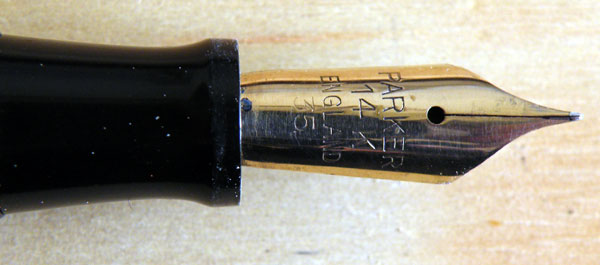
The only other indication that this pen cost quite a lot is the big lump of gold that is the nib. Durability is the watchword here too. Unless they have plummeted nib-first into the floor tiles, Duofold nibs rarely need tuning. That thick, rigid blade of a nib remains stable, and writes as smoothly today as it did in 1946. That’s the downside for me, in a way. If I ever get one with a bit of flexibility, it will become my daily writer.

Buying Pens In Ebay

I constantly search for pens to buy and restore. I source them wherever I can but nowadays they mostly come from eBay. In truth, without eBay, far fewer old pens would be available to us. Before that market existed, most old pens were stripped of their gold nibs and scrapped. Though that still goes on, sadly, it happens much less as people have become aware that pens are worth more complete.

Buying pens in eBay is easy enough but buying well requires a little more thought. There’s a general body of knowledge that you bring to it, and then there are some differences between buying restored and unrestored pens.

Starting with restored pens, the first requirement is to know about the pen you want to buy. Research it in books and online. Consult other pen fanciers if you’re in a position to do so. It’s going to help you immensely if you know the pen’s strengths and weaknesses, any changes in the model during its period of production and what sort of price range the pen falls into for a given condition.

Check out the seller. The eBay feedback system is imperfect, but it’s a whole lot better than nothing at all. Have a look at the actual feedback comments: are they just routine or is there a genuine enthusiasm for this seller? Does he or she mainly sell pens? Pen descriptions are important: are they clear and comprehensive and do they show a knowledge of fountain pens? Are the photographs good enough to let you see what you’re considering buying? The informed and dedicated pen seller is much less likely to try to sell you a pup, I suggest. Their reputation as a seller is as much their stock-in-trade as the pens themselves. It may well be that in time you will develop a list of trustworthy sellers who present pens that interest you.

Buying unrestored pens is similar but there’s a shift in emphasis. You need to know your pens at least as well as you do buying restored pens. Descriptions are unlikely to be anywhere near as good but they should at least cover any faults the pen may have. The quality of photographs is often poor. Sellers vary a lot. Many are house clearance people for whom pens are only one of the many items they deal with. Some – though sadly they’re a vanishing breed – are pen pickers who obtain pens from a variety of sources and are generally quite knowledgeable. I find that the list I develop for buying unrestored is rather different. It’s a list of sellers I will avoid buying from again, usually because they have been less than honest in describing the pens they sell. You undoubtedly have to take more of a gamble buying unrestored, but all sellers have a basic level of responsibility to their buyers. More of that anon.

Some rather more general hints: don’t impulse buy! That’s sure to lead to tears. There’s no magic trick to “winning” on eBay. Without exception, whether you bid early or late, use sniper software or sit with your finger poised on the mouse until the last second, the highest bid wins and that’s all there is to it. In reality, you don’t “win” in eBay. You buy. It isn’t a game, it’s a purchase like any other. Determine before you begin what the pen is worth to you and stick to that. Bid only once. Bidding wars are a mug’s game. Bid late. If you bid early, you indicate to others that there’s interest in the pen, and they may jump on the bandwagon.

If the pen you buy is not as described, you don’t have to accept it. Sellers may say that they won’t accept returns, but that counts for nothing if they have failed to notify buyers of a clear deficiency. Use the channels that eBay provides to return the pen and, in my experience, eBay will back you. I’ve returned many pens that had undisclosed cap-lip cracks or cracked nibs. The vast majority of sellers are honest and the faults were not disclosed because they weren’t pen people and didn’t know what to look for. They accept the return and refund the price with good grace. I always ask for – and almost invariably get – repayment of my postage in both directions. There’s no reason why the buyer should be out of pocket because a pen was not as described. It’s worth adding that these comments apply to eBay UK. The law isn’t the same everywhere and I’m aware that getting your money back doesn’t work the same in some other countries.

A good eBay seller puts the customer first. That sounds like an unlikely ideal, but in reality it’s what every pen seller who makes eBay their business or part of their business must do. Otherwise the bad feedback will accumulate and they can’t sell their pens. Speaking for myself, as a seller of restored pens, good customer service including after-sales service is part of what I do. Not only do I have to, to protect my business, but as a pen enthusiast myself, I want my customers to be happy with the pens they buy from me. Most of the pen sellers who last the pace in eBay are the same, I would suggest.

Compared with the online retailers, eBay appears a little wild and woolly. Prices are generally considerably lower than retail prices, though, and there are often tremendous bargains to be had for the discerning buyer. The variety is immense, too. Often criticised in the online pen discussion groups, I find that most criticism arises from those who blunder into eBay without preparation. Be prepared, as the Boy Scout motto has it, and you’ll have a lot of fun in eBay.


An English Waterman

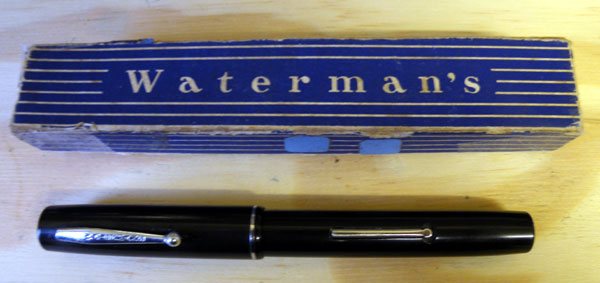
These rather plain Waterman pens turn up quite often. They have no name or number, and resemble the last, celluloid version of the Waterman 52, cut down, without the lever box and a little more streamlined. They’re not fancy but they’re good, and I buy them whenever I can. Guessing that they’re 1930s pens, they’re more robust than Waterman’s output would be ten years later, they’re well-balanced and comfortable in the hand, and they often have exceptional nibs.

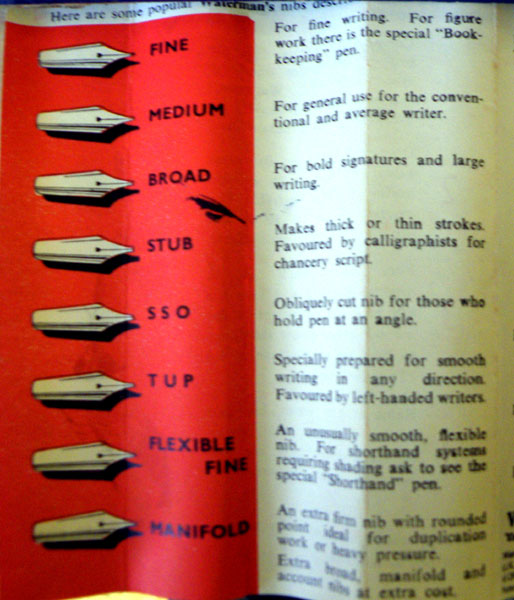
Talking of which, this is from the guarantee/instruction leaflet in the box. Quite a range of nibs were available for this humble pen. First time I’ve heard an oblique called an “SSO” and I’m still not quite sure what distinguished a “TUP” from other nibs.

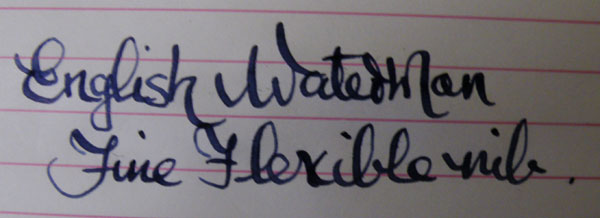
It would be my guess that the “Flexible Fine” was fitted to this pen!

A Bulb Filler

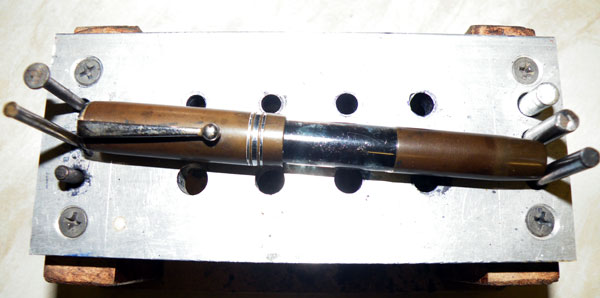
That decidedly ugly thing on my knock-out block is a no-name bulb-filler in hard rubber. It was sold as a Mentmore because it happened to have a tiny Mentmore nib in it. In all respects, it’s identical to National Security bulb-fillers I’ve had before. They were made, I believe, by Henry Stark, Son & Hamilton and that’s the likely source of this pen too. I love bulb-fillers and I haven’t repaired one this year, so I grabbed it despite its sad condition. It cost very little, you’ll be relieved to hear.

Here it is disassembled. Really, that’s the worst part over. I never know what these ink-view barrels are made of. Might be celluloid or some form of perspex, but they’re often very fragile, just awaiting the slightest pressure to be applied in unscrewing the nib/section unit to crack and break into a thousand pieces and bring the restoration to a sad end. This one was quite sound, though, and disassembly was tense but uneventful. Dry heat and infinite patience is the recipe for success.

Here it is cleaned up a little. As you might expect, the clear barrel was the most difficult to clean and it took repeated applications of the ultrasonic cleaner together with overnight immersion in my Secret Cleaning Compound to get it nice and sparkly.

These pens operate on the vacuum principle, so you don’t want air getting in where it shouldn’t. A liberal application of silicone grease ensures that the section screws back in easily without cracking the barrel, and makes an effective seal too. A chopped-down No20 silicone sac completes the job. I left it to dry and settle for an hour and tested it with water. Success!

Here it is restored and ready to write. Still a little ugly, I fear, though not without character and charm, but it’ll hold a lot of ink and it’s fitted with a little flexible Warranted 14Ct nib.

Bulb-fillers tend to be the poor relations of the pen world, because they’re comparatively cheap to manufacture and this filling method was used to make some truly shoddy pens, and that was the association that built up in people’s minds. Intrinsically, however, there’s absolutely nothing wrong with bulb-fillers, and when you get a well-made one like this, it makes an excellent pen. After all, Parker Vacs are bulb-fillers; they just have a plunger to press instead of a bulb to squeeze, but they fill the barrel with ink in exactly the same way. Like all ink-in-the-barrel pens they have a tendency to blob if the ink is allowed to fall too low, but why would you? You can see exactly how much ink is left in the pen!