The Primo Dainty

Some time ago I wrote about a red and black hard rubber Primo pen that I’d found. It was an interesting pen and like so many of the smaller, more obscure brands, I couldn’t find out anything about the company or their output. A few days ago, Steve Falkner told me he had another Primo, the Ladies’ Pen, as it is named on the box or The Dainty according to the barrel inscription. Steve very kindly sent me some photos and gave me permission to use them here.

“Dainty” immediately reminds us of “Dinkie” and that’s appropriate. Whoever began the fashion for tiny beautiful pens, Conway Stewart became the best known for it.
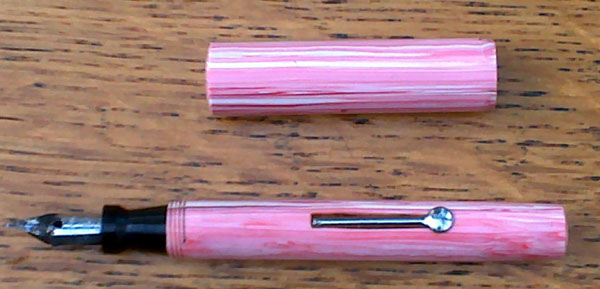
The pen is essentially two tubes, one of greater diameter than the other. That design, also used for the Conway Stewart Dinkies and the small Rosemary pens dates it to around 1930. The box, with its various fonts and its seal is a masterpiece of graphic design and the style coincides with that date. The manufacturers made a virtue of necessity in asserting that their “non-corrosive” nib is “as lasting as gold,” a claim similar to that made for the new Platignum range of pens around the same time. With its simple, clean lines and shocking striated pink, the Primo Dainty holds its own with its Rosemary and Conway Stewart competitors, even though it has a steel nib as against their gold ones.

So we know a little more about the Primo company. A short-lived and minor one, perhaps, as it turned out, but they made some very attractive pens. Thanks very much, Steve, for moving our knowledge forward a bit!

This Week’s Work – Or A Part Of It

This lot arrived this morning: 28 pens in need of restoration. So you know what I’ll be doing for the next few days. If I were the webmaster of a certain fountain pen group which shall remain nameless (but whose initials are FPB) I would make it a competition to Name Those Pens and then drag it out for about a week. However, as I find that sort of thing thoroughly tedious and I expect you do too, I won’t bother. That picture’s probably too small anyway. So I’ll tell you that there’s a Swan there and a Blackbird too. There are several Mentmores of various dates and some Parkers including a Vac and a 51 Vac, along with a brace of Stephenses, a Relief and a wee Waterman chatelaine. And a few other things including a green herringbone Valentine. Doubtless some of them will be featured here soon.

Oh, and the tray’s an example of Scottish early twentieth century chip carving, if anyone noticed it.

A John Bull Boxed Set

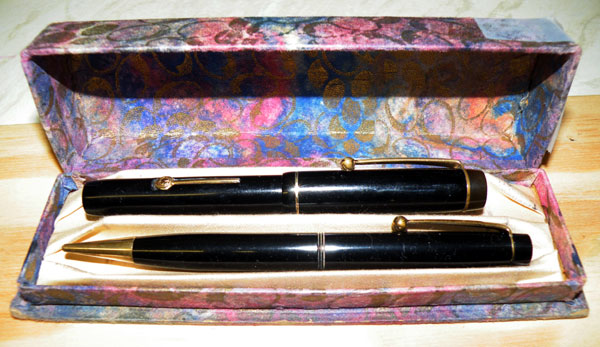
I’ve bought a few John Bull pens over the years and more often than not they’ve been a disappointment. The celluloid ones that I would guess are from the late thirties are good pens but the earlier black chased hard rubber ones seem flimsy to me and often the parts fit together ungraciously. So when I saw this pen and pencil set I debated with myself a little. At length I concluded that as they were clearly later and the price was good anyway, I might as well take a chance.

I’m glad I did. Though they’re not really exceptional in any way, they make a good set. The pencil works, the pen writes with a deal of line variation and the condition of both is good. The box is a smidgen tattered but it’s all there and the colours are quite dramatic!

If you do a web search on “John Bull Fountain Pen” you’ll find several conflicting opinions as to who made the John Bull pens. In every case, so far as I can see, opinion is all they are, without a shred of evidence one way or the other. The late and estimable Jonathan Donahaye, whose opinion I would usually implicitly accept, listed a John Bull pen that he believed may have been made by Conway Stewart. There are some resemblances but resemblance is no proof of provenance. Any of the pen manufacturers of the day could make a pen in any style, and a superficial resemblance to the the popular Conway Stewart would be a good way to sell pens. Wyvern and even Mabie Todd have been suggested – nay, asserted – to be the makers of John Bulls, as have De La Rue, with perhaps a shade more credibility.

This pen has more than a hint of the De La Rue about it. But there I go, falling into the same trap. Resemblance is no proof of provenance.  I could say, in complete accuracy, that there are stylistic resemblances to some some lesser De La Rues, and the quality is comparable with that of the non-Onoto De La Rues.  It’s the same fallacious logic as has misled others, though, and it won’t do.  We need a lot more than that to confidently say who made the John Bulls.   Sight of an old contract would be nice,  or maybe an order…

Another No Name Mottled Hard Rubber Lever Filler

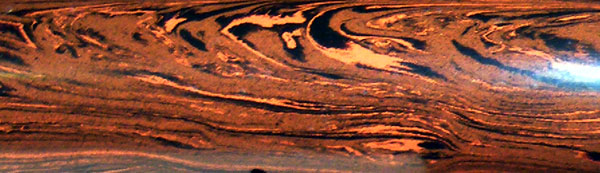
Quite a few No-Name mottled hard rubber nineteen twenties and thirties pens have been coming my way recently. This is a Very Good Thing as despite their variations, these pens usually share the characteristic of being well made. Mottled hard rubber comes in wide variety of patterns from the wholly abstract to quite convincing woodgrain, knots and all. The intensity of the colours varies too, partly through oxidisation over time but also because each MHR mix is a little different.

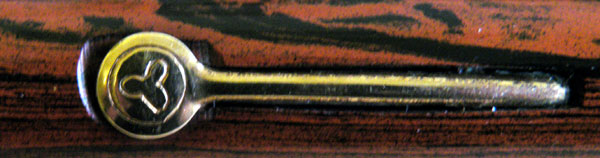
This beauty has a slightly Duofold-ish look to it, with its straight sides and milled clip screw. The clip once had gold plating but it is no more. The plating has held up better on the cap ring and the lever.

That lever with the little three-lobed dingus appears on a lot of no-name pens from this period. I assume that it’s an off-the-shelf part that manufacturers bought in, often to use on pens that would not bear their own name.

It’s always fun to try to spot resemblances that will enable us to identify the pen’s manufacturer. It’s a pretty fruitless exercise. That handsomely stepped section says “Burnham” to me, but who knows? The small warranted nib is a delight, being both broad and flexible.

We sometimes underrate pens because no manufacturer’s name is on the barrel but this pen, and others like it, compares well with the named output of many pen makers.

A Mottled Hard Rubber Bulb Filler

This beautiful Mottled Hard Rubber Bulb Filler sat in my repair line for quite a while. Restoring this kind of pen is straightforward, but the breather tube had snapped off and it was made from a thinner diameter of tube than any I had. I finally got a length of the right size last week and here the pen is, restored to its former glory.

Excuse the flash photography. I had a long day despatching sold pens and restoring a few more, so I hadn’t the energy to set up lights tonight. The flash exaggerates the difference between the hard rubber in the blind cap and the cap, but the difference is really there. This pen was made from three different pieces of hard rubber, if you count the section too. The mottled rubber in the cap is especially beautiful:

Whoever made the National Security Vis-A-Tank that I wrote about back here: http://wp.me/p17T6K-f0 probably made this pen too. There are many resemblances, particularly the amber ink-view barrel. It may well be that the company made up these no-name pens to use up excess materials. While clearly not expensive pens, quality control has been maintained: these are as well made as pens that doubtless cost several times as much. And, in my opinion at least, the result is an outstandingly attractive pen.

Tools: The Archimedean Drill

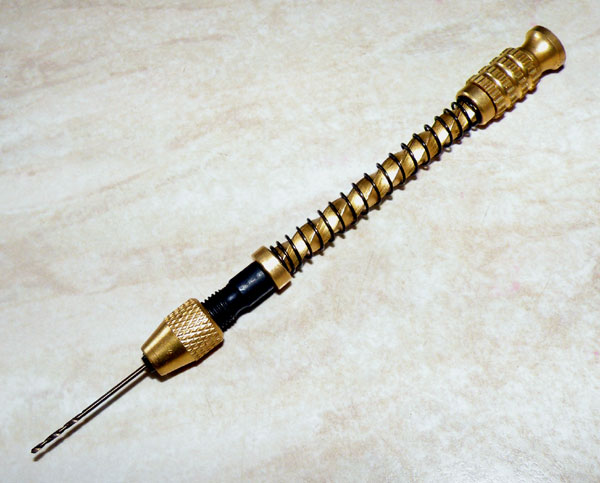
Small electric drills like the Dremel have some uses in pen repair but not that many. Mine won’t take a drill bit smaller than 1mm which is a serious failing. Also, it’s quite clumsy for precision work and the excessive speed and vibration can ruin a work-piece in an instant.

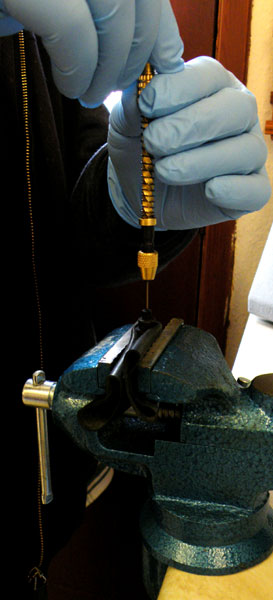
For precision work like drilling out a snapped breather tube, I use this Archimedean drill. It’s a simple spiral drill with a return spring and you can usually find it listed under jeweller’s tools. They vary a little in size though they’re intended to be worked one-handed. I use two but that’s just me – I find it keeps it steadier and reduces the possibility of accidental damage. This one takes drills up to 1.6mm, so as well as being a more precise tool it fills the gap left by the electric drill.

It’s just as easy to use as it looks, and it’s a remarkably inexpensive addition to the tool kit.

It’s More Or Less A Clipless, Numberless Leverless

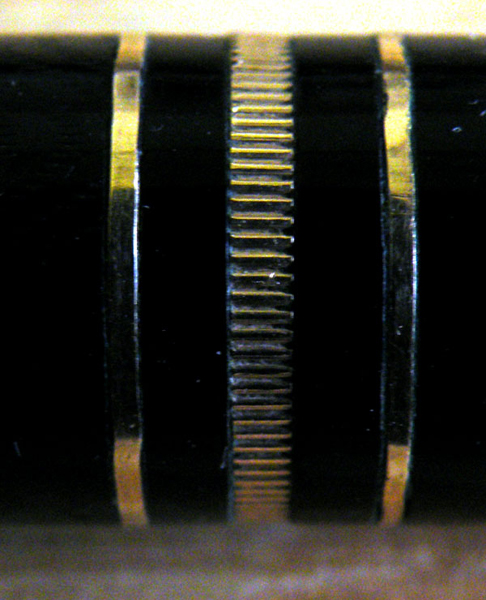
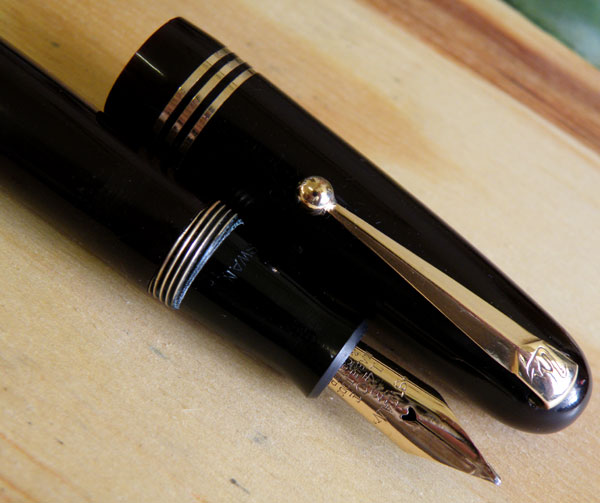
This one’s a clipless Leverless (doesn’t that just trip off the tongue?). Either V. Newby didn’t use his or her pen very much or she/he was very careful with it, because the chasing and imprints are like new, as is the gold plating on the rings.

Now there’s a thing! I haven’t seen a ring arrangement like that before, with two plain narrow bands on either side of a milled band just broad enough to be called medium. The effect is very pleasing.

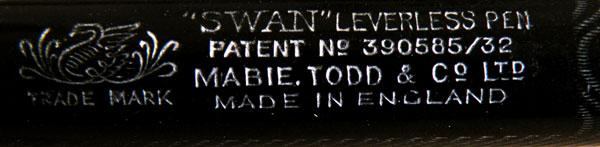
It’s not only a clipless Leverless, it’s a numberless clipless Leverless. I may be reading too much into that but quite a few of the early numberless Leverless pens that I have seen seem to vary from the usual trim. Could it be that these are bespoke pens, and this is a pen assembled to V. Newby’s own specifications?

In any case, it’s a superb pen with its crisp imprint and Swan image on the top of the cap. It’s a big pen at 13.7cm capped. The nib is a No.2 and it gives quite a bit of line variation.

A Swan 3250 and Some Wholly Unnecessary Rambling

I have made some effort to ensure that this doesn’t become a purely Mabie Todd blog. Obviously, my own preferences show. Having looked at the statistics today, there are twice as many Mabie Todd posts as there are for Conway Stewart, the next largest, with Parker trailing sadly behind.

I enjoy all pens (except possibly Queensway, Scripto and the worst of the Platignums) but Mabie Todd pens, and Swans especially, stand out above everything else for me. There are no unpleasant surprises to sneak up on you when you work on a Swan – no glued sections or left-hand threads, no brittle barrels awaiting their chance to break. Everything comes apart as it should and reassembles without difficulty. Swan’s only peer in this regard is the pre-1950 Parker. Then there are the nibs: such is their elegance and grace of line that you can spot a Swan nib across the room. And they write so well whether they be the rigid Eternal, flexible, stub or oblique. I could continue this encomium of Swan (and those lesser fowls the Blackbird and the Jackdaw) indefinitely but I suspect you’ve had enough of the purple prose by now and you get the message anyway: I’m passing fond of Mabie Todd pens.

So I will continue to try to show some balance by the inclusion of the other estimable brands (of which there are many) but in the meantime here’s another Swan.

This is a Swan 3250 and the brass barrel threads indicate that it was an early example of the Swan post-war range. It’s not an outstanding pen except possibly in its condition, which is very good. A very deep red, it comes across as black in the photos. Not especially long at 13cm capped, it’s nonetheless a substantial pen.

This one’s good enough to be collectible and it’s an enjoyable writer too, a very precise medium with some flexibility and a snappy return. In its quiet way, it’s the perfect pen.

Oh, and a quick P.S. to whoever was searching for the info:  The Conway Stewart 12 is 13 cm which is quite a standard length for a fountain pen.  It’s somewhat slender.  The 12 has a stunning range of colours.  If you’re buying, check for cracks around the lever opening, which can be a failing in this pen.

Five Pencils

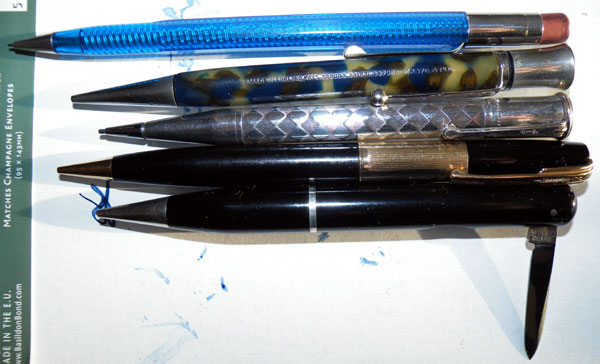
I never intentionally buy mechanical pencils but they turn up in job lots that I buy. I know little about them but admire their mechanical ingenuity. Often, there’s a relationship with pens by the same maker. I just clean them up and send them back out into the world, but I enjoy their colours and style.

The pencil at the top is an offering from Scripto. It has no particular value but it’s colourful and practical. It looks quite similar to a wooden pencil, to my mind.

The next one down is a handsome advertising pencil, a well-made piece. The muted colours are reminiscent of some of the patterns used by Conway Stewart in their Dinkies, which makes it possible that this is a Bina & Barrey pencil.

The third one is a Jif Waterman metal pencil, and very beautiful it is too. Much as I studied the clip, I was unable to see any resemblance to their pens.

The fourth one is a Waterman with a very broad band, clearly a relation of the Taperite. I think the pencil looks better than the pen.

The final pencil is probably the best made of them all, a Strad which incorporates a penknife blade. While it’s beautifully executed, you’re inclined to ask why? What would you be cutting with it? You have a mechanical pencil so you wouldn’t need to sharpen it… I’ve no idea where Strad pencils were made, but I’ve seen other ones, including a woodgrain MHR example that must have been at least seventy years old. It had a set of feeler gauges in case you wanted to adjust your tappets or check your spark plugs while you were sitting at your office desk. It’s one of those wonderful answers that never found a question, I think.

A New Old Stock Osmiroid 65

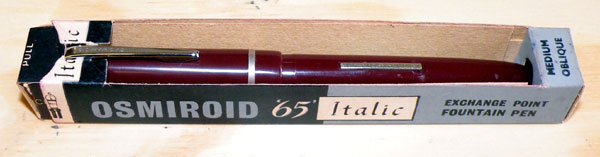
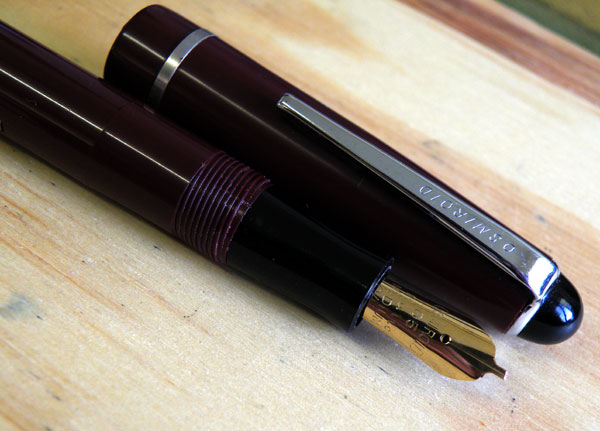
I recently bought a job lot of fountain pens and mechanical pencils. There were a few interesting writing instruments among the lot, some of which will turn up here soon. One unexpected thing was this Osmiroid 65 still in its original packaging. I discussed Osmiroids in general terms back here: http://wp.me/s17T6K-osmiroid and I illustrated that article with a picture of an Osmiroid 75. This pen I have today is the earlier lever-fill No 65.

I don’t have exact dates for the Osmiroid 65 and 75. My husband, who started school in 1955, remembers the 65s being used then or soon after, so it seems that this unused example has been around for fifty years or more.

Normally, new old stock pens will disappear into a collector’s cabinet never to be inked. They fetch a premium as perfect examples of their kind. With an Osmiroid, I suspect the rules will be a little different. While the fact that it is “new” and in pristine condition will still be appreciated, the buyer is likely to be a calligrapher rather than a collector, and the pen will certainly be inked and used.

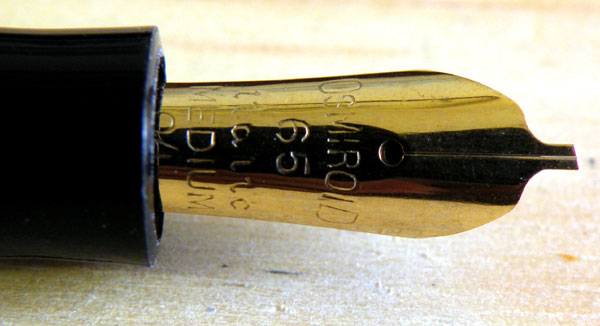
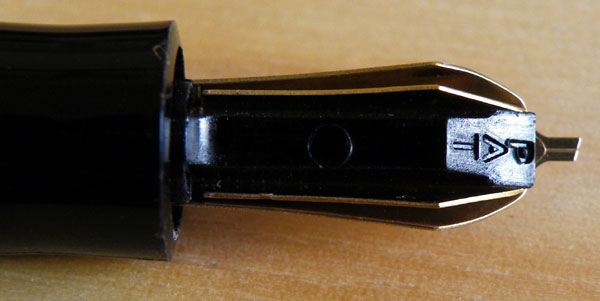
The left oblique italic nib is a beautiful thing, and one of the less common Osmiroid nibs. I haven’t seen one before.