Esterbrook M2 and The Veteran Stylo


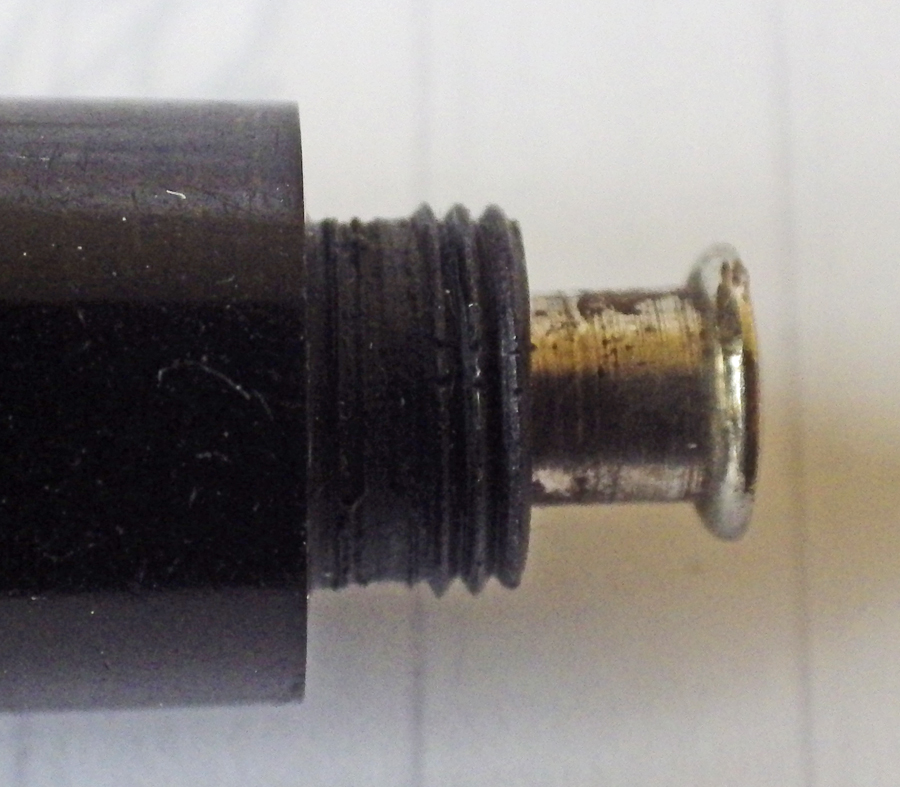
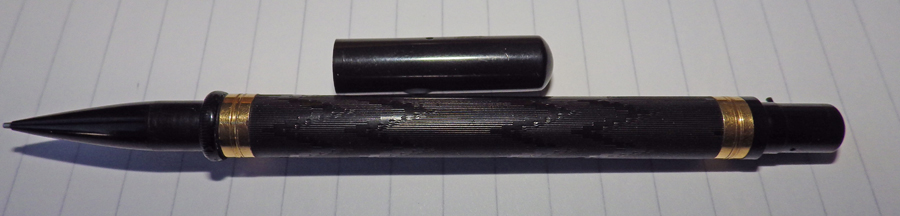
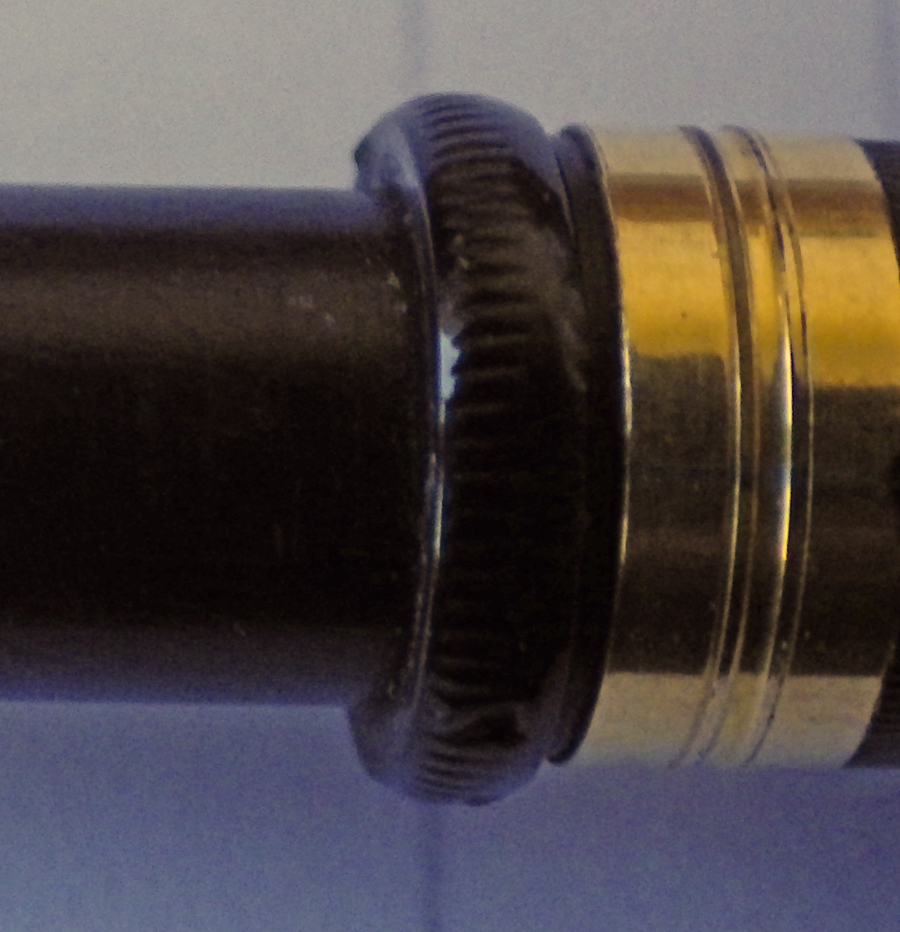
A couple of points of interest today: first is this beautiful American stylo stamped “The Veteran”. The hard rubber is coal-black and shining, the engine-turned pattern is sharp enough to cut you and the gold plating on the barrel bands is pristine. Both in general shape and in detail this instrument appears to be old. The rope-work before the front band speaks of the late nineteenth century to me – at least that’s how I would date it on a fountain pen. It’s a real gem and I would appreciate any comments or advice on this little mystery.
 

Esterbrooks are not uncommon here in Britain but it’s usually the J-types one sees. This pen, the M2, broke with tradition in a variety of ways. Made after 1950 the M2 was created from a softer plastic than the utterly impervious J-type. Thus many have lost the information imprinted on the barrel but this one has not. It was made in Canada; I have seen English-made ones too. The Parker 51 was a major contributor to the popularity of the metal cap. This pen’s cap is very handsome with its machined finish and indented top. The smooth band at the base of the cap is a reminder of the actual cap rings of the past. Someone has compared the indent in the cap to that of a gentleman’s hat and that’s accurate. It is a style that has remained unique to this pen.

Mixing metal and plastic threaded closures has not proved to be a good idea. Swan, with their plastic caps and brass barrel threads reverted to all-around plastic, possibly because of cost but almost certainly because of damage to the cap also. This reverse arrangement has not worked out well either. Some M2s no longer close well though this one does.

In another change Esterbrook has gone for the squeeze-filler. It’s well made and very similar to Parker’s Aerometric. It appears to be equally successful though the sac is not as durable and needs replaced from time to time.

The one place where tradition won was in the choice of the Renew screw-in nib. This one is a 2556 – a firm fine. Plastic threads and soft plastic ensure that this pen is not quite the equal of the admirable J, but it’s an excellent pen nonetheless. It’s less often seen than its predecessor not because of any great inferiority but because the times were against it. It was not only competing against other fountain pens but against the ballpoint.

My thanks to Paul S for both of these writing instruments.
Tools

Sometimes I get lucky and the pen I have bought only needs a sac, hand polished and maybe a little nib adjustment. Usually though, old pens demand a little more love and attention and some are downright challenging. That’s okay though. Over the years I have amassed the tools to deal with almost any situation. A few, like my collection of tools for nib straightening, are specialist but most are the kind of thing you can buy in any hardware store. I have just about every kind of pliers imaginable, for instance, and many of my tools were created for use in dentistry or the operating theatre. Others have been so adjusted and tailored to suit the specific need that it isn’t obvious what they started as. A set of tiny jeweller’s files finds regular use, as do various scraps of rubber inner tube that provide grip.

There are days that I sigh for a lathe. I had a rickety old one years ago when I messed about with motorbikes. I was far from expert with it but it made my life easier on a number of occasions. The cheapest one that would be any good at all comes in around £600 and a decent lathe would be about £1500 second-hand. I can’t justify that and I would have nowhere to use it, not even a tabletop version.

I make do with my Skil power drill, a poor man’s Dremel, together with a vice and several gripping devices. It’s amazing what you can do with a bit of planning and ingenuity. The Skil has a variable speed motor and a host of accessories. I love it.

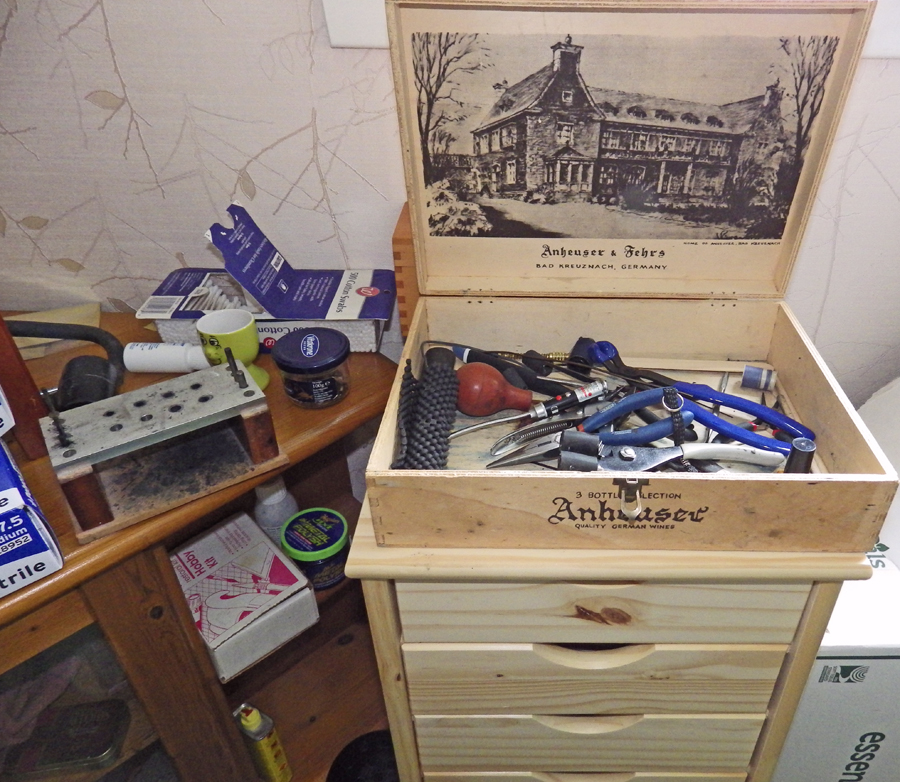
My most commonly used tools reside in a box that once held German wine. Then there are a couple of drawers of slightly less often used bits and pieces and a shelf in the shed holds some more. Also in the shed is a polisher/grinder. I don’t routinely machine-polish my pens – that glaring shine is inappropriate for hundred-year-old hard rubber pens. It’s good for pens that have been abused and for crusty old accommodation clips.

As I found early on, you can never have too many tools. Needle-nose pliers with different profiles all have their uses, and some have met the grinder for adjustment to make them fit a specific requirement. Screwdrivers that rarely turn screws are perfect for other jobs.

As you can tell I love my tools. The whole collection, taken together, make my life simpler and more satisfying. My husband tries to head me off at the door of the hardware store but I usually find a way in. You never know what gem you might find for that problem that’s been bugging you for weeks.

Collecting Pencils Booklet

When I began this blog seven years ago I went through my bookshelf and wrote about the various pen books I had accumulated. There comes a point when you don’t need any more general pen books but as the occasional more specialist publication has come along, I have included reviews of them.

Pencils, as I often comment, are the poor relations of the writing instrument world. Thankfully that is not reflected in the literature and Collecting Pencils by Sue Courtier, Jane Marshall and Jim Marshall is a splendid introduction to this aspect of our hobby.

Though it’s a slender booklet of 67 pages it gives comprehensive coverage of the types of pencils you might come across and the copious illustrations are very clear and colourful. Everything from cedar pencils to the highly collectable nineteenth and early twentieth century novelty pencils by Mordan, Edward Todd and Hicks are covered.

Given the large number of different types of mechanical pencil the section on repair can only be an introduction but there are helpful diagrams throughout the work.

This booklet is no longer in print but can be found at various places on the Internet. This is the second edition and it’s on sale in Waterstones at £12 and the Pendragons have it at £14.99. I would regard it as an essential item for the bookshelf of anyone serious about writing instruments.
The FPR Indus or Demonstrators, Who Needs ‘Em?

It is appropriate that the word “demonstrator” begins with “demon”. I have never liked pens of this type. Their skeletal appearance has no aesthetic charm for me. Their benefit, supposedly, is that they show how much ink remains, not something I have ever cared about as I always have several pens available.  Originally the intention was that a salesman could show how the pen worked.  I know how a piston filler works, having pulled loads of them apart.

I bought this one because it was a cheap piston filler. It’s a Fountain Pen Revolution Indus, which I think is a rebadged Click Tulip. These pens have proved popular, both because they are quite well made and because they offer the opportunity of using alternative nibs, something which has become popular recently.

Where the “demon” part comes in is in that the section stains readily. Because these stains offend my eye I made a determined effort to remove them. I set up a little jig in the ultrasonic cleaner to immerse the section while keeping the rest of the pen out of the fluid. Several hours later the stains had hardly moved. Ink trapped in the cap did eventually succumb to the ultrasonic but the section remained intractable.

This wouldn’t matter a bit if the pen was not transparent. Every pen I restore has a coating of ink in the section. I remove most of it with water and cotton buds but I am sure that permanent traces of ink are left behind, but who cares? Out of sight etc. It seems that with demonstrators we give ourselves problems that outweigh any notional benefits the thing might have.

Queensway 75

My husband tells me that when he was a kid going to school in the fifties and sixties there was a fountain pen class system going on. If your parents were wealthy you had a Conway Stewart or a Parker. A bit less affluent and you might have an Osmiroid or a Burnham. Below that was the despised Platignum. If your parents were really poor, as my husband’s were – they were trying to get a farm going from scratch – you had a Queensway.

Nobody seems to know about their origins. Queensways were cheap because they were shoddy. There were several models in the sixties, none of them very good. If you were lucky, you got one that wrote reasonably well and kept its ink where it was supposed to be. Most of them broadcast ink over paper, skin and clothes. They didn’t look very good either.

By the seventies when this Model 75 was made, they were a little more reliable and some concessions had been made to style. This one has survived remarkably well. The gold plating – which may not be gold – has bubbled a little on the clip and lever but is better on the cap band. Judging by others I have seen, this pen is remarkable in having retained its cap band! The barrel is very tapered coming almost to a point like the Skyline. The clip screw echoes that, pointed rather than domed.

The section is black, tapered and bearing a very decided “stop”. It has a traditional style of nib that wraps around the sides of the feed. It’s a plated nib of course. When I was Googling for information on the brand I came upon another example of this model on Etsy. The seller said it had an 18 carat nib. 18 carat gold-washed! This pen actually writes well and doesn’t spew ink, which may be why it has lived so long. There are signs of plastic shrinkage as you would expect but it isn’t too bad. It’s an adequate pen but you wouldn’t flash it around and boast about it.

I think this was the last of the sac-fill Queensways. Some of the later ones I’ve seen had semi-hooded nibs. I don’t know which cartridges fit, if any, but it may be that the Conway Stewart ones do, because an unholy alliance developed between Conway Stewart, Roll-Tip, Penkala and Queensway, all bad pens which, when amalgamated, made for even worse pens. Some later Queensways are pretty much indistinguishable from some Conway Stewart models.

If these pens are so bad, why bother writing about them? For one thing, anyone finding themselves with a Queensway might want to know what they have. Secondly, they’re fountain pens. People bought them in huge numbers and cheap pens like these are probably more typical of what the ordinary Joe or Jane used at school, college or work than the Swans or Onotos. They have their equivalents today, not in the reliable and durable BICs but in those ballpoints that charities and businesses hand out, that work for a while, then no more.

Pencils Again

The vintage mechanical pencil, as I have often sadly observed, is not held in high esteem. Even the very best of them, the Yard O Leds and the Fyne Poynts, are barely saleable. So far as I am aware, there is no well-represented mechanical pencil hobby with forums of its own. It has an association with the pen hobby but only as an adjunct like inkwells or accommodation clips. There are one or two slender publications and a few blogs and that’s about it.

It wasn’t always so. I often acquire pencils as part of lots. There will be the occasional solid silver one that turns up but the majority are either gold or silver plated. That’s useful because the amount of wear on the plating indicates how much the pencil was used. Some are very worn indeed, just where the user’s fingers rested and where it came into contact with the desk.

Some pencils were sold as part of a set but many were sold individually. To go out and buy a pencil on its own indicates that it was seen as a useful possession. Most writing done, whether at work or at home, was not intended to be a permanent record. For note-taking or drafting the pencil was more convenient. No cap to remove so it could be picked up off the desk to be writing instantly. Those pencils were low-maintenance. Lead lasted a long time and was easily replaced. The Yard O Led would continue writing for a very long time, much longer than any fountain pen or later, ballpoint.

I think, though, that it may have been the ballpoint which led to the devaluing of the mechanical pencil. Though the very earliest ballpoints had caps those were soon dispensed with and the ballpoint became used in just the same way as the pencil. Pen and pencil sets began to be replaced by fountain pen and ballpoint sets. It is much less common nowadays to see new pen and pencil sets offered.

One cannot change what people desire and I have no wish to do so. Fountain pens are central to my life whereas pencils are on the periphery. However, pencils offer a very high quality collectable at a low cost. The fancy silver pencils from the late 19th and early 20th centuries are collected and fetch high prices but the practical pencils of the last hundred years and more have an attraction all of their own.

Over-and-Under Feeds

One of the more intractable problems facing the fountain pen restorer is the over-and-under feed. Considering that it is just a forked piece of rubber, it works better than might be expected, sometimes with the help of a piece of twisted silver wire in Swan eyedroppers.

The difficulty is that, delicate things to start with, the passage of a century or more with all its vicissitudes means that many are broken. There are no replacements except from other pens. Cannibalising parts from later black pens to rescue patterned ones is all very well, but all these century-and-more-old black hard rubber pens are precious and I believe that it is wrong to sacrifice one to save another.

It would not be all that difficult to reduce a redundant, more modern feed to fit the small aperture of these pens, but there are two difficulties. I would have no reliable means of splitting the feed so that it could perform the over and under function. Secondly, these old feeds are flexible and would appear to be made from a different grade of rubber from later feeds.

What is to be done? Though it would take some experimentation, I believe I could shape a later feed to fit under the nib and fit the narrow aperture of the section. The original feed channels would be retained. The pen could then be used for writing once again but it would lose originality. Collectors might say that it would be better to leave the pen as it is. That’s a valid point of view but many of these earlier 20th century nibs are crying out to be used. They are beautifully made, precise and often flexible, for those who value that attribute.

Of course I have not exhausted all the possibilities of producing replacement over-and-under feeds. There may be other materials or sources of soft rubber that I am unaware of. I have confined myself to things that I can do. Others, with greater skills and ingenuity might come up with a better solution.

FrankenVac

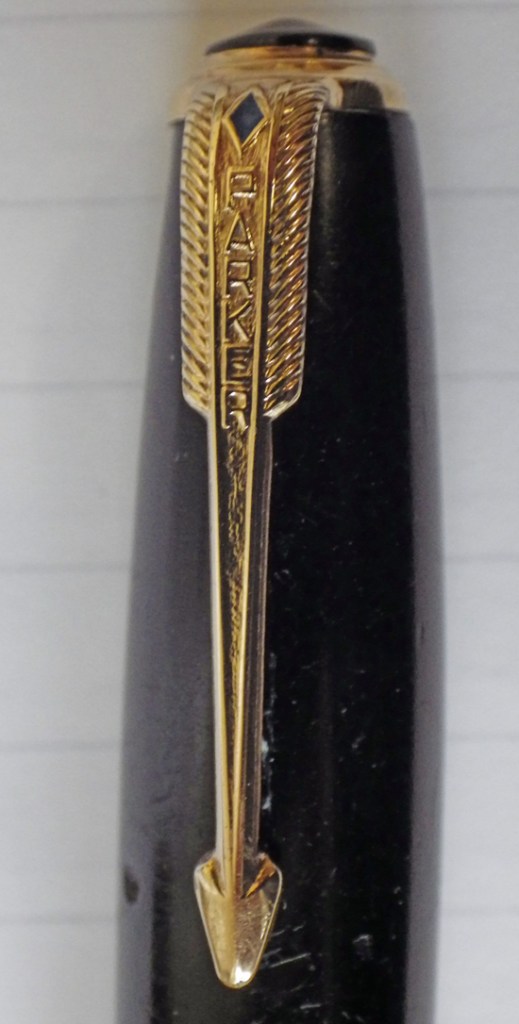
This thing turned up in a lot some time ago. I looked at it, felt somewhat puzzled and set it aside. Coming back to it today, all I have added to it are a nib I had lying around and a pressure bar. Otherwise it’s as it came to me. I’m not very happy with the section which doesn’t seem right. Apart from that, what is it? The barrel says it’s a Vacumatic but it’s a button filler. The average amateur couldn’t make that conversion. Any thoughts on the matter? Lots of photographs to let you see what it is.