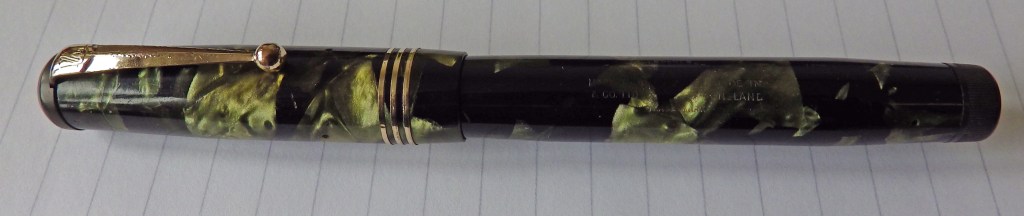
An Accordion Filler Unique

I find the history of Unique to be very opaque. I don’t really know when the company began making pens but by the 1930s – perhaps the 1920s – they were making black chased hard rubber pens of decent quality. They seem to have had considerable success in the 50s, judging by the number of pens around today but by the end of that decade it’s likely that they were feeling the pinch like the other fountain pen manufacturers.

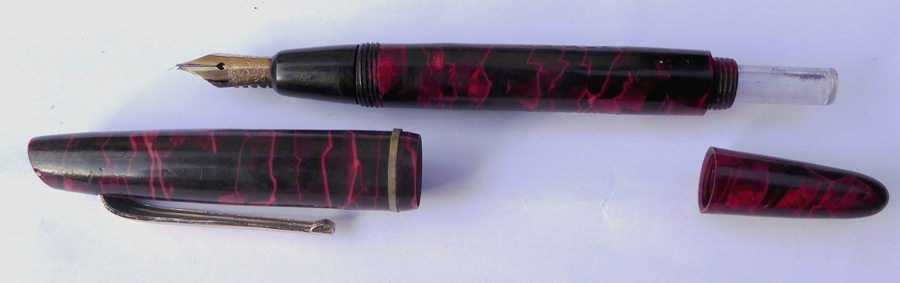
Occasionally the clouds part and a brief glimmer of light gives us a view of Unique’s situation. This rather attractive red and black marbled pen was made in France. Perhaps it was cheaper to have the pens manufactured there than in the UK.  It’s a well-made pen, machined from the rod rather than wrapped celluloid or the injection moulded plastic which was becoming ever more common at that time. At 12 cm capped it’s quite a small pen. It has a warranted English nib and the barrel is imprinted “Unique” and “Made in France.”

What is most interesting about this pen is that it is an accordion filler. The clear plastic plunger, when pressed, squeezes the concertina sac and when released ink is drawn up into the sac and the hollow plunger itself. A filling system related to the bulb filler, it is unique to France. It never caught on anywhere else. It is, I think, the most under-appreciated filling systems, being efficient, capacious and durable. These accordion sacs are made from some tough material, usually being perfectly usable today, nearly 60 years after they were made.
Unfortunately for Unique, this little pen didn’t catch on. Sales seem to have been poor and the pen is a rarity today.

Thanks to Peter G. for the photos and information.

Another Strange Parker

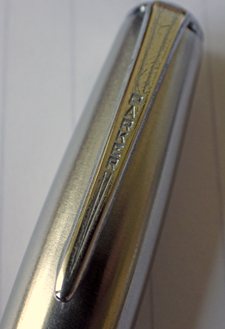
It’s a Parker button filler.  It has an aluminium button like an AF.  The cap is smooth steel with a tapered clip marked “Parker”.  The nib is Canadian.  The dark blue barrel has no imprint.  The section is transparent.

Edit to add:  Thanks for the help.  It appears to be a Parker VS Mark II from the early part of 1948 before they changed to Aerometric fillers.  The clear feed is from the earlier model.

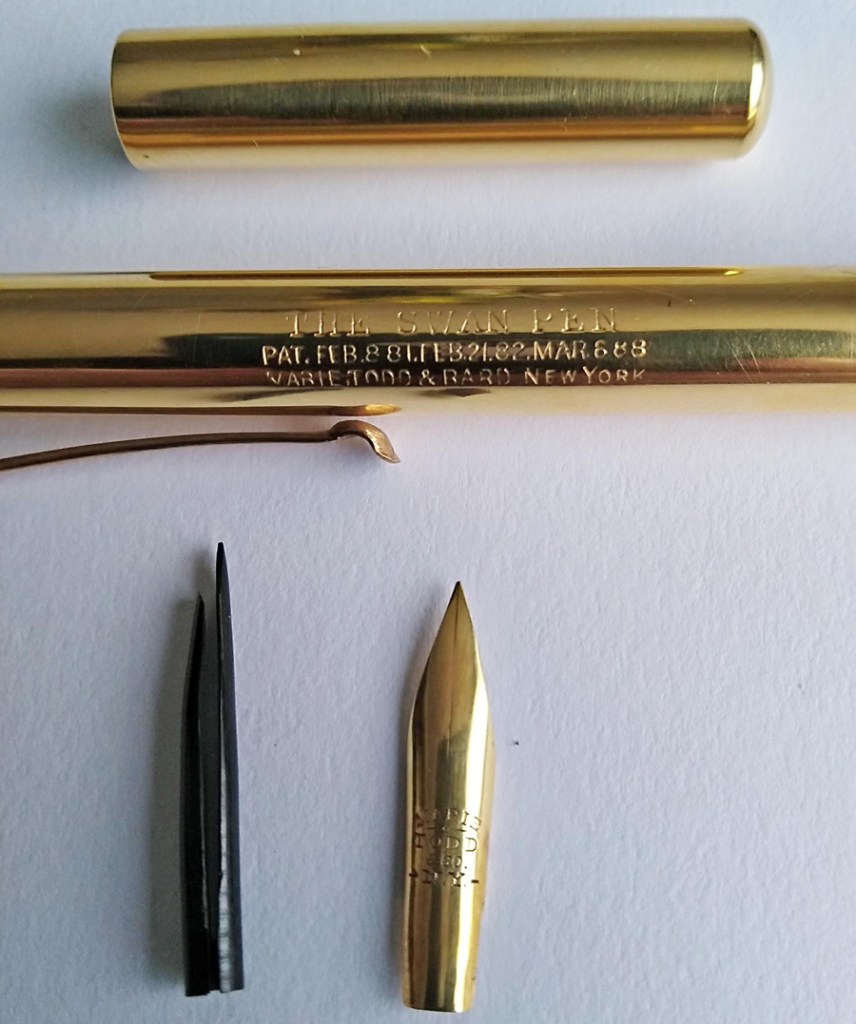
Mabie Todd & Bard Gold Plated Overlay Eyedropper Filler

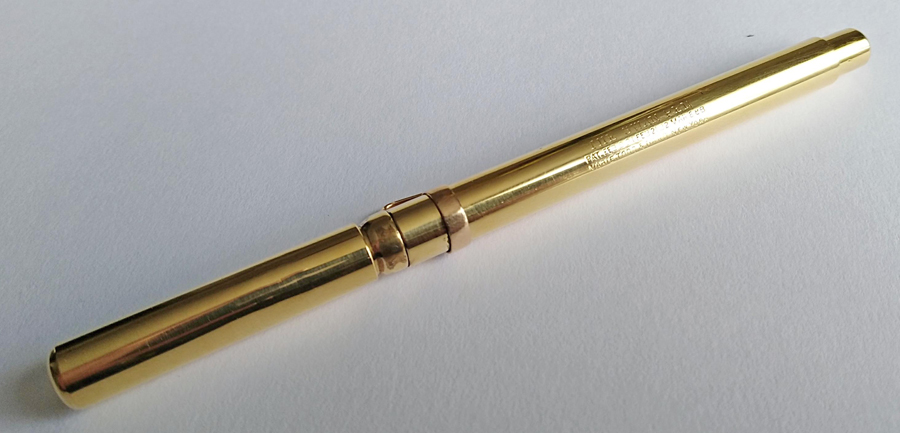
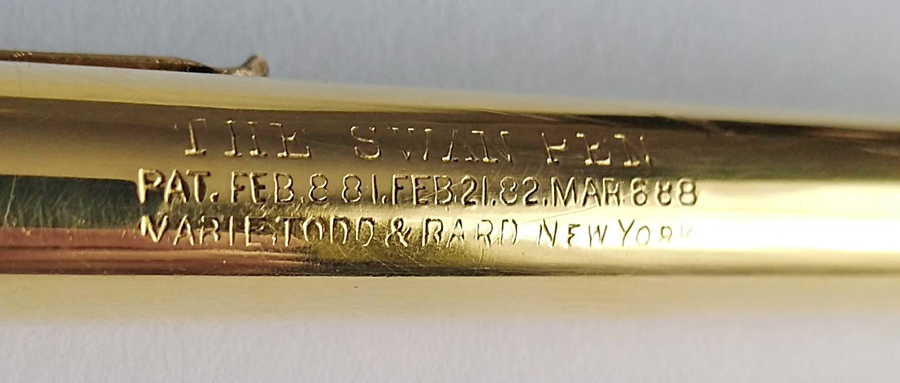
I had an email the other day from Rodrigo Flores of Chile. He has his grandfather’s Mabie Todd & Bard 18 carat gold-filled eyedropper filler and wanted to know when it was made and some idea of its value.

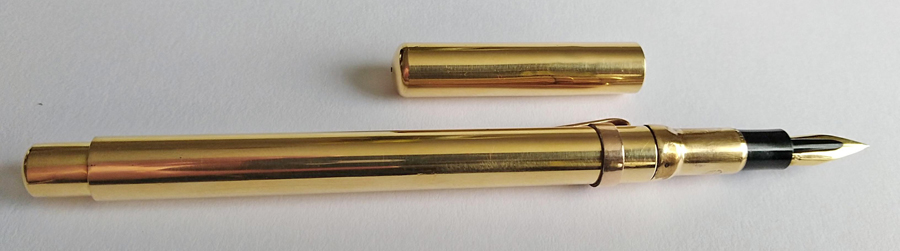
An approximate date was easily established. I have a collection of Mabie Todd adverts and a comparison suggested that the pen was made around 1900. Value, as always, is more difficult. A pen is worth what someone is prepared to pay on the day. A gold-plated Mabie Todd & Bard eyedropper filler was sold a few days ago in eBay and I gave Rodrigo that price. It wasn’t a close comparison, just a ballpark figure. The pen that was sold had a decorated overlay whereas Rodrigo’s is plain. Also, the eBay pen showed the usual signs of the passage of a century and more whereas Rodrigo’s pen is almost pristine.

It’s quite an unusual pen. The choice of a non-decorated overlay was not often made. Though the decorated ones are undoubtedly beautiful, the plain gold overlay is very impressive in its reserved and minimalist way.

After the passage of almost 120 years very few pens are in this splendid condition. I am sure that Rodrigo would never part with this precious heirloom but if it ever came on the market, presented in the right manner, this pen would be the subject of hot competition between serious collectors.

My thanks to Rodrigo for the photographs and the privilege of writing about this pen.

Conway Stewart 28

We discovered some years ago that Mabie Todd model numbers actually make sense – or at least most do. Similarly, De La Rue numbers seem less of an impenetrable puzzle than they once did, but Conway Stewart numbers make no sense at all.

Though they obviously worked well in the company’s favour, their production policies seem a little strange too. There was a time in the fifties and early sixties when the 27, 28 and 58 were on sale, three very similar pens with slight differences in trim and nib. There was to be a pen available at every price point, it seems, and that gave Conway Stewart a healthy bottom line for many decades.

The 28 is a handsome pen and came in a pleasing variety of admirable patterns. This one is the grey hatch, a gorgeous chaos of grey and black striations. There was great artistry in the production of celluloid patterns. It looks well with the gold trim.

Conway Stewart’s nib sizes don’t really compare with anyone else’s. This should be no surprise; there was no urge towards standardisation across the board in those days. Each company followed their own star, a wholly admirable attitude. The No 5 nib is smaller and thinner than the Duro but a good nib as Conway Stewart nibs go. Conway Stewart nibs, it should be said, are not as good as Swans, Watermans or Onotos but they are adequate and reliable, helped by the ebonite sections and feeds that give good ink delivery. When, probably at a customer’s request, Conway Stewart exerted themselves to make a stub or oblique they are very good indeed.

Among all the post-war Conway Stewarts I particularly admire the 28. The gold trim is modest and appropriate, the pen is the right length for me – a little longer than the 84 in other words. I would regard it as the successor of the 286, that great prewar and wartime success. Despite the apparent meaninglessness of their numbers, there is a line of succession in Conway Stewart models over the years. If you wanted the latest style at the same level of decoration as your last one, you could find that pen in their extensive range. And, of course, the numbers are only meaningless now. Once there was a book of numbers with a sequence that was entirely logical to Conway Stewart and its employees. It’s just a pity that it disappeared long ago.

Latest Uploads to Sales Site

Avoiding the housework, I did some pen fixin’
And yardwork could wait, said this cheeky vixen.
But now I’ve uploaded these various pens,
Those horrid domestic chores threaten again.

So please have a look, perhaps treat yourself
Before I’ve no choice but to go dust a shelf!
I’m really not cut out for housewifely duties;
I’d much rather play with my fountain pen beauties!

More on the Mystery, and the UNO Deluxe Technical Pen

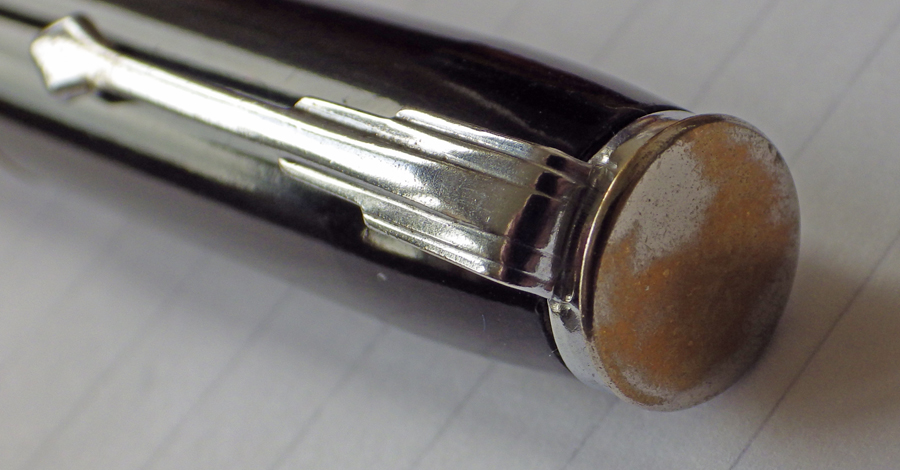
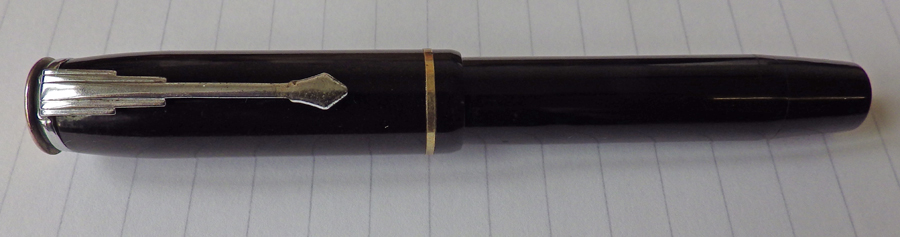
Some more on the subject of the mystery pen I wrote about at the weekend. Annoyingly there is not a vestige of barrel imprint though it seems unlikely that there never was one. Though it is in good condition there are other indications that the pen is well used. The metal top of the cap was once chrome plated like the clip but it has worn through to the base metal. The steel Genius nib is certainly a replacement for one – probably gold – that wore out or was damaged. I plan to replace it with a gold nib.

The pen measures 10.8 cm, a little shorter than the Duofold Streamline Junior which it resembles in some respects. The mix of chrome plating on the clip and gold plating on the cap band is unusual but there can be no question that it is original. The filler-button housing is brass. The cap threading is unusually long, taking 3 1/2 turns to close the pen.

Everything about the pen indicates quality. Usually, it’s the cheap pens that never developed a market that cannot be identified. This one is the opposite, a pen of the quality of the Duofold. I would guess that it is a 1930s pen.

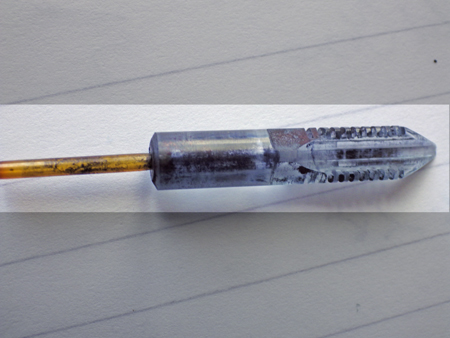
Moving on, another thing that caught my eye today is the UNO Deluxe No 1 tubular pen. This version appeared in 1965. There are a few of them around, mostly because they were the standard technical drawing pen of the National Coal Board. They had a lot of drawing offices and a lot of pens.

Though I haven’t attempted to use it, the UNO looks perfectly capable of working today. These pens had to be stripped and cleaned at the end of every working day. It’s the most basic of writing instruments with no trim or decoration. Just a tool to get the job done. It’s another example of the means used to apply ink to paper

Mabie Todd Swan Eternal No 4

This Swan No 4 Leverless is an impressive and comparatively large pen at 13.2 cm capped. The trim is good with three cap rings and a gilt Swan logo on top of the cap.

I have heard it said that numbers were not stamped on the barrels during World War II. I think there’s a bit more to it than that – I’ve seen plenty of nineteen fifties Swans with no numbers. Be that as it may, I believe this to be a wartime pen.

There is an especial depth to Swan marbling. Stare at it for a while and you begin to feel that you could plunge into its depths. There is black, dark green and several shades of lighter green here. Most attractive.

Referring back to the model numbers, this pen doesn’t have one but if it did it would be 1041. It has an Eternal nib. These nibs come in for a bit of obloquoy in some of the pen discussion boards. The flex kids think that theirs is the only game in town and an inflexible nib is a nail and unworthy of consideration. That’s the limitation of their view. The Eternal is a magnificent nib, robust, smooth and impressive. Its inflexibility makes for fast, accurate writing, which is what most of us want.

A Green Marbled Unique

I’ve written about Uniques before and there have been knowledgeable comments made to those posts. The little magnifying glass above will lead you to those discussions if that is your interest. This time I will avoid the more general stuff about the brand and confine myself to discussion of this pen.

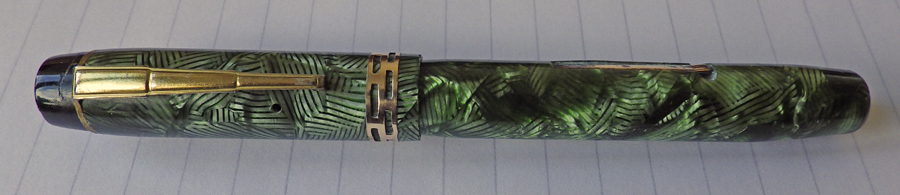
I would guess that it is a product of the early nineteen fifties. It is a handsome pen in very good condition. The gold plating has held up well except on the lever where there is some loss. The clip is stepped in the Art Deco style and the cap band is moderately broad and pierced. The pattern of the celluloid is marbled dark and light green with an overlay of randomly aligned striations. I have seen this very attractive pattern on Uniques before. Those pens were made from wrapped celluloid sheet. I can see no seam here and I assume it was machined from the rod. The tassie is made from some form of plastic, hard rubber having been finally laid aside for that purpose. I’m not sure about the material of the section. The feed may well be ebonite.

The nib is small, perhaps a little smaller than a Swan No 1. It is warranted and probably made by Unique themselves as they had a gold nib plant. The lettering on the nib is instantly recognisable. I come upon these warranted nibs frequently and they are always of very good quality.

This is a very handsome pen indeed. Uniques are not as collectable as Conway Stewarts but this is a sound, well made, well designed pen. Aesthetically, all the parts come together in a very satisfying way. Though there are some later Uniques that are of lesser quality, perhaps giving rise to a poor reputation for the brand, this pen and many of its predecessors are as good as anything produced by Unique’s competitors.

My thanks to Paul S for this pen.