Old “Inky” Stephens, who began the famous company, was all about ink. There is no indication that he particularly cared about pens of any sort. He developed the famous Registrar’s Ink which was used for important documents for years. Though later generations opened the company up to other, related interests, Stephens was always primarily an ink manufacturer. Indeed, calligrapher’s ink in various colours is still made under the Stephens name.
The company’s reputation for reliable ink led to its great popularity and its use in many schools, banks and businesses. The company arranged writing lessons in schools, using dip pens. Though this may well have been intended to advertise its ink for use in schools, there was undoubtedly some concern that children be taught to write well.
Later still, by the nineteen thirties, those running the company saw the opportunity to expand into supplying fountain pens, rightly confident that there are good reputation would lead to strong pen sales.

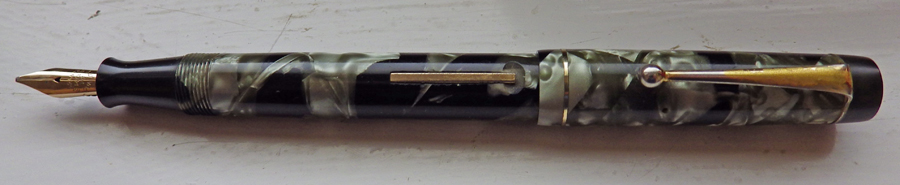
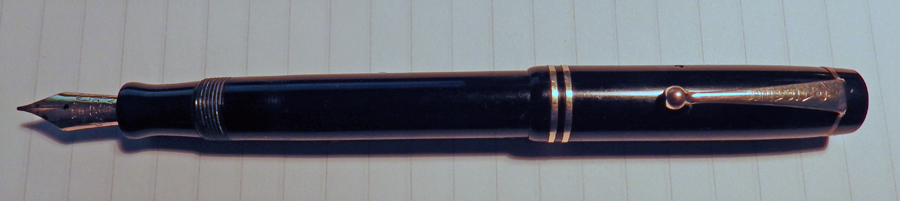
I have had doubts in the past about the degree to which the Stephens company was involved in the production of the pens which bear their name, but now I have little doubt that there thirties and forties pens were entirely a Langs product. This black and grey marbled No 106 is an excellent example. The number refers to the price which in this case was ten shillings and sixpence. That is almost impossible to convert accurately into modern money but online converters suggest £65 – £70 which seems reasonable for a pen of this quality. Like all of Langs output at that time, the pen is in a traditional style with no attempt to modernise the appearance or mechanics. Like the Mentmore I wrote about recently it is in the style that had become the standard British pen.

Eighty years later, this pen remains in very good condition, almost as good as new. Langs pens were built to last. The gold plating has held up well, only showing wear on the clip. The warranted nib appears original. Restoration consisted only of sac replacement and cleaning. The pattern is attractive and these pens were good sellers at their various price points as is shown by how many are still around.
The thirties and forties may be regarded as the highlight of the pens that were produced for Stephens. Later, when Langs was gone and Stephens became involved with Waterman, pens were made for them in France, principally by JIF Waterman but also by some other French manufacturers. Quality was variable (though some very good pens were made) and their popularity fell away. These later pens are much less common. Eventually Stephens stopped selling gold-nib pens.
Stephens gave us some great pens, splendid writers in a wide variety of nib styles and of course their famous ink still turns up quite frequently in eBay. I have a huge bottle of their red ink probably from the sixties. I rarely write with red ink so I don’t suppose it will ever be used up.










 Goodwriterspens's Blog