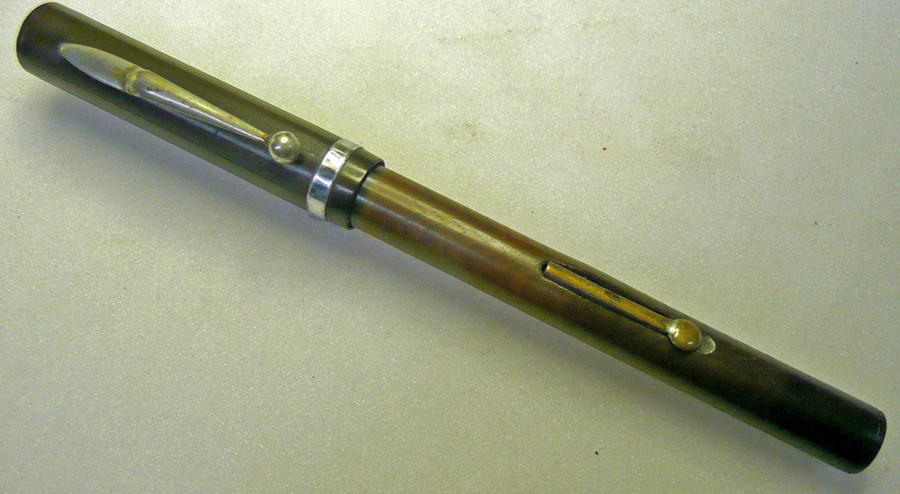
Parker Duofold Black & Pearl

As you may have gathered by now, I’m particularly fond of Duofolds of almost any date, with the exception of the current ones which don’t do much for me. I think of Duofolds as the first truly modern pens.

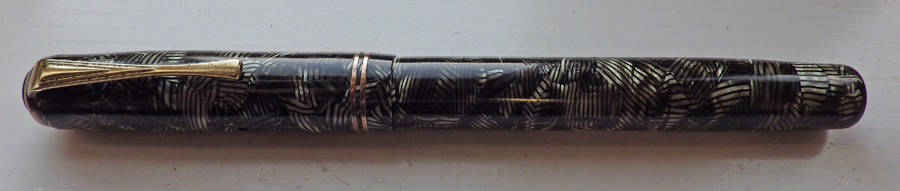
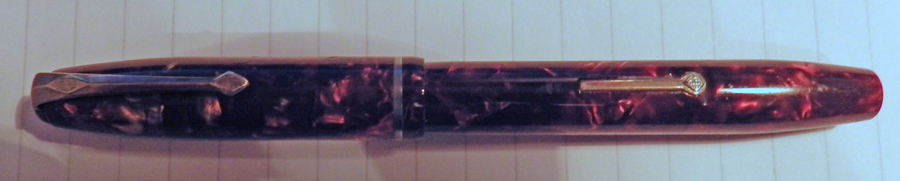
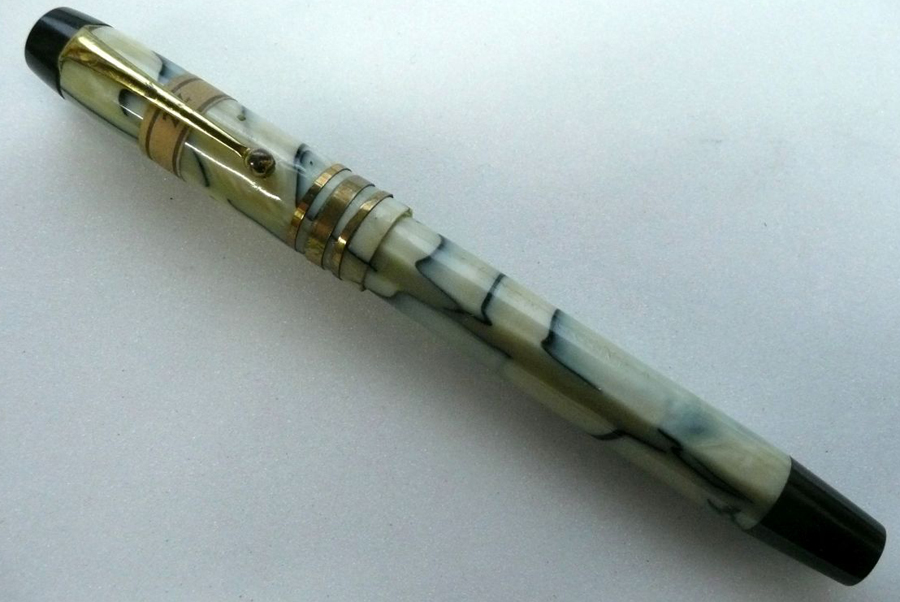
This Junior is one of the quite early ones, dating to 1928 or so. The pattern is known as Black and Pearl. It is especially prone to discolouring but if it isn’t too bad the colour change is attractive too. This one hasn’t suffered too much. I’ve seen others where the pattern has almost disappeared.

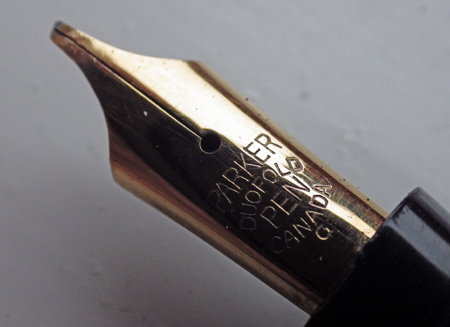
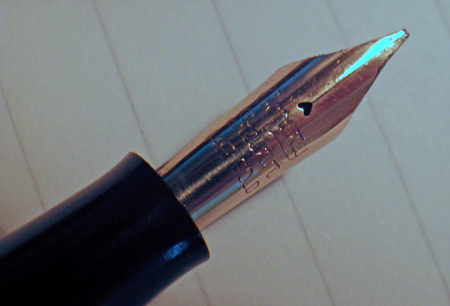
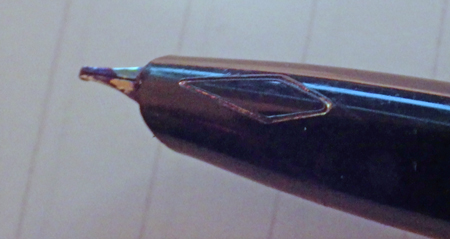
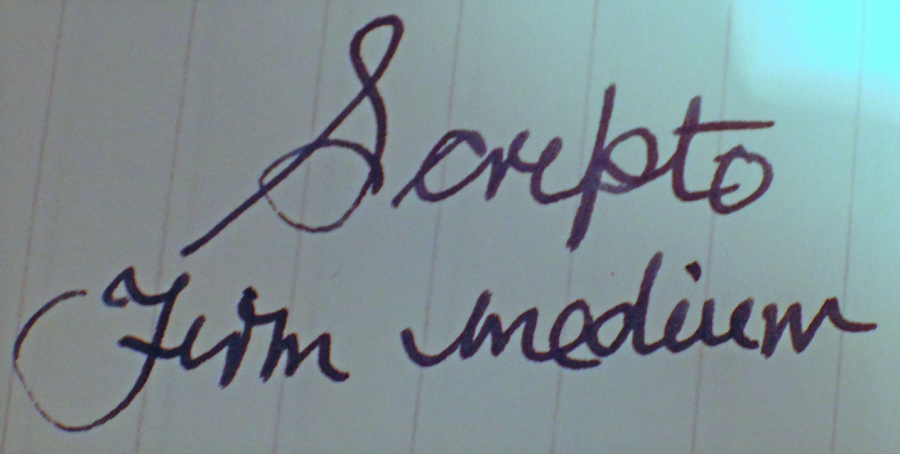
When it came to me the nib had had its day. The tipping had probably worn off and someone had tried to stub it, without notable success! I had an English Junior nib and despite the fact that the two nibs had thirty or forty years and the Atlantic Ocean between them, it was a perfect fit. For many years Duofolds remained Duofolds; despite style changes they were still essentially the same pen.

The pen has lost some gold plating on the clip and cap rings. That’s a sign that the pen has been well used and loved for at least a large part of the last ninety years. As I get older I become more attached to the really good pens that I find. I can’t keep them all, though, and indeed I don’t really have any need for more pens so someone else will get this beauty when I upload it to the sales site.

The Parker 25 Revisited

I wrote about the Parker 25 some time ago and I’m afraid that on that occasion I could find little to praise. Several people wrote me to say how fond they were of the pen and this is an attempt to give a more balanced report.

First, there are a couple of things about the pen that I continue to dislike: the ball of the tipping material makes it write like a ballpoint. Also, being a rather slender pen I cannot write with it for long. That said, it does have some rather good points. It is a very simple design with little to go wrong. There are many of these pens around and they always seem to be in good condition. That reflects both the popularity of the 25 over its two decades of production and also how robust it is. The one I have at the moment has a squeeze converter, still working well.

The design either appeals or it doesn’t. I find the barrel rather strangely shaped but that’s entirely subjective. It does post very reliably. The nib has no breather hole. My pen was very dry and I thought that running a shim through the nib would be difficult without a breather hole but that didn’t prove to be the case. The ink flow was good after that.

The pen still closes firmly and that’s true of all the 25s I’ve had. The clip is still quite firm too. It’s a very easy pen to clean. There’s a hole under the feed. Insert something there and pull and the section and nib come out easily. That makes the 25 the ideal pen for those who like to use saturated or iron gall inks.

On reflection, then, I didn’t find it too difficult to find good things to say about this pen. It was in production from 1975 to the late 90s – perhaps 1999. It proved to be a big seller at quite a low price. For those who think they might like a Parker 25, they can be picked up for very little money.

Wyvern No 50

Wyvern models are confusing and they are likely to remain so until someone does major work on them. This No 50, when compared with other Wyverns, seems to be a mid-thirties pen. It has the rather stylish Art Deco clip, double cap bands and the usual arrow-shaped lever. With the cowled clip and black “jewel”, it’s one of the better Wyverns, enhanced by the hatched pattern. As is usual with Wyverns, the gold plating has worn almost completely off the clip.

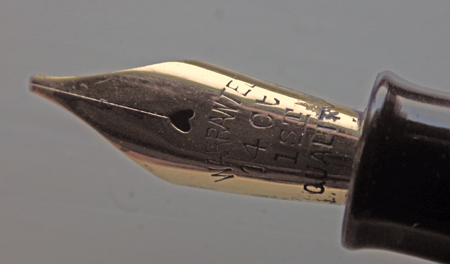
This is a straightforward lever filler with no traps for the unwary, like the left-hand threads that some models have. Some Wyverns have brand-engraved nibs, often with the attractive Leicester Dragon. Others, like this one, have warranted nibs. Both types were made in-house and there is every reason to think that this is an original nib. It is a fine stub.

Wyverns are hard to place in the British market. Some of the lower-quality pens, like the 60C Perfect Pen and the Orium models are less attractive and subject to shrinkage. At the other end of their range the animal-hide covered pens were highly regarded when they were issued and are much sought-after by collectors today. Like Mentmore’s production there is a great deal of variation in the quality of Wyvern pens.

For the writer, a pen is as good as its nib and this is where Wyverns excel. Some Wyvern nibs are firm, others, like this one, are flexible. All are good. With the exception of the leather covered pens, Wyverns don’t fetch a very high price, so there is the opportunity to obtain a very nice and useful pen for little outlay

The Bic Easy Clic Standard

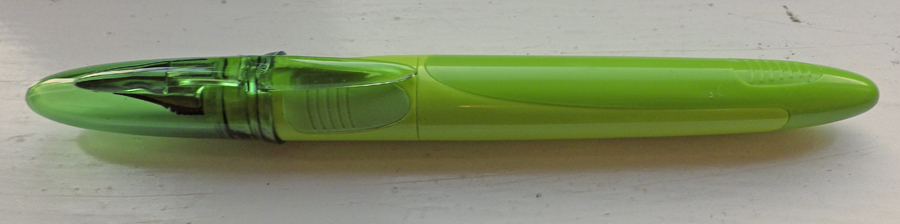
I had made up my mind not to bother with any more modern pens, but someone kindly sent me this current oddity, the Bic Easy Clic Standard, probably intended as a school pen.

When I see the word “Bic” I think of the ubiquitous Crystal Bic, probably the best reason for dispensing with ballpoint pens. I used them because I had to in the office. I found them to be very unpleasant and I didn’t think very highly about the Bic company. However, they have made fountain pens in recent times, though I don’t believe they have ever caught on.

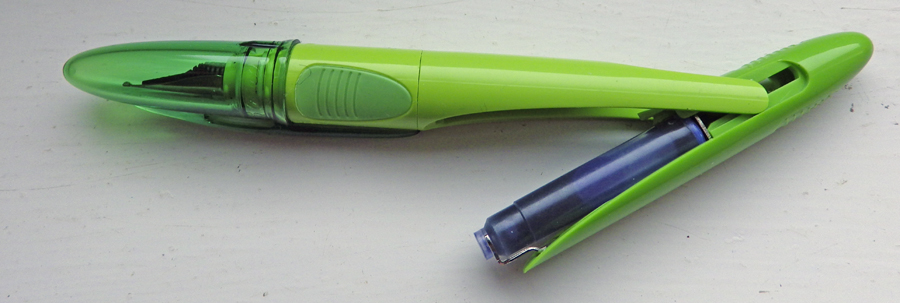
This pen comes in a bubble pack with one short international cartridge, the only size it takes. The pen has a side refill system. Pulling on the indicated places opens the pen and you can remove the old cartridge and pop in a new one. I think it’s a rather good system. That’s the Easy Clic’s claim to fame!

The pen comes in bright colours: blue, purple and green. I have the green one. It is coloured pale green and paler green. Strangely the area we would normally refer to as the section has what looks like a thread but the cap does not screw on.

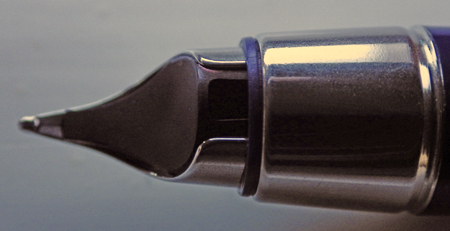
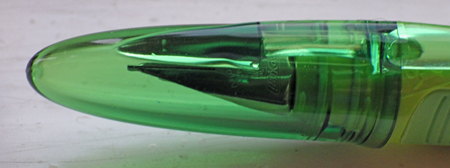
It’s a small pen, fine for my small hand but probably not comfortable for someone bigger. The nib is shaped somewhat like an arrow head and the feed is multi-finned. Aesthetically it does not appeal to me but it works well, giving good ink flow right from the start with no skipping or hard starting.

The pen has two indents for your thumb and forefinger, lined with soft plastic. It isn’t quite as bad as the Lamy triangular grip which I cannot use at all, but I do find it annoying and uncomfortable. Also, the pen I have is a medium. I don’t know if other nib sizes are supplied. I prefer a finer nib.

I see that they are offered between £5 and £9 on eBay. The Bic works well for a pen at that price but I would have to say that I wouldn’t really want it at any price. The grip does not suit me and the pen is quite ugly.

Pen manufacturers (or at least some of them) seem to think that school pupils, if they want fountain pens at all, want them in bright colours and strange shapes. Indeed the Easy Clic bears some resemblance to an infant’s toy. Who am I to say whether the pen companies are right or wrong in this belief? Time will tell, based on whether this pen and others like it are a commercial success.

Happy Christmas!

A Happy Christmas to one and all, and if you celebrate something else, may that be happy too. I don’t suppose that I will do a lot of business before the New Year so this is a good opportunity to look back at how 2018 went.

It’s been a good year. Selling prices for unrestored pens continued to rise though not as steeply as before. The price increase is a good thing. Unless people with old pens to sell can make some money on them, they’ll strip out the gold nibs and trash the rest. That’s the last thing we want to see happen. Quite a few previously unknown pens (to me, at least) have turned up in the course of the year. There is still more work to be done on vintage British pens.

I will remember this as a year of Parkers and German pens. The Parkers that came my way in great profusion were American, Canadian and British. They are always a pleasure to work on and sometimes hard to part with. They are admirable pens and many of them are just my style of pen. I love nails but they have to be good nails.

I started buying in Germany early in the year. Strangely, many German sellers will not send pens out of the country. Thankfully there are quite a few that do and it enabled me to begin an education in vintage German pens, mostly piston and button fillers. I know more about the subject than I did but I will never have a comprehensive knowledge; there must have been hundreds of brands, reduced now to about half a dozen still in business.

Swans and better Conway Stewarts remain at the core of what I do. Both have become expensive and rightly so. Few modern manufacturers, if any, turn out pens of that quality. Both still remain quite common, reflecting how well they sold when new.

Old pens continue to fascinate and excite me. I hope that 2019 will be as good a year as this has been, especially in finding pens to write about.

Raspberry Marbled Conway Stewart 75

Conway Stewart made many pens in this style, some smaller, some larger, many more expensive but all to the same exacting standards of quality.

The 75 is a rather odd range of pens. There are blues, reds and greens in both muted and bright colours. This raspberry marble is considerably brighter than the burgundy version. The intent was, as ever with Conway Stewart, to please all tastes, even the most conservative who chose black.

The quality is apparent in a variety of ways. Most readily evident is the fact that the pen, sixty or seventy years old, looks new. The barrel and cap are free of scratches or bite marks and the chromium plating remains bright. Out of sight and unobserved by the writer, the pressure bar is of the swing type, more efficient in filling the sac with ink than a J-bar. This is a technique developed by Waterman and doubtless Conway Stewart had to pay a royalty for its use. Quality comes at a cost which they were clearly ready to pay in those years. It makes the later cost-cutting and decline in quality all the more regrettable.

When we talk about the quality of British pens we usually place Conway Stewart third behind De La Rue and Mabie Todd. Perhaps, in reality, we are talking about price rather than quality. Conway Stewarts, until the late sixties, were just as well made as those more expensive pens but they were targeted at a different, less wealthy market. I am equally pleased to repair Conway Stewart, Mabie Todd or De La Rue pens, the lever fillers anyway; I avoid the plunger fillers. I know that each of these pens will be a pleasure to work on because no corners were cut in their manufacture. There are never any nasty surprises.

In the heirarchy of post-war Conway Stewart pens the 75 is fairly far down. The choice of chrome plating rather than gold kept the price down and the pen is smaller than some of the more expensive ones. It has a decent nib, however, and many today might think that the chromium plating goes better with the bright red marbling than gold would.

Scripto Cartridge Filler

Recently there was discussion about the Scripto in Fountain Pen Geeks (an estimable forum). My husband remembers the Scripto from the sixties. It was sold in Woolworths and was, he said, the scrapings from the bottom of the fountain pen barrel, a poorer pen than the Platignum (and that’s saying something!). I worked on one or two myself and those were not good pens, either aesthetically or as writers. My comment in the discussion was somewhat disparaging. A couple of other people came in to defend the pen.

Digging through the pile of pens I have yet to restore I came upon (you’ve guessed it!) a Scripto. Unlike other Scriptos I’ve had this is a cartridge filler. It has a bright metal cap and a hooded nib. The hood has a metal insert which mimics the Parker 61. The cap fits well.

The cartridge is unlike anything current. I flushed it and refilled it with a syringe. It wrote perfectly well with no hard starting or skipping. I had to eat humble pie and returned to the discussion in FPG to report that I had changed my mind about the Scripto.

Well, I’ve changed my mind to some extent. Like the Platignum, a pen in the same price range, it depends which Scripto you have. The two lever-fillers I repaired were just bad pens with poor ink delivery except for the purpose of leaking. They were not worth the effort I had put into them and were ultimately consigned to the landfill. This cartridge pen is very much better and would make a decent everyday writer though it is evidently a cheap pen.

I suppose this goes to show that it doesn’t do to rush to condemn.

More on the Golden Guinea

Here we are, back with the Golden Guinea again. Paul S has provided me with a photo of his very beautiful Golden Guinea, complete with the twenty-one shillings pricetag which proves my theory wrong. The Golden Guinea did cost a guinea! I think that means the pens must have been later than the thirties as I had surmised. Beautiful as these pens are they are hardly first rate; why would anyone pay twenty-one shillings for these pens when a much better one could be had for far less money? The riddle remains…

Paul also kindly gave me a photo of a pen called “Guinea Pen 21/-“.  Going on appearance alone, I would say this is a mid-twenties pen. Never having handled it, I can’t say with certainty, but it looks like a quality pen. Is there any connection between the pens other than the word “guinea”? I suspect not, but at the moment there is no evidence one way or the other.

Incidentally, this pen had had its nib replaced, and with a beautiful New York Mabie Todd overfeed. I’m sure a better home could be found for such a nib!

These pens are indicative of how prolific the fountain pen industry was in Britain. While we enjoy our knowledge of the big names, there is so much that we do not know about the everyday pens that people used for work and correspondence. We are right to congratulate ourselves on how much has been recovered from the past, but there remains so much that is beyond our knowledge and may always remain so.