Schneider and Fischler: The Book of Fountain Pens and Pencils

The Schneider and Fischler book was once a highly regarded reference but, having been published in 1992, the advances of the intervening years have diminished it. The best thing about it is that it shows pens you won’t see anywhere else. The rarities are all American unfortunately. The pens of major pen-producing countries like Japan, France, Italy, Germany and Britain are covered only lightly.

A disproportionate number of metal overlay pens are presented. That, I think, was the emphasis of the hobby at the time. All pens that are not hard rubber are described as “plastic.” It would have been useful to know what the other materials actually were. Indeed, most of this large volume is devoted to photographs with very brief information.

It is perhaps in the photographs that this volume most shows its age. Very poor by modern standards, it is as if they were taken through coloured gauze. The colour and even the shape of some pens is indistinct.

This is beginning to be a litany of criticisms and I’m not quite finished yet. There is a section on pen repair which should be ignored. It appears to have been acceptable in those days to risk burning your house down with naked flames being applied to pens. We know better now.

It isn’t all bad, though. I’ve been at this game for a long time yet I was deeply surprised at the large number of pens and pencils shown that I had never even heard of, let alone seen. Pencils are not forgotten, as they are in most other works and there is a section on pen/pencil combinations.

Prices vary between £50 and £60 for the book and you may judge whether this is an essential for your bookshelf or whether the money might be better spent on pens, ink or tools. Despite all I have had to say about it, I’m glad to have it.

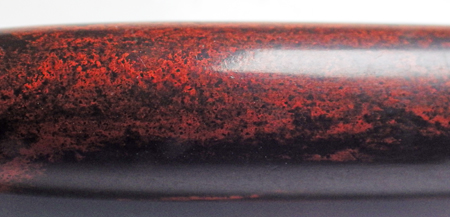
Mabie Todd Fyne Poynt MHR Pencil

I love and admire mechanical pencils almost as much as fountain pens but demand for them is low. Such pencils as I have dealt with have come in a batch with fountain pens that I wanted. I have never bought a vintage mechanical pencil for its own sake – until now!

I saw this splendid Mabie Todd Fyne Poynt propel-repel pencil in eBay the other day and I was determined to have it. I paid a reasonable price for it and count myself lucky to have obtained such a fine pencil. This would match a 1920s fountain pen in the SF range. I often have those pens but they are mostly in the more common black hard rubber material. The mottled hard rubber ones go for quite a lot more nowadays.

No matter, it’s a very fine writing instrument in its own right and I will enjoy it for as long as I have it.

Conway Stewart 479

I’m not especially fond of cap rings. Whether they are single and slender or multiple in patterns such as thin/medium/thin, they’re just things to help to keep the cap lip from splitting. I would make an exception for the ones that are genuinely decorative or are a feature, like the Swan Visofil pierced cap bands or the large metal bands of the Sheaffer Triumph 1250 or Waterman Taperite. Otherwise I would prefer that they made stronger cap lips.

The Conway Stewart 479 is an excellent example of a pen with no cap rings. I’ve had many of them and none has had a crack in the lip. This is because the lip is a fraction thicker than those with cap rings. It seems an altogether better design as cap rings don’t actually prevent cracking of the cap lip, as we have come to know all too well.

The 479 was a very popular pen and it had a long period of production. It came in some outstanding colours, too, like this deep plum and black marble. It’s a very rich pattern, all the better for being uninterrupted across the cap and barrel by cap rings. This particular example is enhanced by having a quite flexible stub nib.

A Croxley With The Wrong Clip

This Croxley arrived the other day. When I saw it advertised I realised that it had the wrong clip. No problem, I thought. I have a couple of Croxley clips. However, neither of my clips would fit. The internal diameter of the washer is 10.6 mm, considerably larger than either of my clips. I had to revert to the clip the pen came with.

How can it be that Croxleys vary so much? One would think that such things as clip screws and caps would be identical, or nearly so, in a production facility of the late 40s. It’s almost as if they were hand-made.

On the same subject, a friend is looking for a plain clip for a National Security with an internal diameter of 11.3 mm. That’s BIG!

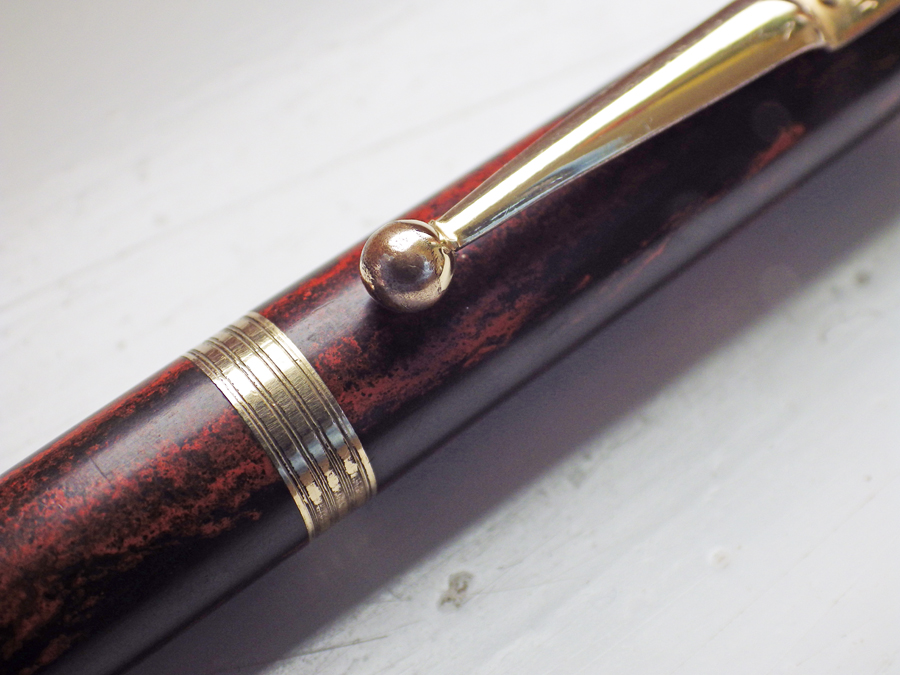
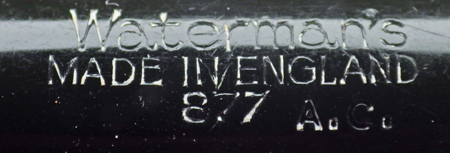
Waterman 877

If this Waterman had been made in America or Canada it would have a model name. English-made ones just have a number: 877. Anything of the Taperite kind has a reputation for being difficult to repair. Specifically, they are said to be hard to do disassemble. Actually that is only true of the US ones. Those have sections glued into the barrel and the one or two of them I have had would have counted as one of the labours of Hercules.

This one has a dark green barrel and section and a gold and silver coloured aluminium cap. Despite a couple of dings in the cap it’s in good condition. The clutch closes the pen very firmly and the clip only shows wear at the tip. The box lever is in lovely condition.

Though these pens show some resemblance to the Parker 51 in the partially covered nib and long section, many of these nibs have at least some flexibility, something lacking in the 51. The semi-hooded nib of the Parker 45 is rather like this Waterman nib.

These pens are not especially popular, partly from the mistaken belief that there are hard to repair but also because many of them have not survived well. Waterman gold plating of this period is notoriously poor. Often the caps are loose but that is easily repaired. Some have loose sections – a distinct contrast with the US variety – but again that isn’t an insoluble problem. A good example, like this one, is a very nice pen indeed. The designer, whoever he or she may have been, dared to create a new and different style, one that works well, in my opinion.

Packaging

I have pens delivered almost every day. As a result, I feel I am in a position to evaluate packaging. There are three standards of packaging: bad, stupid and good.

Bad
This is a pen thrust into a padded bag or even a plain envelope with nothing more to protect it. I don’t need to explain why this is the worst type of packaging. I count myself very lucky that I have had pens destroyed by this type of packaging only three times.

Stupid
Stupid packaging involves unnecessary amounts of packing tape or worse, Sellotape. The pen is somewhat protected during transmission but it is in danger of being damaged during unwrapping. It’s generally the case that in stupid packaging, the tape outweighs the pen by a huge amount. In the worst case, the pen is wrapped in tissue paper then mummified in Sellotape. Several layers of bubblewrap are applied, each one heavily taped. This mess is then packed into a reused box that was never intended for posting and usually arrives squashed out of shape. I got a pen in someone’s prescription box this morning. The result is that the pen is not protected though it keeps the tape manufacturer in business.

Good
Good packaging is robust, either a postage tube or a section of plastic tubing. I use postage tubes and lots of bubblewrap with the minimum of brown packing tape. Packing tape is better than Sellotape because it is visible. A pen in plastic tubing with a layer or two of bubblewrap can be popped in a padded bag with complete confidence. On occasion, when a pen is being sent overseas, I might use more packing tape on the seams of the box because of the amount of handling the package will receive, otherwise I keep it to a minimum. These are not the only good methods. Many people are cleverly inventive and come up with other good solutions.

It is the bane of my life to be presented with a lumpy package big enough to hold a ghetto blaster when I know I have only ordered one pen, only too aware that there will be many layers within like Russian dolls, each with its own sticky mass of tape.

Wypac 39 Button Filler

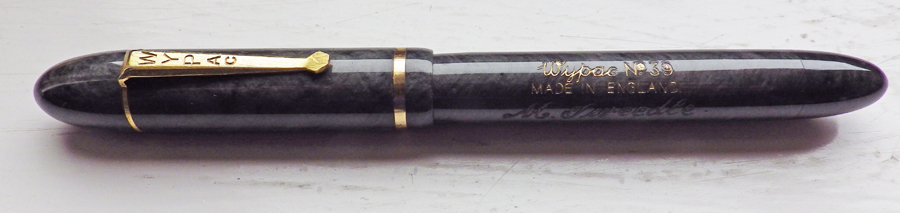
The Wypac 39 is about style; from the shadowed and cursive scripts on the box to the mid-cap clip and the gilded lettering on the barrel, this is a well-designed and executed pen. The surprising thing is that it didn’t catch on and most Wypac models are uncommon, bordering on rare.

Stephen Hull mentions Wypac on page 186 of The English Fountain Pen Industry 1875 – 1975 but only in relation to the stylo. Taylor, James (Braemar) 148 Shooters Hill, London SE3 appears to be either distributor or manufacturer. In a comment in one of the pen discussion boards I see a suggestion that these pens were made by Wyvern but I see no evidence to support that. Wyvern may or may not have made these pens; the coincidence of the first two letters of the words is not enough.

The date associated with these pens is 1949 and it would have been then, or soon after, that Morrison Tweedle was presented with the pen (according to writing inside the lid of the box) for acting as usher at the wedding of Joan and Bill. There can’t be many Morrison Tweedles around and I believe I found him in Liverpool, born in 1921 and, if it’s the same man, still around in 2002 – 04.

It’s a pity that Wypac was not more successful. This model 39 is a handsome and robust pen in mixed pale and darker grey. The “M Tweedle” on the barrel enhances, rather than detracts from the pen. It carries history.

A Swan Leverless

I do love the Leverless! This particular example has no number and is of the 1930s. It measures 12.6 cm capped and has retained the little gold plated Swan on the cap top. It has picked up a few scratches but the gold plating is good on the cap band though a little worn on the clip. The nib is medium, stubbed and soft but only very slightly flexible.

Even when the Leverlesses I buy are said to be restored, I open them up to take a look. Usually, they have been fitted with too narrow a sac, as if they were button or lever fillers. The Leverless needs a sac that fills the barrel. A smaller sac will slide past the paddle and the sac will not fill well if at all. Leverlesses are my favourite repair and it’s worth recounting the process for those who don’t have the Marshall and Oldfield book, though it’s well worth getting it.

The Leverless must be fully disassembled and when the remains of the old sac have been removed, the nib and feed must be drifted out of the section and all components cleaned. The sac is shellacked to the section. For some sizes of Leverless a necked sac is best because it requires a large sac to fill the barrel but the section peg is quite small. If a necked sac isn’t available I apply shellac to the peg in the usual way and bind the sac to the peg with fine thread. The assembly needs to be left for a couple of hours to ensure that it is properly cured. The thread can be carefully removed at this stage though I often leave it there. I use a very slender dowel to push the sac fully into the barrel. Then the feed and nib can be fitted.

This pen has a size 20 sac and takes a good fill of ink. The turn-button is a little stiff, as it should be. A loose turn-button can lead to unfortunate accidents!

The Leverless was one of Mabie Todd’s most popular Swans for many years and it is an excellent filling system, keeping the hands away from the ink. During the years of its production, repairmen knew how to replace the sac properly. It is only in recent years that poor repair methods have harmed its reputation. Repaired properly it holds very little less than a lever or button filler – probably more than those lever fillers that employ the inefficient J-bar.

Dickinson Croxley

I’ve written about the Dickinson Croxley before. The search box above will discover my musings, for what they’re worth. Dickinsons found some very pretty celluloid patterns and I think this pink and black is one of the best.

Croxley nibs are very good, often flexible to some degree. This one is a soft fine which means that the nib flexes very easily but doesn’t give line variation. Soft nibs make extended periods of writing very comfortable, acting like the suspension of a car.

One peculiarity I have noticed is that the clip screws vary a lot. The threads are often long. Sometimes there is a gap of a centimetre or two between the threads and the top of the screw, other times the threads run all the way to the top. If you require to remove the clip screw for one reason or another, the length of the threading can be a little annoying. Often they are frozen solid with dried ink. There doesn’t seem to be any good reason for the threads to be so long, or for there to be such variety in them.

That’s the worst thing I can say about the Croxley. They are very well made and are among the best of the post-war British pens. Though a more tapered version was produced too, this very traditional-looking pen was very popular and sold in large numbers. It’s practicality over fashion!