Sunday Ramblin’

There are so many options with fountain pens: an unlimited range of brands, firm or flex, fine, medium, broad, heavy or light – I’ll stop before this gets too boring. The main divide in the pen world for me is vintage and modern. Most people reading this have an interest in old pens, I should think, but I know that there are a few who like new pens too.

Most of the pens in my box are old ones. As you would expect most of them are British – Conway Stewarts, Swans, English Parkers, an Onoto, an Altura Waterman among many others. There are a couple of US Parkers of different vintages, several German piston fillers, mostly prewar, and 60s/70s Japanese pens, if that’s not too modern to be considered vintage.

I use modern pens also, mostly low-cost (but excellent) Japanese pens. I’m writing this with a Sailor Lecoule and I also have modern Pilots and Platinums. I have a Waterman Carene, too – a great modern pen. And then there are the mechanical pencils, mostly Fyne Poynts by Mabie Todd.

What do you use? Are you vintage only and spit upon any modern pens you see? Or maybe both, like me? I think it’s unlikely that I have many readers who only use modern pens but I’ve been wrong before and maybe I am again!

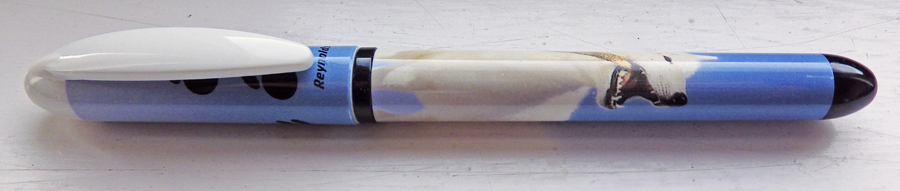
A French Reynolds School Pen

This Reynolds pen, with its Arctic wolf image and pawprints is not my usual thing but it raises a couple of points. First it is a well-made pen, all its parts fitting together well and it’s plated steel nib delivering ink smoothly. It’s aimed at the youth market, showing that there are still good school pens around – or were; this pen is a few years old.

The other point of interest relates to the long-lived Reynolds business.  It was best known as the first company to produce an at least somewhat reliable ballpoint pen in the USA, from which it made a fortune before ballpoint pen prices fell. Reynolds then invested in fountain pen factories in India and France. These were successful, especially in India, until in 2016 the factory producing these pens dropped the Reynolds name and began making pens under the name Rorito. The French factory too continued producing well-made, low-cost pens until 2007.

Unlike many pen manufacturers Reynolds dealt with the decline in the fountain pen market by exporting production – and largely sales – to other countries. This business model enabled them to continue producing basic fountain pens in markets where they were still demanded.

A Stubborn Auto-Flow


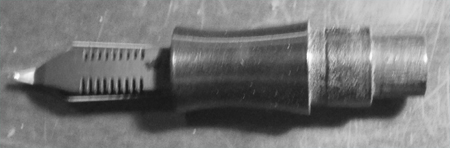
Removing sections hardly ever gives me any trouble. A little heat to loosen things up and out they come. This Mentmore Auto-flow was an exception. After several sessions with the heat gun the section began to move. It would rotate in the barrel but it wouldn’t come out. I persisted without success. I don’t like wiggling a section in a barrel. That seems like a good way to crack it, but needs must when the devil drives. I gently but persistently wiggled the section and eventually it surprised me by coming out. I have a little more sympathy now for those people who appear in the pen boards complaining that they can’t get a section out. This one took a couple of days but subjectively it felt like several months!

Part of the problem was that the section had been shellacked in – with copious applications of shellac. I naturally thought of my friend Grandmia but he wasn’t responsible on this occasion. The crunchy sac was clearly too old for him to have attached it on one of his videos. The other cause of the difficulty was the shape of the section. My apologies for the shaky black and white photo. The combination of the shellac and the peculiar shape of the section cost me an hour or two.

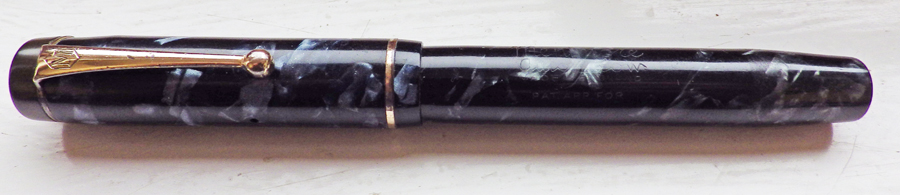
That aside the Auto-flow is a great pen. It was made from 1935 to 1942, or possibly a little later. Though coming in splendid colours like this blue marbled one, there is nothing fancy about an Auto-Flow. Whether lever or button-filler they take the shape that we think of as the typical British pen. Mentmore nibs come in fine, medium and occasionally broad. I don’t ever remember seeing a stub, oblique or a flexible Auto-Flow nib. I believe that, in a way, is why they were so popular – the buyer got a sturdy, reliable, uncomplicated pen and that seems to have been what many British buyers wanted. They sold in thousands and because they are robust they appear in eBay in large quantities today.

They are underappreciated these days when everybody wants flex, oblique or stub, and remain quite inexpensive, at a time when the prices for many other pens are rising steeply. I confess to being an Auto-Flow fan, except for those examples that have large, blobby lumps of tipping material. Those would be ideal for ballpoint users as they will take considerable pressure!

Sunday Ramblin’

Some restorers dislike personalisations and go to great lengths to remove them. What is the basis of this dislike? It may be that they believe that their customers won’t want a pen that bears someone else’s name. They may be right in that. Perhaps they believe that the engraving spoils the beauty of the pen. I would disagree with that but it’s a matter of taste.

I’m in the other camp. We are dealing with old historic pens and an engraved name adds to that history. We always know that a vintage pen had at least one previous owner. The personalisation gives us the name of that owner. Usually we cannot tell who that person was – where they lived, what they did for a living or who they really were but still, I like to think, “this was Bob’s pen.”

Surprisingly often we can go further. There is a lapis lazuli Parker Duofold Streamline Junior on its way to me at the moment. It bears the inscription A E Fewster. That’s an uncommon name which makes a search more likely to be productive. I found two. One was a US sportsman in the 1920s. I think it’s unlikely that this was his pen. It was made in Canada and Canadian pens were for export to Britain and the Commonwealth. America was well supplied with Parker pens from Janesville.

The other A E Fewster is more likely. He was president of the Australian Labor Party in the 1940s. Canadian Parkers were exported to Australia. We can’t tell what happened to the pen after he was finished with it but it’s perfectly possible that such a high quality pen may have travelled from Australia to Britain to join a collection there. Or it may have belonged to some A E Fewster who has no World Wide Web presence. Anyway I love the sense of its history that an engraved pen has.

Rambling on to another topic, I get quite annoyed by those sellers who say something like, “study the photographs carefully. They form part of the description.” No, they don’t. A description is words and a photograph is an image. Both can be used to lie but the important part of any pen sales document is the description.

I sell pens and I would never rely on photos to give anything more than a general idea of what a pen looks like. They can also be used to illustrate something I have said in the written descriptions such as, “there is a scratch near the lever – see photo.”

EBay recognises the importance of the description. One of the reasons they give for returning an item is “not as described.” As a buyer, I appreciate good photos but I don’t depend on them. The seller can show or conceal as much as he wishes but the description is the legal bit of the sale. Some sellers give hardly any description. That’s fine. The poor quality of his description does not protect him if the pen arrives with a crack he didn’t mention. The pen’s going back and eBay will support me.

I try to give as good a description as I can, mentioning faults and usually illustrating them. Why would I do anything else? Domestic buyers are protected by law and overseas buyers are protected by my precious reputation.

Pens Uploaded to Sales Site

I sometimes sneak new listings through
When no one’s watching, it is true.
Come have a peek not just today
When I’ve come here with things to say
About the pens fresh on my site
Uploaded on All Hallows’ Night.

It would be wise to come on by,
At random times – just have a try!
You may find something no one’s seen
If you are quick and you are keen.
Goodwriters Pens has things to share;
So have a look to see what’s there!

Mabie Todd Swan 242/53

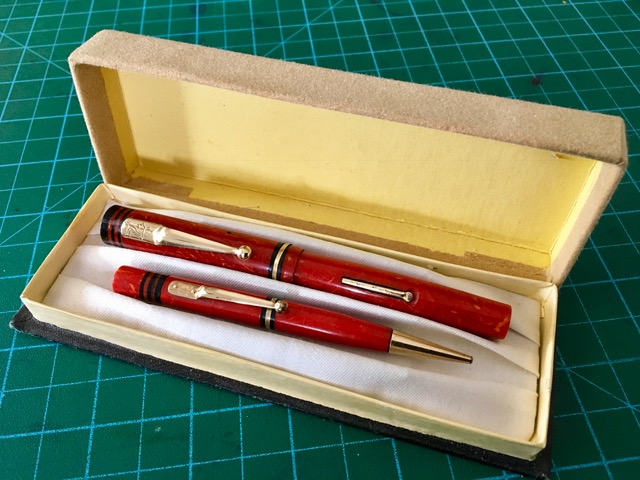
This splendid pen was made in New York  in 1929 to 1930.  The imported British version cost 22/6d.  So far as we can make any sensible currency conversion this was about £50.75 in today’s money, or three days’ wages of a skilled craftsman.  That’s remarkaply cheap and does make one wonder about the prices of today’s pens.  The Lamy Lx 090 Marron costs more than that.  It’s an aluminium pen and is special because it’s brown.  That doesn’t seem like a comparable deal to me.  YMMV.

My correspondent found the pen first, then managed to acquire the matching Fyne Poynt pencil from another country!  That’s dedicated collecting.

With thanks to Rob P for the excellent photographs.

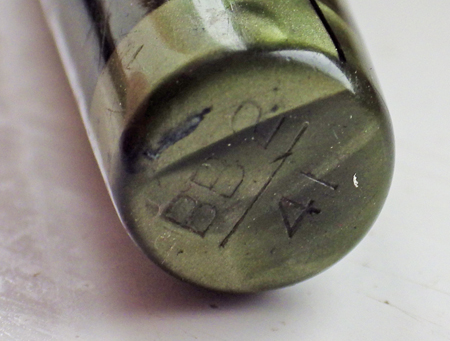
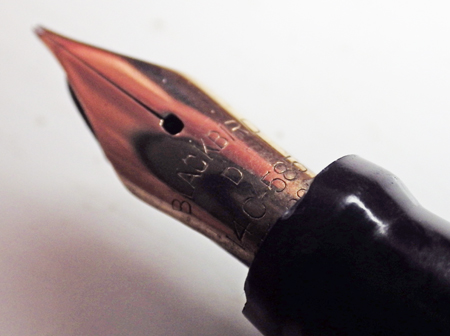
Mabie Todd Blackbird BB2/41

Whenever they appear – which isn’t often – I try to acquire Blackbirds in the BB2 range. Lovely little pens, aimed squarely at the school market. They are quite similar to the 52– range of the same period, and like them their worst fault is thin chrome plating which wears off and exposes the bare metal.

Otherwise, this pen has survived in great shape. It’s in a beautifully subtle green/black marbled pattern, quite unlike the last one of this type I had, a BB2/39, a much brighter and busier pattern than this one. The search box will lead you to it if you’re interested.

These Blackbirds and the 52– models are comparatively uncommon. I feel sure that this was not because of unpopularity but because as school pens their market was generally less careful than older people.

Still, this is a mid 30s example of the pen that some, at least, of the schoolchildren of the day used. All pens are fragile objects and these Blackbirds are a little less sturdy than their Swan equivalents. It’s a privilege to hold this pretty little pen.

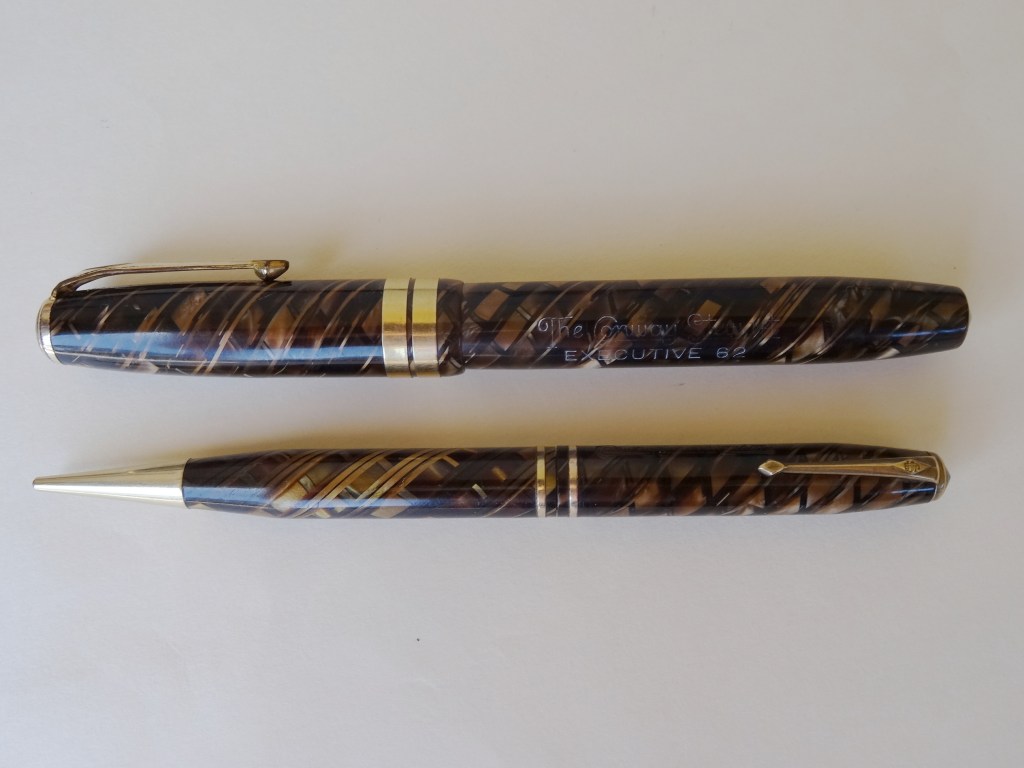
Conway Stewart Executive 62

You won’t have seen this one very often unless you’re in the Antipodes, and even then, in this splendid Tiger’s Eye pattern it must be very rare. It will look familiar though because it resembles the Executive 60. That pen appears with two medium bands or one broad band, whereas the 62 invariably has two bands, I am told. Strangely, Jonathan Donahaye found a black one with no bands at all.

I think it’s most likely that, like the Executive 60, the 62 comes with either the Duro nib or the Manifold.

I’m not sure I follow the thinking behind Conway Stewart’s decision to create special pens for export. As they were so similar to the mainstream pens – in many cases differing by only a barrel imprint – there probably wasn’t a large cost implication. De La Rue, for instance, appears to have exported the same pens as they sold in the home market, at least until they established an Australian factory, and even then I’m not aware of any special models.

With thanks for photographs to a generous collector.

Elysee En Vogue Cobra

I am fond of German pens for two reasons: quality and piston filling. The Elysee does not have the latter but it has the former very evidently.

The Elysee is one of the less well-known pens. They had a short period of manufacture from 1980 to 1991 but that was long enough to establish their very recognisable style. The company was begun by R Dummert in 1925 to produce jewellery including some fountain pens. In 1980, much against the trend of the industry, Demmert applied the resources of the company to the production of fountain pens to meet a concept he had developed.

The earlier pens were very slender as was the fashion in the eighties. This pen, the Elysee En Vogue Cobra, was manufactured between 1992 and 1997 and is a little broader and more comfortable in the hand.

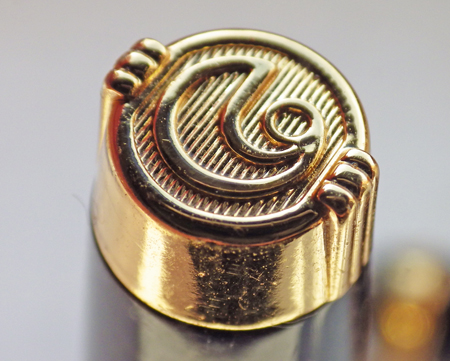
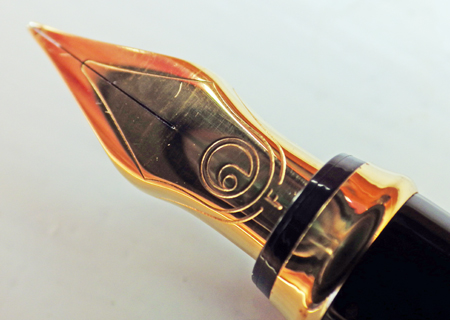
It is in a snakeskin pattern, grey lacquer over a brass base with goldplated trim. The logo appearing on the nib and the top of the cap is a stylised ‘D’ for Dummert. I believe the nib is plated steel. The pen closes with a satisfying snap. The filling system is cartridge/converter and it takes standard cartridges. The company was taken over by Staedtler in 1991 and it is to their credit that the concept of the pen remained the same. The company closed down in 2001 and Elysee joined the list of German brands that have disappeared.

Rambling About Nibs

Hans Gilliams raised an interesting point: many vintage pens came with all sorts of nib shapes – needlepoint, fine, medium and broad obliques (left and right versions), medium, broad and extra broad among several others. Many well-known modern brands offer far fewer options, mostly fine, medium and broad. Some even only offer fine and medium. There are some honourable exceptions. Graf von Faber Castell offers extra fine, fine, medium, broad, medium and broad oblique. Platinum 3776 comes in a veritable host of nib types.

Of course I haven’t written with all of these pens and cannot comment on how good their nibs are. Modern Conklin offers quite a range but having had one of their stubs I can report that it had a huge blob of tipping material and wrote just like a broad. Pelikan offers EF, fine, medium and broad but again, my experience of them was not especially pleasant. My fine had a round ball tip and I found it most unsatisfactory to write with. Baoer provides what they call an oblique; again, a large lump of tipping material, ground down and polished on one side. Not a very satisfactory oblique!

When the fountain pen was the main writing tool, people had a greater awareness of what they needed to write as they wished. I have no doubt they could be very specific about what they wanted and some manufacturers responded very well. Mabie Todd, for instance, in their adverts, offered a huge range of different points. I’ve handled a great many Swans over the years and have enjoyed that variety. No great blobs of tipping material here! Conway Stewart, too, provided several different cuts of their nibs.

Why the change? In the post-war period the ballpoint gradually took over as the primary writing instrument and a generation of writers learned to hold their pens vertically and apply the pressure the ballpoint required. Fearing that the earlier type of nib would be damaged by these writers, fountain pen companies and nib manufacturers began making a more robust nib with a large blob of tipping material that would withstand the heavy pressure applied and would replicate the effect of the ballpoint.

Or so the story goes. It seems a reasonable explanation to me. In recent years nibs have improved slightly in response to writers’ requests. I emphasise “slightly.” Personally I like firm nibs but I don’t like the ball tip that many manufacturers still stick by.

Though I think that the reason I have given above remains the main one, there are probably other reasons related to cost of production and maintenance of warranties. Of course, along with everything else, the truly flexible nib has disappeared but that is ground that we have covered often before.