Dixons Summits

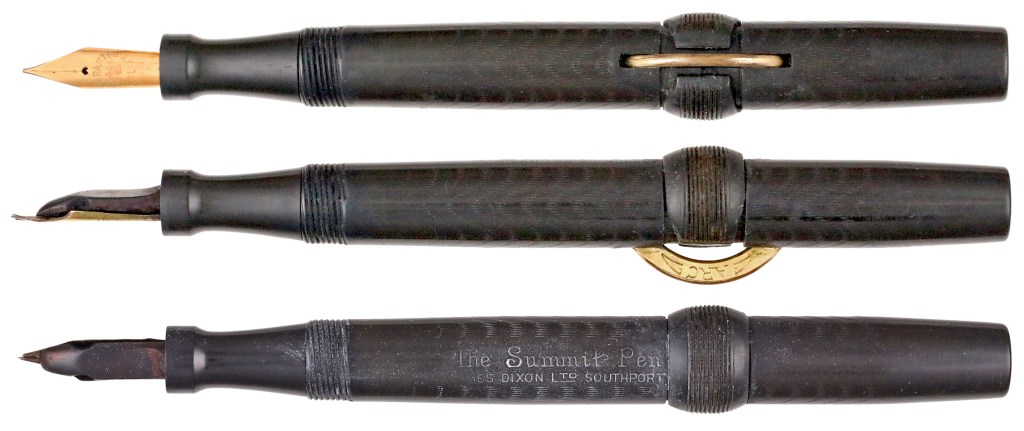
The first Summit brand was made by James Dixon Ltd. These are rather rare nowadays but well worth looking out for, though that may take a lot of patience with no guarantee of eventual success!

I think the quality shines out in all of these pens. Very satisfying design and pleasing chasing. The lever filler, in particular, is a splendid pen, the equal of anything of its day. The safety pen, too, is an admirable instrument. The biggest surprise for me is the crescent filler, something I never knew existed. Any crescent filler is going to be reminiscent of the much better-known Conklin but the design is equally well executed here.

These Summits are clearly products of a company in the first rank of pen manufacturers. It is pleasant to speculate about what they might have achieved, had the company lasted longer.

Many thanks to Andy Russell for information and the excellent photographs.

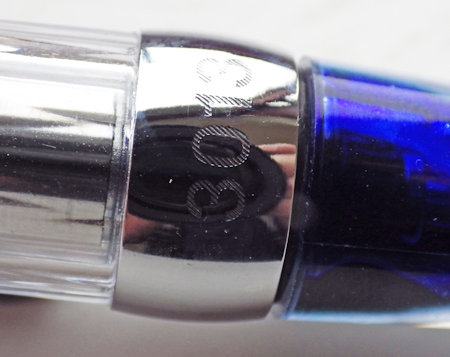
Wing Sung 3013

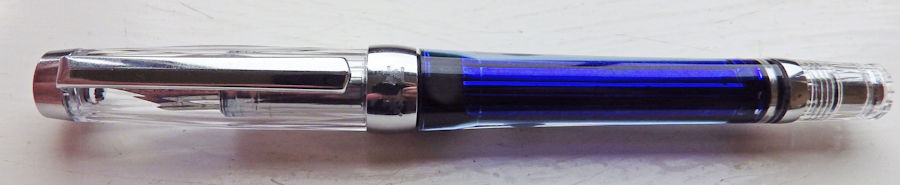
It’s a modern pen today, the Wing Sung 3013. It is described as a vacuum filler. Actually it’s a plunger filler, along the lines of the Onoto. It doesn’t fill the barrel completely on the downstroke and repeating the process draws no more ink but the action is smooth and most people would be quite satisfied with the small lake of ink in the barrel.

It’s a large pen at 14.5 cm capped and it’s medium heavy at 33 g. For comparison the Mentmore Autoflow is 19 g and it’s far from being the lightest vintage pen. The 3013 doesn’t post securely but if it did it would be inconveniently long anyway. Unposted it’s long enough. It is quite back-heavy and that could be tiring in an extended writing session.

It is transparent, of course. The blue is Baystate Blue. The nib is excellent as is the ink-flow. My only complaint about the nib – and it’s a minor one – is that it’s supposed to be EF but it’s fine – an unusual problem with an oriental pen. I note that several people have complained about the nib in reviews. Perhaps I have been fortunate.  There is a large step from barrel to threads to section but it did not interfere with my grip.

The shape is rather odd, with the widening of the barrel near the section. There are faceted areas at the top of the cap and the tail of the barrel. There is quite a bit of metal in this pen. Chinese plastic, especially transparent plastic, is always suspect because of the problem of cracking. Time will tell. Though the design is not entirely aesthetically pleasing it is well implemented. Everything fits as it should and this is a pen that can easily be fully disassembled.

The pen is very cheap. It’s more than decent value for money, I would say. It will never be my favourite pen because of the weight distribution and the odd design but I like it and will use it.

A Thirties Fyne Poynt Pencil

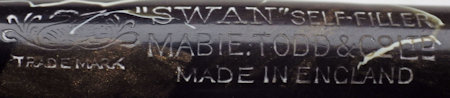
Since its inception the Blackbird has been regarded as a school pen, though many models were not significantly less than the Swan in price and quality. It is often the Jackdaw that fills that niche better.

However, in the mid to late thirties there was a range of pens that definitely seemed to fill that role, the simple Blackbirds in bright primary colours of the 52 – – range. Some years ago I had the red (5277), green (5276), blue (5275), and black (5260/62). Built to a price that would have been affordable for some in those difficult years, they were probably not the pride of the Mabie Todd stable. The thin gold-wash on the trim wore away, and the plastic used was subject to shrinkage, something we hardly ever see in the rest of Mabie Todd’s pens. In some of these pens the lever slot gaped and in others the cap no longer fitted well.

On the other hand, the bright colours are cheerful and appealing, and the nibs were well up to the usual excellent Blackbird standard. When new they must have been very pleasing pens.
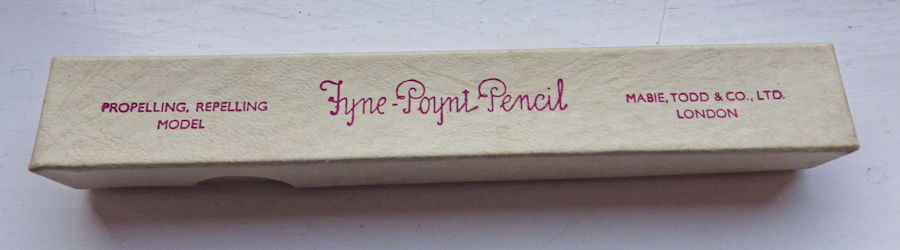
I was unaware until recently that there were matching pencils. This bright blue one matches the 5275. Though the original box is retained, showing that it was purchased on its own, there may have been pen and pencil sets. Though it remains in generally good condition the pencil appears to have been well used.

I’m rather out of touch with what children use in schools these days. Probably not mechanical pencils. My husband says that when he was in school in the 50s, most school work was done in pencil, in his case the wooden kind though some children did use mechanical pencils. It was only major essays in a special workbook that were written in ink.

Because I have an interest in them I have a few modern mechanical pencils and many vintage ones, mostly Fyne Poynts. I don’t see mechanical pencils being used generally today. Many pen sets offer a fountain pen and a ballpoint. It seems that there is no great demand for sets with mechanical pencils. Just a glance at eBay, though, will show that once they were bought in huge numbers and most of them that have come my way bear evidence of considerable use. Mechanical pencils may be somewhat specialist now but it was not always so.
Summit S125

First, I have had several new subscibers recently.  Welcome to them and I hope they will find what they are looking for here.

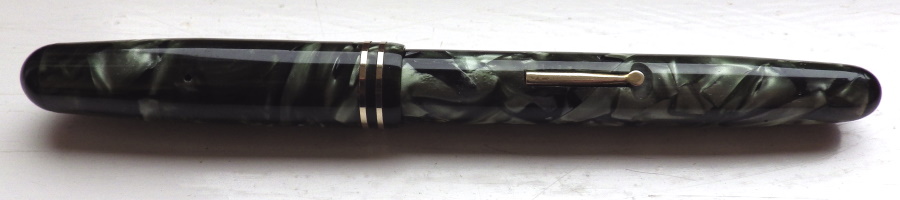
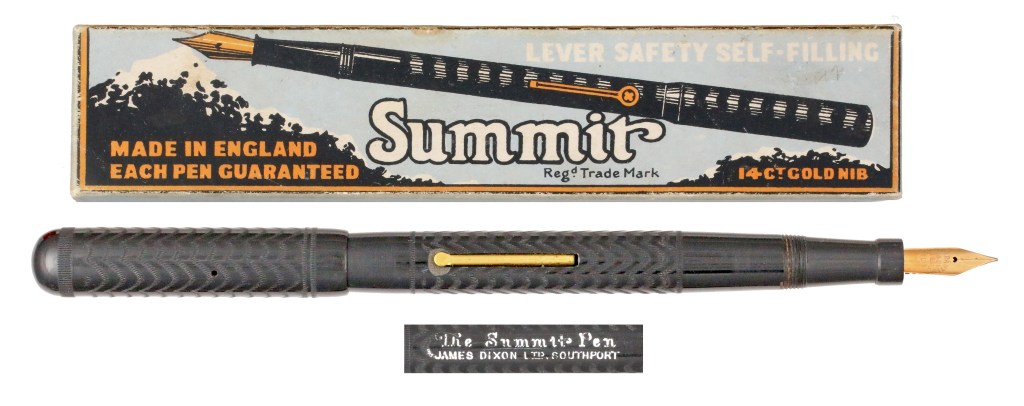
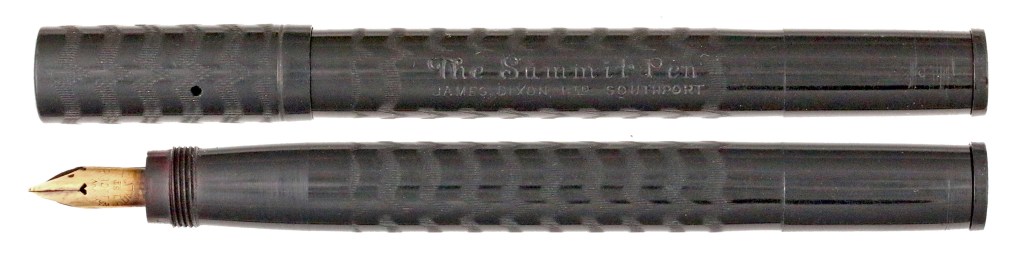
I enjoy colourful pens and complicated filling systems but sometimes simplicity is enough. This Summit S125 is a case in point. It’s a straightforward lever filler in black chased celluloid, not without elegance and dignity but a pen of no pretensions.

It probably dates to the late thirties and it does show some signs of extended use. The clip is absolutely devoid of its original gold plating and it is patchy on the slender cap ring. The chasing has held up well. It’s still sharp and it catches the light as the pen is moved. The straight lever has kept most of its gold. The gold nib is stamped “Summit.” It delivers ink faultlessly and, unusually for a Summit, is semiflexible.

Summits are great pens, made by Langs to the highest quality. The S125 is in the middle of the range, a sound but inexpensive pen that would be the choice of many who needed long-lasting reliability.

There is a general resemblance between Summits, Mentmore Auto-flows, Stephens pens and Croxleys, to name a few. Two of these were made by Langs, of course, and a third had a relationship with that company. These pens were made in a very similar way with a washer clip held by a large clip screw and a barrel that tapers slightly to a flat end. Such a pen is instantly recognisable as a British fountain pen and it could not be confused with pens from Germany, France or the USA. It’s the standard British pen.

With the exception of a few perceptive collectors of my acquaintance Summits do not seem to be greatly sought after. That surprises me. They come in colourful patterns, have enough variety to make an interesting collection and are great writers. Perhaps they are the sleepers in the vintage pen market.

Lapis Lazuli Duofold

From the first time I saw one – a very, very long time ago – I have always loved the Duofold. It’s probably the most copied pen ever, even more than the Parker 51. Its huge influence carries on to the present day.

Much as I love the Duofold I couldn’t use one in those days because I always wrote with a flexible nib and Duofolds are not noted for flexibility. I know there are some that will produce a little line variation but most are nails.

Times change and so did I. I decided to try firm nibs and I have never looked back. I love a nail. Duofolds became right up my street and I have had one ever since, a beautiful black firm fine that is a treat to use.

Is there a best vintage Duofold? Best in shape, best in colour? Silly question really. We all have our favourites and mine is the original, the 1st version that was produced from 1921 to 1928. The only major differences in that period were the shift from hard rubber to Dupont’s Permanite and the change from a single medium cap band to two slender ones.

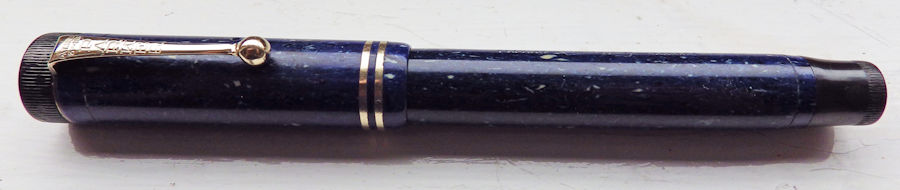
Which is the point where this pen comes in, a 1927 or 1928 Lapis Lazuli two-ring Duofold. Such a splendid thing, perhaps the answer to my earlier question. For me, this is the best Duofold. The mineral Lapis Lazuli has been well known since antiquity, used for carving and crushed to produce blue paint. It was an obvious choice for pen manufacturers once it became clear that celluloid could be made in such colours. Parker made two versions of its Lapis Lazuli, one being white on blue, the other pale blue on dark blue. I believe this one is the earlier white on blue.

An Aristokrat

Fountain pens were big business for more than a century and still manage to continue at a greatly reduced rate. Many fortunes were made and, more importantly, hundreds of thousands of people were employed in skilled trades. Incalculable numbers of manufacturers made pens. Various lists have been made of all the pen manufacturers there have ever been. Those lists will never be completed. Interesting smaller pen makers keep turning up.

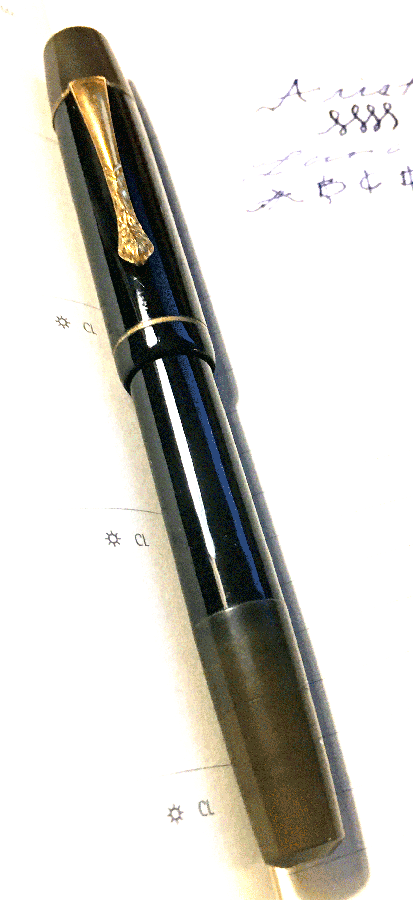
This elegant pen is an Aristokrat. No-one seems to know very much about this company, even among German pen enthusiasts – it is undoubtedly German. Some say Aristokrat has some relationship with Soennecken, others say that this is untrue. The company seems to have been based in Fuerth, near Nuremberg. Hard rubber and celluloid – and maybe moulded plastic – pens continued to be made until as late as the sixties.

On this pen and some of the other Aristokrats I have seen, the highly decorative clip stands out. Some Aristokrat nibs bear an eagle image. Quite rare and poorly documented, the Aristokrat remains a mystery for now. Who knows – someone may come along with a history for this independent German manufacturer one of these days.

Thanks to Scott Paden for photographs.

The De La Rue Pen

Today I have a lovely small De La Rue Pen. For those of you who may have forgotten, De La Rue was (and is!) a large company which makes most of its money from specialised printing. From our point of view their claim to fame is the Onoto, both plunger and lever filled, and the De La Rue Pen which is always lever filled.

What’s the difference between, say, a lever-filled Onoto and a De La Rue Pen? Clearly, the latter is the “Junior,” but in terms of quality I see no difference. This pen is remarkably well designed and well executed. It has no clip, never had one. The parts all fit together very well and the pen looks almost new. It has a warranted 14 carat gold nib but this is no ordinary warranted nib. They are usually anonymous and not always of the best quality. This one is a 33 by TDLR & Co – Thomas De La Rue – and it is a splendid nib, every bit as good as the equivalent Onoto. There is some line variation and the nib is soft and springy.

The pen is 12.7 cm capped. The two cap bands stand a little proud, like those on US Duofolds. I estimate it to have been made in the very late 30s or 40s.

The TWSBI

I’ve never understood the fuss about the TWSBI. To me it’s just another Far Eastern pen, by no means the best of them. I’m told that it has a section to itself on Fountain Pen Network, but there are few things that surprise me about FPN. There are a great many reports about various TWSBIs developing cracks and even falling apart altogether. Probably better off with a Wing Sung, Pen BBS or Moonman, all of which seem to be more robust.

I had one briefly. It was supposed to be flexible but wasn’t. Perhaps that’s unjust. After all, you could flex a cold chisel if you can apply enough force. I sold it on, probably just in time before it collapsed into a pile of its component parts.

Perhaps you’re seething with rage by this time at the dreadful calumny I am inflicting on your favourite pen. You believe I am entirely wrong. Okay, convince me!