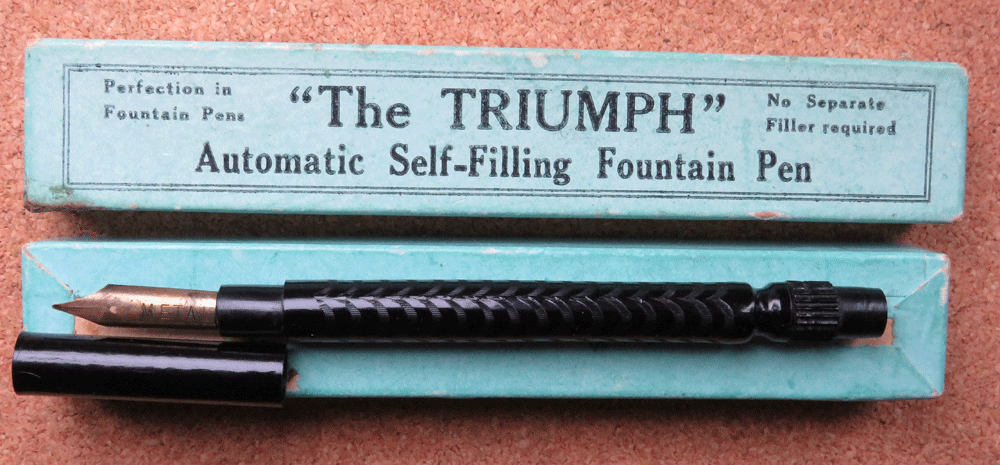
The Triumph Automatic Filler

I thought I had written about these weird and wonderful pens before but when Mario Kaouklis showed me his excellent picture I searched the blog and there was nothing. I remember discussing such pens on one of the boards, probably Lion and Pen of fond memory, many years ago.

Andy Russell kindly reminded me of these pens and put them in context. They are decidedly old, an attempt at a self-filler in the early years of last century when everything else was eyedropper fillers.

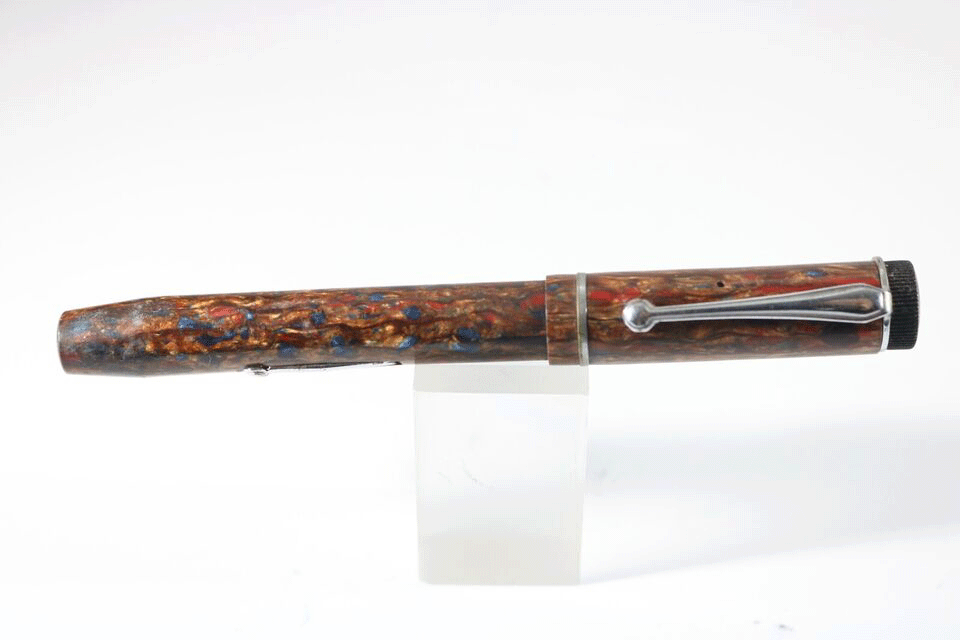
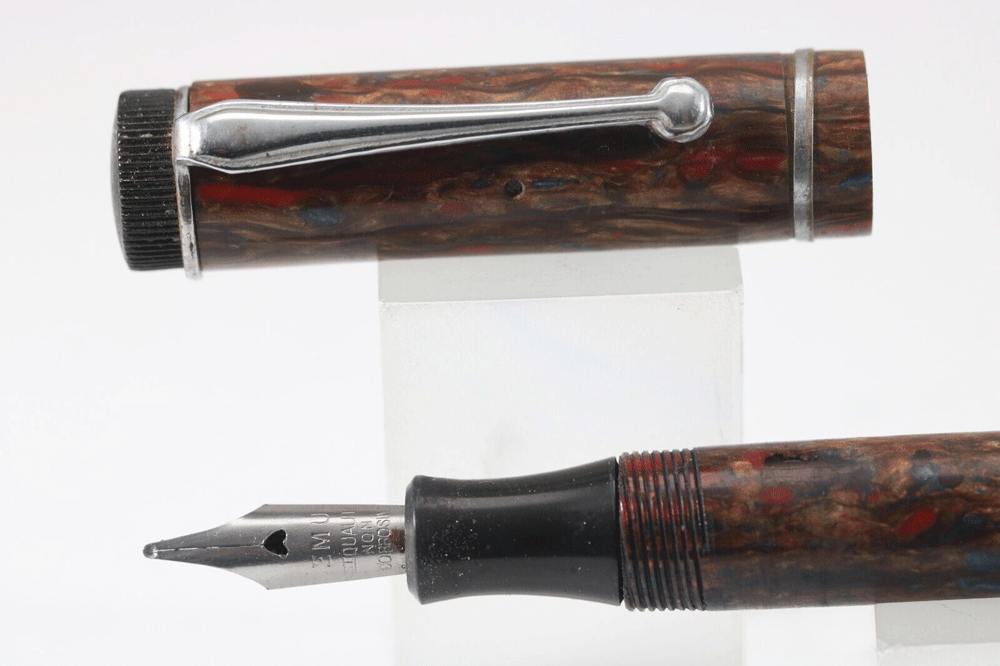
The pen appeared as the Victoria or, as this one, Triumph. A later, similar pen was the Manos from Austria. I think it is fair to say that these pens are assisted dip pens rather than true fountain pens. They don’t come apart for servicing but the one I had long ago was persuaded to give up its secrets. There is a piston with cork seal which draws up the ink. The ink isn’t then delivered to the page by capillary action as in a later piston pen; one must twist the knob periodically to release ink. I think the difficulty is caused by the poor design of the feed. In most, nowadays, the seal has perished and they draw very little ink.  Their main attraction was that they were cheap. In 1904 the pen fitted with a gilt nib cost 3/- and 5/6 for a gold one.

My one appeared to have an original nib, once gold plated, a truly dreadful thing, but it appears that any nib could be fitted. The Stationer Printer and Fancy Trades Register gave the Victoria a tremendous boost in 1904. I believe they sold well. While uncommon, these pens turn up not infrequently, suggesting that they must once have been plentiful.

Thanks to Mario and Andy.
The Altura Two-In-One

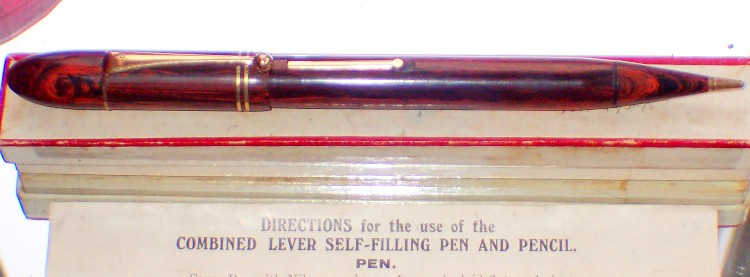
Here’s another Altura combo. I can’t add a precise date but it’s undoubtedly later than the other and pre-war. It’s a rather more standard combo than the earlier one but elegant in its curving lines and mid-cap clip. The latter is something that De La Rue often used in their pens and it isn’t entirely surprising to discover that there was a close relationship between Altura and De La Rue.

Thanks to Andy Russell for the picture.

A Handsome Platignum

Platignums don’t always have the best reputation. They were built to a low price and sold in their many thousands. Now and then, though, an exceptional Platignum happens along.

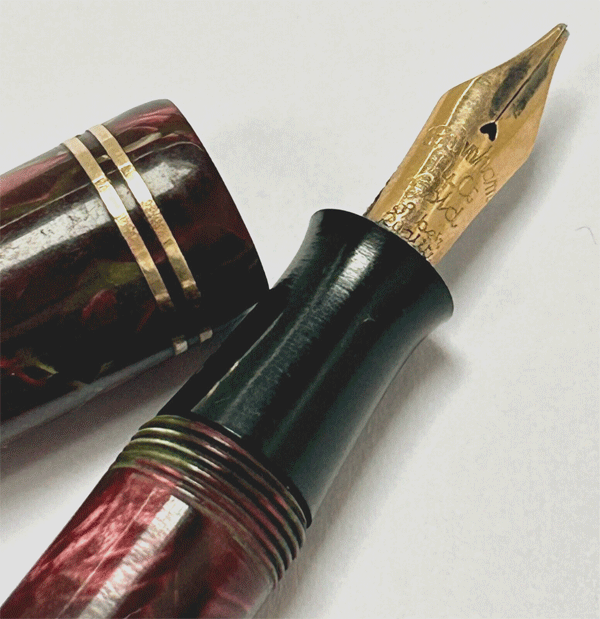
Platignum had a wide and wonderful choice of plastics and this is a very attractive one. The nib looks original and in good condition which suggests little use, I can’t easily date this pen but I would guess at pre-war and it carries a debt of gratitude to the Parker Duofold so it must be after that appeared. I’m sure someone will put me right on that.

Though I concentrated on gold nib pens when I restored and sold, many Platignums came my way when I bought job lots of pens. Most were not worth restoring as they would sell for very little if at all. However the exceptions, like this beauty, will attract attention and should fetch a good price.

I came across both British and American collectors of Platignums. The US buyers often went for pen and pencil sets whereas the UK collectors were more likely to buy an individual pen like this.

eBay remains one of the best places to find individual pens. While it might seem I am providing a service to eBay sellers, the reverse is true. In giving me permission to use their photos and talk about their pens they are a great help to me. My thanks to Ross of Rossco’s Pens for permission to use his sale and photos. His auction can be found at https://rb.gy/hgldam The pen needs restoration but with lever fillers this is a simple matter.

A Glitch?

A quick post to say that a reader has reported a glitch which appears in emailed blog posts. After each period, the program inserts a hyperlink with the first word of the next sentence- the hyperlinks lead to a 404 page.

Is anyone else having this problem? I can only check the blog posts in different browsers and I don’t see it happening there, but I don’t see the emailed version of blog posts.

An Altura Combo

My thanks to Andy Russell for these photographs and the information on this combination fountain pen and pencil. 

PAT. NO. 508607 MADE IN ENG BY
WEDEKIND’S.50 BAKER ST.WEYBRIDGE.SURREY.ENG

Despite what the above imprint says it was made by Altura for Wedekind, who made souvenir and advertising items. It is precisely machined in the beautiful mottled hard rubber. The pencil, unusually, is made to hold a thick graphite lead or crayon, such as might be used by an artist. The lead is retained by a superbly-made collet fixing turned in the same mottled vulcanite. The end of the cap holds a sharpener.

This combo was introduced almost on the outbreak of World War II. Wartime limitation of production of fountain pens meant that it was only made for a few months and for that reason is likely to be rare.

The clip, held on by a thick metal washer, has been broken off. It would be good to know what the original clip looked like. Has anyone a photo?

Blog Statistics

WordPress sent me an email listing the annual statistics of this blog. There were an incredible 45,288 visits in the course of 2023! At first I thought it had to be a mistake but after I reviewed a few of the previous months’ statistics I am satisfied that it is accurate. 

Many of those visits are to the work I did in the early years; to articles about individual manufacturers or about methods of repair and restoration. 

I wrote only 30 articles in 2023, pretty poor by any standard. I intend to do better in 2024. My only excuse is that I am enjoying my well-earned retirement. Many of my recent articles have been discursive; about writing styles and the use of the dip pen.

With regard to the latter though the dip pen isn’t a fountain pen it is an honourable predecessor. The immense variety of nibs makes it fascinating. Though some of those nibs are available in fountain pen form, others are not.

Getting back to fountain pens, as I plan to do, I will be on the look-out for the rare and unusual and any subjects I haven’t already covered. The almost incredible statistics are so inspirational and I will build on that next year.

May 2024 be a kind year to all of you.

Burnham and Casein

When I was buying and selling fountain pens, first in eBay and later from my own sales site (now closed) I avoided these colourful post-war post-war Burnhams. I was right to do so; many are subject to casein rot and the photographs weren’t always good enough to tell which were the good ones..

However, it meant that I missed out on such beauties as this one. Post-war Burnham patterns are absolutely unequalled. It is something of a paradox that Burnham’s casein was more attractive than anyone else’s, even Conway Stewart’s, while being much less stable. Burnham and Conway Stewart were the only major UK users of casein. The other large manufacturers gave up on it despite the wonderful colours it is capable of because of its instability.

The damage that damp and temperature change can cause to casein is not superficial. It penetrates the entire piece and is irreversible. That, one might think, would have been enough for all pen makers to reject it, but not so. The casein that Conway Stewart used both before and after World War II is considerably more stable. This may have been a matter of better curing or it might have been due to a difference in manufacture.

I believe that casein rot may be infectious. I was once given a box of around twenty-five casein Burnhams. Most parts were crazed though one or two caps and barrels were not. As there wasn’t a complete pen among them I set them aside. Later the parts that had been in good condition had become crazed and fragmented like the rest despite being kept dry in a place that had an even temperature.

I would like to emphasise that the pen illustrated is absolutely clear of the problem and is a real gem, one of the more expensive Burnhams of the period, with a splendid 14ct gold nib and neat cap rings. Pens like this are among the very best of post-war British production.

I am grateful to alsretro for permission to use the eBay photographs of his lovely pen to illustrate my article. https://shorturl.at/jlJUY will bring you to his auction.

Dip Pen Handles

Several years ago I bought an old wooden pencil-case with delightful imagery on the lid. It contained the pens and pencils that had been used by its schoolgirl owner long ago; probably in the nineteen-thirties.

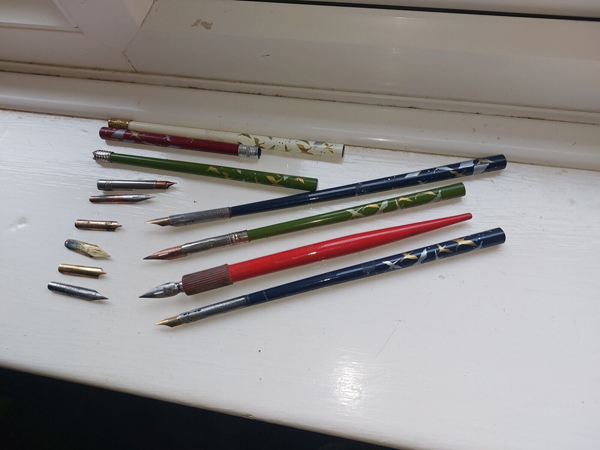
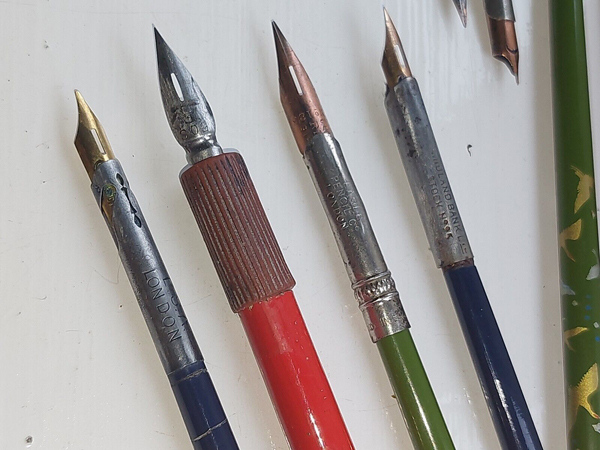
The handle of her dip pen is very slender, too thin for me to use comfortably. I use a thicker handle. These images from soscandalous’s eBay sale show both styles. I thank Shell for permission to use her photos.

That looks like an excellent lot to me; the red one would suit my hand quite well. Obviously I don’t know what the final price will be when bidding gets under way. I hope she does well.

In general dip pens and nibs – especially nibs – have become quite expensive in recent times. A quite ordinary unopened box of nibs will be offered for £25-£30 in eBay these days. I’m thankful that I got a couple of boxes much cheaper some time ago. I also have a box of miscellaneous nibs sent to me by generous friends.

I write with a dip pen quite a lot now as my correspondents will know, usually using either relief or stub nibs. I love how it enhances the appearance of my writing.

To get back to dip pen handles, my husband tells me that when he was introduced to them in school (a remarkably long time ago – would you believe 1957?) the handles his class was given were of the very thin type. It is possible to find thick handles that are obviously quite old, so why were beginners given those thin little sticks that are so hard to manipulate? Any ideas? Of course use of very thin handles was not restricted to novices. They were in every office and offered for use in banks. I suppose once you had gone through the difficult learning process of using those things as a child, they had no fears for the adult. I didn’t learn using them and my hand is quite sore after a couple of paragraphs with one. That’s why I have a selection of nicely tapered thicker handles.

Nibs

I think that’s enough about calligraphy, for the moment at least. I want to talk about nib types in all their variety. My usual nib is a firm fine. That’s what enables me to dash across the page in a way that no other nib can do. I don’t restrict myself to fines though. If I’m writing on large paper, A4 or its predecessors, I like to use a larger nib. Not a broad – I can’t use them, but a wet medium or a sharp, medium italic. I wish I could use a flexible nib but I can’t make much of them. They slow me down, for one thing and I am unable to create the elegance that others do with flex.

There are other nibs that have a special purpose: obliques for those who rotate the pen (or just like to use obliques), music nibs, architect-cut nibs and probably a few others. I came very late to dip pens but they have opened a world of nibs to me. Just for writing I like the Esterbrook Relief or William Mitchell Pedigree Round Hand Pen but there are so many other shapes and types to explore.

At one time, when inks were more caustic than they are now, your fountain pen had to have a gold nib if it was to last. I’ve seen the sad ruins of pre-war steel nibs. Better ink and better metal has improved that situation and a quality steel nib is as good as any gold one now. Fine Japanese steel nibs are as good as it gets.

I’m no expert in The Wonderful World of Nibs. I’m sure that many of you will be more informative.