Nib Types

Here’s a thought. I have them occasionally. Why is it that Mabie Todd and to a lesser extent De La Rue have greater variety of nibs than all the other manufacturers combined? We know and accept that this is so, but why? Conway Stewarts are mostly fine, medium or broad, yet I have seen Conway Stewart advertising showing a large range of nib types. It is true that once in a while you will come across a stub or oblique Conway Stewart nib but they are decidedly uncommon.

Similarly, Mabie Todd advertises the huge range of nib types that they offer. The difference is that you can find them in the field, and in appreciable numbers, too. Can it be that if you are the discerning type and not satisfied with a medium or a fine, you naturally think of Swan?

Or is it the other way around, that Mabie Todd’s advertising penetrates the market so well that if you want a stub the fine array of nibs that they show comes immediately to mind? As an aside, in a closely related subject, most by far of the Summits and Mentmores that come my way are mediums. Stephens seem to have provided their pens with a lot of broad nibs. I’m writing this with an early 30s Conway Stewart and yes, it’s a medium and a very good one.

I can understand why medium was the most popular size. It lays down enough ink on the paper to be easily read without going to the excess of broad. In some hands the use of a fine tends to become rather spidery.

The Post-War Conway Stewart Dinkie 550

The post-war Dinkie 550 sets are something of a mystery to me – they are not the most practical of pens but they sold in enormous numbers. It wouldn’t be too wide of the mark to say that sales of Dinkies went a great way towards keeping the company profitable during the difficult years of the 50s and 60s. There are always sets and individual pens available in eBay and elsewhere, sometimes in quantity.

Their quality and beauty are not at issue and it isn’t quite true to say that Dinkies are wholly impractical as writing instruments. Just to assure myself that it could be done, I wrote two sides of A4 with one. Because the pen is so small it became uncomfortable quite quickly. I’m not one of those who insists that their pens must have the dimensions of a hammer handle – I like my slender 80s Japanese pens and my Swan 3160, but it became difficult with the Dinkie even for me. I can’t imagine that it can have been any less difficult when the pens were in the hands of their first owners.

That being the case, why did the Dinkie sets still sell so well? I suspect that the target was different from the end user. Husbands, brothers and fathers bought them as presents. Most of the recipients didn’t use them, hence the great numbers of sets in pristine condition today. I’m not saying they were never used but mostly they were tucked away in a drawer and the lady went back to her more practical pen.

Conway Stewarts are not an area that I concentrate on now but I’m happy to see the arrival of a good Dinkie set. They sell well as collectors’ items. The post-war ones which are under discussion here, appear in different models and patterns and a considerable collection can be built up of post-war Dinkies alone.

Wandering off the subject a little, the pre-war sets or individual pens are even more collectible and therefore more expensive. Many of the very colourful casein pens of the 30s are very attractive and quite rare now. A bit out of my league.

The Joys of Shipping

As some of you may be aware I opened the sales website a few weeks ago. All is going well, though shipping is still a concern in some places. I am aware that others have had difficulties with Italian deliveries but I haven’t had any trouble there. Australia and New Zealand are still taking longer than usual. The US is averaging around ten days which is back to normal.

Unexpectedly, Holland is my biggest problem at the moment. One item was sent almost a fortnight ago and the tracking failed as soon as it arrived in the Netherlands. Very worrying. Royal Mail will take no action until a month has passed.

I would like to reassure customers and potential customers that should the pen you have ordered go astray I will refund you in full while I make a claim on Royal Mail. That’s not so easy as it once was. Despite happily accepting a premium for insurance, they quibble and argue over payment. But that’s my problem not the customer’s.

It’s also worth saying that it has been a long time since a pen vanished and was not delivered. Indeed, in the many years I’ve been trading, perhaps five pens have been lost, three of them in one package that never got beyond Inverness, many years ago.

Leaving money aside, the loss of a pen in transit is upsetting for everyone concerned. The customer may well have set his or her heart on getting the pen they have carefully selected. I have worked on all those pens and while it would be an exaggeration to compare them to sending my children out into the world, I like to know that they are received and enjoyed.

Of course we are waiting for the outcome of the Brexit negotiations. Will our pens be subject to Customs charges in Europe in future? I profoundly hope not but the government has issued new export stickers. Is that a straw in the wind? Of course the new ones demand more information to be filled in than the old ones. Bureaucrats! It was never going to be less!

Mabie Todd Swan 3172

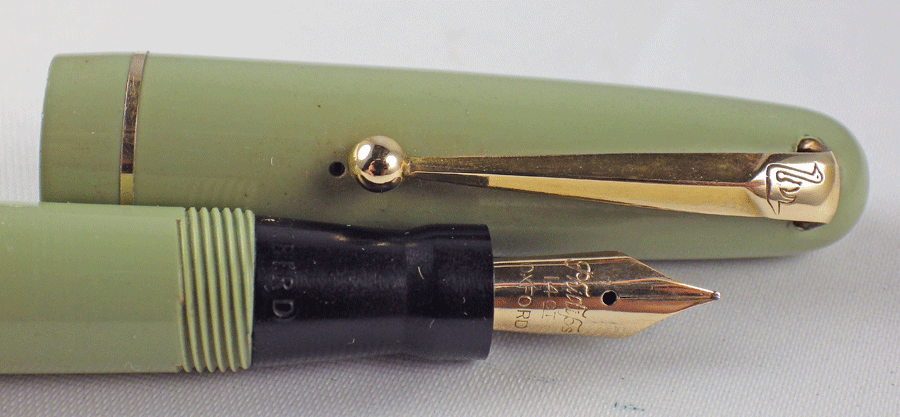
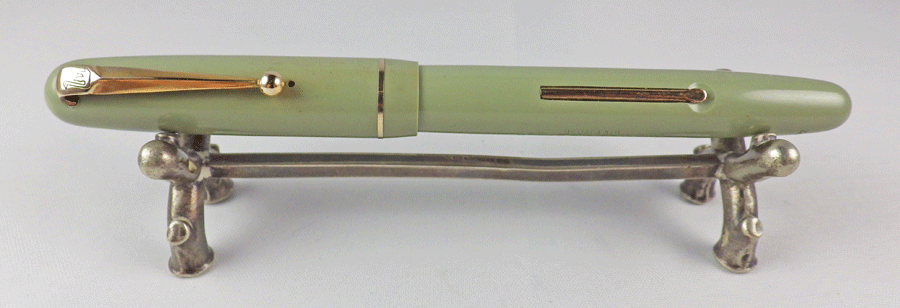
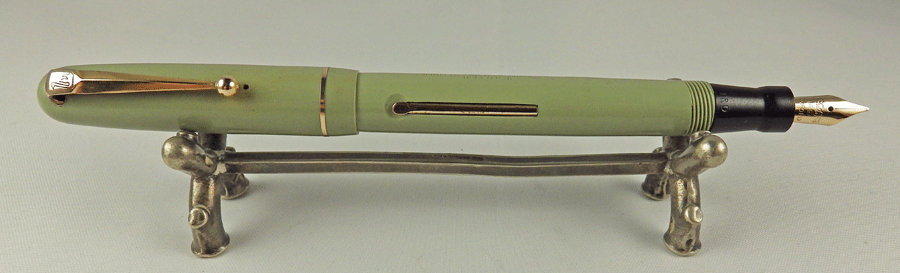
The 3172 is among the least common of Swan’s 1950s pens. It’s a delightful colour and for once the description of the colour is accurate: pastel green.

Why did this pen not sell well? One must remember that the 50s was the decade of denial of colour – black suits or black morning coats with grey pinstriped trousers. Black pens of course. A man seen wearing pink in those days would have caused a riot and a pale green pen would have caused its owner to be viewed askance.

Enough with the 50s fashion, and on to the pen itself. It’s the same as all the other No. 1 nib torpedo pens apart from its delicate, pleasant colour. I’ve had one or two of these pastel green pens before and it seems that they hold their colour well, unlike the greys which can fade with a yellow tinge.

The pen has a firm Phillips nib. This is correct and may be either original or a replacement. Phillips of Oxford took over repair of Mabie Todd pens and ultimately received unassembled stock which they put together with their own-stamped nibs.

A lovely small pen, not suitable for the flex brigade but a very nice writer and of interest to the collector.

Posting

On the subject of posting there are four questions: do you ever post? Do you never post? Do you sometimes post? If so, when do you choose to post or not?

I never post. I used to but I found it unwieldy with bigger pens. I gradually gave it up with smaller pens, too. If there is nowhere secure to set the cap I hold it in my other hand.

There are people with expensive new pens who do not post because it will mark the barrel. This is correct; it assuredly will. Part of the reason I don’t post is similar. Most of my own pens are vintage and several models are subject to cracking of the thin cap lip, which can arise from posting too forcefully. That isn’t the main reason for cap lip damage but it’s worth avoiding.

Another reason is balance. I have never written with a posted full-size Duofold, as an example, because it would be uncomfortably back heavy. Through time, I suppose I developed some form of muscle memory about pen balance and now I wouldn’t be comfortable posting even a small pen like a Swan 3160.

There are a few pens I am aware of that were designed to be posted. 1920s and 1930s cheap hard rubber pens were often threaded on the back of the barrel to accept the cap. Conway Stewart’s cheapest pen of the era also had threading on the back of the barrel. I believe it was a pen intended to be bought cheaply in quantity by employers, a forerunner of the Crystal Bic. If I had one I wouldn’t post those pens either. There may be other pens configured in this way of which I am unaware.

For years I have seen discussions on this subject with people posting opposing reasons for posting or not posting. They seem to me to be good reasons but neither are decisive. There’s no real deal-breaker in the world of posting. If you like to post, you post; if you don’t, you don’t. Or maybe you just say the hell with it all and buy a Pilot Capless.

The Mystery Conway Stewart

Thanks to all those who tried to guess which pen was illustrated. Chris J is the winner. He guessed that the pen was a Conway Stewart 205. Several people were so very near!

The pen is not illustrated in Stephen Hull’s book. I think most people were consulting the late Jonathan Donahaye’s wonderful listings but he only shows an earlier, flat-top version. The one place no-one thought to look is in my blog. A Conway Stewart search of the blog would have taken you right to it! I wrote about this excellent writer some years ago.

Congratulations to Chris J for his detective work!

Which Conway Stewart?

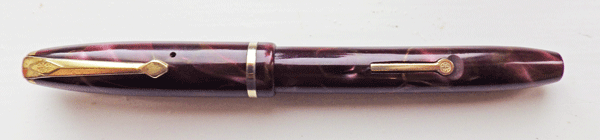
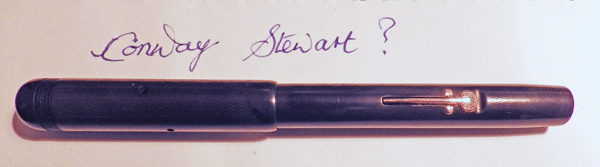
This is an old Conway Stewart and a good ‘un, part of my own collection of very good writers. A very sculptural section there!

A pen bearing this number was available from very early in the company’s production and changed a little over the years. This is the early thirties version. Conway Stewarts got more colourful after this but I don’t think they got better. This is a splendid pen.

It once had quite deep chasing but it has gone almost entirely from the barrel and is shallow on the cap. That’s hard rubber, as I said my last post.

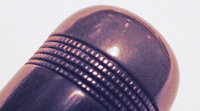
Beautiful knurling on the top of the cap. The only pen I have with better knurling is my Ford. But anyway, what number Conway Stewart is this? If the correct answer comes from the UK I’ll send you a good (but not expensive) modern pen. If the correct guess comes from overseas you’ll have my profound gratitude and admiration for your knowledge of British pens (it’s the cost of the shipping)

Hard Rubber

Ebonite, hard rubber, whatever you want to call it, was the first material used for fountain pens. It is light and warm to the touch making it comfortable in the hand. Though none of the larger modern companies use hard rubber much if at all, Indian manufacturers use it creatively.

It is said by some that the main reason celluloid became so popular is because hard rubber is brittle. I don’t find that to be true. Red hard rubber and the various varieties of mottled hard rubber are more brittle than black hard rubber, but I’m not sure that any of them are more brittle than celluloid itself. Where the material is thin, as in the cap lip, hard rubber, celluloid or the plastic that Aerometric Parker Duofolds were made from, all have a tendency to crack. Those pens that have a tendency to mysteriously crack in thicker, unstressed areas are often celluloid.

No, I think the real reason celluloid caught on right away was because it could be made in so many colours, and with such depth of colour. Though some highly decorative pens were made in hard rubber like the Wahl Eversharp wood grains and the various Waterman ripples, there was a limit to the colours and patterns that could be produced. They tended to lose their shine quickly, and with the shine went the little depth they had once had. Celluloid is harder and retains its shine well. Chasing in celluloid does not wear as quickly as it does in hard rubber.

All the major companies made pens in black hard rubber and all faded quite quickly. The mystery is that there is a group of 1920s British pens in black hard rubber that never fade. Was there a cheaper version of black hard rubber that only incidentally had the property of holding its colour and shine which only became clear years later?

In the US Waterman and Wahl Eversharp persisted with hard rubber long after Parker and Sheaffer moved to celluloid, but eventually even they made the switch. There was a period when no gold-nib pen maker used hard rubber. Celluloid, casein and some other, less definable plastics ruled the roost. During World War Two, Mabie Todd returned to black hard rubber. No one knows why. Did they have unused stocks of the material that reduced manufacturing costs? It was clearly the case that the colour black was very popular in 40s and 50s Britain, and perhaps that made the return to black hard rubber easier. In any case, many pens were made of that material and those that have not faded too much are handsome and comfortable pens.