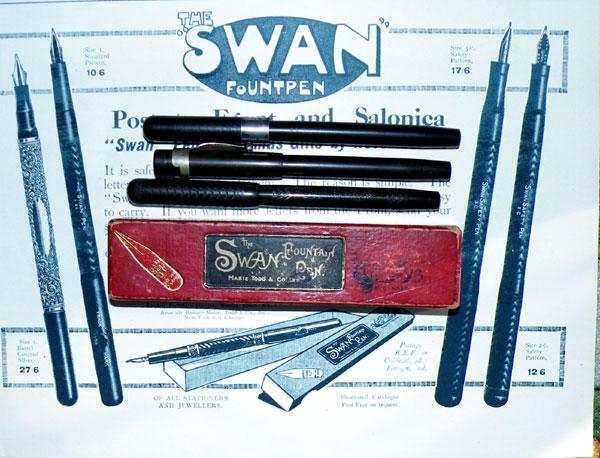
A 1915 Swan Advertisement

When we think of World War I, we tend to envisage the vast killing fields of France and Belgium where a generation was thrown away in futility, but there were other theatres of war. I stupidly covered up the advertisement’s headline, but it is, “Post to Egypt and Salonica “Swan” pens as Christmas gifts by November 27”. Though the ad is not dated, both the Egyptian campaign, to protect the Suez Canal from the Turks and the expedition to Salonica (now Thessalonika) to help the Serbs against the Bulgarians began in 1915. In 1915, then, you could buy a Swan 1500 for ten shillings and sixpence. Nowadays, good examples can change hands for in excess of £150.

I’m unfamiliar with the pen illustrated on the far left but it appears to be a shorter version of the 1500 with a sterling silver overlay. The two pens depicted on the right are Swan Safety Screw Caps, one with a No2 nib, the other with a No 3.

I’ve included a contemporary box, two versions of the Swan Safety Screw Cap No2 and a 1500.

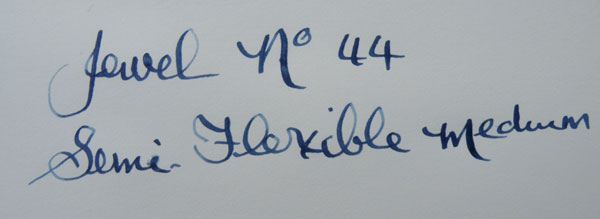
The Jewel No 44

I could have sworn I wrote about the Jewel Pen Co. Ltd before, but looking through the blog it seems not.

Jewel is one of the oldest British pen companies. It was founded in 1884 by John Calton as an import company for John Holland pens and Mackinnon stylos. As John Holland produced “Jewel” pens in America this is where the name doubtless came from. Within a few years the company was making its own stylos and fountain pens. Neither a great innovator nor a market leader, Jewel nevertheless kept up a steady stream of profitability until 1939, when it was bought by British Pens Ltd. It continued in a semi-autonomous fashion bringing out the occasional new model but declining in market share until 1951, when Jewel closed down.

They were an interesting company that produced a wide range of pens. Probably the biggest outsize pen I’ve had was a Jewel, and I had a tiny, Dinkie-sized pen as well. They covered the whole range of cost, too, from quite rudimentary steel-nibbed school pens like the Ritewell, to very handsome jade and lapis lazuli lever-fillers like the Nos 63 and 83. Like Macniven & Cameron in that respect, Jewel defies the simple-minded classifiers to assign it to a “tier”.


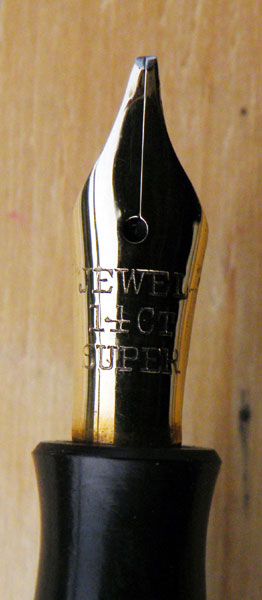
This is a No44, made during the Second World War. Made in black hard rubber with gold-plated trim, it’s not an exceptional pen in any way but it is well made and the plating has survived in excellent condition.


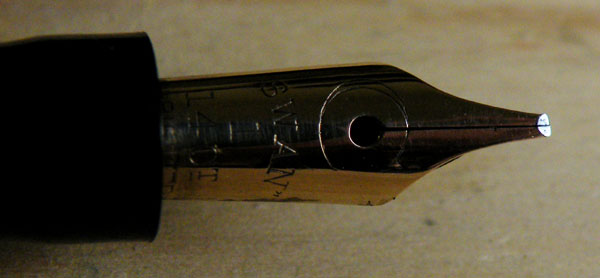
The “Jewel 14ct Super” nib is semi-flexible and somewhat stubbish. In general shape, the pen is quite similar to a pre-war Swan, an impression enhanced by the inserted clip.


Perhaps not the last pen to be made by Jewel, but very close to it, the No 44 shows that the company was capable of turning out a very acceptable pen to the end.

A Conway Stewart 286 Stub

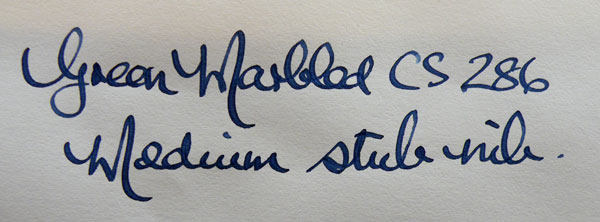
An ordinary, if rather pretty, Conway Stewart 286, you might think, but not quite. This one’s that rare thing, a Conway Stewart stub.

It’s a beauty, rigid, wide and giving easy line variation while it lays down a lot of ink.

Basing it on what passes over my bench, Conway Stewart made far less obliques, stubs and flexes than, say, Swan, but they could make a good one when they chose. The Conway Stewart approach to the stub is almost as if the tines were chopped off and the tipping material applied. Swan, when making a stub, used a high-shouldered nib with comparatively narrow tines, making a somewhat chisel-like shape at the nib-tip. This means that Swan stubs are often flexible whereas Conway Stewart ones are firm, or at least the ones I’ve handled are.

The Wind Of Change

I’ve started doing a couple of things I always avoided. Is that a gnomic enough start for you?

I’ve never used firm-nibbed pens all my adult life. In that distant time when I was a teenager I got hold of an old BCHR Onoto which I couldn’t repair but I could use as an eyedropper-filler. It was very flexible and that was the start of my life-long love-affair with such pens. Of course, I’m aware of how firm-nibbed pens behave. I test a few every week, but I’ve never really used one. It may be that by limiting myself in this way I’m missing out on something. There may be wonders of the consistent line that I have yet to experience.

The other thing, and you may have noticed this, is that I don’t do modern pens, and “modern” for me is anything after about 1965. It’s not that I haven’t tried. A few years ago, when they were the latest thing, I bought a Sheaffer Intrigue. It was a disappointment. The pen was as heavy as a similarly-sized lump of lead. It had a tricky filling system that allowed for the use of cartridges or a fixed converter. In the small size of the pen, this required the best of precision engineering. It didn’t get it; instead it was hacked together and it worked when it liked. At least it had a beautiful nib… which didn’t write on the upstrokes. It was a disgrace to the fine name of Sheaffer.

Some time after that I was foolishly attracted by a picture of a Laban Mento and I bought it. When I took it out of the crate-sized box I couldn’t believe how big it was, and the picture had done no justice to just how lurid the colours were. We called it the Clown Pen. I persisted in trying to write with it but it was like trying to write with a fence-post. It was a horribly bad starter too. Apparently the fix was to seal the inside of the cap with wax, but if you have to apply hacks like that to a new pen, it really is time the manufacturers gave themselves a good shake.

So I’ve stuck with pens that are my age or older, often quite a bit older. Until this week, that is, when I bought two new, firm-nibbed pens. Actually, I tell a lie. One is a Cross and it’s brand new. It was remarkably cheap because it is an advertising pen and it has a Ford logo on it and no-one wants a pen with a Ford logo. I can understand that but I’m not as fussy as some. The other’s a seventies pen, one of those cartridge-filler Sheaffers with the inlaid gold nib, the ones that immediately preceded the Targa, if I remember correctly. That may be an old pen to you but I regard such cartridge-filling cop-outs from a proper filling system as new.

In truth, I like them both. The Cross is purportedly a medium, but it’s a decidedly generous one. It worked straight out of the box, and worked well, something that I believe is pretty much regarded as a bona fide miracle in a new pen. The line it lays is nice and wet and my writing looks pretty bad. Oh well. I will persist. The Sheaffer has the same characteristics – newish and firm – but it feels very different, mostly due to that long inlaid nib changing the angle at which I write. It makes my writing equally atrocious but I avoid looking at it and I admire that beautiful nib instead.

To those of my customers who will be receiving this week’s pens around now and are looking at my covering letter with some worry and consternation: It’s OK. I haven’t had a stroke. I’m just trying out these rather different pens.

The Pitman’s Fono Deluxe

If you’ve come across a Pitman’s Fono pen you may have wondered about its strange name, and whether there is a connection with Sir Isaac Pitman, famous for several things but mostly for his system of shorthand which was adopted worldwide.

Indeed there is a link and it’s pretty direct. Sir Isaac was, for the most part, a publisher, though he took an interest in many matters of language and orthography. The publishing house he built up in the Victorian period, Sir Isaac Pitman & Sons Ltd, continued as the family business long after his death and remnants of it remain even today, subsumed within Longman Publishing, itself a part of Pearson Education.

A large part of the firm’s publishing was concerned with Pitman’s shorthand system and around 1930 the company began to make – or have made for them – pens which could be regarded as the best type to use for shorthand. The “fono” part of the name relates to Sir Isaac’s fonotypy, a rationalised method of spelling which he developed.

What of the pen itself? Well, it comes in several models with a very modest increase in trim between one and another. This one is the Deluxe version with a medium cap ring and rather good plating. The nib is warranted and semi-flexible. The pen sits well in the hand and is almost weightless, a feature much appreciated by those who wrote all day at work, though many people unaccountably prefer a heavy pen these days.

Though a very good pen, it isn’t really exceptional in any way. Pens like the Conway Stewart Scribe 330, issued around the same time, or some of the lower-priced Swans would have done the same job in the same way, and they probably claimed a bigger market share. Sales were evidently high enough for the pen to remain in production for a few years though and it is by no means a rare pen these days. In any given year around a dozen will appear in eBay and they’re well worth snapping up, both because they’re great writers and for their unusual history.

Plum Hatched Conway Stewart 28

Judging by the numbers that have survived the 28 and the slightly more expensive 27 were two of Conway Stewart’s most popular pens. Apart from the width of the cap band, they’re pretty near identical and come in the same colour patterns.

This is the burgundy or plum hatched variety of the 28. Plum seems more appropriate to me. The hatch is a beautiful pattern but the red versions are often faded by now. The visible areas look a little dull and there’s a sliver of the original brightness hiding under the cap. This one’s completely unfaded and presents the original glory of the pattern.

The 28 tends toward the long and slender. Perhaps not quite as much as the 85L (I don’t have one to compare at the moment) but more elegant-looking than, say, the stockier 85. It shows in the length of the clip as much as in the combined length of body and cap. To my eye the 85L looks a little stretched. I think the 28 has it just about right.

A Touch Of Luxury, Edwardian Style.

The year is 1911. The British Empire is at its peak. The country is enjoying the rising tide of Edwardian prosperity. God’s in his heaven and all’s well with the world. So what do you give the man who has everything? One of these new-fangled motorcars, perhaps – maybe a Daimler-Benz or a De Dion Bouton? No. You give him one of these.


Judging by the shape it’s a safety pen and it’s made by Mabie Todd & Bard for the princely sum of twelve guineas, or more if you want to go for an even higher specification. I think if ’twere me, I’d settle for this one. Solid gold, turquoise and diamonds is enough. More would be vulgar.

It’s pretty well impossible to calculate how much that would be in today’s serially devalued pounds and pennies, but it can be put in perspective by noting that the company’s cheapest writing instrument, the Cygnet No 2 Stylo, cost five shillings. For the price of one solid gold Swan with its turquoise and diamonds, you could buy fifty-seven stylos and still have change left over.

I have to concede, then, that ridiculously opulent pens were targeted at people of scant wisdom and poor taste even before the age of Krone and the Limited Editions. Still, at least it doesn’t have Swarovski Crystals or a fragment of the DNA of some luminary or other. For all I know, you may even have been able to write with it. I can’t say with any certainty, as this pen has not yet crossed my humble workbench.

Pens, Nibs And Points.

I was sitting here thinking (as I do, from time to time) about the varying nomenclature employed in defining that bit of our fountain pens which does the actual writing. In the comparatively long ago, that thing that we call a nib was a pen. To quote from my 1895 Lloyd’s Encyclopaedic Dictionary (6 vols),

“An instrument for writing by means of a fluid ink. Pens (from Lat. Penna, a feather) originally were made of the quills of large birds, but now quill-pens are comparatively little used, being superseded to a great extent by metal pens. The latter were first introduced for sale in 1803; they are made principally of steel, but other metals, as gold, silver, platinum, aluminium, &c are also used.”

No mention of nibs there, you’ll notice. Not a word that sprang to mind in 1895. Consulting the same source, however, indicates that it was around.

“A small pen adapted to be placed in a holder for use. The usual form of steel pens. Quill nibs are also similarly made and held for writing.”

So, it would seem that when “pen” is used for “nib” it shrinks from the whole quill down to the cut tip, whereas nib pretty much retains its original meaning, that is, the prepared writing tip. Nib seems more apposite, yes?

A term that I see bandied about with unfortunate frequency as a synonym of nib these days is point. Frankly, this one seems perverse, dug up from the cobwebby depths of the early twentieth century just to be different. In my 1895 dictionary approximately sixty disparate meanings for point are given; none of them refer to the writing tip of a pen. By 1911, however, Mabie Todd & Bard were using it in advertisements to denote the nib. Thereafter it sank from sight as a redundancy. It has never been in common parlance. If you ask the man in the street what a nib is, chances are good he’ll be able to answer you accurately. If asked about a pen he’d be in no doubt. It once more refers to the whole writing instrument. A point? It’s a thousand to one against that he would define it as a nib.

Let’s drop the geekery. A nib’s a nib. Or, as they say in eBay, a knib or a nip.

Mabie Todd Swan Calligraph 3170

I wrote about Calligraphs back here http://wp.me/p17T6K-bM. As I said back then, Calligraph can be a bit of a misnomer because so many of them are perfectly ordinary non-calligraphy pens. However, sometimes you come across one that lives up to the name and once in a while you come across a sort of strange Wondernib that does everything. How does Oblique Italic Flexible sound?

It’s a true italic, sharp-edged enough to dig into the paper. It is tipped, unlike some other italic nibs. It’s oblique and, quite unexpectedly, it has oodles of flexibility! I managed a cursive writing sample with it but it wasn’t a comfortable thing to do. It wanted to dig into the paper on the upstrokes, as any good italic should do. Flexibility in this configuration of nib feels really odd. I can’t imagine what writing style they had in mind for this nib but any calligrapher with a creative and innovative spirit would have the time of his life with it!

The pen model number is 3170, that is, lever filler with a No1 nib, colour code 70, which is one of those that I haven’t seen defined anywhere. I’ll say teal, for the moment, though I’m not entirely pleased with it. Cobalt comes to mind, but there’s a hint of green here that cobalt doesn’t have.  This is the first – lever-filler – type of Calligraph, by far the best version

A 1913 Swan Advertisement

Mabie Todd, it must be said, always produced stylish adverts. This is true, in fact of most early fountain pen promotional imagery; the commercial artist is often undervalued but he or she is a true artist. The area of work within which he practices is irrelevant except to those who imagine that the value of art is expressed in those grotesque sums of money thrown around at Sothebys or Christies as the obscenely wealthy vie at the pig trough of self-aggrandisement.
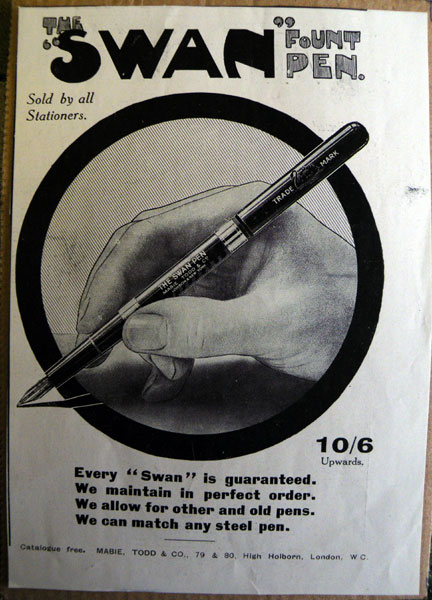
 

The heading is in that strangely arresting, bulging text that Swan used for a few years. It’s followed by a little message in italic: Sold by all Stationers. That doesn’t need to stand out. This is 1913 and Swan is king! You would know where to get one. Then there’s the price – 10/6 – in very bold text with underneath, not so noticeable: Upwards. I think the message is to concentrate on the 10/6 and ignore the fact that the model illustrated, with its two barrel bands, will likely cost a lot more.

Then, in a bold sans serif font, is the company’s main message, reassuring and accommodating. The language is a little obscure to us now. You’ll be pleased to know it’s guaranteed and can be kept in good order. Like Waterman, Swan will fit any nib you want, including your own. To order, prospective purchasers sent a steel nib that replicated the gold nib that they wanted – fine, medium, broad, stub, oblique – whatever the customer desired, Swan could produce. And finally, in small print at the bottom, the address to write to for a free catalogue. Would that I could get that catalogue now!

The ring around the hand concentrates the eye wonderfully. The hand is behind the ring, the pen before it. Though impossible and a little Escher-like, this makes the pen the centre of your attention, and it is drawn in much greater detail than the sketchily-drawn hand. The pen breaks the “frame” of the circle in two places, and its shadow does so in a third. This play with the concept of space harks back to the Post-Impressionists’ borrowings from Japanese prints a generation earlier.

I’m sure some among you can put me right if I’m wrong, but I believe the term “fountpen” was only used by Mabie Todd, though on both sides of the Atlantic. I don’t think it means anything in the sense of specifying a particular sort of pen; it’s just a catchy term that stuck around for a while then faded away.
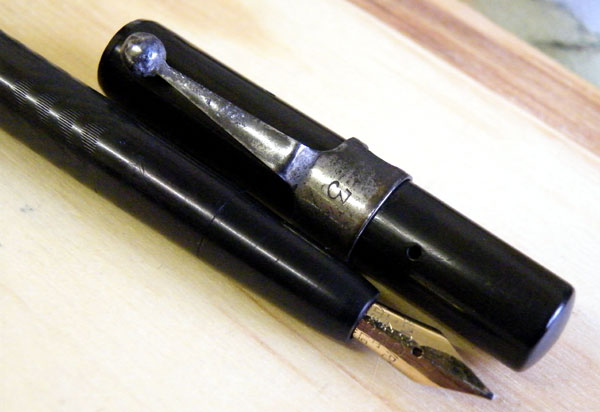
 

I’ve yet to own a Swan Fountpen, but I have had a Blackbird one. The Blackbird Fountpen eyedropper filler appeared in 1921 and had no more than a superficial resemblance to its older Swan sibling. Gone is the over-and under feed, replaced by the spoon feed that Mabie Todd experimented with for a while before settling for their ladder feed. The high dome of the Swan has become a very shallow one, almost a flat-top.


Very slender, the pen is long at 17cm posted, but so light that it balances well in the hand. These pens are not especially common. Perhaps they were a carefully inexpensive pen, keeping the cost down by sticking with the now outmoded eyedropper, when self-fillers were the coming thing. I imagine they were overtaken in sales terms quite quickly and were quietly removed from the market.