Mabie Todd Swan Visofil V111/59

The Swan Visofil was introduced in a fanfare of publicity in 1937 and it was clearly seen by the company as a major part of their future but it was not to be. Visofil production was a casualty of the Blitz, so far as I can tell, but it is instructive that whereas the company moved heaven and earth to reintroduce the Leverless and Self Fillers, the Visofil never reappeared. That may have been the government’s decision. They took control of wartime production and, across the industry, the emphasis was on fewer and more simple models. It may also be, though, that Mabie Todd were not entirely grief-stricken at the necessity to drop a model that was expensive to produce, fairly fragile, and had not reached sales expectations.

Comparatively uncommon now, the Visofil is eagerly sought after by collectors, and small wonder. When restored, it’s an excellent filling system, the pen comes in some of Mabie Todd’s most beautiful colours and the trim is decorative.

 

This is the smaller purse or vest pocket version in Italian Marble, a V111/59, I believe. It’s a wonderful colour mixture and unique to Mabie Todd, so far as I know. As well as in their prestige Visofil models, they used this colour, and some of the other Visofil patterns, in their low-cost Jackdaw school pens. The No1 nib is an oblique stub with some flexibility.
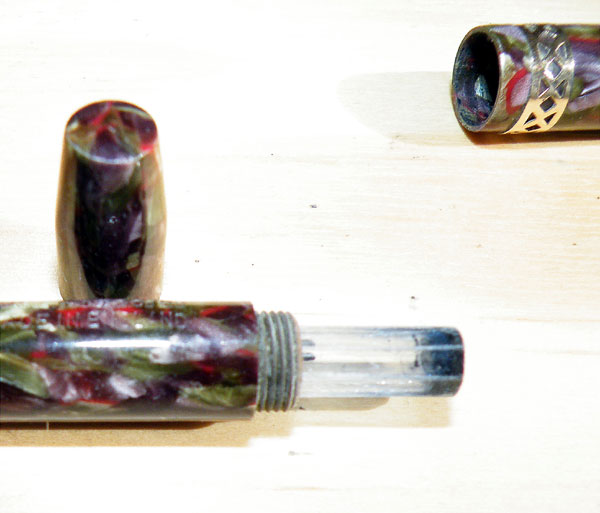
 

My thanks to Eric Wilson for restoring this pen.

Sheaffer Sentinel Tuckaway

When the Tuckaway first appeared in, I think, 1941, it had no clip and the suggestion was fairly strong that this was a pen for a lady’s purse. They did things like that back then, whereas now if you were to suggest that women should confine themselves to little tricky pens you might well get a slap in the kisser. Not from me, of course. I’m against violence in all its forms. Unless I’m annoyed.

Anyway, soon thereafter the Tuckaway became unisex and grew a little clip. I’m informed that this truncated clip is called a clasp. So there. After that it went through the full gamut of Sheaffer options – lever filler, Vac-Fil, Touchdown, open nib and triumph.

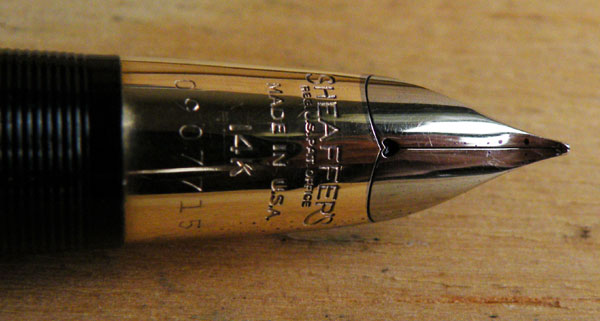
This is one of the late ones, a Sentinel Tucky with Touchdown filler. It’s a small pen with big attitude. When you take the cap off the conical nib looks almost out of place on the short pen, but when it’s posted it seems to come back into proportion.

The tip-tilted nib is as hard as a nail. When I got it, it was inexplicably toothy. I could see no reason for it even under magnification, but a little bit of polishing and it’s a pleasure to write with.


The Sentinel may be short but it’s not slender and the section provides a good gripping area, all of which go together to make it surprisingly useful, even for extended periods of writing.

This one’s a keeper!

A Burge, Warren & Ridgley Website

Mike Bryan made me aware that there is a web site devoted to Burge Warren & Ridgley here:

http://www.neptunefountainpen.com

There’s a lot of information on the pens and stylos there and there’s also a book, authored by Mike Bryan and Stephen Hull, entitled The Neptune Pen: A History of Burge, Warren and Ridgley.

It’s heartening to find yet another site on a British pen company. It puts information where we need it, on the web and available to everyone. It can only be good for the hobby.

Sheaffer Lifetime Flat Top

You may remember that I decided to try to improve my writing with firm-nibbed pens instead of covering up my imprecision with the swirls and curlicues of flexible nibs. The project continues and there is some visible improvement, though at the cost of speed. Normally, I write very fast indeed without losing legibility, something I had to learn to do for note-taking in university. Frankly, though readable, the result isn’t pretty, hence the current effort at improvement. Slowing down your natural speed of writing isn’t easy. It’s like grinding along in first gear in an endless traffic queue.

The upside of all this is that I can now have all the stiff-nibbed pens I ignored before. I admired many of those pens but felt that they were not for me. Now they are! The first one I went for was the Sheaffer Lifetime Flat Top, one of those early pens that got it so right first time that it cannot be improved.

It’s a very simple design. Like all the other flat-top pens that were around at the time, it’s virtually just two tubes, one slightly larger than the other. Actually, the barrel does taper a little as does the cap lip, but otherwise it sticks to that very minimalist design. Unlike most other pens of the time, the Lifetime exudes great rolling waves of sheer quality. The moment you take it in your hand, you know that qualitatively this pen is way out on its own. There are many roads to beauty; one is perfect fitness for purpose. That’s what makes this one of those perfect pens, like the 1920s Swan Eternals or any pre-World War II Onoto.


As luck would have it – I wouldn’t have known – the example I bought is an oversize one, measuring 13.5cm capped. It’s a big, chunky pen, bigger than I have become used to, but not too big. It fits the hand well, it has an easy balance posted and it weighs little. More, by a shade, than the black hard rubber pens I usually use, but nowhere near enough to be tiring over an extended period of writing, like some modern brass-barreled pens.


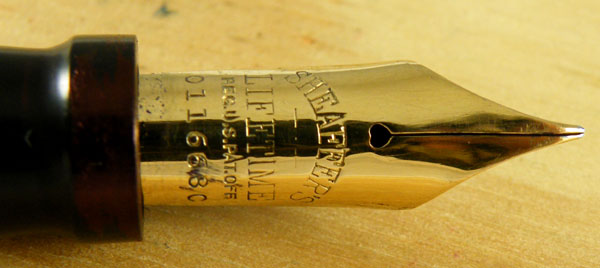
The nib is the stiff nib that all other stiff nibs aspire to be. There is more flex in a granite slab. It’s a smooth writer, though not without enough feedback to prevent it from being one of those horribly slippery nibs they make today. It’s always ready to write without hesitation even after sitting for several days. The feed, a fairly simple ladder type, delivers just the right amount of ink. It holds a gallon of ink, and as this nib is a fairly parsimonious medium, you don’t spend much time filling the pen. This is a great, practical pen.

I see other firm-nibbed pens in my future. Maybe a Tuckaway, perhaps even a Lucky Curve Pastel and certainly a Newhaven Duofold NS.

I’m having fun here.

Mabie Todd Swan Safety Screw Cap No 5

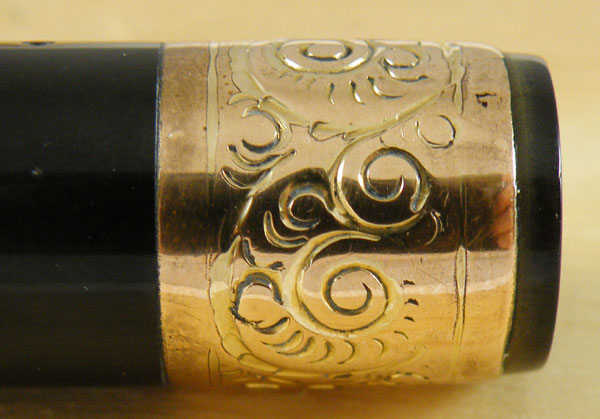
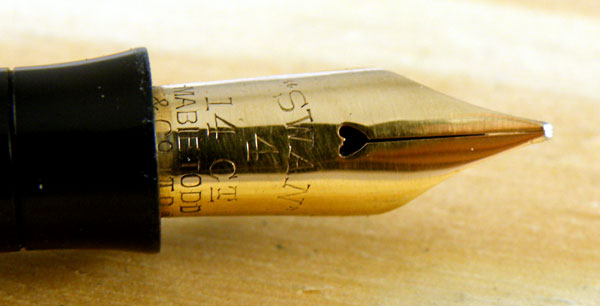
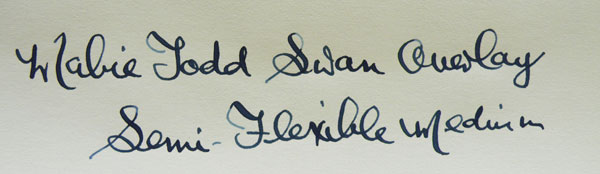
Pen companies are happy to announce their new models, but they neglect to tell us when they stopped making a particular model, darn them! So it is with some confidence that I say that Mabie Todd brought in the Swan Safety Cap range in 1911, but it’s a more shaky guess that they ceased production in 1920. That was the year they introduced lever fillers, making the Swan SSC obsolete. However, I expect they remained on sale in shops for a time after that.   When the Safety Screw Cap was launched, Mabie Todd made much of the the screw-on cap which was intended to stop the pen leaking into your pocket. Advertisements also drew attention to the ladder feed, an innovation which the company kept until the end, and to the gold bar over the centre-line of the nib which delayed drying out.    This pen, I believe, is one of the later ones, made after they stopped installing the gold bar over the nib. It’s a No 5, and while it retains all the features of the smaller Safety Screw Caps, it’s an altogether more chunky pen. While still quite long posted, it doesn’t share the long slender proportions of, say, the Safety Screw Cap No 2. Indeed its length both posted and capped is much more like a modern pen. Quite worn by long use, the pen now shows little sign of chasing and the barrel imprint has almost gone. The decorated cap band still looks good despite obvious signs of plating loss. The large nib is a No 4. One might expect a No 5 pen to have a No 5 nib, though I can’t be certain that this was the case. The No 4 nib may well be a replacement, but it’s in proportion with the rest of the pen and it looks good there. It’s a semi-flexible medium. 

Burge, Warren & Ridgley Neptune

Burge, Warren and Ridgley may sound like a partnership of shady lawyers but in fact they were one of the pioneers of British fountain pen making. They’re largely forgotten today because they ceased to trade in 1929 but at one time they had a wide range of fountain pens and stylos on offer.

Perhaps best known was their Neptune fountain pen which started life in 1892 as an eyedropper filler, was repeatedly improved and became a lever-filler in 1922. The version above is an eyedropper, No 210. I don’t have a production date but the style suggests that it was made between 1912 and 1920.

The high-shouldered Burge, Warren and Ridgley nib is a beauty and it has notable flexibility, too.

BW&R was probably taken over by the Jewel Pen Company and disappeared except for a period during World War II when the company’s name was used to obtain a pen manufacturing license from the government – just a ploy to increase output, probably.

Never especially innovative, the company nonetheless produced some unusual colours in hard rubber, terracotta, sage green and purple among them. Much as I would like to find a purple Neptune, I’m happy to settle for this black chased hard rubber No 210. They don’t appear all that often.

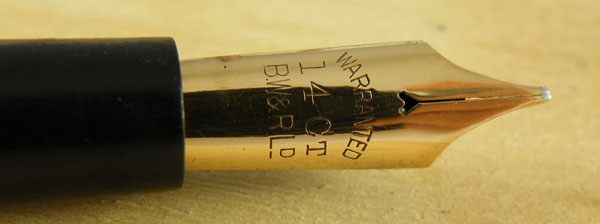
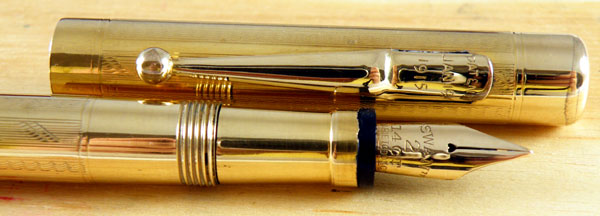
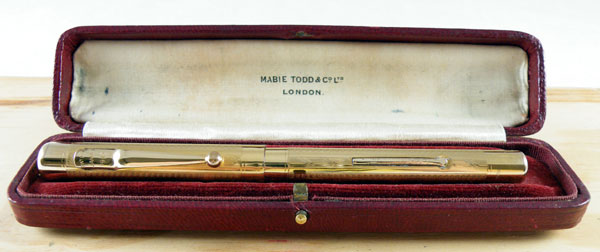
A Boxed Mabie Todd Swan Overlay

The one thing that the UK arm of Mabie Todd shied away from for a very long time was making overlay pens. So far as I’m aware, no overlays were made in Britain before World War II. Overlays were always a small part of pen production and it probably made economic sense to share one facility for their production.

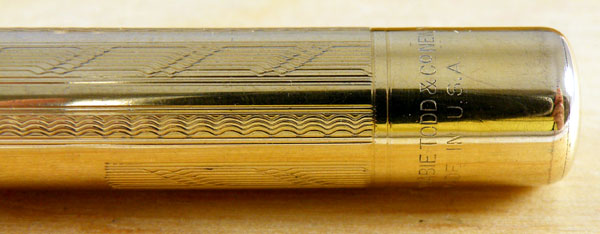
I don’t know whether this was a pen produced in America purely for the British market, or whether it was also on sale in the USA. These pens are not rare, though they’re moderately uncommon, and they turn up not all that infrequently in either clipped or clipless versions. Here’s a similar one with no clip and a different engine-turned pattern: http://wp.me/p17T6K-b5


Without a little more information, dating these pens with any exactitude is impossible. Any time between 1920 and 1930 will do, and even a year or two after 1930 doesn’t seem to me to be impossible.

Is there a pattern-book for engine-turning somewhere? It would be nice to put a name to this pattern but it’s beyond me. The pen’s not quite perfect; there’s slight plating loss at top and bottom and on the ball of the clip. There’s also a tiny area of loss where the exposed edge of the section meets the plating, a common area for attack by the harsher inks of long ago. That said, in its red leather (or probably leatherette) box it’s a real stunner.

My guess would be that under the gold lies a Swan Minor No2, one of the most deservedly popular pens of its day. As always, it writes beautifully.

Home Again!

Thank you all for your concern and kind comments.  We’re both home and husband is out of the woods.  Not to get too medical, but it was one of those situations where a medicine prescribed turns out to be the very worst thing possible with an unexpected, potentially lethal side-effect.  Still, all’s well that ends well.  Martin, you’ve had a terrible time and you’re much in my thoughts.  May all go well with you.

All the sold pens are dispatched and now I’m beginning to catch up with other things.  I have some wonderful pens to post about, some Swans, some other interesting pens.

Thank you all again.  Here’s a very fine Swan logo from around 1910:


In Limbo

Hi All, just a quick post with apologies for the recent silence.  My husband is currently in hospital, rather unexpectedly, and we are far enough away from there to merit my overnight stays nearby rather than trying to get back and forth each day.  This leaves me computerless (too late did I discover that the hospital accommodation supposedly has free wifi!), and so while I have posts brewing in my brain, it may be a few days until I can get back to writing.  It’ll be back and forth the next couple of days by necessity, but it’s more like a flying visit to home, throw clothes in the washer, bravely bear the cat’s guilt-attacks, collect the mail and head back out for the early train in the morning.  Only reason I came home this evening was to handle eBay sales, correspondence, and of course, to assuage the now-wild-eyed cat who, even as I type, sits next to the laptop yowling at me in what amounts to cat cursing.  At least, that’s what the set of her ears is telling me!

Hope to be back soon, believe me…

The Blackening Rant

We’ve discussed the ethics of pen re-blackening on a previous occasion. Let’s now look at the practicalities. Unless there is a system so secret that we don’t know of its existence, re-blackening doesn’t work. Anyone who believes that a pen painted with Syd Saperstein’s noxious potion looks like black hard rubber did when it was new is suffering from a specially virulent strain of terminal self-delusion. The only difference that I can see between a pen re-blackened with that stuff and with boot polish is that the boot polish looks better. It does tend to smell of boot polish and come off on your fingers, but it looks better.

I would like to say in the liberal airy-fairy vacant-headed way that so many do that your pen is your own and you can do with it as you wish. You’ve got a fine old Waterman 52 that’s a tad brown. If you decide to re-blacken it, it’s nobody’s business but your own, n’est-ce-pas? Well, no. It may come as a shock to you but you’re going to die one day, and that Waterman 52 will go back into the Great Pen Pool and come back around to be a nuisance to someone like me. So I’m not going to be that wishy-washy liberal oh-so-fair-minded person. Indeed, what I would rather say to you is that if you have the least notion of re-blackening a pen, go out your front door, turn sharp right, turn sharp right again and beat your head on the wall until the idea goes away, or the proposition becomes impractical due to your vision being affected by the blood in your eyes and the onset of concussion.

Of course, most pens that are re-blackened aren’t re-blackened by innocents for their own pleasure. They are re-blackened by grasping, avaricious crooks, devoid of morality or ethics, just to make a few bucks more regardless of the damage that is done. I spent an hour tonight removing, as best I could, a heavy application of Syd Saperstein’s gunk from an otherwise excellent Swan Safety Screw Cap No2. It looked unbelievably dreadful, as re-blacked pens always do. It looks a lot better now, but nowhere near as good as it did before the paint-happy cretin went to work on it. The notion that you can completely remove re-blackening is a fallacy. Pens with chasing and with the scratches of a century of use will retain blackening, do what you will, to their detriment. Re-blackening a century-old pen of such a high quality as this is simply vandalism. It’s utterly inexcusable and anyone who would do such a thing is no pen lover.

In conclusion, in case you missed it, don’t re-blacken your pens. You are only their temporary custodian. Most of the pens I’m talking about are already older than you and they will outlive you. Treat them with respect. Polish them carefully, with good, appropriate polish. That will make even the most faded pen look more attractive. Use them. The more they are handled, the more they will darken, and the better they will look.

Old things are meant to look old. It’s one of the places where their charm resides. If you want a new pen, buy one and leave the old ones to those of us who appreciate them.