It’s Only Appearances

You may have noticed that I’ve changed the theme for this blog.  I liked the old one better, I must say, but it didn’t have a search facility.  A couple of years ago that wouldn’t have mattered but as the posts proliferate it becomes harder to find what you’re looking for.   Of course, it would help if I kept up with the categorisation…

I gave the search bar a try or two.  It seems to be quite good.


The Swan Ladder Feed

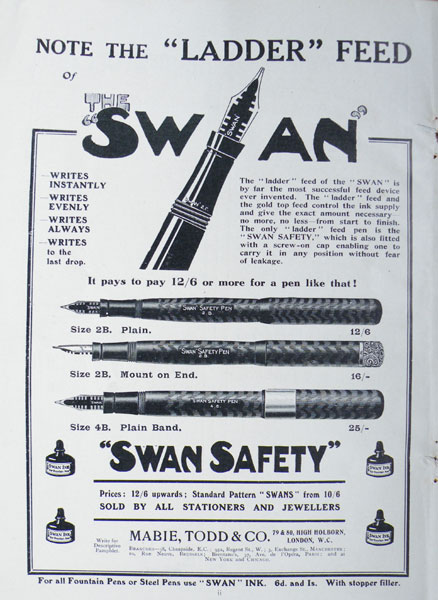
Advertisements are wonderful things. This one nails the introduction of the ladder feed for Swan pens at 1912. I have a suspicion that Mabie Todd continued to experiment with other feeds in Blackbirds for a time, but this was the date that Swans adopted the ladder feed which they retained right to the end.

It was only the year before, 1911, that Swan had brought out the Safety Screw Cap so it’s new enough to also be made a feature in this full page spread. Would you pay 12/6d (62 ½ pence) for a pen like that? I would, and indeed I’ve paid a great deal more on many occasions. Safety Screw Caps are wonderful pens, fully modern in every respect except the filling system – and who can say the eyedropper filler is outdated, with so many on the market today?

On the middle pen illustrated, you’ll see what Swan call the top-feed. Discussion still goes on around this short-lived feature which Swan and a few other manufacturers installed on their pens in those years. It isn’t a feed, exactly, because it doesn’t extend far enough through the section to reach the reservoir of ink in the barrel. Only the ladder feed does that. However, it may redirect some of the flow of ink once it reaches the nib. Another possibility is that it shields the gap between the tines from the air and delays drying out. It’s quite likely that the gold top-feed did these things, to some degree at least, but it was entirely unnecessary. Later models dispensed with it and performed just as well. The ladder feed itself delivered the ink to the nib beautifully without assistance.

Provided the appropriate feed was matched to the nib, Swan’s ladder feed was (and remains, of course) superior to the other types of feed around at the time and it continued to hold that lead for many years. Properly adjusted, broad, stub and even flexible Swan nibs don’t suffer from ink starvation as so many of their contemporaries do. Even into the forties and fifties when Sheaffer and Waterman developed deeply-cut multi-finned feeds to control ink flow, Swan stuck with their tried and tested ladder feed which remained the equal of of these innovations.

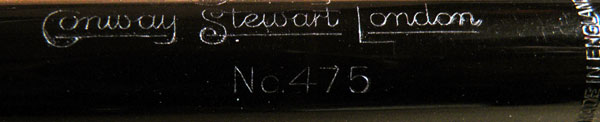
Conway Stewart 475 in Chocolate Brown

When I bought this Conway Stewart 475, it was advertised as being black, which it clearly isn’t. It’s a rich, dark, chocolate brown, and as such it’s a quite uncommon pen, uncommon enough that we might use the ‘r’ word, much as I abhor its over-use on perfectly common everyday pens.

Many of the 475s that turn up today are black, and the 475 tends to be regarded as just an economy-level pen in Conway Stewart’s pre-war range but there’s more to the 475 than that. Conway Stewart experimented with several colours that are seldom – or never – seen in other pens. Apart from the gorgeous moss agate and red-veined jazz*, there are moire-patterned colours and the self-coloured pens – aubergine, forest green and this chocolate brown.

Most 475s are 1930s pens. This example is the last version, made from 1937 to some indeterminate point in the 1940s. They come with the number stamped on the barrel either large or small; this one’s decidedly large.

Beautiful and uncommon as some of these colours are, they’re part of a pattern of Conway Stewart behaviour, in which eye-catching colours were often applied to inexpensive pens. The Scribes and 479s are other examples of this trend. After all, these unusual colours were just another celluloid rod to the supplier, doubtless costing the same as any other. At no extra cost, then, the company was able to make some of their economy ranges more attractive and therefore probably sell better.

* I use Jonathan Donahaye’s colour descriptions here.

Swan Mystery Material

I had always assumed that all the colourful pre-war Swans were celluloid but it seems it is not so. I sent this pocket-size jade lever filler to Eric Wilson to have a crack in the cap lip celluloid welded. Eric gave it a try but, to his surprise, couldn’t because it’s not celluloid!

So what is it? At that date the most likely alternative would be casein. It may be casein but I’m by no means sure that it is. With the application of a little heat, casein gives off an unmistakable cheesy smell that indicates its origins. I hope none of the neighbours were looking in my kitchen window as I alternatively heated and sniffed the pen – they might have got the wrong idea! (Watch out for that Deb! She’s a pen sniffer, y’know…) Despite my best efforts, I could detect no dairy smells from the pen. It smelled of nothing, in fact.

The other test for casein is its reaction to water. I’m not going to dump this pen in a glass of water – that’s a test too far – but I’ve never seen a Swan pen with the craquelure that afflicts casein pens that have been exposed to a mixture of humid and dry conditions. Admittedly, some caseins are more resistant to this failure than others – Burnhams show it more than Conway Stewarts, for instance – but given the right – or wrong – conditions, all will show it to some degree.

If it’s not casein, and though I can’t be absolutely positive the indications are strong that it’s not, then what is it?

The Bird Box

Looking back over the last three years, my pen restorations average out at about five hundred a year. Each and every one of those pens is in some way appealing and I consider keeping many of them, though usually only fleetingly.


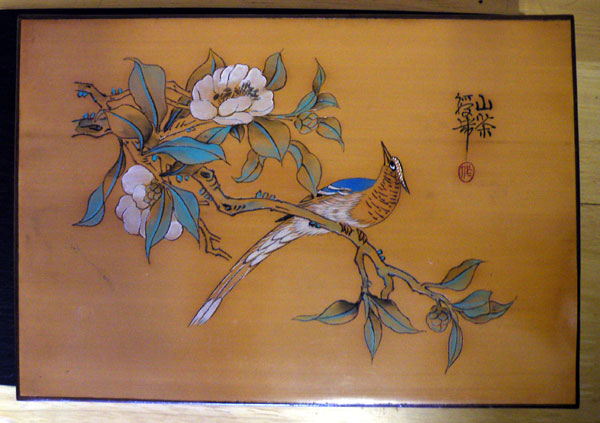
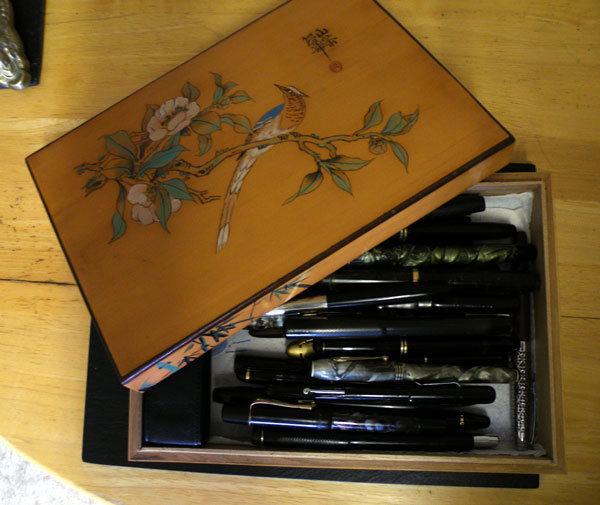
Though I don’t collect pens I have accumulated a few over the years. If they’re in this box, they’re mine.


I counted them just now and there’s 35 pens in there, plus one on my writing table. Depending on what your own situation is you may think 36 pens is a lot, but I’ve been interested in fountain pen for a very long time. Some of the pens in that box have been in my possession since the early seventies. Actually, given how many pens I handle, I think I’ve been admirably disciplined in keeping the accumulation small. There was a time I had many more when I collected Conway Stewarts. Eventually I realised that possession conferred no benefit on me and I sold off my collection.

So what do I have now? There are quite a few pens that just suit my hand very well, several of them being obliques with varying degrees of flexibility. A few were gifts and some are mementos of people I knew who are no longer around. There’s a few 1920s and 1930s Conway Stewarts that I couldn’t part with because they are such admirable pens. There are one or two extreme rarities like the Fattorini pen (http://wp.me/p17T6K-qN) and the Clipfill pen (http://wp.me/p17T6K-kn) because I know that such interesting and unusual pens will not come my way again.

Not all of those pens get used. There are about fifteen that do because I enjoy writing with them. I hang onto the rest for other reasons. Will my accumulation grow? Probably not. Yes, another pen or two might take my fancy but there are a few in that box that could go and not be missed. For the most part, though, it will remain the same. I like my motley crew of pens that have found their way into the bird box.

The Conway Stewart Conway Pen 340

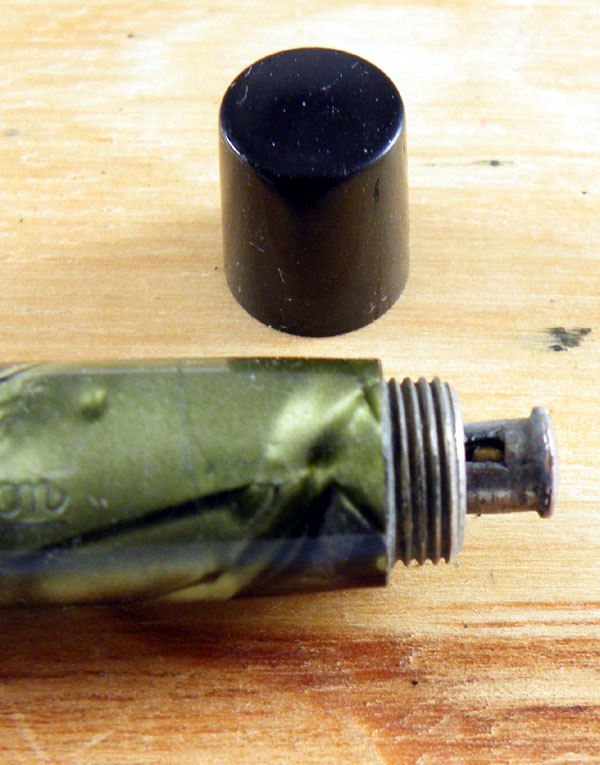
As you may well have gathered by now, I’m no collector but I do hang on to a few pens that seem to me to be exceptional in some way. This Conway Stewart Conway 340 fits that description in a couple of ways. First, it’s a button-filler – of which more anon – and, second, this pen isn’t listed in any of the usual sources.


I’ve written about Conway Stewart button-fillers and my admiration for them before, back here: http://wp.me/p17T6K-6v . When this pen appeared a few weeks ago I grabbed it. I had to pay quite a bit but I believe it was worth it for the pen’s rarity and the fact that it’s technically different from the 485 and various Duro button-fillers it has been my good fortune to handle.

Conway Stewart’s interest in button-fillers was entirely confined to the 1930s, so far as I can see. After that decade they reverted to lever-fillers and stuck to that except for a brief flirtation with the Speedy Phil filling system in the fifties and descending to cartridges in the period of their final decline. I can’t guess how they determined which pens would be best served by the button-filling system, but the split was between top-of-the-range Duros and some inexpensive workaday Conway pens like the 485 and this 340. I have to modify that statement a little. After all, this pen turned up out of the blue as an unknown, to me at least, and there may, for all I know, be other, differently trimmed button-filler Conway Stewarts out there waiting to be discovered.


This, then, is likely to be a thirties pen too and there’s nothing stylistic that argues against that in the pen. The pattern, which I would characterise as pale green with black veins, isn’t common but it’s not unique, I don’t think. I’m sure I’ve seen it before. Where this pen differs from the 485 and the Duros is that the button is housed in a metal collar. That does seem to be unique, in my experience at least.


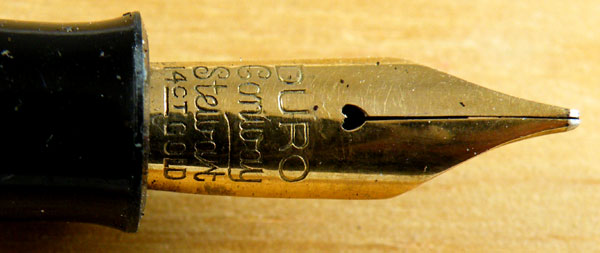
There were some severe problems with the cap of this pen. Eric Wilson applied his magic and it looks superb now. He also swapped the warranted nib it had for a beautiful Duro. You may say that’s not right – a Duro nib in a lower-cost pen with no cap bands – but it fits well and writes beautifully so, as this pen hasn’t been previously recorded anywhere, I say it’s right. Prove me wrong.

The Fattorini President

Back in the beginning of April, I saw a small job lot in Ebay that took my interest. There was a virtually worthless Platignum Silverline, a black chased hard rubber Blackbird and a strange pen with no nib that was evidently quite old. At first glance, because it had a prominent barrel ring, I took it to be a crescent filler that had lost its crescent. When it arrived and I was able to examine it properly it clearly was not a damaged crescent filler. I toyed with the idea that it might be a coin filler, but after sliding the barrel ring back and forth a few times I concluded that it was a primitive form of piston filler.

 

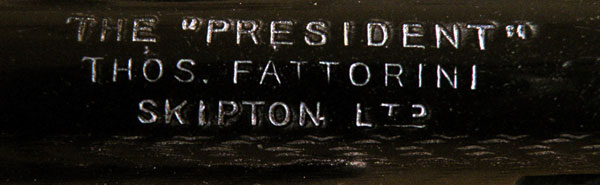
Apart from the missing nib the pen was in remarkably good condition and the clear barrel imprint told me that this pen was The President, made (or sold) by Thos. Fattorini Skipton Ltd. A quick search online showed that the Fattorini company still existed, and there’s a wonderful PDF file of the history of this entrepreneurial family here:

http://www.buttoncrs.com/pdffiles/FattoriniCompaniesHistory.pdf

I found an email for the company’s Birmingham sales team and wrote including a couple of photos to enquire whether they knew anything about this long-ago product. I had little hope of a reply so it was a pleasant surprise when an email arrived from Greg Fattorini, Managing Director. He informed me that though they had no record of this pen, they had outsourced manufacture of pens that they sold in the their jewellery shops, some from De La Rue, the makers of the Onoto pen, and others from Switzerland and the USA. If I was pushed into a corner I think I might opt for the USA as the most likely source of this pen, given its resemblance to other American pens of the period. Given that Thos.Fattorini (Skipton) Ltd. was incorporated in 1919, I’m forced to put the pen’s date at that year or very soon after, though the style of the pen would suggest a few years earlier.


The use of the barrel ring to operate what is, essentially, a syringe filler is quite ingenious. I’ve never seen anything quite like it elsewhere.
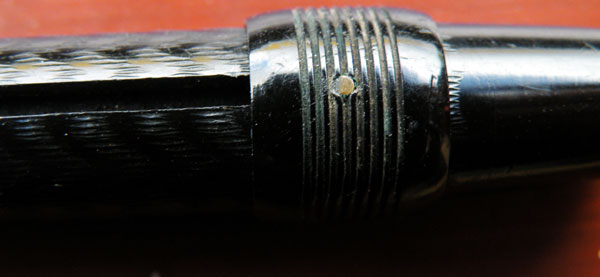
The whole filling assembly is held together by a tiny brass pin which would have to be drifted out for the pen to be serviced. I was fairly certain that if I tried to remove the pin I’d break the whole thing, so I sent the pen to the estimable Eric Wilson, who fitted a cork seal and returned the pen to working condition. He notes, “I would imagine there was quite a risk when putting the pen in your pocket of catching the barrel ring, pulling it up and squirting ink on yourself!”
 

That risk aside, the pen is a very handsome rarity. It’s in remarkably good condition for its years. The black hard rubber has not faded at all and the chasing is crisp and sharp. It’s an innovative and high quality instrument and a credit to the house of Fattorini.

Canadian Waterman 52V

In the bad old protectionist days (as opposed to the bad new global days) Britain used tariffs to favour its own national production, as did every other country. As Commonwealth countries were exempt from these taxes, Parker and Waterman were quick to establish manufacturing plants in Canada to exploit the British market, hence the large numbers of Canadian pens we find today, some of them interestingly different from their American equivalents.


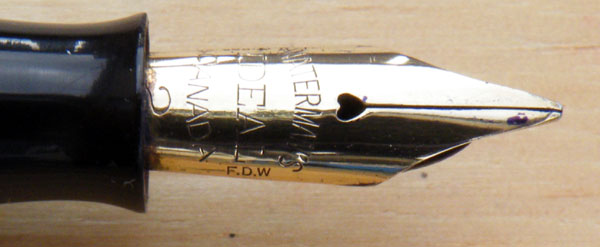
This 52V is, I think, identical to the American version except for the imprints. At 10.7cm capped, it’s a short pen, but not so short as to be uncomfortable to write with when it’s posted, for me at least.


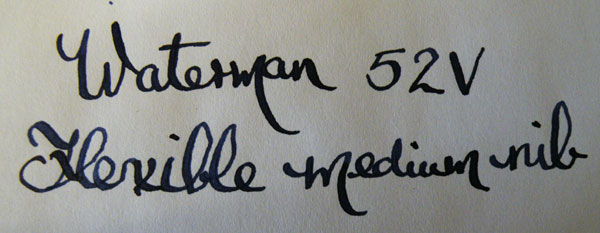
And that’s a very good thing, because this is a writer’s pen par excellence. The beautiful Canadian Ideal No 2 is a generous medium and flexes at a touch. It snaps back instantly to its default width and the spoon feed keeps up effortlessly with a supply of ink. It’s a joy to write with.


Waterman may have been a little late in the day in getting into celluloid, due to its commitment to patterned and plain hard rubber, but by the nineteen thirties it was using some of the loveliest patterns ever seen. This grey and russet pattern has great clarity and almost seems to shine from within.


Flat-topped and with the metal of the clip at the top of the cap, it has a slight resemblance to the contemporaneous Parker Moderne in that respect. The pierced clip is instantly recognisable.

These pens are not uncommon and they’re almost invariably fitted with a flexible nib. As half-sized pens, they tend to sell quite a bit cheaper than their full-sized brethren. If you want flex and you don’t find a short pen uncomfortable to write with, the 52V is a pen to look out for.


Mabie Todd Swan Leverless 4461

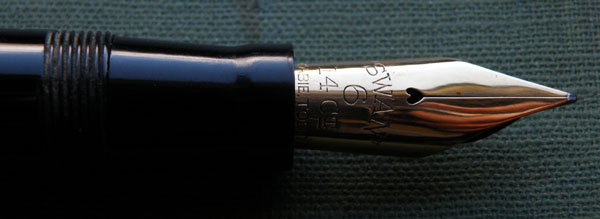
Here’s another big one, the Leverless 4661, pretty much the replacement for the Levereless 2060 which I wrote about here: http://wp.me/p17T6K-jZ .


It doesn’t have the brass barrel threads, so I’m guessing that this one’s from 1950 or 1951. It’s a handsome black hard rubber pen. Though it’s substantial, it’s not exceptionally large at 14cm capped, so the huge No 6 nib is something of a surprise when you take the cap off. It’s a hunk of gold and makes a beautiful nib with its heart-shaped breather and deeply-incised engraving. Surprisingly, for such a big nib, it has an appreciable degree of flexibility.


These were interesting years for Swan. The company had gone public a couple of years before and in 1949 they’d finally managed to unveil their much-delayed new range of torpedo-shaped pens. Despite the depressed state of the post-war economy, these pens were selling like hot cakes. Who would have guessed that within another couple of years they would have been taken over by Biro Pens Ltd, a company which did not have the best interests of Mabie Todd’s fine heritage at heart, and who would initiate the rapid decline from this high point to the dissolution of Swan in a few short years.

Stephens Leverfil No 76 in Dusty Rose and Black Marble

Stephens had a comparatively short but very productive period as a seller of gold-nibbed fountain pens. Beginning in 1935 with their stud fillers, this period in their much longer history was pretty well over by 1955. Though details of their later history when they were involved with Jif-Waterman are confusing, the earlier chronology of the company is, in general terms, quite well known.


For instance, this beautiful Leverfil No 76 was introduced in the autumn of 1941, a period when Stephens used some very lovely patterns of celluloid that seem to have been unique to them.


Though at seven shillings and sixpence it was their second cheapest pen it is well made with admirable attention to detail, such as the nib that was made specially for this pen.


What remains a puzzle, to me at least, is the variety of clips that Stephens used over a short period, apparently without much consistency. There’s this clip with “Stephens” stamped into it, a similar ball-ended clip in either gold or chrome plating without the lettering, and sometimes an arrow clip appears.

The greater mystery that has yet to be resolved is the extent to which Stephens own employees were active in the production of these pens. It is possible, though unlikely, that they were entirely made under contract by some other company, with Langs being the most obvious choice. The early stud fillers were made to a Langs patent and bore a striking resemblance to that company’s other output. The component parts of these wartime lever fillers also resemble other Langs pens. It may well be that parts were manufactured by Langs and the final assembly was carried out by Stephens. Stephen Hull mention (in Stephen Hull: The English Fountain Pen Industry 1875 – 1975) that when their head office was bombed in December 1940, work continued at their main factory at Highbury. Prior to that, customer repairs seem to have been done at the head office, so it is fair to assume that the main factory may have been devoted to assembly if not complete manufacture of the pens.

My thanks to Stephen Hull for the factual information quoted above. The speculation is my own.