The Stabil Junior Button Filler

DSCF0931

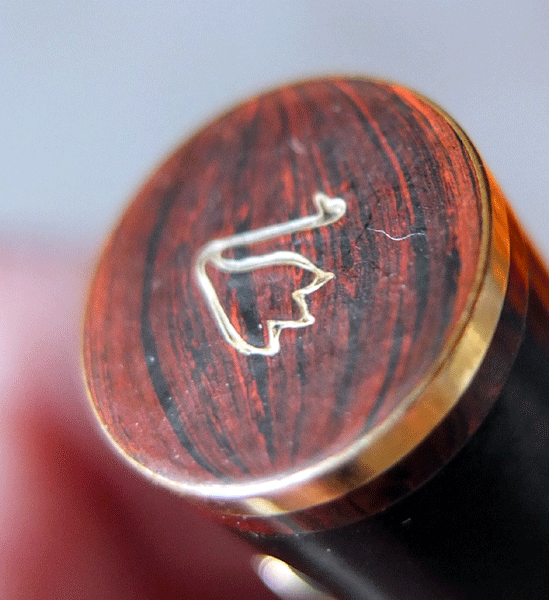
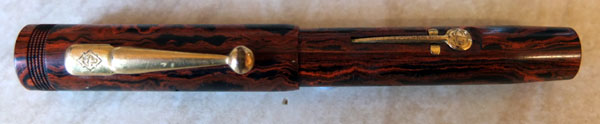
This very beautiful pen is the Stabil Junior.  For comparison, it’s the same size as an English Parker Duofold Aerometric, so the “Junior” title doesn’t imply small size, except in comparison with the senior-sized Stabil, which is a distinctly over-sized pen.

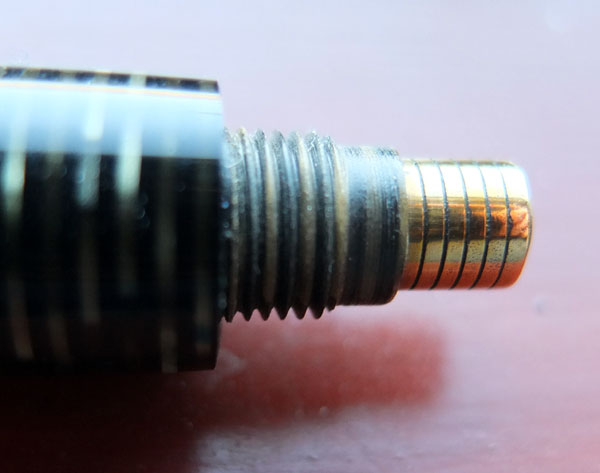
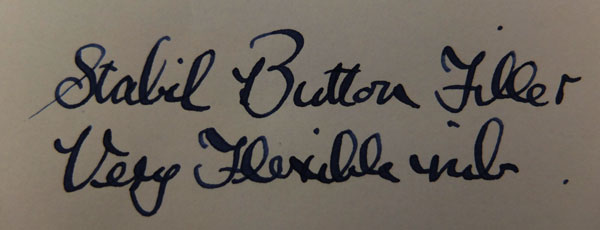
The plastic appears to share an origin – or at least a concept – with the Parker Vacumatic.  It’s fairly generally Parkerish, even to the button which is reminiscent of the Duofold AF.  The major difference is the nib which is supremely flexible.  The feed, too, is unlike anything else I’ve seen and is capable of keeping up with demands of the flex nib.  It’s a very high quality pen with a solid feel in the hand.  The threads are deeply and well cut and the gold plating remains very good.

DSCF0933

DSCF0932

If you try to research Stabil, you’ll find that it isn’t an especially well-known company.  Some say it’s German, others that it’s Hungarian but I prefer the explanation that it’s a Belgian company, established by Chaim Jukubowicz in 1938 and remaining in business until 1974.  The company appears to have made much of its income as an importer of Sheaffer pens while manufacturing quite small quantities of its own pens.  The nib fitted to this pen, with its bison imprint, is a German Nichroma – a sub-brand of Penol.  I don’t know if it’s original but it seems quite likely that it is.
DSCF0937

DSCF0928

This interesting pen may have been the product of a small company, but in terms of quality it’s the equal of anything else that was on the market at the time.
DSCF0939

The Conway Stewart Quail Stylo No 3


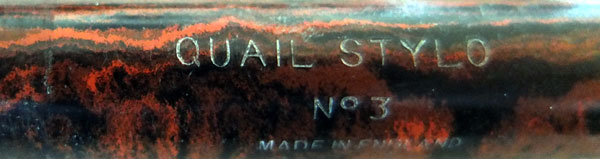
DSCF0919This little Conway Stewart began life as a stylo, the Quail Stylo No 3 to be exact.  It was subsequently converted into a fountain pen using a short, thick feed and a folded-tip white metal French nib.  I suspect that it didn’t work well as the inside of the section is stepped, meaning that the feed didn’t fit as it should.

DSCF0921

DSCF0924
I searched Stephen Hull’s Fountain Pens For The Million and The English Fountain Pen Industry but found no reference to this stylo.  There is no mention of it in Jonathan Donahaye’s list either.  Of those listed, it most resembles the Pixie 113 Ink Pencil.

Does anyone know anything about this stylo?

There seems little point in posting an enquiry to Fountain Pen Network’s Conway Stewart section as all those with a good knowledge of the brand left some time ago.  Sad business.  I’ve posted to Fountain Pen Board instead.

A Flock Of Swans

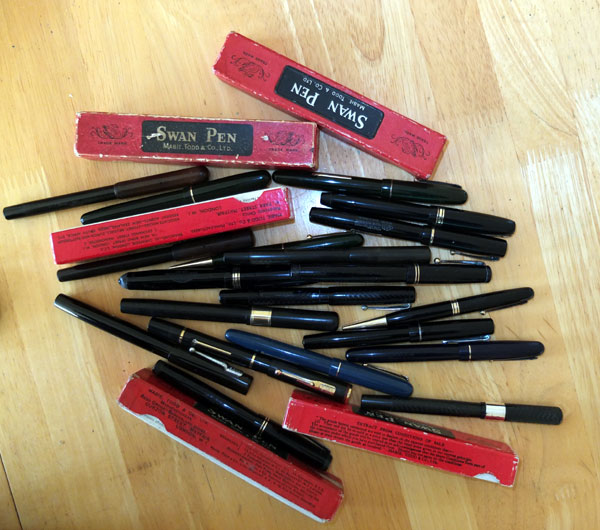
I’ve been concentrating on restoring Swans this weekend and here’s the result of my labours:
DSCF0917
There are a few more interesting examples to come in, so I’ll wait for them.  Then it’s write-testing, photography, writing descriptions and uploading to the sales site.  All being well, I should be listing these at the end of next week but I make no promises.  Life is so full of time-wasting interruptions!

I’m enjoying fixing the Swans.  There’s no better pen to work on.

A Swan No 6 Eternal Nib

DSCF0914

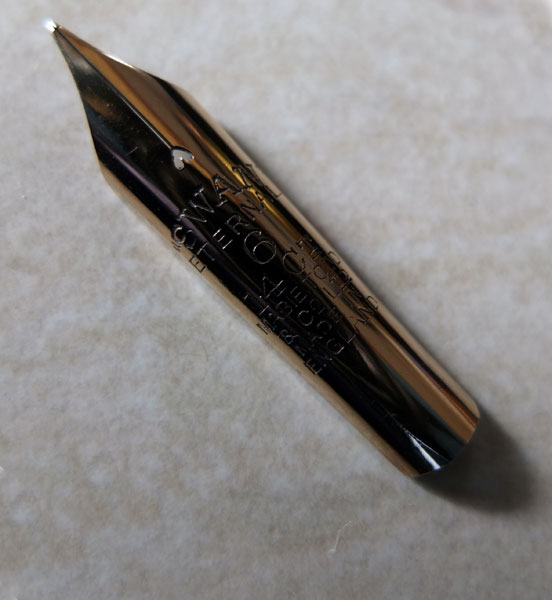
A No 6 Swan Eternal nib is a considerable lump of gold.  I’m sure you could make a respectable wedding ring out of one.  It’s not the biggest of the Swan nibs, of course.  There’s the No 8, quite a bit larger still.  I hadn’t seen one in the flesh, as it were, until recently.  Eric had a very fine example to show me.

I took the opportunity to photograph this one while I had it out of the pen as the sac was drying.  As many will be aware, re-saccing a Leverless makes for an unusual order of reassembly.  First, the shellac on the sac and section have to dry completely – no shortcuts with this one!  Then the sac has to be slid into the barrel with a dowel inside it to keep it extended and, last, the feed and nib can finally be fitted to complete the job.  All this is because to work well a Leverless needs a barrel-filling size of sac, unlike lever-fillers and button-fillers.  I used a No 22 sac on this 4660.  Necked sacs are great for Leverlesses if you can find them.

The nib has been reunited with the pen now, ready for write-testing.  A matching pencil goes along with this one.  It was all Swans I restored this morning.  I’m planning that my next upload to the sales site will be a Swan Fest!

Disaster!

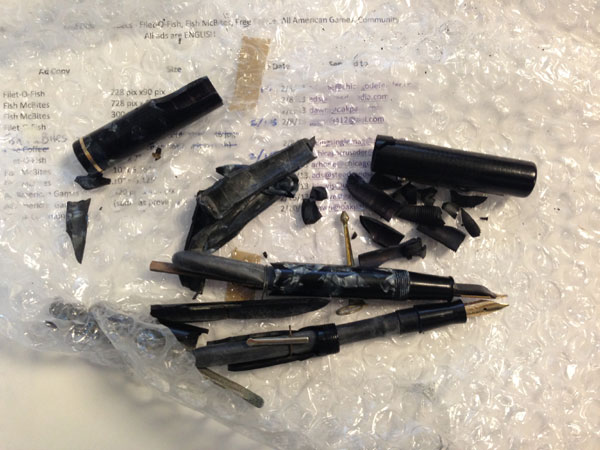
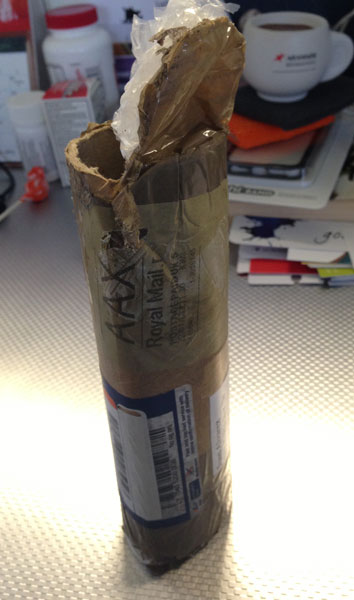
I’ve been having quite a good week – sold a few pens, bought a few more – but you never know when disaster is about to strike. I’d sent a nice Conway Stewart 286 and a Blackbird to a customer in Chicago and I was anticipating hearing from him that he’s received his pens. And he did. In bits.

image

Over the last three years I’ve sent out in excess of 1500 pens. I’m careful about packing – stiff postal tube, plenty of bubble wrap, all held securely with parcel tape. I’ve never had a pen damaged before. One or two have “gone astray” as Royal Mail like to put it, but no damage. Someone has to have driven over the package to crush it like this. There’s no other explanation.

Photo_Feb_11,_3_28_17_PM

The poor customer was devastated, seeing his long-awaited pens in fragments. Of course all my packages are insured and I was able to refund him right away, but that’s not the point. The point is that these pens had survived a very long time, one around seventy years, the other more like eighty, only to be destroyed because someone was too careless to do their job properly.

DSCF9181

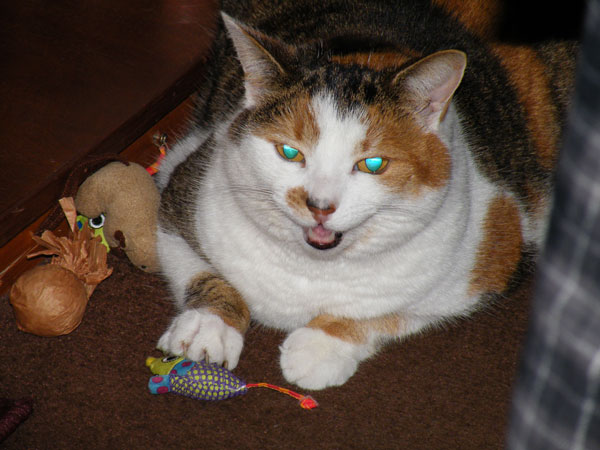
My assistant is very cross about it and plans to bite the postman.

Today’s Uploads

I’ve just uploaded some goodies to the website including a splendid capillary Parker 61 in its box, a fine early De La Rue Onoto with an over-and-under feed, a very fresh Swan 200 from around 1915, and an even earlier WHS/Conway Stewart syringe-filler. Perhaps the prettiest pen is a 1940s advertising National Security pen in glorious green and black. Please have a look around, there’s something new in every category!

Goodwriterspensales

The Majestic Pen

It’s not easy to research “The Majestic pen” on Google or any of its lesser brethren. The first hundred or so responses relate to a modern Majestic kit pen which is no way helpful. Eventually, after enough digging that you’re hearing Australian accents, you find that there was a late twenties Majestic pen, a sub-brand of Wyvern. That’s what I thought this was when I bought it due to an attack of the stoopids .
DSCF0618
That’s not what it is, of course, it’s an entirely unrelated American Majestic pen. By the late twenties, J. Harris & Son, manufacturer of black hard rubber pens, had become the The Majestic Pen Company, which turned out a multitude of colourful and inexpensive pens. Most have plated nibs; the best, like this one, have warranted 14K nibs. They made combos too.

So, it’s essentially a low-quality pen, what Americans tend to think of as third tier. By time I’d removed a few decades-worth of grunge, the plating on the trim was pretty well gone, but on the other hand, that astonishingly bright and lovely striated red shone out. What is that? Crimson? Ruby? I don’t know but whatever it is it will catch your eye across the room.

DSCF0620

The celluloid has survived about 80 years without distortion and the pen has an ink-view section that came clean and transparent. It may not be a Parker or a Sheaffer, but I think stylish, durable, low-cost pens like this one are well worthy of our attention too.

Mabie Todd Swan SF 230/60

DSCF0404

I think many of you will know that I never let a Swan SF 230 pass me by if I can help it. This one’s a 60, in other words black hard rubber. I picked it up for a song because of the inscription. Most people, it seems, don’t want personalisations on their pens, especially if they’re picked out in bright yellow! Me – I’m the opposite. A good, professional inscription makes the pen for me and gives it extra interest.

DSCF0402

The pen just arrived this morning, hence its dull appearance. I haven’t begun to restore it yet. The pen dates to about 1925, and as it was given to R. Gwynedd Jones on his twenty-first birthday, he must have been born around 1904, plus or minus a few. What else does it tell us? Well, he’s Welsh, more than likely, with that name and he comes of a well-to-do family – this is an expensive pen. I hit Google and fairly soon had turned up two – or it might be one – R. Gwynedd Jones who would fit the description so far as age is concerned. There’s an author (or it might be two authors) who published Yr Offeryn – Ffars Mewn Tair Act (1953) and Y ditectif (1963). The first one seems to be The Instrument – A farce in three acts and the second – wild guess here – something about a detective. So is this our R. Gwynedd Jones, a mid-twentieth century Welsh author who – if my crude translations from the Welsh hold up – was also involved with poetry festivals and Eisteddfods?

DSCF0410

The other R. Gwynedd Jones (it really doesn’t seem likely that it’s the same person) was a solicitor living in Pwllheli on the Lyn Peninsula in North-West Wales. In 1935 he was Clerk to the Justices, a good job for a lawyer just starting out, and in the same year in private practice he managed the winding-up of the South Carnarvonshire Farmers Association. So is this my pen’s first owner? Or may it have been that he was part of the slaughter of World War II? Or was he someone else entirely, who lived a long life of pleasant obscurity and never did anything noteworthy enough to hit Google’s indexes?

We’ll never know. I might hang onto this one though. I’ve always wanted an SF 230 of my own and this one is especially endeared to me by the inscription.