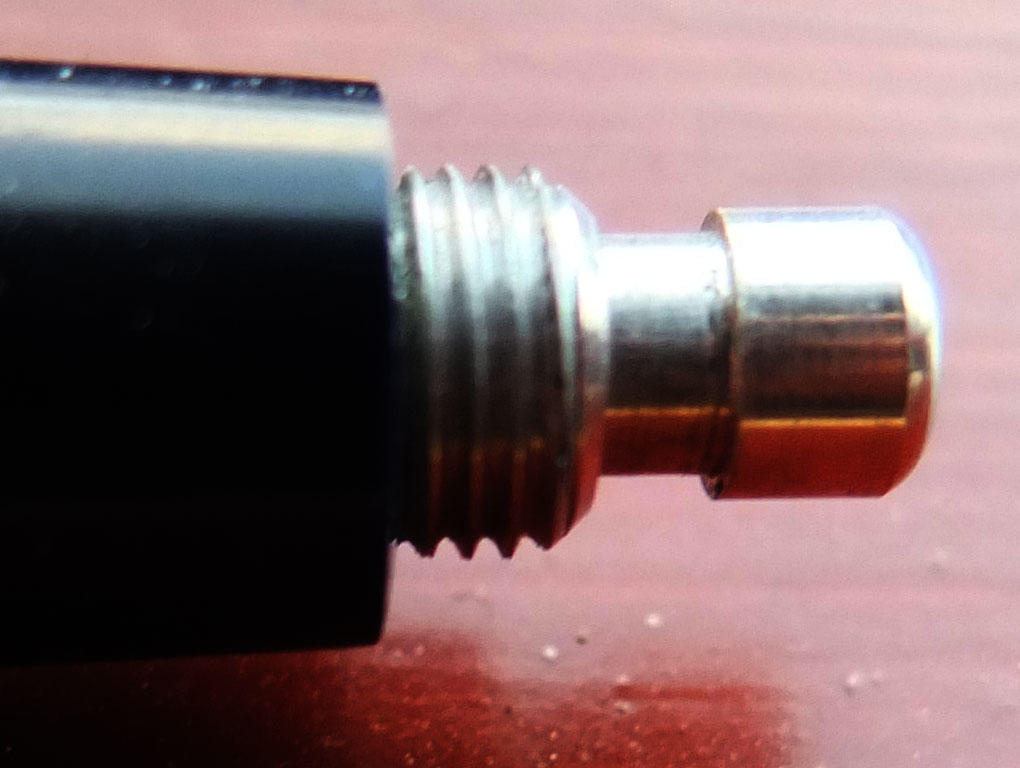
Mabie Todd & Bard Overlay Eyedropper Filler

DSCF2388

Unusually, I was aware of this pen before I had the opportunity to buy it.  The previous owner wrote about it in Fountain Pen Network and I would reference that post if I could.  However, FPN’s search facility, which is never very good, is grindingly slow today and I had to give up.
DSCF2391

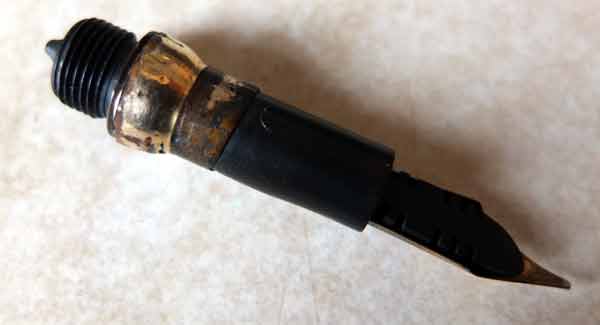
The pen is in worn condition and it’s almost an exercise in unoriginality but that’s neither here nor there with a pen of this quality.  The seller said the cap was not original.  Nor is the No3 nib or the ladder feed, both of which are replacements.  I may well have a nib that suits the pen better but I will leave the ladder feed.  It may be an anachronism but it’s also an improvement.
DSCF2399

I had a look through my reference files to see if I could discover which pen it actually is.
DSCF2400DSCF2401
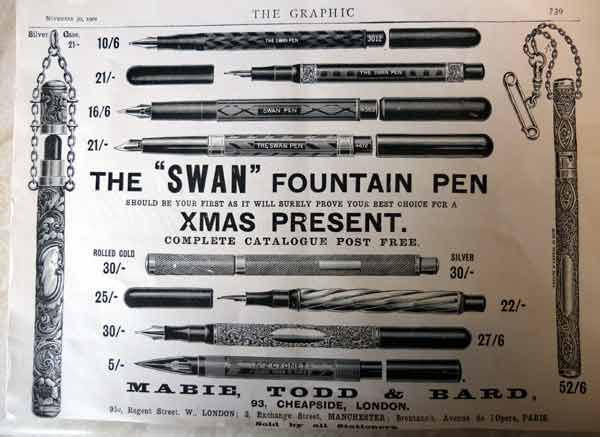
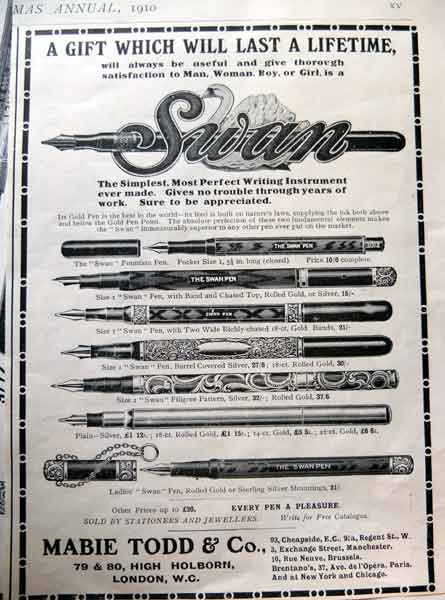
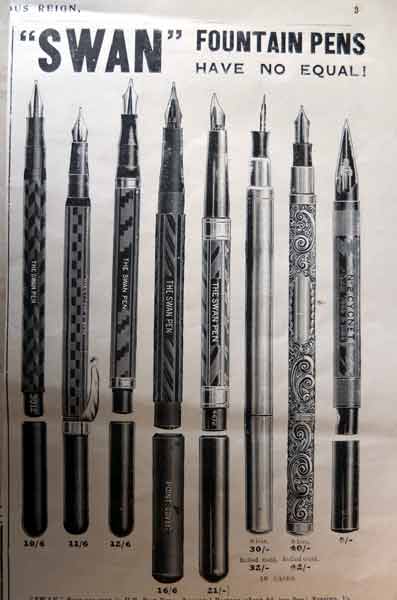
There were pens with overlay barrels and plain BHR caps as these advertisements show, but these are not this pen.
DSCF2402

I think the pen second from the right in this 1911 advert is the closest to this pen, if you look at the metal partially covering the section.  That’s the type though the date of the pen is impossible for me to determine exactly.

DSCF2393

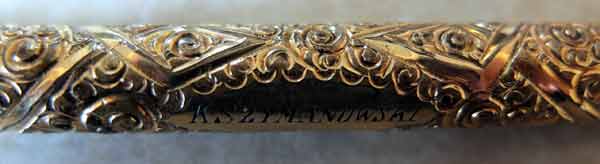
Could this pen have belonged to the Polish composer Karol Szymanowski?  I can find no good biography of  Szymanowski.  It is said that he travelled widely, but I can’t tell if he ever set foot on these shores.  Of course, there are a variety of other ways his pen might have arrived here, some more likely than others.  Perhaps Szymanowski is as common a name in Poland as Smith is here.  I don’t know.  The dates give no difficulty.  Szymanowski  lived from 1882 – 1937, so it would not be stretching things too far to say that he bought this pen in the early years of the twentieth century, then discarded it in later years when better designs came along.  It’s not unlikely, either, that a successful composer and musical director with a good sense of amour propre would buy a very expensive pen and have his name engraved on it.

Could this have been the pen he used to write the operas Król Roger and Hagith?  We’ll never know, but it can’t easily be disproved either.

The Yaltec Flashlight

I’ve employed a wide variety of flashlights and penlights to peer into the barrel of pens in search of dislodged pressure bars and sacs that have turned to a particularly repulsive version of chewing gum.  I haven’t been especially pleased with any of them, and about a month ago I went trawling the internet for something better.

DSCF2376

I found that a whole new generation of flashlights had grown up while I was looking the other way, probably missing this event through lack of light.  I picked out the Yaltec because it wasn’t too wildly expensive and the copy wasn’t as melodramatic as some of the others.  Two of the things that  were said are that it is “The Brightest Pocket Sized Torch in the UK “ and that it produces “1300 Lumens per square metre (at one metre) CREE XM-L U2 LED”.  I confess I have no idea what the second boast means but the first one may well be true.  It’s certainly BRIGHT!  Scary bright, like if you shone it upon yourself it might drill right through you.  Peering into fountain pen barrels has never been easier.

It uses those stocky little CR123A batteries, and though it’s not as demanding as I had anticipated, it does scamper through them quite quickly.  However, you can get rechargeable ones, though you’d almost certainly have to buy yet another charger, as I did.  I have chargers for two different types of camera batteries, a supposedly universal charger (hah!) and two other chargers for our ebooks.  That’s not counting the dedicated chargers for hedge trimmers, screwdrivers and so on through an interminable list.

All that aside, though, my life has definitely become a little brighter.  And when I sit in this room (which is north-facing and quite dim) staring hopelessly at all those Parker and Swan pens in very, very dark blues and greens and reds which look black in any but the strongest light, I only have to flick the switch on my Yaltec and all is revealed.  Oh, the sense of power!

Kaweco Sport

DSCF2025

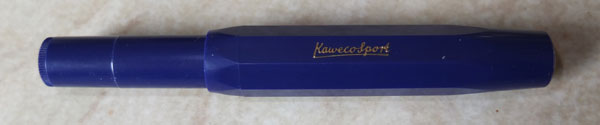
As you may have noticed I seldom buy modern pens.  Not my thing, really, but I had a bundle of small international cartridges that came in a lot I bought some time ago and I wanted an inexpensive pen to use them up.  I didn’t really consider any of the Chinese pens.  They haven’t worked out for me – metal sections and brass barrels make no sense to someone whose usual pens are Swans and Conway Stewarts.  I’ve had earlier piston fill versions of the Kaweco Sport with gold nibs and I knew that the current classic Sport isn’t as well featured as they were, but I like the idea of the long-short pen.

DSCF2027

I bought mine from Amazon and it came directly from Germany.  Postage included, it was around £20.00.  I opted for the broad and that’s what I got but it isn’t all that broad.  More of a generous medium, I feel.  That’s not a complaint, really.  The nib width is good.  I’m pleased with it.  The pen weighs practically nothing, which is how I like them and it does what it’s meant to do.  The threads, both cap and section, are good.  There’s no clip but I wasn’t going to be carrying it anyway and the octagonal cap keeps it from rolling off the desk.  The plated nib has a few curlicues on it as they all do nowadays, but it also reminds us that Kaweco has been around since 1883.  There’s a little gilded disc with “Kaweco” on it on the top of the cap, and “Made In Germany” is on the bottom of the barrel.

DSCF2029

In use it’s long enough posted, the ink flow’s great out of the box and I’m very pleased with it.  Great little pen.  Everybody should have one.

DSCF2014

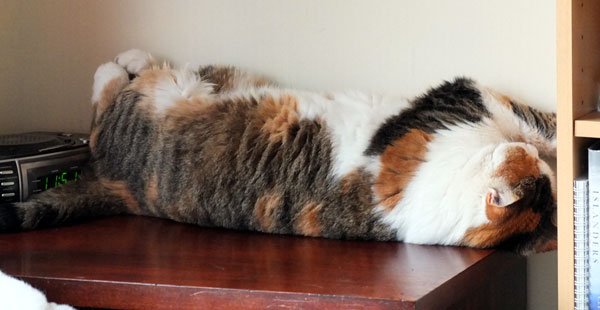
My assistant doesn’t work on Saturdays.

DSCF2018

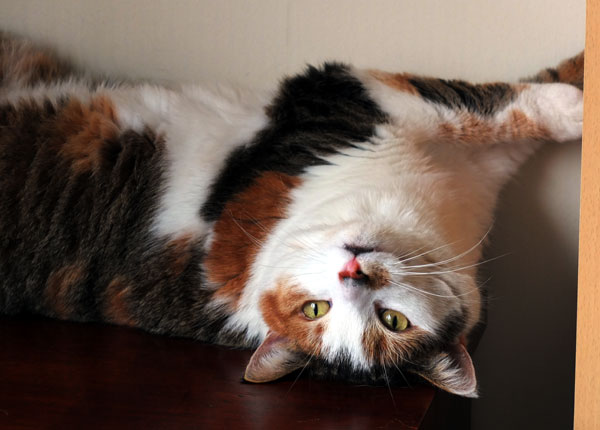
She’s not very keen on having her photograph taken either.

The Waverley Nib

DSCF1997

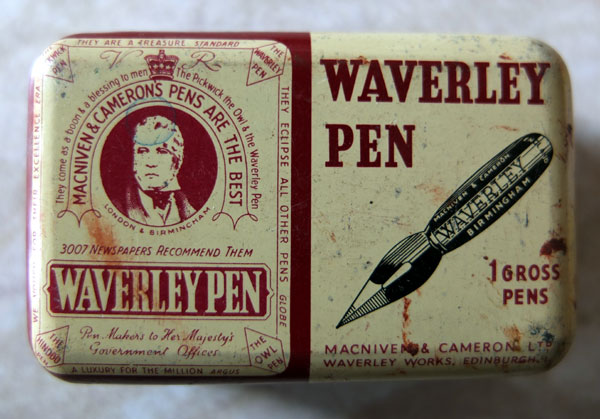
Once upon a time, children, in the long, long ago, there was an inspired inventor called Duncan Cameron.  In those days of horseless carriages and ridiculous hats, people wrote with either a goose feather or a pointy steel dip nib.  The feather was OK but the nib had a tendency to dig into the paper, sending a spray of ink, together with the occasional blot across your penmanship.  Duncan addressed this problem by creating the Waverley nib, characterised by a narrow waist and and an upturned nib.  Some say the nib was patented in 1850 and others say it was 1864.  Either way, ’twas ages ago and I don’t have the energy to hunt down the truth of the matter (bad, bad historian; slaphand).  Anyways, it was an immense success and the nib was taken up by almost everyone except schools where they liked to continue to torture the children with paper-slasher nibs.

The Waverley nib became Macniven & Cameron’s best-selling product, and when they later decided to branch out into fountain pens like this splendid example:

various-001

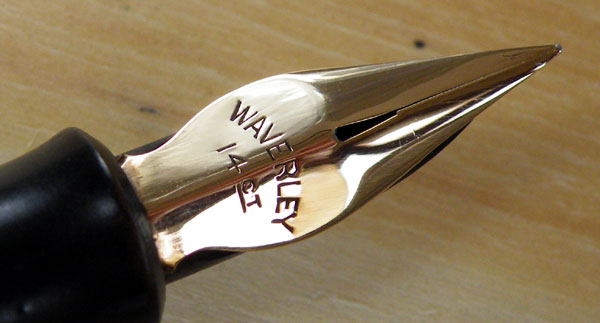
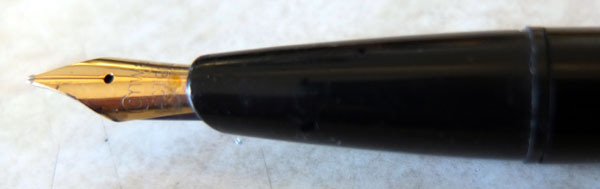
they retained their well-known narrow-waisted, leaf-shaped nib as a selling point.  What they didn’t do, of course, was tilt the tip of the fountain nib, for the simple reason that fountain pen nibs have smooth, long-lasting tipping material and have no tendency to dig into the paper.  Such a thing would be redundant, so they didn’t do it.  Here’s the fountain pen version of the Waverley nib, as straight and untilted as any other:

various-008

Probably independently, Sheaffer took up the idea of tilting the tips of nibs, particularly their tubular nibs, in the belief that this made them smoother writers.  They were wrong, of course.  Those tip-tilted Sheaffers don’t write any more smoothly – or indeed any different – than any competently-made nib.

Mr. Richard Binder took up the idea of the Waverley nib some time back, though for some reason he transferred the idea to fountain pen nibs, rather than dip nibs where it actually has some benefit.  Now, I see in FPN, he has acquired the commercial rights to the term and is getting a little snappy about others using it.

Considering how much the term has been bandied about in the last few years, it seems unlikely that it could be legally limited in this way.  It’s amusing, though, how these things come around.

They come as a Boon and a Blessing to men
The Pickwick, the Owl and the Waverley Pen  

When Duncan Cameron named his improved nib after Sir Walter Scott’s novels and the area of Edinburgh where the main railway station is, he couldn’t have foreseen that the concept would give rise to litigious grumblings on the other side of the Atlantic a century and a half later.  However, as we know, the history of the fountain pen is one of homages and copies.  Truly, there’s nothing new under the sun!

The Conway Stewart 57

DSCF1988

I don’t usually buy pens from Conway Stewart’s later output so I must have been dozing off when I bought this 57.  It happens.

I got around to assessing and restoring it today.  Actually, it was in pretty good order and didn’t need a lot done.  I had to put a new sac on, but removing the Pressac sac shield and refitting it was no trouble at all.  Other than that, I flushed the nib/hood unit until the water ran clear, cleaned the pen up a bit and that was that.

DSCF1989

This is by no means the last of Conway Stewart’s pens and while it shows a decline in standards from the high days of the fifties and earlier, it’s not at all a bad pen.  There are the usual slight markings of use but that’s all.  To my surprise, the gold plating has held up well despite clear indications that the pen has been well used.

DSCF1991

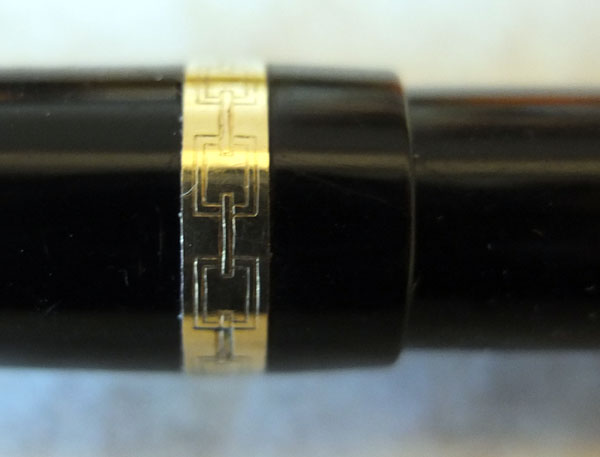
So how does this pen of Conway Stewart’s declining years stack up just as a writing instrument?  I think one might be entitled to knock off a point or two for the filling system.  The Pressac bears a superficial resemblance to Parker’s Aeromentric filler but it isn’t as efficient as it lacks a breather tube.  It’s just a squeeze filler.  The nib’s a nail but that’s OK – plenty of people like nails.  The clutch works well and the pen closes firmly.  The ink flow’s good and the pen sits well in the hand.  I could use this pen quite happily.  It wouldn’t be my first choice but it wouldn’t give me any problems either.  It’s on a par, I think, with the better Chinese pens that are being produced today, with its squeeze filler and nail nib, except that it harks back to a well-respected line of pens and it has a gold nib, which sets it a step or two above.  Also, the chain motif on the cap band might lift it another half a step further.

DSCF1994

One other thing about this pen is that it’s a bit of stylistic grab-bag.  It’s a long, tapering pen like the 85L but it shows pretensions to something more modern.  The nib is fully exposed.  Why then does it have a long hood – which serves no practical purpose – rather than a normal section?  I think it shows two things: that Conway Stewart’s designers knew that the public wanted something new, but also that they didn’t have the money to tool up for a completely new pen, so they made this cheerless compromise.

The 57’s diamond clip is a reminder of past glories but the purposeless hood is an omen of things to come.

The Dickinson Croxley Button Filler

Dickinson Croxley had a short life (1947 – 1949) but, judging by the number of their pens out there, a very successful one.  I’ve heard it said that because of their outdated styling and the absence of an alternative filling system (Croxleys are generally lever fillers) there was no future for the brand and Dickinson wound it up.

This has never struck me as being a satisfactory explanation of the demise of the company.  After all, Conway Stewart got another couple of decades out of the lever filling system.  Moreover, in 1948 Croxley made a streamlined pen that broke away from the admittedly staid line of their previous production.
DSCF1972
As if that wasn’t enough, here’s a Croxley button-filler with a metal cap, in a very modern style for 1948.  It seems that Croxley’s designers had a good look at what was happening in the rest of the market before they came out with this pen.  The clip’s fitting is similar to what Conway Stewart were doing, but simpler and better.  The shallow-cowled washer clip is held by a plastic stud that has a slot for a normal screwdriver on the inside end. No aluminium nut or spanning screwdriver! DSCF1985

The beautifully machined button and its housing bear a debt of gratitude to the Parker Duofold AF which was introduced in the same year.  The pen caps with a Parker-like clutch.  Taken all in all, this remarkable pen is evidence that whatever other reason there was for Dickinson to bring an end to the Croxley range of pens, lack of new ideas wasn’t the cause.

The one failing that mars this otherwise pristine pen are plier marks on the section, evidence of the drooling cretin at work once more.  Thankfully they are shallow and relatively unobtrusive, as I am prevented from minimising them further by the ribbing on the section.
DSCF1974
This example was produced, probably as a giveaway for members, for the Manchester Unity Of Odd Fellows.  You will know, of course, that the Odd Fellows were a benevolent society whose origins are lost in the depths of time, and also that the Manchester Unity broke away from the parent body in 1810 to become a most effective and innovative Friendly Society, providing such benefits for its members as health care provision in pre-National Health Service times.  I think they’re still around but they’re not getting their pen back!

DSCF1976

Stuff

Phew!  The last few days have been hectic!  Not pen stuff, more that irritating nonsense we call life.  It won’t be letting up for the next couple of days either, so updates here are unlikely before the weekend at the earliest.


It all gets a bit pesky sometimes.

Pen Prices

At the end of December and into the beginning of January I took a break from buying in ebay.  When I returned to it, I found that prices for unrestored pens were generally higher than they had been.  I took it that it was a temporary blip and didn’t think much more about it.

Now it’s March and prices haven’t leveled out again.  If anything, they seem to have taken another price hike.  Mid-range Swans and Conway Stewarts that I would have bought for under thirty pounds last year now regularly get bid up to the high thirties and even into the forties.  Considering that there has been no commensurate rise in the prices reached by restored pens, it’s kind of insane.

I don’t know why this has happened.  I could speculate, but that’s all it would be – speculation.  One guess is that with the troubled times we’re in and the rise in unemployment, more people are trying to make a living from ebay, and in this specific area, from pen restoration.  I do see more and different sellers of restored pens in ebay.

Unfortunately for them, it’s not going to work.  If you’re paying £40.00 for a Conway Stewart 27 and selling it for £45 (or less) you’re not making a fiver, you’re losing money.  The cost of delivering the pen to you – usually around £3.00 – is part of the buying price.  You don’t recover it.  Then there may be a sac, use of cleaning materials and polishes and at least some notional figure for your time.  It’s a kind of bubble that must burst sooner or later.

It’s inconveniencing me but it isn’t any kind of a disaster, at least in the short term.  I always have a quite large stock of pens by me, and ebay’s not the only place to buy pens if it comes to it.  I won’t pay those prices, though.  Yes, if the general restored pens/vintage retail market is forced into an upward lurch in price I would have to accept that this is where prices are and will be.  We’re not there yet, though.  I prefer to believe that this inflation in unrestored pen prices will pass and we can go back to something like business as usual.  I see no advantage to anyone in a rise in price for restored vintage pens.  They’re dear enough already.