Unique No 1 Pen & Pencil Set

As I’ve said often before, I’m not really a collector.  Nonetheless, I have around thirty pens that I’ve hung onto because I found them especially interesting or attractive.  They don’t have any great value and the next pen fancier along might not think much of them.  One of the first pens I bought with the intention of keeping was a black hard rubber Unique No 51, made some time in the 1920s.  The reason it appealed to me so much is the contrast it made with the last Uniques.  Though still adequate pens, the 1950s Uniques were obviously placed low in the market, whereas the 1920s pens were extremely well made.  They failed a little on the trim, but the design and machining of these early pens was very good, they are a pleasure to use and the nibs – at least on those I’ve acquired so far – are a smooth and flexible delight.
IMGP1514
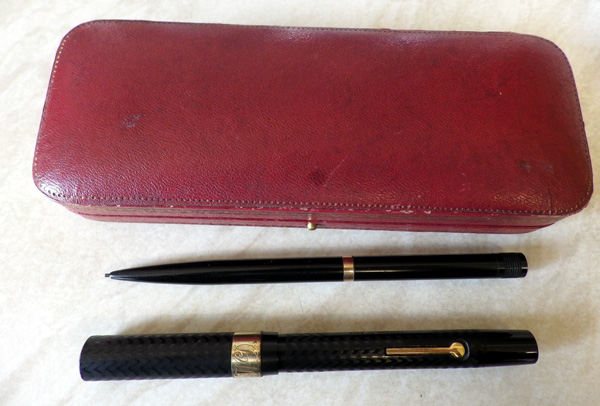
When this very fresh set appeared last week I put in a bid and got it.  It arrived today, and I haven’t had time to restore it yet, so here it is in all its glory.  The pen has been used enough to have acquired the very slightest fading to very dark brown.  The pencil is pristine.
IMGP1515
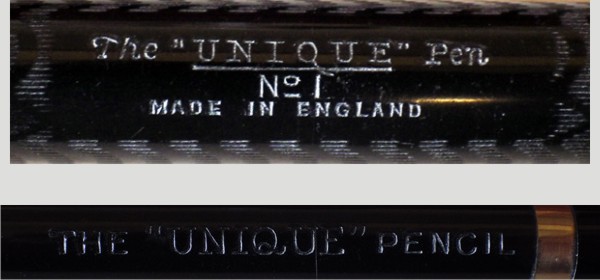
The Guarantee document is dated August 31st 1928, and it is assigned to EF Drury, 16 Chapel Street, Southport.  The slightly tarnished cap band bears the initials WD in a flowing cursive script, so it was bought for a relative, perhaps a son or daughter.  The pen, which is a Unique No 1, bears a strong resemblance to my No 51, with its deeply-cut engine chasing, clipless cap and concave section.  It differs in that the nib is a warranted one rather than the Unique nib in the 51, but it’s a lovely nib with lots of flexibility.
uniqueedit
I’m impressed with the smooth, slender pencil in black hard rubber, bearing a single gold plated band.  I wondered if it was still in working order, and a slight twist of the knurled end produced the lead at the business end.  The plush-lined leather (or imitation leather) box is in good order and still retains its gold trim.  As well as the guarantee, the box contains filling instructions and a price-list for replacement parts.  A nib would cost you two shillings and sixpence and a cap was only a shilling.  You are reminded to send fourpence for the return post.  Today, a nib would cost you around £25 if you could find one to fit, and caps are rarer than hen’s teeth.  Oh, and the postage would be more than £4.00!

Edited to add:  Where are all the 1930s Uniques?
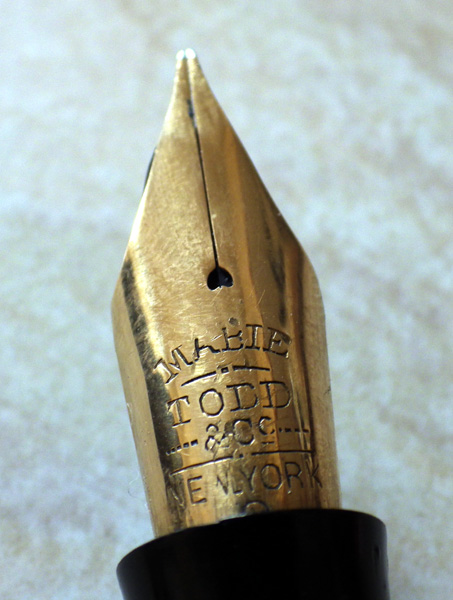
Mabie Todd Pen List Live!

John Brindle’s list is available now here.  I’ve also added the URL to my blogroll, down on the right-hand side of this blog.  Many thanks to Martin Holloway who made a splendid job of creating the site.

As well as being a useful source as it stands, John’s list provides an excellent start-point for further research.

A Jade National Security Button Filler

IMGP1218

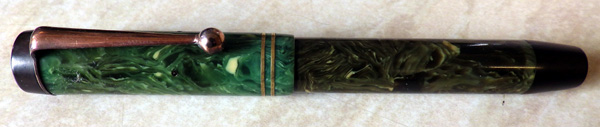
This National Security button filler is an unashamed copy of the Parker Duofold.  If it was a Duofold the twin cap rings and streamlined profile would date it to the early thirties and that date will probably be right for this pen too.  I have no doubt that it was made for National Security by Valentine, as they seemed to have carte blanche to copy Parker pens for their own range and for those pens they made for other companies.

IMGP1220

I haven’t set to work to restore this pen yet.  Like many jade pens it has a fair degree of discolouring on the barrel, though the cap is as fresh as the day it was made.  There’s nothing I can do about the discolouration but it isn’t really unattractive.  The warranted nib has no tipping material left, so I’ll have to find a replacement.  That indicates a lot of use, but the barrel imprint is sharp and clear.

IMGP1224

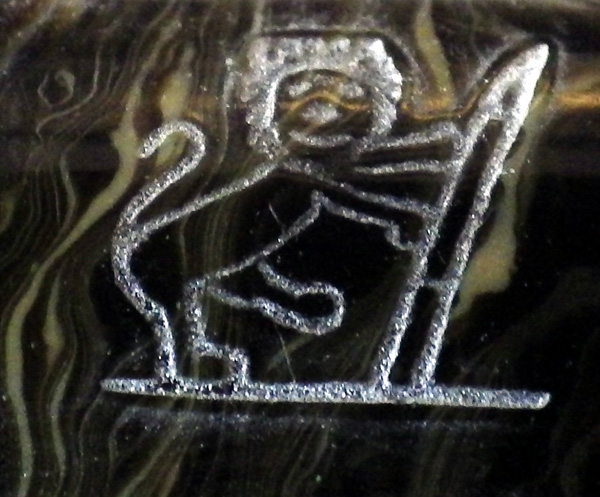
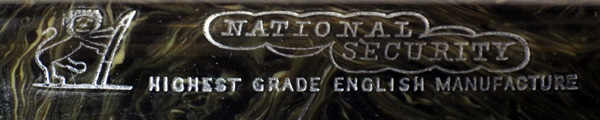
I’m very fond of the smiley lion.  He’s my avatar in Fountain Pen Board, though that example was on a lapis lazuli pen.

National Security pens are by no means rare but we know surprisingly little about them.  They along with Rosemary were the house brands of British Carbon Papers.  Other than the fact that they were wound up in 1948 I can find little information on BCP.  They shared premises at Farringdon Ave with Henry Stark, Son and Hamilton who made most of their early pens, while later ones appear to have been made by Valentine and Langs.  Apparently BCP was not popular with the rest of the pen industry as they refused to join the price-fixing arrangement of the time and undercut their competitors.
IMGP1223
A tremendous range of pens was sold under the National Security imprint, and you never know what you might find, from obvious Duofold copies like this one, to bulb-fillers and snake-skins.  They’re very collectable.

No Number Swan

There are so many Swans that have no model number.  Most are no mystery and you can easily work out what they are; others are more difficult to fit into the Swan range.
IMGP1212
When I saw this pen in ebay in somewhat scruffy unrestored condition, I took it to be a Swan Minor No 2.  Both are long, quite slender pens with a handsome fixed clip, but there the resemblance ends.  The Swan Minors I have seen are engine chased, this one is smooth.  Minors have a black hard rubber lever, this pen has the long gold plated lever that you see on the SF2.  The Minor is 13.5cm capped, this pen is 14cm.
IMGP1213
So what is it?  It isn’t an SF2 barrel mated with a later cap because the shape of the barrel is wrong.  In any case, there’s no indication this pen is made from bits.  Both cap an barrel are without any fading and the level of wear is very slight and the same on both parts.  I would say that it’s entirely original.  I don’t have a clue what it is.  Taking all its parts, it seems to fall between the SF2s and the Swan Minor 2s, taking part of the style of each.  Any ideas?
IMGP1215
It’s a gorgeous pen, long but not unbalanced, and the nib is a medium with appreciable flexibility.

The Mabie Todd Pens List

Just a few quick lines today as my assistant and are up to our respective ears (hers are relatively higher than mine) in work.

The Mabie Todd  numbers site proceeds apace.  Many thanks to Martin Holloway who has acquired the domain and has begun work on the site.  He has been reading your comments with interest.  I think the way that it will work is that Martin will have the final say on what it is practical to do, under John Brindle’s ownership of the material which he is very generously making available.

Martin has suggested a downloadable .pdf file of the material, which seems like the way to go.  Illustrations of the pens seems the next logical step and Martin is looking into how that could be best implemented.

It will take some time and quite a lot of work but I’m looking forward with great anticipation to seeing this coming to fruition.

New Mabie Todd Research

A gentleman by name of John Brindle phoned the other night to speak to me.  I was unavailable at the time and my husband, another pen enthusiast, took the call.  John spent last winter researching Mabie Todd fountain pens, and he has drawn up a list correlating model number, colour, cap bands and filling system.  He has recorded – literally – hundreds of pens.

I have the list before me now and it’s an astonishing piece of work, clearly very valuable to Swan and Blackbird enthusiasts.  John seems amenable to the idea of having it published but I want to ascertain that more formally.  Then I would either need a copy of the original digitised document or I would have to key it in.  It shouldn’t be difficult to find somewhere to host it for a time to make it widely available.

A No-Number Nineteen-Twenties Swan

I often come across Swan pens with no model number.  Was the model number intentionally left off or was it an oversight?  If the latter, there seems to have been a lot of oversights and it was an omission that could easily have been returned by inspectors for rectification.  It’s just another Mabie Todd puzzle, like so many more.  Sometimes it’s absolutely clear what they are – if it’s streamlined, dark blue and has a No 1 nib, it’s a 3120 – but other times it’s harder or impossible to discern what model a pen is.
IMGP1196
Take this nineteen-twenties beauty that came my way the other day.  It’s barrel-stamped as a Self Filler but there’s no number on the barrel end.  Never has been, either, as it’s not at all worn.  It’s a very long pen at 14cm capped and an outstanding 17.5cm posted!  It’s slightly more slender than, say, an SF230 but it isn’t very slender.  It’s reminiscent of the Swan Minor range, though I seem to remember an SM2 as being shorter and having a machined pattern, whereas this has none.  Whatever it is, it’s a gorgeous pen and it feels good in the hand despite its length.

IMGP1202

The handsome No 2 nib is semi-flexible and a pleasure to write with.  In a recent email conversation, my correspondent and I concluded that semi-flexible is the way to go.  You want some line variation but a full and easily induced flex is just too much for everyday writing.

IMGP1206

In conclusion, though this pen has points of resemblance to several other pens of its time, I haven’t seen another quite like it  It’s quite special.

IMGP1198

Mabie Todd Swan 3230

It was in the early nineteen-fifties that the uniform grey pens were popular.  Almost every pen manufacturer made a grey pen.  It was a sign of the (very slightly) changing times.  It was a reserved, dignified colour but it wasn’t black.  For a few short years, in fact, grey was the new black.  Then many of these lovely grey pens began to show an unpleasant yellow discolouration.  Though it didn’t affect every pen, it was indiscriminate – Swans, Parkers, Wyverns – all were likely to suffer this malaise.  By the late fifties the grey pen had gone, never to return except for Conway Stewart which turned out a few in the seventies with the same sad results.  If it was decaying sacs that caused the discolouring, one would have thought it would have affected every pen but it didn’t.  Was it a widely – but not universally – used ink?  I don’t know, but it varied from slight patches of barely discernible yellowing to whole pens that took on a pale, ghastly corpse-like hue.  Not nice.
IMGP1189
This Swan 3230 is one of the few that didn’t succumb to the yellow plague.  Good thing too, because it’s a superb pen.  The gold plating has lasted well throughout and the plastic has readily taken a shine. 

IMGP1193

It’s my impression  – I may be wrong – that the grey plastic is harder than the other colours Swan used at this time, and doesn’t take scratches so easily.

IMGP1194

It has had the nib replaced, with a No 3 rather than the No 2 it originally had.  I’m happy to leave it where it is though.  It fits and writes well and it’s a rather nice broad, rarest of all the nib types back in the day.

The unpopularity of the grey pen remains today.  A grey Parker Victory, for instance, will always go for a few pounds less than an otherwise identical black one, and this bias persists across manufacturers.  If you want a bargain on a first rate Swan, wait until a grey one appears in ebay  But watch out for the dreaded yellow lurgy!

IMGP1191

Musing On The Pen Boards

I gave up on Fountain Pen Network after the last round of deletions and suspensions so I have no idea how things are going there.  I cannot find it in me to care, either.  However, I see many of the more knowledgeable and interesting former habitués commenting on other boards now.  Indeed, this diaspora of FPN refugees seems to have reinvigorated some of the other boards.  I have high hopes of better things to come on FPB and FPG.

Talking of FPB and FPG, it is amusing to see David Isaacson, the calm, eminently reasonable and even-handed mod of FPB playing the part of an irritating thirteen year old troll in FPG.  My assistant thinks it’s a total hoot!
DSCF3135
For myself, I can take it or leave it…

Mabie Todd Swan SF8

The postie arrived with her usual burden of pens this morning.
IMGP1182
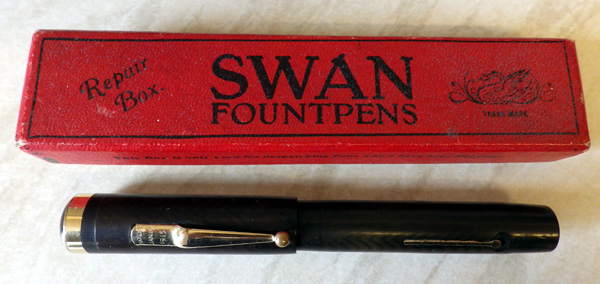
This one looks interesting – you don’t often see a Swan repair box.
IMGP1183
Pretty big, isn’t ?
IMGP1185
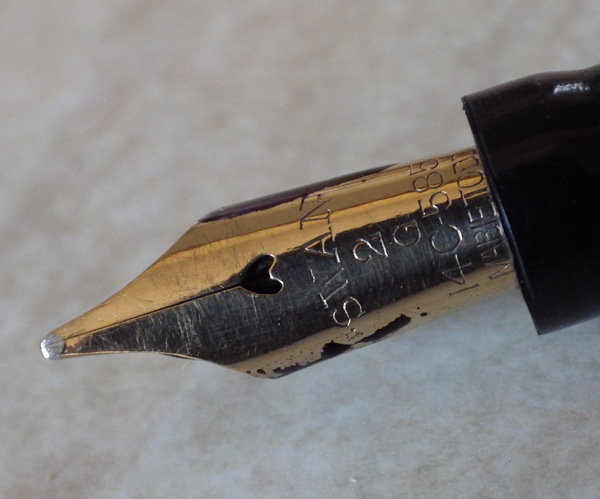
That’s a Swan No 8 nib, only the second I’ve ever seen.  It will be a real pleasure to bring this one back to working condition.