An Eleventh Century Irish Poem

Colum Cille The Scribe

My hand is weary with writing,
My sharp quill is not steady,
My slender-beaked pen pours forth
A black draft of shining dark-blue ink.

A stream of the wisdom of blessed God
Springs from my fair-brown shapely hand:
On the page it squirts its draft
Of ink of the green-skinned holly.

My little dripping pen travels
Across the plane of shining books,
Without ceasing for the wealth of the great –
Whence my hand is weary with writing.

Tr. by Kuno Meyer

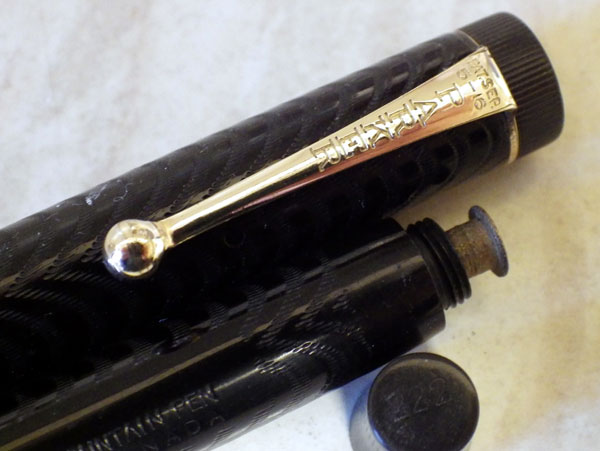
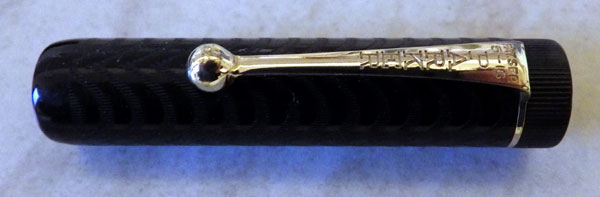
Black Hard Rubber Parker Lucky Curve

IMGP4750

IMGP4753

This is a pre-Duofold Lucky Curve button-filler.  I can’t identify or date it more precisely because I’m not well up on American and, as in this case, Canadian pens.  Suffice to say that it’s a handsome old pen and this one is in exceptionally good condition, still shiny and black with little wear on the engine-turned pattern and the imprint. Oh, and it has 222 on the end of the barrel but I haven’t a clue what that signifies.
IMGP4761
As with many button fillers someone had taken the old sac out and while they were there, they had taken the time to throw the pressure bar away.  Of course it might have been that the pressure bar was rusted or broken, but it happens so often that I suspect a conspiracy.  There are some bad, nihilistic groups out there you know.  I can just see them now, cackling fiendishly as they throw yet another precious long pressure bar into the waste-paper bin.  As luck would have it I had a long pressure bar in stock and was able to fit it and bring this fine old pen back into working condition.  Foiled, you filthy throwers-away of pressure bars!  You will never win!
IMGP4760
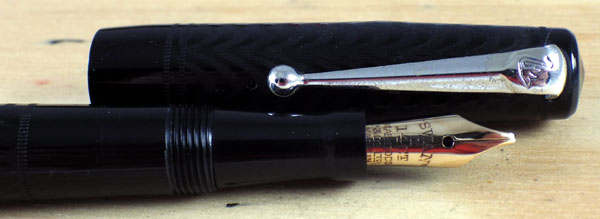
This pen is a Lucky Curve in name only, as like so many of this type, the feed has been cropped, by a former repairer, I assume.  I see the odd complete Lucky Curve, but not many.  However, it doesn’t seem to have affected the pen adversely.  It writes well with just a hint of flex and it sits well in the hand.  It’s a slender pen, but not as slender as some of the earlier eyedroppers.  I could live quite well with this pen.
IMGP4756
If any of you have more information about this fine old Parker, please don’t hesitate to enlighten me.  I confess myself in need of education where pens from the other side of the Atlantic are concerned

Ephemera

I’ve just loaded up a new section of the sales site. I called it “Ephemera” but I maybe should have called it “This & That” or “Stuff” because most of the things there aren’t particularly ephemeral. Have a look anyway, you might find what you’ve been looking for!

OK Foreign Pens

IMGP4738

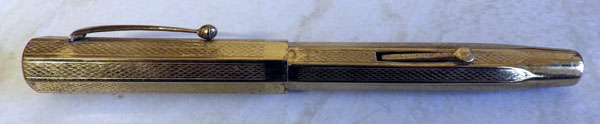
I suppose that many of you will have come across pens with “foreign” on the lever and “OK” on the  steel nib.  They are often very attractive pens, like this one, but all that I’ve had were impossible to repair.

Generally the section is stuck into the barrel with some mighty adhesive which could be useful in salvaging sunk oil-tankers.  It could withstand a straight lift of several thousand tons without giving an inch.  As I proved to myself recently, heat will eventually defeat it but it’s a long and tedious job.  I was utterly determined to get this one apart just to see what was in there, and because it’s a pretty pen in good condition.  Someone might have enjoyed it.
IMGP4739
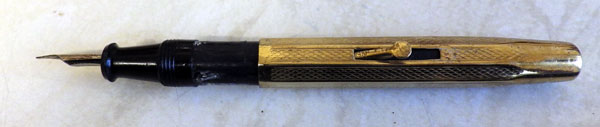
However, as you can see, there’s a plastic inner sleeve through which the inner end of the lever passes and there seems to be no way of disengaging it.  Checkmate, foreign pen.  I suppose I could go the delicate, technical route and hack the plastic sheath to bits with tin-snips, but who has the time?  I haven’t quite conceded defeat yet.  I’ll put it on the shelf and have a think about it.  Probably for years.

I finally got the bits and pieces together for the “ephemera” section and I photographed them all last night.  I’ll edit the photos, write descriptions and I should be uploading them very soon, provided I don’t get interrupted too often.

I always thought of ephemera as things of short duration – newspaper advertisements, perhaps or posters.  That kind of thing.  Now the term seems to have been expended to include anything related to the collected object – in this case fountain pens – regardless of their solidity and durability.  Some of the things I’ll be including as “ephemera” will still be around when the last celluloid pen has disintegrated into a dusty pile of chemicals.  But who am I to argue with linguistic change?  It’s not so long ago that it was a heinous crime to start a sentence with but, but now it’s OK.  In fact, reading the pen boards, most posts seems to start with “well”, as in “Well, I finally bought the Montegrappa…”  Well, that’s OK too.

That’s enough demented rambling for today.  To work!

A Little Pricey, Perhaps?

A little bird told me that there was an exceptional sale at an auction the other day.  Here’s the story:

I was watching an auction on the-saleroom.com for a lot with a Ford Patent pen
and a Montblanc Safety, hoping other people wouldn’t notice (they did
unfortunately), but a different lot with two Swan pens sold for more than
£3500. The auctioneer was a bit shocked given their estimate. Here is the
lot:

http://www.the-saleroom.com/en-gb/auction-catalogues/keys–aylsham-salerooms/catalogue-id-2898070/lot-20567821

When you add in buyer’s premium and VAT, the cost must add up to about
£4500. I wondered if I am missing something – I have seen sterling silver
Swans sell for £600, but this auction price seems unusual. I had no idea
Swan collectors are so keen.

I confess that pens of this quality are mostly out of my league, though I have dabbled a bit on behalf of a customer some time ago.  A good condition hundred-year-old sterling pen was around £400.00 then.  Admittedly, these examples are reputedly pristine, but even so…

It’s unusual for the habitues of auctions to get into the sort of bidding war that we see on eBay, so I think that’s one of the less likely explanations, though it isn’t impossible.  I’m completely flummoxed – I can think of no explanation for the price these pens have reached.  On a minor note, the estimate that the auctioneers arrived at suggests they wouldn’t be the best people to be selling your precious pens.

So that’s the story.  Any thoughts?

A Flexible Swan SM100/60

It’s not uncommon to see in the pen discussion groups the opinion that the smaller Swan nibs aren’t worth bothering with and it’s only No 3 and upwards that are worthy of collection.  I don’t know what the thinking behind that is (prejudice? ignorance?)  but I’m quite happy that it should be repeated loudly and often, thereby leaving the No 1s and No 2s to me.  It’s among those sizes more than any other that I find the delicious stubs and impressive flexibility.
IMGP4657
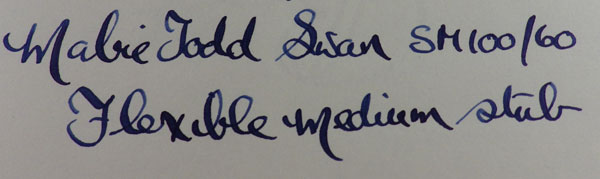
Take this unassuming SM100/60, a pen that will hardly fetch a second glance, and if it does so it’s usually to comment on its unusual black hard rubber lever.  However, have a look at the writing sample.

IMGP4665

I can’t make the most of these flex nibs but there’s enough there to give an indication of its capabilities.  In the hands of a master I’m sure it will impress a great deal more.

These were not expensive pens, in fact they were about the bottom of the Swan range, and they are very often supplied with exceptional nibs – flex, stub or oblique.  In other words, Swan’s concern that the customer should be provided with exactly what suited him or her didn’t stop at the prestige models but extended to those on a limited budget – who, if they worked in a clerical capacity or were students, were often the people who used their pens the most.

So far as I can tell from the company’s adverts over the years, there was never an extra charge for supplying a nib to to the customer’s taste.  There’s something there that many modern pen companies can learn from.  Naming no names, there are several manufacturers of very expensive pens who offer no more than fine, medium and broad.  Others add extra fine.  One or two will “custom grind” a nib to oblique, stub or italic but that costs extra.  Seems to me they might be a little more obliging.  Perhaps they feel duty bound to provide the “nibmeisters” with a living.  No such critter existed when pens were just what you wrote with.

The Perfect Pen

For a long time I had the perfect pen for me.  It was a long,slender black chased hard rubber Onoto with a flexible oblique stub nib.   It weighed virtually nothing (a very good property in a pen for me) and the glorious nib allowed me to write fast and legibly and make all sorts of fancy swirls when the mood struck me.  Alas, time goes by and what was perfect yesterday may no longer be today.  Arthritis has made gripping a slender pen painful and I had to set the Onoto aside.  After a time I sold it.  A pen like that shouldn’t sit not being used.

What would my perfect pen be now?  Nineteen-twenties or thirties Duofolds are about the girth I want and those excellent pens weigh very little, but it’s very rare indeed that I find a Parker nib that suits my hand.  The nib would have to have some useable flexibility and I remain fond of a well-formed stub – medium, though.  Broad stubs are too much.  Aesthetics would matter too.  I would only want BHR if it was fully black and crisp.  Otherwise, some colour is essential.  Something like Mabie Todd’s prewar russet/jade marble would be nice.  That would imply one of the larger prewar Swans, which would do very well.  An Onoto Magna in mottled hard rubber would be quite satisfactory, thank you.  Red hard rubber would be even better.

While I wait for my perfect pen to come along I pick and choose among the stock, or use pens from my accumulation.  At the moment I use my tiny Kaweco Sport.  It meets absolutely none of my requirements and it has a hard, rounded broad nib.  It’s a challenge to try to write well with such a pen.

What would your perfect pen be?  Do tell!

Early Days: Part the Third

For a time, it seemed to my husband that cartridge-fill pens were the only option and he bought a cheap Waterman with this filling system.  It did the job quite badly, but he persevered with it.    What made it so frustrating was that the junk-shops had excellent gold-nibbed pens for sale for mere pennies: Conway Stewarts, Swans, Onotos, Sheaffers, Parkers.  All were in need of basic repair and he could source neither a repairer nor the parts that would enable him to do the job himself.  He bought several of those old pens, though.  Looking back now, it would have been better  if he’d bought a whole lot more.  To cut a long story short, he did eventually find some sacs and was back to writing with decent pens.  The plated-nib Waterman was relegated to the drawer and never used again.

Now that he’s retired he has become less narrow in his estimate of what makes a good pen, and will write with cartridge pens and even those steel-nibbed, round-tip pens that he detested before for their characterlessness (is it a word?  It is now.) and emulation of the ballpoint.  He says it’s a challenge to write well with pens like that.  However, back when he was working, a good pen with some flex and character like a Swan or an Onoto was essential so that he could write fast and legibly.

There has never been a better time for the fountain pen user than now.  For those who are dedicated to the ballpoint style of writing, there is a horde of new pens at all prices, while for the more traditional fountain pen user, all the old pens are back as good as new.  That’s a fantastic range of choice.

Early Days: Part The Second

My husband was not unduly put out by being restricted to using a pencil.  After all, it was much easier to control than that horrible dip pen.  Anyway, it was soon after that that he moved to another school, one that was more liberal in every way.  Pupils could write with whatever they wanted.  In those days, ballpoints (or Biros as they were known here, regardless of who made them) were notable mostly for unreliability.  Usually, they stopped writing while the refill was still full.  Others developed the infuriating habit of skipping, but only intermittently, so that you hung on to it a little bit longer in the futile hope that it had cleared itself.  The ones that wrote best tended to deliver a little too much ink.  It gathered around the point and left a sticky blob every sentence or so.

My husband opted for the fountain pen, and his first one was an Osmiroid 65.  It was a great pen and it lasted a whole week before he lost it, as was his way.  The next one was the first of many rock-bottom Platignums, the kind that had a plastic body and a gold-alike plastic cap.  It blobbed and blotted and sometimes refused to write.  It was almost as bad as a ballpoint.  The years went by and he grew out of losing things.  His mother’s Conway Stewart was passed down to him and he began to really enjoy the pleasure of a good fountain pen.  Ballpoints were much improved by this time and most of his classmates used one but they didn’t win him over.  They were characterless, required a vertical grip and downward pressure.  They hurt the hand after a page or two.

Those were just about the last of the days when you could get your pen resacced.  You left it at the newsagents and picked it up a few days later for a very reasonable payment.  A sac lasted a long time, and by time he needed another new sac, the service had disappeared.  It seemed to be the end of the sac-fill pen.  But was it?

(Further thrilling episodes to follow)

Early Days

Long, long ago and not terribly far away my husband began school and among other things he learned to write.  In those days, the kiddiwinks were seated at double desks and each desk had a hole for an inkwell.  Splashes and trails of blue-black ink had stained the dark wood.  Getting to play with that stuff seemed like a most attractive proposition but it was only pencils that were allowed for the first couple of years.  But even for a youngster, the days roll by, the weeks accumulate and lo and behold the day arrived when the teacher inserted brown bakelite inkwells in the holes in the desks, applied the huge bottle of Stephens ink – strong both of colour and of odour –  and issued each pupil with a dip pen.  Seemingly endless instruction was given while the children quivered in anticipation of deploying the pen at last.  Finally, finally, the teacher wrote a sentence on the board and left the children to write it in their copybooks.  He dipped his pen, noticed that a quantity of ink had magically attached itself to the underside of the nib, and carefully applied it to the paper.  On the very first upstroke, the gimlet-pointed nib dug into the paper and splattered blots across the paper and the desk.  That was a bit disconcerting.  Try again.  Same result.  He knew that this was unlikely to meet with approval, and he could hear the teacher approaching, studying each child’s work and offering praise or advice as required.

His efforts were met with neither praise nor advice but with a screech of outrage at the inkblots all over his copybook and the desk, followed by a good crack over the knuckles with the ruler, as those were the days when it was believed the children learned by pain and fear.  Now a simple lack of dexterity was compounded by the shaking of the beaten hand.  More blots were added to the total and the nib became bent, with tines pointing to different points of the compass.  Further knuckle-thrashing ensued, together with a loud public announcement that henceforward he would be confined to using a pencil as he was too stupid to use a pen.

It was not an auspicious start.  The surprising thing is that he went on to write, moderately legibly, with a variety of writing instruments.  But not dip pens…