Writing on Animal Skins

Aren’t we lucky that we can just pop paper in the printer or open a new notebook and begin writing away? It isn’t so terribly long since none of that was possible. Perhaps not in living memory but a little before that paper was an expensive item for the ordinary household and before that there was no paper available at all but that was okay because hardly anyone could write.

I suppose we are all aware of the medieval illuminated manuscripts crafted on vellum: gospels and books of hours, as devotional works were called. Classical texts from antiquity were recovered and were also copied, as were original works, religious and scientific. All of these had to be copied up by hand, mostly in monasteries though some scholars were famous for the quality of their handwriting. All this was done on parchment or vellum. Some say that vellum is processed from calfskin whereas parchment is made from goatskin or sheepskin. Others say the two names are interchangeable.

To make parchment you washed the animal skin, soaked it in lime solution, washed it again, stretched it out on a wooden frame, scraped off the hair with a hooked knife called a lunellum and cut it into rectangular sheets. Scribes kept a pumice stone to even out the gooseberried skin and perhaps a boar’s tooth to polish the surface so that the ink – made from oak gall – would adhere. They kept a different knife to scrape off any mistakes.

This may seem an arduous process but it is estimated that the English royal government alone produced thirty thousand documents a year by the 12th century. So far as I can remember I have never actually handled any parchment so I bought a small piece so that I would know what I was talking about (for a change!). It is a cream coloured oblong of a substance quite unlike anything else. The piece I have is goatskin and there are slightly darker areas where the animal was coloured. I expect that this would have been unacceptable for a monastery. The parchment scrap is stiff, thin and has a slightly dimpled appearance, probably the gooseberry effect mentioned earlier.

I didn’t want to sully my little piece of vellum with my scrawl so I asked my friend Hans, who is an immeasurably better writer than I am, to choose a quotation that he found appropriate and you see the result above. Hans said that writing on parchment was quite an experience; some parts were rough, others very smooth. The ink does not penetrate, rather it dries on the surface. He used walnut ink (which looks splendid!) and a John Mitchell 0661 nib. Who can say whether it would have been easier using a quill.

There’s more to say on this subject. Monks or scribes used materials that were produced in-house, as it were. No nipping out to buy a bottle of ink in those days (actually it isn’t easy now, either!). I may take this further in a future article but this is as far as my research has taken me.

Deep gratitude to Hans Gilliams.
Sacs

Rob Parsons raised the issue of sacs, a more complicated business than it might at first appear. For years we were offered sacs that we were told were silicone but were actually PVC. Now the real thing is on offer. They are good sacs. Some people imagine that they are “better” in some way than latex sacs. This is not true. They have a purpose and their use should be limited to that. They are useful for celluloid patterns that are likely to be spoiled by a failing latex sac: jade, black and pearl, lapis lazuli and some others. The downside is that they provide more resistance to the mechanism than latex sacs and may apply too much pressure on levers and pressure bars.

Pliglass sacs look somewhat similar but are very different. They are used only in Parker Aerometric fillers such as the British Duofold and later Parker 51s. They have the wonderful property that few fail and and they are likely to last until the human race is no more. The few that do fail are the result of damage. They discolour but this is not a reason for replacement. Proper Pliglass replacements are available now.

Finally we get to latex sacs, by far the best solution for hard rubber pens or celluloid ones that will not discolour. They are very flexible and are therefore less demanding on filling mechanisms. They do fail through time and indeed it might be said that they begin failing the moment they are made. However this is a slow and imperceptible process. Latex sacs last a long time. As I said earlier I would expect this not to be a concern for eight to ten years. Many last much longer and I have heard stories of vintage pens being opened and found to contain a perfectly pliable original sac!

A concern was mentioned that the price of latex sacs is rising. The Pen Sac Company (the only manufacturer of latex sacs now) finally applied a modest increase in the cost of latex sacs few months ago. The price had remained at the same level for years and years. Because I use a lot of sacs I buy from the source and I don’t know what price rises have been applied by retailers. To be fair to them, they have to cover the import costs, as I do, and they are quite steep. I would say that they are only justified in raising their prices once in recent years, given that The Pen Sac Company only raised theirs once. How retailers charge for sacs is their business. Shop around.

I love latex sacs. They are much less bother than the alternative. Shellac fixes them firmly and never fails whereas you have to hunt around for adhesives for the other kinds and they are not always as reliable and easy to work with.

Finally, I regard The Pen Sac Company as the vintage pen hobby’s saint. The owners have restored old, failed machinery and made the production of all shapes and sizes of sacs possible. Without their determination to make restoration of old pens possible we would only have those vintage pens under glass, to be admired, not used. Way back when I started out in this hobby I didn’t know where to get ink sacs. There was no Internet to guide me and I had a splendid early Waterman with a wonderful nib. I could only use it as a dip pen. Thank you, The Pen Sac Company.

Lever-Fillers

Some people don’t like sac-filler pens, that is lever-fillers and button-fillers. For someone who has only used cartridge/converter fillers I can kind of understand why that might be. It’s all about flushing and lever-fillers especially can be difficult in that regard. Button-fillers, if they are properly serviced, are the easiest to flush of all pens, so the problem really focuses on lever-fillers. I use them a lot but mostly I refill with the same ink, only flushing after the third fill. Then I accept that so long as I get enough water through the pen to ensure that there will be no residue settling in the sac and feed I’m confident to put it away. I only use blues and blacks in my lever-fillers.

Once you accept that routine or something similar there’s no real reason to dislike lever-fillers. There might be an aesthetic dislike of the lever breaking the pattern of the barrel but really? Isn’t that a little fussy? A continued prejudice against lever-fillers denies one some of the best fountain pens there are: 1920s Watermans, Wahl Eversharps, Swans, Conway Stewarts – there’s quite a list of glorious pens denied to lever-haters!

On the good side, they’re easier and quicker to refill than a converter and give an enormous range of inks less expensively than cartridges. Personally, I avoid the red end of the spectrum with my lever-fillers but there is no real reason why I should do so. I could assign a few pens to these colours.

Some people avoid sac-fillers because they don’t trust the sac. They’re quite right; the sac will fail. I find my sacs take an average of eight to ten years between services. That’s not a bad lifespan. It’s vanishingly rare for a sac to fail while the pen is in use. It’s usually when you go to fill a pen that has been out of rotation for a while that you feel some resistance when you lift the lever. The sac has gone leathery and it’s time to fit another, or if you don’t want to do it yourself, to send it to the pen mechanic of your choice. I don’t know what they charge for that nowadays – say £30 and a tenner for return postage. 40p a year for the joy of using your lovely flexy Swan? I don’t think that’s too expensive.

The lever-filler was the most common filling system throughout the glory years of the fountain pen for a reason – or several reasons. It was convenient for the user, taking seconds to fill without having to remove any parts. The cost of production wasn’t excessive, probably less than plunger and piston fillers. There were cheaper pens available: bulb and syringe fillers, but they were not so reliable, having a tendency to drop blots of ink just as you reached the bottom of the page.

I don’t expect this article to change the minds of those who are convinced sac-fillers are too much trouble. They will go on with their cartridge/converter fillers and piston-fillers. That’s okay. If they all changed their minds and decided to buy those lever-fillers after all it would just jack the price up. I’m happy to leave things as they are!

A Bonzo Box

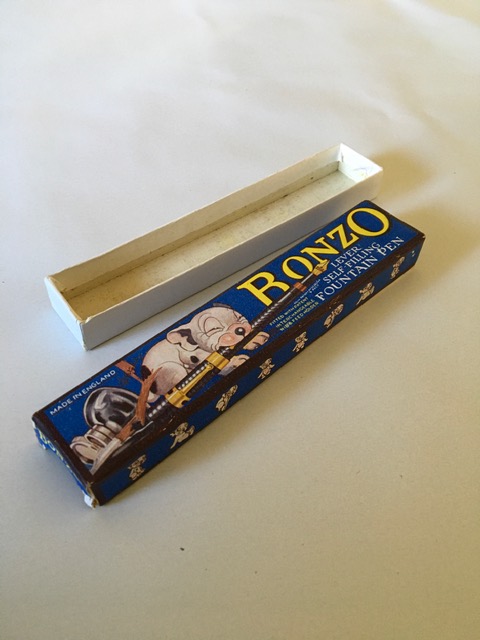
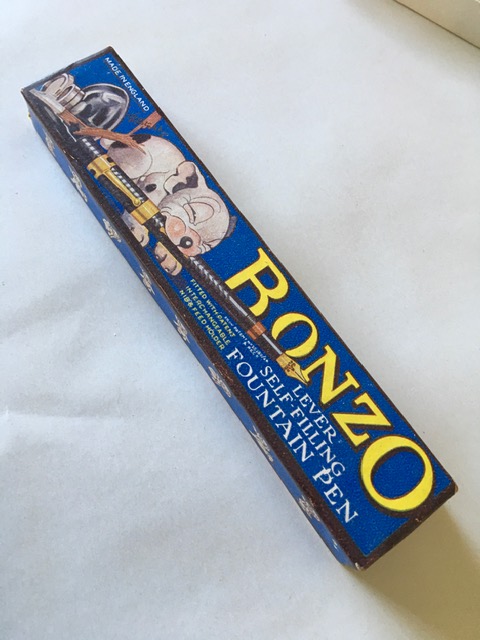
I wrote about the Bonzo pen once before. The search box above right will find it. On that occasion I had the pen but no box. Rob Parsons has kindly given me photos of a box in superb condition.

There isn’t much humour in pen world advertising and presentation. These humorous Bonzo images in brilliant colours provide exceptional light relief.

Some Swan and Onoto advertisemnts are funny and Conway Stewart’s “Speedy Phil” image is a light-hearted one. I’m sure there are many more but I can think of none quite as bright and cheerful as Bonzo.

In contrast to the box, the Bonzo is a serious pen, elegant and well made with its inserted clip (though actually the one illustrated on the box is earlier and has an accommodation clip) . It is certainly the best pen that Mentmore produced during that period.

Record it!

Humanity has an inbuilt need to write. At first it was purely practical, I’m sure, those cuneiform blocks recording stock and sales but it wasn’t long before the need to comment on life, record events and tell stories intruded.

Whether it was reed pens and papyrus, animal skins and quills, steel pens and paper it served an undeniable need. Fountain pens were not so different from the dip kind, just a little more convenient. Ballpoints added whatever it is that ballpoints add. Machines began to intrude as people composed directly onto the typewriter, later the flatter keyboard that fed a word processor or spreadsheet.

It’s possible to make moral judgments about these methods of laying our thoughts on paper or onto blocks of computer memory but ultimately it’s just about preference.

For many years my preference was fountain pens alone. There’s enough there to keep you fascinated forever, each nib being different from every other and there’s the charm of vintage and modern filling systems.

As a child I failed utterly at writing with a dip pen, the lethally pointed nib catching in the surface of the paper, spraying ink where it shouldn’t go. A few other kids managed it, a mystery to me. I hate to be defeated and a few months ago I decided on a rematch. At first I seemed to be no better than I was at seven years old but quite soon the years of acquired manual dexterity kicked in. I was astounded that I was finally able to write with the feared and detested dip pen even if it was only with relief and round hand stubs.

Over the years the batches of fountain pens I have bought for repair and resale contained occasional dip pen nibs. Some I gave away, others I kept though I could not have explained why. I now have a cigar box of nibs of every possible shape. Every new nib I tried was a challenge to be persevered with until I had some form of scrawled success.

It has become another obsession. I enjoy the slower pace of writing with dip nibs, though many retain quite a few lines-worth of ink with each dip. All my correspondence with friends of the pen persuasion is done that way now, with India or IG ink. Dip pens lack the everyday practicality of fountain pens but hey, this is a hobby. What does practicality have to do with it?

An Edward Todd Combo

I admire these early dip nib/pencil combinations. They are beautiful, clever and practical. This one probably dates to 1880 or thereabouts, though they continued to be made until 1920. It was made by Edward Todd. The pattern is elegant and the gold nib is especially beautiful.

I would guess that due to the difficulty (though not impossibility) of carrying ink, the pencil would be more used than the pen.

Probably gold plated (but it’s possible that it’s solid gold) and so beautifully decorated, this little instrument, as well as its eminent practicality, spoke of its owner’s taste and wealth. There are inexpensive extending pencils in base metals but I have never seen a cheap, early combo.

This little combo has survived in outstanding condition. It invites both use and admiration.

With thanks to Mario Kaouklis

Censorship!

You may remember the late 18th century deed I wrote about a few days ago. It seemed innocent enough to me but Facebook declared it objectionable because it “contained nudity or sexual activity”. I can only assume that these decisions are made by a thoroughly defective software robot. That would be bad enough but on appeal the decision was confirmed. That was supposed to be the result of examination by a person. It’s almost beyond belief! It’s the censorship of stupidity. I have an account warning. If Facebook interprets a hand-written deed as something pornographic, what in the world will they make of a photo of a pen?

An 18th Century Document

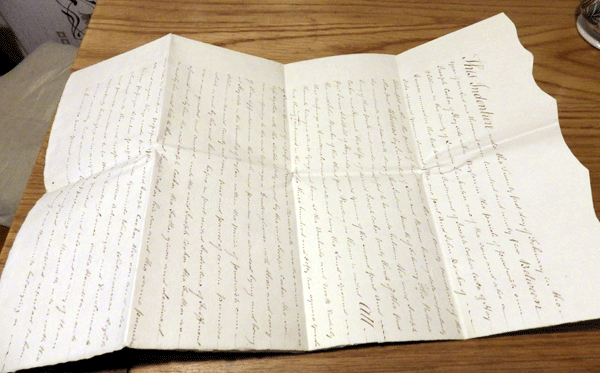
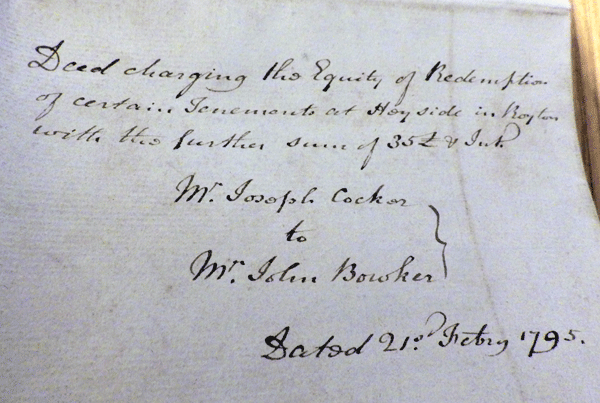
You can find anything on eBay. A friend showed me an old legal document he had, a fascinating thing. I was inspired to go looking for something similar and I found that there were many documents of all ages for sale in eBay, After much hunting I settled on a deed of 1795. It arrived in very good condition.

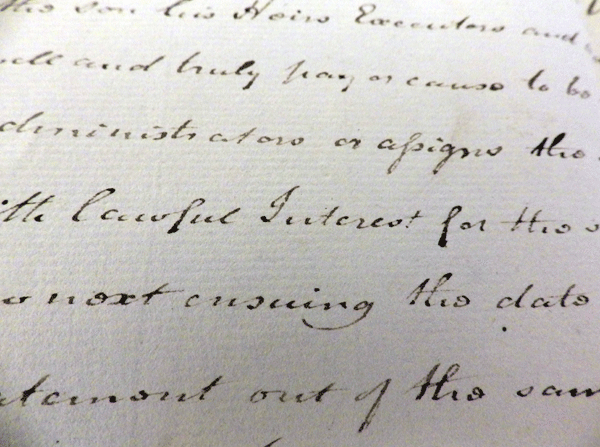
These old documents survive so well because of the paper they are written on. It is thick and durable, almost like cartridge paper. It is faintly off-white, a colour I would describe as less than cream, perhaps ivory. It appears whiter than it is in the accompanying photographs because I’ve increased the contrast. The deed is written on a single large sheet of paper, 47cm high and 60cm wide, folded to make each page 30cm. I’m sure there will be a name for this size of paper which resembles modern A3.

The legal import of the document is rather beyond me but it appears to relate to land and buildings in Royton, now part of Greater Manchester. The writing appears mostly quite modern though the long ‘s’ is occasionally used. It’s mostly legible though the clarity varies. No doubt this document was written by some Bob Cratchit-type clerk who most likely got rather bored writing such dry deeds day after day and the writing probably suffered a little for that reason. Actually, I think he did astonishingly well. My own writing, as I draft this article, is less than legible to anyone else.

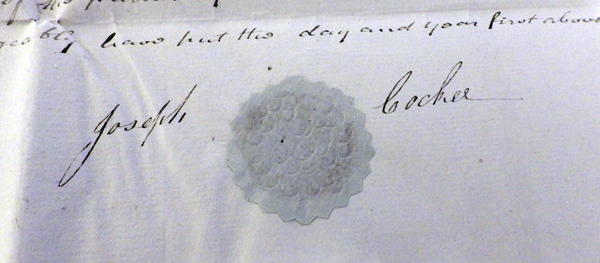
This was the day of the quill, of course. Cheap metal nibs had yet to come. The clerk’s desk would have held all the necessary accoutrements of his day, a sander, a quill knife, inkwell, wafers and seal. The ink is grey/brown, probably India ink a very little faded with time. I love this deed. It’s a window into the past to allow us to look on the work of those writers who were our predecessors of the pen more than 200 years ago.

A One-off?

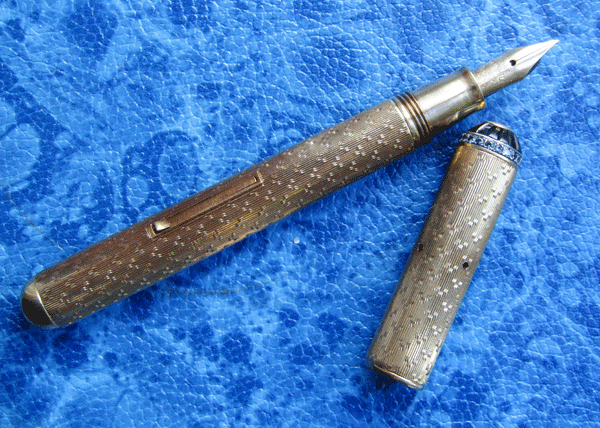
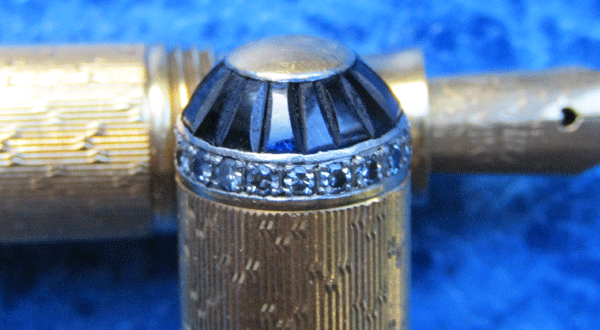
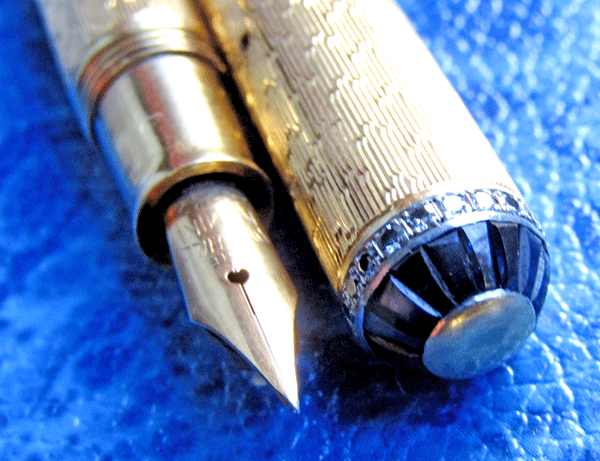
A solid gold pen, the cap encrusted with sapphires and diamonds. That may sound a little like one of those high-priced modern limited editions, jewel laden, opulent and tasteless. In fact, this pen isn’t like that at all. Its opulence is measured and it is a restrained thing of beauty.

It appears to have been made in the late thirties, most likely by Dunhill though that has still to be confirmed. Everything about the design, together with the Dunhill/Namiki nib, suggests that it came from that house.

I don’t buy expensive pens and I hardly ever envy those who do but this pen comes close to being an exception. Not only is it a thing of loveliness that you could spend ages admiring, the Namiki nib is as good as you would expect it to be, flexible and highly responsive. It would be sacrilege to imprison such a pen in a display case. It demands to be used and used often.

When it comes to such pens, discussion of cost is largely irrelevant but when one considers the combination of highly satisfying design and pleasurable utility the pen is clearly worth a lot of money and compared with the price demanded for anything remotely similar today, its lucky owner secured a bargain.

With thanks to Mario Kaouklis