I see today that the pens are to be cartridge/converter. That’s sad. I understand that such decisions may be driven by cost, but if you’re reviving the company only to make a poor shadow of the original, why bother?
Pen Thoughts
New Wahl Eversharps?
I hear tell that title to the Wahl-Eversharp brand has been secured and that new versions of old favourites are on the way. I’m no fan of bringing dead old companies back to life, something I’ll explain shortly, but there’s at least a good chance that this will not be the disappointment so many others have been because of the involvement of Syd Saperstein, whose dedication to the Wahl-Eversharp marque is obvious to anyone who has read his writings in FPN and elsewhere over the years. I think that Syd will ensure that the new company’s production is not a travesty.
Would that there had been a Syd Saperstein to oversee the production of the various Conway Stewart companies since it first rose from the grave. Conway Stewart has, I believe, annoyed more people than it has pleased, showing little understanding or respect for the name it uses. Onoto has done rather better, paying more attention to its customers’ wishes and even recreating a plunger filler. The nib is the beating heart of a pen, though, and the present-day Onoto company cannot reproduce the wonderful nibs that were the glory of Onotos, and of course the pens’ price ensures that they will never be more than a passing interest to all but a few.
There were other revivals, or perhaps it is more fitting to say revenants, like the dreadful Mentmore, a rebadged Duke, a concoction of brass tubing and mystery metal that is an insult to the name of one of the most innovative of British pen companies. There was even, horror of horrors, a Chinese-built Swan for a time, but I’m delighted to say that I’ve heard nothing of it for some time and I fervently hope it has died a death.
I think it has to be said that even when the result is not as disastrous as some of the foregoing, wrapping oneself in the long-gone glory of a company that has been dead for longer than most people have been alive doesn’t show much in the way of self-confidence or creative imagination. In none of the above revived companies has the true ethos of the original pen-makers been emulated, partly because it would be hard, if not impossible, to do so in these much-changed times, and partly because many (though by no means all) of those involved don’t care about the history, only the supposed value of the name as expressed in the balance sheet.
It’s good to restore pens. Restoring companies has not been so successful.
The Wahl-Eversharp venture may be different. I hope so. It would be nice to see a new Doric, especially if it actually had a filling system instead of the ubiquitous cartridge, and a nib that was not the usual bland mass-market offering.
More Grumbling
I awarded the second negative feedback of my life this week. The first was some time ago when somebody ripped me off over postage. This one was over that eBay perennial favourite, the cracked fountain pen cap. The pen was an English Parker Duofold Aerometric in dark blue, and visually it was perfect. A visual inspection’s not enough, though, especially with English Duofolds which are notorious for cap-lip cracks. Running a thumbnail around the lip is the litmus test and, sure enough, my moving thumb stopped sharply as my nail encountered a crack. Once alerted to its presence, it wasn’t invisible; the darker line of an aged crack was immediately apparent.
The seller had feedback of a mere 27 and this appeared to be his first sale of a fountain pen. I tried to let him down gently by saying that such a small crack might easily have been missed, but I wanted my payment and all postage costs back. My attempt at being conciliatory fell on deaf ears. The buyer came back vigorously denying that the pen was damaged in any way when it left his hands. I asked Customer Support to open a case and we duked it out for a couple of days. The seller was aggressive and devious which did not endear him to me. In the end, I lost patience and escalated the case to Customer Support to make a decision. They immediately gave me back my payment and original postage.
Result? Well, of sorts, but I still had to return the pen to the seller. I have no option but to protect myself by using a tracked, signed for service which costs £3.65, which means that I – the innocent party – am out of pocket over the transaction. I shouldn’t be. I should have been the proud possessor of the Parker Duofold in good condition that was offered for sale and that I believed I had bought. Well, you may say, £3.65 isn’t going to break the bank. I agree, but these days, as I said in an earlier post, I’m getting three or four misdescribed pens a week and they all go back at the same cost.
Anyone can make a mistake. I make a few myself, but I don’t expect anyone else to pay for them. If you buy a pen from me that turns out to be deficient I’ll take it back without a murmur and I’ll pay back your additional postage costs. That’s only equitable, after all. If I buy from any respectable trader online, I won’t get stuck with the cost of returning goods. It’s only a certain type of eBay seller – mostly of the “sell anything” variety – who believe that any mistakes they make must be paid for by someone else.
EBay is aware of this problem. I and others have brought it to their attention time and again. They’re sympathetic (sympathy’s free) but they say they cannot help. Agreed, they can’t reach out and take the money out of the seller’s pocket, but I have no doubt that they could find ways to apply pressure if they wanted to. That leaves it up to me to apply whatever sanction I can, and that’ll be the negative feedback. I do so not in a spirit of vengefulness. That would be petty-minded. I do so to educate; to help sellers to understand that not only will their mistakes affect my bottom line, it will harm theirs too.
Small Objects Of Desire
I spent this afternoon repairing pens, several Swans, a couple of Conway Stewarts, a Waterman and some Parkers, and as I did so I was considering the choice that the pens’ original owners made, and the impression that their pens made.
They used to say (and forgive me if I don’t have the quote quite right) that the Conway Stewart was the manager’s pen, the Swan was the doctor’s pen and the Onoto was the lawyer’s pen. Total hogwash, of course, in that Conway Stewart and Mabie Todd provided pens for all budgets, and even De La Rue’s Onoto range included lesser-priced models. Also, it leaves out a variety of other professions and occupations that depended to some degree on an ability to write. What, then, was the architect’s pen, or the minister’s? What did the chartered accountant write with?
In reality, of course, everyone who needed a pen, whether for work or leisure, could find what they needed in any one of the several ranges of pens the various manufacturers offered. Clerks, entering figures in permanent records, had to have pens to do so, and it doesn’t seem unlikely that many of those pens would be lower-priced Swans and Blackbirds, Conway Stewarts, Wyverns, Mentmores, Summits, Burnhams – all the pens I routinely handle today. I suspect that the pen that secondary school children did their homework with came from the same area of the market.
However, we judge each other in all sorts of ways – by the house we live in, the clothes we wear, the cars we drive and, back in the day, by the fountain pen we used. Most pens would be nearly invisible tools of the trade, whatever the trade might be, but many pens were made to stand out and say something – something complimentary, of course – about their owner. One didn’t own a Conway Stewart 60, a crocodile leather-covered Wyvern or a Swan 4660 because they wrote better than other pens, but because they were recognisable and said that one had money, discernment and perhaps even good taste (though I’m not so sure that that applied to the owners of animal-skin-covered pens).
It’s rather different now. Pens are much less an indicator of style now than they once wear. The most senior manager, doctor or lawyer may have the ubiquitous throwaway Bic ballpoint or Pentel rollerball on his desk or in his pocket without it being cause for comment. These writing instruments are universally recognised as being the practical solution to the need for something to write with. They bear no implication of success or failure, class or prosperity. They’re just pens. Of course there are those (not as many as you might think) who will spot a Montblanc as being a prestigious pen, though they’re unlikely to recognise any other equally valuable pen. Most, if they see that it’s a fountain pen at all, will take it as a mark of eccentricity rather than discernment.
Changed days indeed.
My Winter Break
There comes a point in mid-December when eBay sales tail off. Buyers abroad stop bidding because they don’t want their pens caught up in the Christmas mail madness. That seems to have happened now, so I can heave a sigh of relief and put my feet up for a month. Not quite, actually. I’ll have a batch of pens to upload to the website later this week, and I’ll continue to buy and repair throughout the festive period.
Last week I had two pens with serious undisclosed faults. Today’s only Monday and already I’ve received a Duofold Senior with a crack in the cap. My assistant is very displeased.
The Pricing Puzzle.
I’ve discussed the mystery of price in here before, but I’m going to ramble on about it again today. The reason that it’s a problem – and therefore interesting – is that there is nothing that even remotely resembles a market price for the kinds of pens I deal in. If I were to be in that part of the market that buys and sells the highest of high-cachet pens, I would have something approaching a market price to refer to for my solid gold Balances and Parker Red Giants. It would be fluid and changeable, to be sure, but provided I kept myself well informed, I’d have a ball-park figure for my sales items. For average-to-excellent run-of-the-mill Swans, Parkers, Conway Stewarts and the like, no such thing exists.
If you’re a classical economist (i.e. someone with graphs for everything and knowledge of nothing) you’ll say that the market will dictate the price. The nearest we have to a market for old pens is eBay. I’ve bought and sold in eBay for years and it doesn’t help much. The variation in price between two items as identical as seventy-year-old pens can be is enormous. Is a standard Waterman 52 with some fading and a semi-flexible nib worth £35.00 or £78.00? I don’t know, but I’ve sold those pens at both those prices in eBay this year.
This concern over prices arises from something that happened a few days ago. I’d been on the look-out for a Mentmore Supreme for a customer and I found one in eBay. Reading through the listing, I discovered that the pen, along with many others, was being sold by an online retailer of old pens. Someone like me, in fact. A little worrying, that! This retailer was selling off all his stock as he was taking down his sales website. So I went and had a look at the site, which was still up, and it didn’t take a lot of puzzling to work out why he’d gone out of business. His prices were almost beyond belief! What calculation makes a green marbled Dinkie 550 worth £100.00? Together with a pencil in a presentation box these things often fail to make £30.00 in eBay! A black Parker Moderne is worth £160.00? Fact is surely stranger than fiction, and this guy had actually been selling pens at these elevated prices. Not many, of course, probably not enough to justify his expenditure, but some.
Now I can’t tell you what a black Parker Moderne is worth (see above) but I could tell you what I’ve bought and sold them for and it’s a fraction of £160.00. In a way, it’s a worrying thing. It suggests that the commercial end of our hobby slides ever nearer to the practices of the antiques trade where dealers think of a number, double it, double it again for luck and write a price ticket. Most of the pens we deal in aren’t intrinsically valuable and you can’t make them so by wishing, hence this particular trader’s exit from the old pen marketplace. With the odd exception, they’re at the useful end of the pen spectrum, or at least that’s how many of my customers express their appreciation for pens they’ve bought.
So what’s fair? How do I determine a price? Essentially, it’s buying price plus a moderate profit to cover time, parts and fixed costs. Works for me and seems to work for my customers – long may it do so! All I’m saying, I suppose, is look around. Despite the great number of helpful and generous people there are in our hobby, these waters are not without the occasional triangular fin cutting the surface. Don’t buy the first example of the pen you want that you see. There might be a better deal around the corner.
This Cracks Me Up!
As I said yesterday, two pens with broken caps were delivered. One was a real heartbreaker – a Lapis Lazuli Duofold Junior in otherwise excellent condition. The other was an everyday Blackbird Self-Filling Fountpen. The first seller apologised and asked that I return the pen for a full refund. No problems there: it was a hairline crack that I, too, might have missed. The seller’s response was the appropriate one. I’ll be leaving good feedback.
The other one didn’t behave so well. In response to my initial email he replied, “I’m sorry the lid is cracked. Can you send a photo of the crack please as I was not aware of any exterior defects.” Why would you need a photo? The pen’s coming back anyway! Nevertheless I set up the mini-studio and took a photo which I reduced in the normal way, to 600 pixels on the longest side. Here’s the photo, showing a crack that you could drive a bus through.
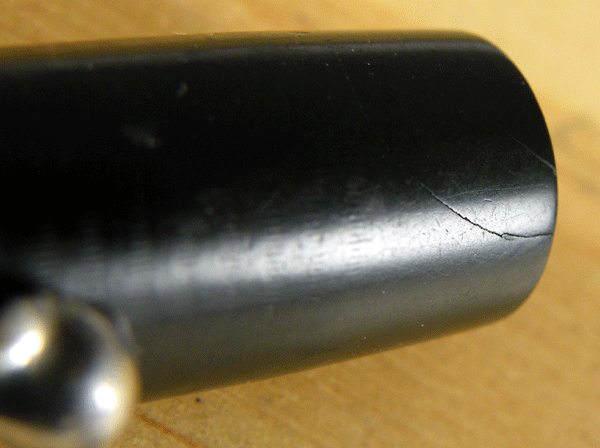
Prince Charming’s reply was, “Thank you for the photo. The photo is very small so it is hard to see the crack in detail. Perhaps it happened in transit. I will refund the pen if you send it back. We will both be out of pocket for the postage.”
Have a look at that crack. It has worn edges and it has the same degree of fading as the rest of the pen. It didn’t happen in transit. And there’s no reason on earth that I should be out of pocket because someone tried to sell me a pen with a gaping crack in the cap! I sent Price Charming a full-size photo which I hope choked his broadband to death. I also made him aware that I expect return postage to be paid. I have yet to hear his considered reply. I suspect that this one will end up in eBay’s dispute resolution centre. And I will win, as I have before in similar cases. And then I will leave appropriate feedback.
I’m not whining about people making mistakes. I’ve made a few myself and I’ve had customers return a pen with damage that I had missed. When they did they were given a full refund including postage both ways. Even when the pen was coming back from Spain or America. That’s only fair. Why should a buyer lose the cost of returning a deficient item? No fault resides with him; he shouldn’t be penalised.
It Annoys Me A Little…
When a body has been hung, drawn and quartered it’s not like a jigsaw puzzle. It doesn’t even remotely look like it could be put back together. The hanging distorts the neck in an amusing way and the disembowelling flattens the body somewhat. Stepping carefully over the untidy pile of entrails, I began to tidy up my execution tools.
Looking back at my handiwork I mused, “That’ll teach him to sell me a pen with an undeclared crack in the cap!”
A Glance Down Memory Lane
Occasionally a thing will happen that highlights the revolution we have lived through. This morning among the packages of pens the post-lady delivered was a letter (remember them?) handwritten by a retired gentleman who, I think, wishes to revisit his youth in the form of a Swan pen. He was given my address by a customer of mine and enquires if I have a leaflet or brochure of the pens I am offering for sale. No computer, you see, and no ability to peruse the website.
Considering the retro technology that we favour here, the old gentleman shouldn’t be deprived of the ability to pick and choose among my pens just because he doesn’t have one of those pesky new-fangled computers. It’s a challenge, however. He does have a telephone, though, and I believe I’ll give him a call and try to get an idea what age and type of Swan pen he’d like.
Once I have a general idea, I can knock up a brochure of a dozen or so pens quite easily. Only black and white, though. Normally the only printing I do is the record-keeping of the business and I have no call for colour. I got rid of my expensive-to-run scanner/printer/make-the-tea device quite a while ago because I was tired of paying Hewlett-Packard’s annual wage bill in colour cartridges.
It’s all a little reminder of how we did business not all that terribly long ago – writing to the manufacturer or retailer for the latest catalogue or brochure of goods, picking one out to order and awaiting delivery of the item some time later. It’s easier now – or should be – with digital photography and the World Wide Web, but maybe it lacks some of the excitement and anticipation of the distance shopping of long (is it really that long?) ago.
This And That
It has come to my attention that the “Contact Me” button on my sales website isn’t working. I’ve notified the developers and I hope to have it put right quickly. My apologies to anyone who has tried to raise a query that way.
I hear tell of a clip-filler Wyvern. Interesting. So far as I know all the clip fillers were American made but I’ll be happy to be proved wrong. It’s my belief (I read it somewhere and can’t bring to mind where) that the earliest Wyverns, like the first Conway Stewarts, were American-made imports, re-badged.
Info, anyone?
 Goodwriterspens's Blog