Mentmore Ink-Lock Vacuum Filler

The ink-in-the-barrel pen has always seemed like a good solution, mostly because it has the potential to have great capacity. The original ink-in-the-barrel pen was the eyedropper, but manufacturers wanted to add a self-filling ability. The grand-daddy of them all is De La Rue’s Onoto plunger-filler, which dates back to 1905 and remains, in my opinion, the all-round best of the ink-in-the-barrel pens. It wasn’t until 1925 that another came along, Chilton’s Pneumatic Filler. Parker’s Vacumatic* followed in 1933 and Sheaffer produced the Vac-Fill, virtually a revamp of the Onoto system, in 1935. Last – and least known – is the Mentmore Ink-Lock in 1938.

 

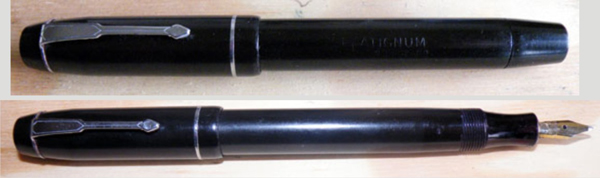
The name Ink-Lock doesn’t refer to the filling system but to a patented method of shutting off the ink when the pen was capped. There are also lever filler and button filler Ink-Locks. This ink-in-the-barrel filling system was given its first outing in the Platignum Visi-Ink. Pressure in the barrel is reduced by forcing air out through the feed channels by squeezing a bulb, thereby drawing ink in. This is repeated several times until the pen is full. In principle, this method is less like the superficially similar Parker Vacumatic and more like the Chilton.

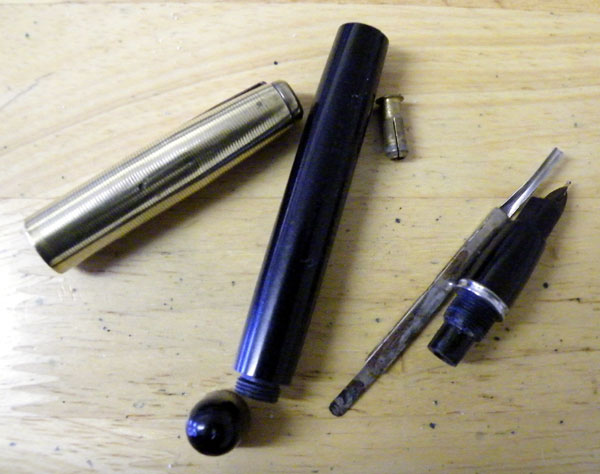
“My!” you’re thinking, “How clever Deb is to have sussed all this out by her little self!” The truth, sadly, is that when presented with this strange pen that didn’t want to come apart I cried a little and stamped my foot. Then I sent it to the estimable Derrick Purser:

( http://www.classicpenengineering.co.uk/index.html )

who puzzled out the workings of the pen, manufactured some parts that were missing and also provided me with information on the filling method. Much kudos to Derrick!
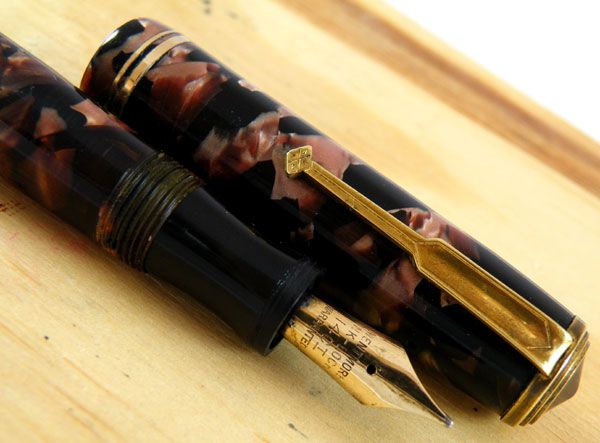
 

Mentmore Ink-Locks are far from common, and I would even go so far as to say that this version is somewhat rare. Why? Not because it was a bad pen, far from it. I suspect it was a misfortune of history. The pen was produced not long before World War II, and I suspect that it was dropped in favour of the simpler designs like the Autoflow as war shortages began to restrict the industry. However, we still have this pen to remind us that Mentmore was once the most innovative of British pen companies.
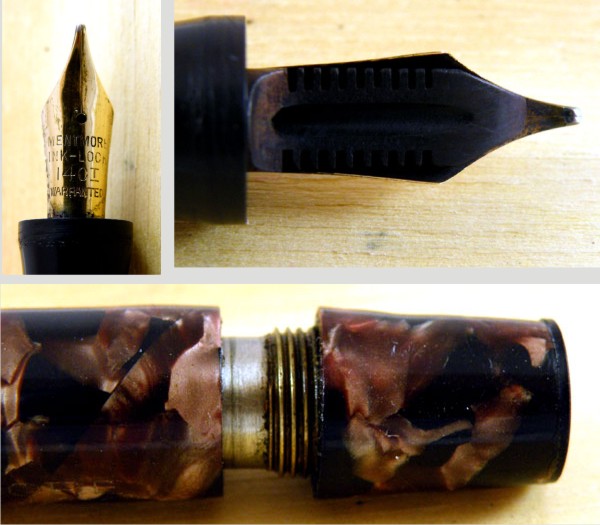
 

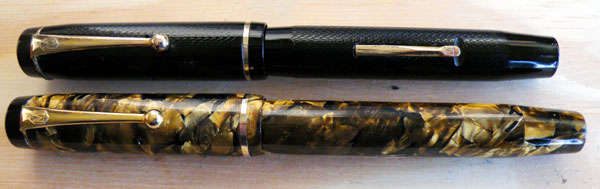
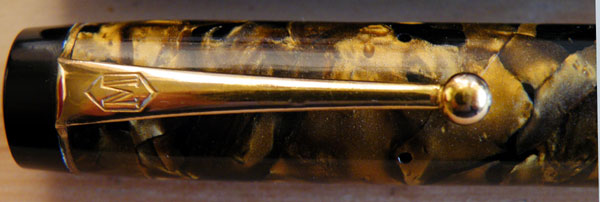
Mentmores of this period usually have a family resemblance to one another, but the Ink-Lock breaks the tradition. It has a most un-Mentmore-like washer clip of a vaguely arrow-shaped design held by a stud. The feed, too is quite unlike the usual Mentmore feed. The combination of a narrow and a medium cap ring is unique among the company’s output, as, I believe, is the very attractive brown/pink/red marbled celluloid.

*I suppose that the withdrawal of air as a motivating principle is especially obvious in all these pens, hence the names like Vacumatic, Vac-Fill and Pneumatic Filler. However, it is worth mentioning that these pens are no more dependent on the vacuum principle than the less complicated lever filler or the more efficient piston filler. All self-filling pens use vacuum. Prove me wrong.
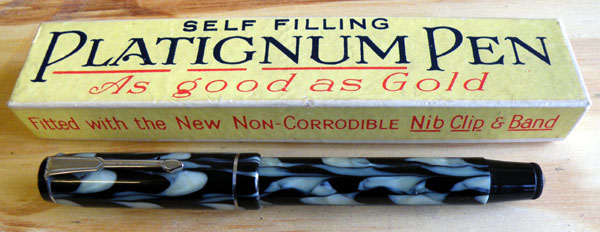

A Colourful Platignum

There are Platignums and Platignums. There’s the very basic sort that your parents bought you for school if you were like my husband, who says his pens were lucky to last the week, and were broken or lost by time Saturday came around and another one would have to be bought. No point in buying Parkers for a kid like that, and that’s where the basic Platignums excelled: cheap and just about capable of writing with. No-one’s collecting them.

There were other rather surprising Platignums, though. They were boxed rather than stuck on a card and they came singly or in a pen and pencil set. As well as being adequate writing instruments, they came in stunning colour patterns. These ones do have a following with some serious collectors of other more prestigious pens among them.

This pattern is called “Black and Pearl”. The “As good as gold” tag that you see on the box dates back to the 1920s, when Platignum was born as an offshoot of Mentmore. It was the company’s assertion that their steel nibs were as good as anyone else’s gold ones, a claim you don’t really have to believe. That’s not to say that they didn’t make many good pens. It was really only in the post-war period that some of their lower-priced pens went from economical to downright cheap.

This one’s quite a well-made pen. It uses Mentmore’s patented screw-in plastic button and Platignum button fillers are efficient. I haven’t tested its writing abilities yet, but if previous Platignum steel nibs I’ve tried are anything to go by, it will write perfectly well, provided you don’t want too much in the way of character from your nib. These spoon-ended nibs have a shorter life than a properly tipped nib, but as most people don’t use their pens very much nowadays that’s no longer as important as it once was. In any case, I suspect that this pen will be bought more for its appearance than for its utility.

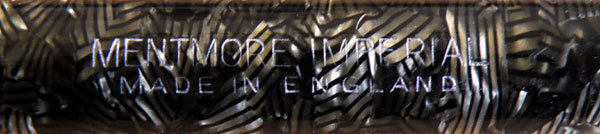
Mentmore Imperial


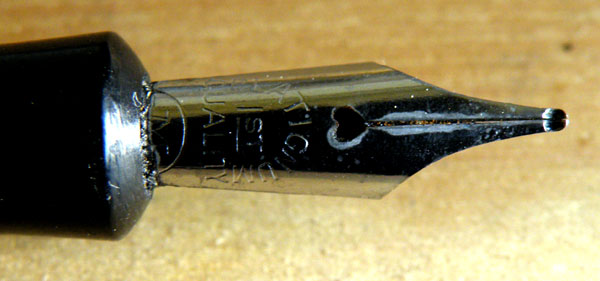
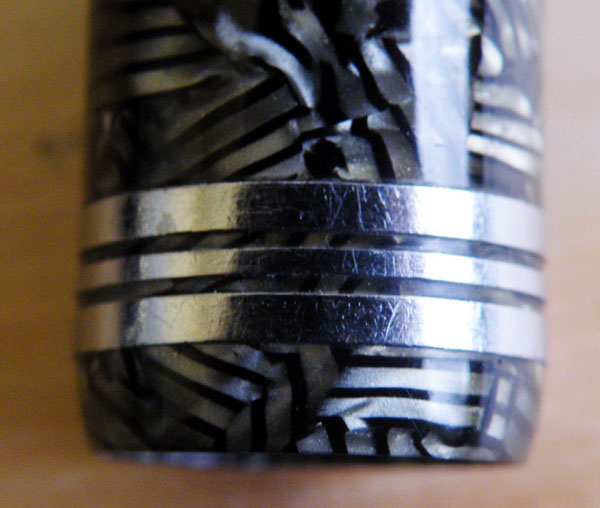
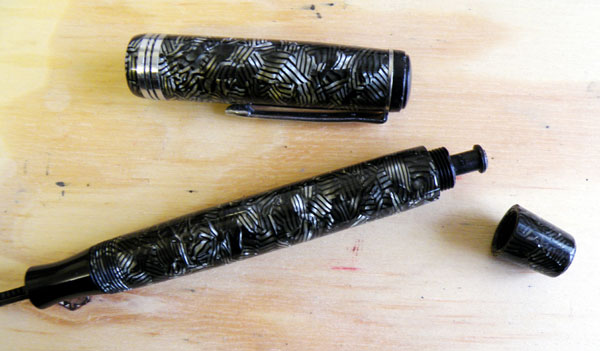
I’m guessing that this is a post-war pen. Though the beautiful hatched celluloid (which almost every company used) was around in the thirties, it became much more commonly employed after the war. The flat clip looks like an early fifties design to me, as do the closely set medium/narrow/medium cap rings.


At first glance I took this to be the quite common arrangement of a single broad cap ring incised and painted to look like three, but no, this is the real thing, as the picture shows. The use of aluminium in the clip and (quite possibly) the cap rings seems like a late development for the company too.

Though they made many lever fillers and even a bulb filler (so I’m told) Mentmore excelled at making very efficient button fillers. The usual brass button has here been replaced by a screw-in plastic one which was novel enough when this pen was made to require a patent of its own, as is recorded in tiny embossed printing on the end of the button.

It is often the case that things become most dear to us when we’re on the point of losing them. If my dating is right, and this is an early fifties pen, the British Empire was well down the long slide to dissolution as emerging nations booted us out left, right and centre, but the company chose, perhaps defiantly, to call this “The Mentmore Imperial”.

Though Mentmore was soon about to be quietly allowed to die while Platignum took over, this pen shows no sign of the company’s imminent decline. The substitution of base metal for gold plating in the trim may well be an aesthetic decision rather than a cost-saving. The cap and barrel are machined from the rod, instead of being made from wrapped celluloid, a saving that many companies were making at this period. Everything fits together beautifully and the well-machined threads remain unworn today, even on the blind cap which gets used frequently. Mentmore were still making fine writing instruments at this point.

Mentmores Again

I felt the need to get out and about this morning, so I fired up my time machine and went back to 1952 to buy these two Mentmores.

In truth, it’s rare to see sixty-year-old pens in as good condition as these. A speck of wear on the lever of the black chased one, and that’s all. Along with a few other pens, mostly Watermans, these came from a well-cherished collection that’s being sold off.

Though they’re not the kind of pen I use, because of their (mostly) stiff nibs, I admire Mentmores. I think they may have suffered a little from association with their budget brand, Platignum, but in actuality they’re very sound pens, at least the equivalent of Conway Stewart or Summit, and, in the case of their button-fillers, a more efficient filling system than either. Users of modern pens take to them readily, because they tend to have a larger iridium ball, like contemporary nibs.

It may be winter now, but looking at the button-filler, with its glorious golds and bronzes, transports me right back to autumn. No-one else uses that celluloid. It’s quite exceptional; bright, warm and satisfying to the eye.

There may be a little less to say about this sturdy lever-filler, but I do enjoy good, sharp engine-chasing. This is a fine example.

Platignum Button-Filler

The very cheapest pens, like Queensways, Universals, Platignums and the like are consigned to my “spares and repairs” box, to be sold off as a job lot when enough have accumulated. This morning, however, this pen gave me pause for thought:

It’s a Platignum button-filler of indeterminate date that was included in a lot that I bought. The steel nib was rusted out, otherwise it appeared all right, and I decided to disassemble it. Once you have all the parts there and you can have a proper look at it, it’s a good, sturdy, well-made pen. Mentmore/Platignum always made very efficient button-fillers and this is no exception. Is it right to cast a good pen aside because it bears a less-than-popular name? It’s every bit as good a pen as a Mentmore or a Wyvern.


I resacced it, cleaned it up and fitted a little Kaweco nib that will never find an appropriate home elsewhere and fits well. It’s a great writer. I’ll offer it for sale at a low price that will cover my costs. If it sells I might fix up a few more, if not it’s back to the “spares and repairs” box.

Mentmore 46

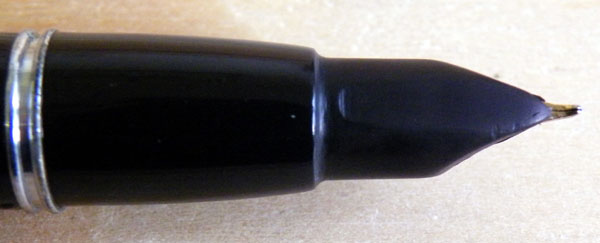
I have to admit that I’m a little traditional (some might say hidebound) in the type of pens I like. I don’t care for hooded nibs – too modern for me (even though the design is older than I am). I find shiny metal caps a bit flash and in poor taste. I don’t buy pens like that intentionally, but you never know what’s going to turn up in job lots, which is how I came by this strange beast:

It’s a Mentmore 46, made around 1950. There were two versions, one with a silver-coloured cap at 17/-, and this one with a gold-filled cap at 25/-.

I stripped it down to find that it’s a much more traditional pen than it at first appears. It has a normal, if small, nib and a ladder feed. It’s a button filler. As usual with Mentmores the button was a swine to remove, but I have my methods. I fitted a new sac and reassembled it.

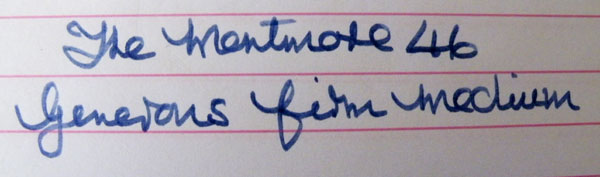
I have to admit (there’s that phrase again) that this turned out to be a much better pen than I expected it to be. It’s very well made, with sturdy components and good machining. It writes very well. It may be a little odd-looking, but no more so than any other hooded-nib forties or fifties pen.

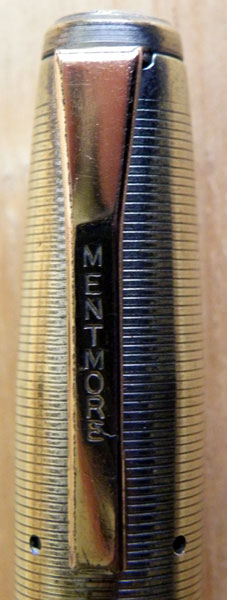
The cap, with its clear engraving on the clip, is much less blingy and tasteless than many of these things are. All in all, if I saw another one at the right price, I’d buy it.

The Mentmore Manufacturing Company

Mentmore, which started production in 1923, is often regarded as one one of the smaller British companies but this is far from true. Until the company ceased trading under this name in the late fifties, sales of their own-branded pens were healthy and they also produced many no-name and promotional pens. The company’s earliest pen was the “Spot”, a high-quality pen with a white dot on the cap. It isn’t common now and is sought-after by collectors.

Mentmore Autoflow Button Filler

Mentmore is probably best remembered now for its Autoflow range of lever and button fillers. They are well made pens with efficient filling systems and appear in black hard rubber and black and variously-patterned celluloid. The 14ct gold “Osmi Iridium” nibs were made in-house. They usually have a generous amount of tipping material and most are firm mediums. Less often seen are the Mentmore 45 and 69 with sterling silver caps. Towards the end of the company’s life, a hooded-nibbed Diploma was produced. The quality of these injection-moulded pens was variable.

In 1927, the Mentmore Manufacturing Company created a subsidiary, Platignum, to make inexpensive pens aimed at the school student market. Most of the Platignum output had white metal or plated nibs, though there were some with with gold nibs. Platignum was innovative both technically and in aesthetic design. In the early days they utilised unusually-coloured hard rubbers, such as olive and black and yellow and black. Many of these pens were acceptably well made and can be found in good condition today. They also produced pens with an ink-view section and later, a version of Waterman’s capillary X-Pen was manufactured under licence. This was a high-quality pen which still occasionally turns up. In the late fifties Platignum produced the “Quick-Change” calligraphy pen, a lever filler that was threaded to accept different oblique and italic nibs. Unfortunately the plastic in these pens tends to shrink, so that caps often don’t fit well now, but a good one remains a usable calligraphy pen.

Platignum Varsity Pressmatic

Around the same time the Varsity Pressmatic was offered. Made from better plastic, these steel nibbed squeeze-fillers have often survived well, though their odd design means they’re not to everyone’s taste! During the sixties, Platignum made some truly awful school pens, plastic with plastic “gold” caps that leaked on your fingers. They made many a school student of that era glad to switch to ballpoints. Since then, cheap cartridge Platignums appeared in the eighties and nineties and I believe Platignums are available once again, though I don’t know whether they are made by the same company or another that has bought the name.

That’s by no means a comprehensive listing of MMC output, whether as Mentmore or Platignum. Successful at both the quality and value ends of the market, they were an interesting company with a fascinating history yet to be written.