Christmas Swans

The days are getting shorter and the nights are getting colder. You can’t walk into a shop without tripping over Santa and his reindeer and being deafened with the jingle bells music. I know it’s only November but I get the idea the shopkeepers want it to be Christmas.

I look around but I don’t see anything I crave for Christmas. Spirit me back to 1925 or so and I might find something though.

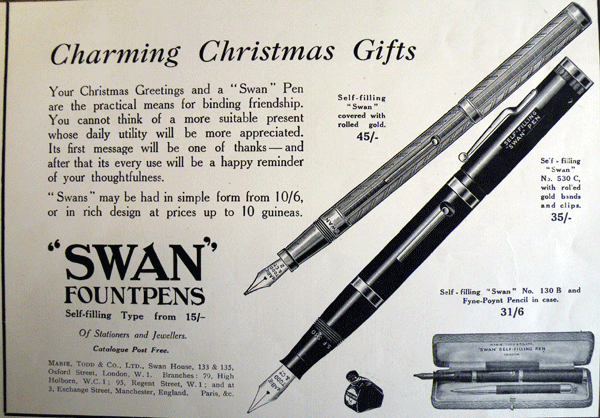
35/- for that SF 530 C. That’s – what, £1.75? Can’t buy a bottle of ink for that now. I know, I know, in real terms it was a lot of money back then and if they were capable of making one, an SF 530 would cost a lot today, but let me dream!

Come to think of it, I’ve never even seen an SF 530.

A Well-Travelled Blackbird

Here’s a perfectly ordinary Blackbird Self-Filling pen from the teens and twenties of last century. I covered these pens before, back here: http://wp.me/p17T6K-6O. I was in some doubt as to whether or not to buy this example because of the scratches on the cap, no doubt inflicted by the unusual after-market clip. In the end I went ahead and I’m glad I did.

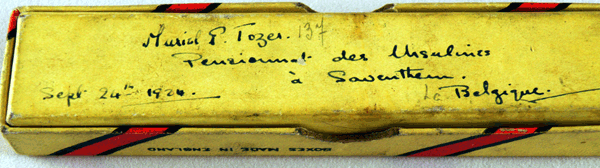
On the underside of the box is written, “Muriel G. Tozer, Pensionnat des Ursulines, Saventhem, Belgique.” The date, September 24th 1924 is there too, as is the price, 13 Belgian Francs. The “Belgian” part of that is important. In 1924 the French Franc was in hyper-inflation and the Blackbird would have cost at least 500 Francs!

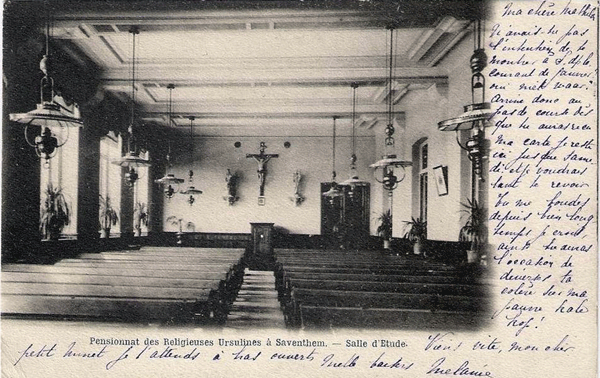
A pensionnat is a boarding school. The Ursulines aren’t quite a teaching order but they have a teaching role, primarily for the development and fulfilment of women. I found several run by the Ursuline order in Belgium and here in Britain, and I eventually found some postcards of Saventhem.

Here it is, looking distinctly forbidding.

The refectory looks nice, though.

As does the chapel.

Here’s a group of the pupils, though by their dress it’s a decade or two before Muriel was there. (My apologies for the eye-hurting graininess of the photo – best I could do with what I had)  Sadly, I was unable to find any more references to Muriel. Was she a child of a military or diplomatic family, sent to school in Belgium while her parents served abroad? Did she come from a devoutly Catholic family? Did she go on to become a Sister of the order herself, as many former pupils did?

We often talk of scratches, cracks and discolouring as being part of the history of the pen. So they are, if you accept a tenuous enough definition of history, but usually history means more of a narrative, events and places that the pen can be associated with. This pen has a history.

Broad Oblique Blackbird BB2/60

It’s no good clamouring and begging. This one’s already sold!

A few days ago, someone asked me for a Swan with a broad oblique nib. I didn’t have one. It’s hardly surprising – they’re rarer than hen’s teeth. I see a few obliques in the course of a year, but broad obliques? Once in a blue moon.

The very next day, among a delivery of pens I’d bought was this BlackBird BB2/60, a very common pen, but with a very uncommon nib – a broad oblique! I’m not a superstitious sort, but the implausibility of that juxtaposition of occurrences did make me wonder if there’s an unusual conjunction or alignment of the planets around now…

Anyway, I was able to get back to the gentleman and tell him that while I didn’t have a Swan with a broad oblique nib, I did have a Blackbird that is both seriously broad and fully oblique. He’s happy and so am I!

Mabie Todd Swan Gold-Filled Ringtop

Eric, do you recognise this pen?

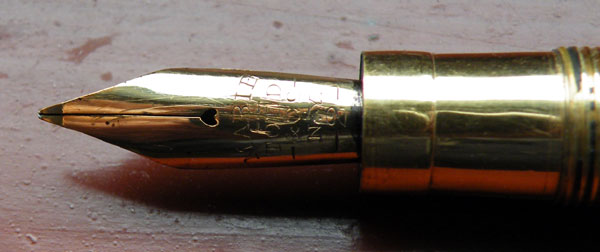
It’s what’s often called a ladies’ pen, but it would have been equally at home on a watch chain or in a waistcoat pocket. It’s gold-filled. All the gold and gold-filled overlay pens were made in New York at this time, as were the nibs, so this pen is an American Mabie Todd Swan through and through.

If this pen were British-made (in which case it couldn’t be gold-filled, of course!) I would date it to 1920 to 1925 or thereabouts. Not before 1920 as British Swan had no lever-fillers until then, and certainly not much later, given the early style of the pen. As this pen was made for the British market, it may well conform to those dates, but I can’t be sure as my ignorance of American Mabie Todd pens is both wide and deep. They may have introduced lever-fillers earlier, for instance.

I’ve handled several of these small pens over the years and this one differs in only one respect: the condition. Though there are very slight scuff marks where the pen has been posted or capped, there’s no base metal showing through anywhere. That’s quite remarkable for a gold-filled pen of this age. I can only assume that it was little used and then stored carefully away somewhere. It certainly hasn’t been left to roll about in a drawer.

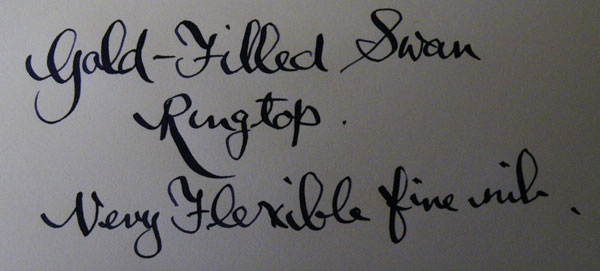
There’s no doubt that pens like this were made to be admired and to impress. It’s a bit of pocket jewellery – bling with class! That’s not all it is though. It has a superb very flexible nib with a slightly crimped upturn at the end of the nib – not an uncommon feature on those New York nibs.

It’s a delight and I could write with it all day, except that time is short and less enjoyable matters are pressing. Hence the poor photos, for which I apologise, but maybe it’s enough to see what I’m talking about.

Mabie Todd Swan 4261

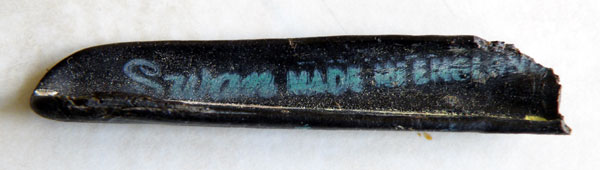
I did a pile of pen fixin’ today, I’m pleased to say, and among those restored was this Mabie Todd Swan 4261. It dates to around 1950 and it’s a black hard rubber Leverless. Though it’s not a large pen with its No 2 nib, it has three-band trim and was probably fairly high in the price range. It has few of the surface scratches that a well-used pen develops and the gold plating is in excellent condition. When I took it apart I found this:

Original Swan sacs don’t appear all that often. I find Conway Stewart ones all the time, the original ones being pale brown and the replacements black. I suspect that Swan didn’t issue sacs to their repair agents but just left them to fit standard stock.

Given its pristine condition this pen might be well unused shop stock. There’s no box, it doesn’t have a price label or chalk marks but it’s more likely than not that that’s what it is. I didn’t buy it as New Old Stock, nor could I advertise it in that way, but it’s nice to have an essentially new sixty-year-old pen.

Mabie Todd Blackbird 5244

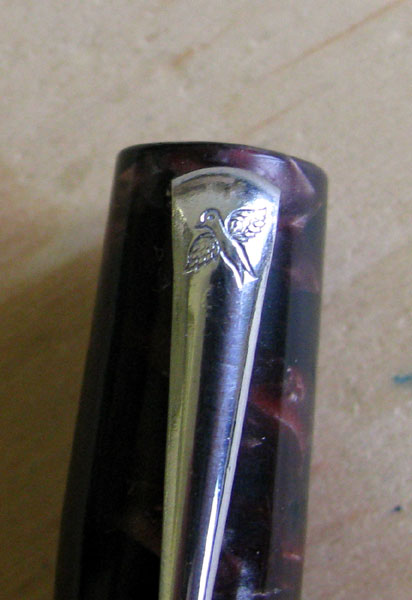
Excuse the quality of the photography today. For one thing I’m not using my usual camera but a little Canon PowerShot SX100 which doesn’t really have the capabilities of my Fuji which has gone to Orkney with my husband today. For another, I’m only snatching a few minutes from a day of restoration and I didn’t want to take the time to set up the light-box. As a result, the only photo that does justice to the colours of this very beautiful pen is the one that shows the barrel imprint.

It’s a Mabie Todd Blackbird 5244, the 44 indicating that this pen is made from rose marbled celluloid. It’s a late thirties example and it has survived in remarkable condition. Mabie Todd priced Blackbirds cheaper than Swans but they didn’t make their savings on build quality, just on a general reduction of trim.

There’s no cap ring, the clip and lever are chrome plated and the Blackbird nib is made from slightly thinner material than Swan nibs were. Also, the top of the cap is left blank, where a similar Swan would have borne the logo there. That said, this is a splendid pen that compares well with the top of the range output of many other manufacturers. The celluloid is glorious and the pen writes well with appreciable flexibility.

Not all in the garden is rosy, however. I bought this pen unrestored but the previous owner had pulled the section to remove the old sac. In doing so, he savaged the section with very sharp pliers. I can often get rid of pliers marks if they’re not too bad, but in this case the jaws had been sunk into the section, then wrenched around it, leaving very deep scores. Neither heat nor abrasives can get rid of something like that. Luckily, I had a correct section in the Mabie Todd spares tin but that’s not really the point.

If you’re not going to fix the pen, leave it alone. Removing the old sac isn’t doing the buyer a great favour, especially if you’re going to destroy the section in the process. If you are going to fix the pen, throw your pliers away unless they’re padded pliers intended for pen repair. The supply of old pens is large but it isn’t infinite. Cannibalizing pens for replacement parts isn’t a sustainable practice in the long term. Let’s stop destroying perfectly good parts needlessly.

Disassembling A Mabie Todd Swan Eyedropper Filler

One of the many good things about having a WordPress blog is that I can see the search terms that people have used that have brought them to my blog. One that has been repeated in various forms of words is, “how to disassemble an old Mabie Todd Swan eyedropper”. In the hope that those in need of assistance will call again, here’s a how-to.

Many of you, I know, will regard disassembly of an eyedropper as one of the easier tasks, but it can be a puzzle for someone who hasn’t done it before. I’m using a Swan 1500 for illustration but the method remains the same for many earlier Swan eyedroppers, and also most ones made by other manufacturers.

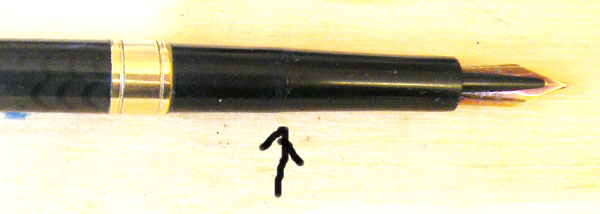
One of the commonest problems on well-made pens like Swans is that it can be very hard to see where the pen opens. The join between barrel and section can be so fine that it’s virtually invisible. Use strong light and magnification if necessary. I’ve shown here with my crudely drawn black arrow where the faintly-visible join is on the 1500. It will be in a similar position on most eyedroppers.
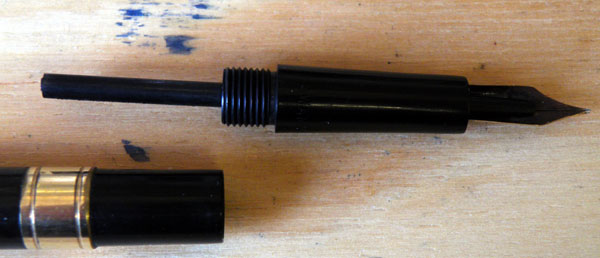
Someone will correct me if they’ve found different examples, but all Swans and indeed all the other eyedroppers I’ve worked on are conventionally threaded. In other words, the section will unscrew from the barrel with an anti-clockwise turn. Expect the threaded part to be quite long Sometimes these are reluctant to move because they are stuck with old ink. Gentle dry heat will loosen them up; remember that these are black hard rubber pens – soaking is not advised.*

Assuming the need to disassemble further, this is one of the few occasion where using a knock-out block to remove the feed and nib would be wrong and could cause damage. Grip the feed from the rear of the section and pull it out. The nib will be left in place. Then simply pull out the nib from the front. Sometimes the feed will be stuck with dried ink. Carefully trickle water through the assembly, taking care not to soak the outside as this may cause fading.
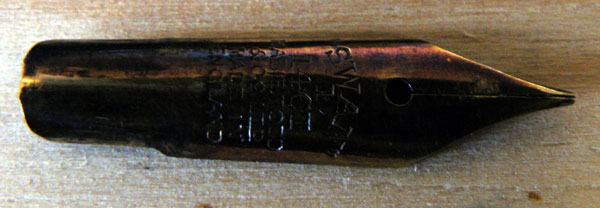
For reassembly after you’ve reinserted the feed, you will note that the tail of the nib is narrowed. Look inside the nib end of the section;

there are slots to slide the nib into. Adjust the feed until it sits right on the nib and reinsert the silver wire into the back of the section. That’s it!

Some people apply silicone grease to the threads of eyedroppers to prevent leaking. It’s rare that this is actually required. These long, very finely cut threads are almost always ink-tight in my experience, and the application of unnecessary grease is likely to be a messy nuisance. By all means, if the pen actually leaks at the joint, use silicone grease but don’t do it by default.

*Opinions vary about soaking but in my experience water, whether hot or cold, is best kept away from the visible exterior of black hard rubber pens. Some rubber, and particularly rubber as old as the material in these eyedroppers, has often already deteriorated through oxidization, though it isn’t visible. Any contact with water will make it fade at once. Then you’ll have to rub the part down to return it to black and it probably won’t match the rest of the pen. You may even resort to one of the several potions and processes you’ll find on the internet, none of which I can recommend. Better to avoid the necessity in the first place.
An Early Swan Nib

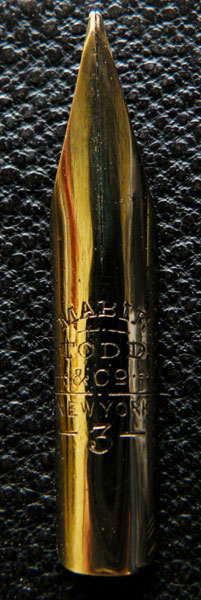
Isn’t that a beautiful thing?

It’s an early No 3 Swan nib – quite how early I can’t say at the moment, though I expect research will turn up a ball-park date eventually. No breather hole. It’ll be interesting to see how well that works when I get a pen to fit it in. It’s also very flexible, expanding from fine to triple broad at a touch.

The nib turned up on its own in eBay a few months ago. Bidding was hot and fast at the end and I paid nearly £40.00 for it, and was glad to get it at that price. I just need the rest of the pen now…

Actually, in a way, I won’t be especially aggrieved if I never find a pen for it. It’s such a jewel on its own, wonderfully evocative of an early stage in fountain pen development. It’s an inch-long masterpiece.

A Late Blackbird

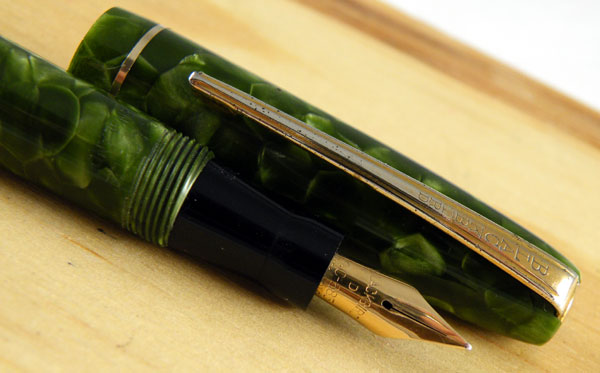
Strangely, though the last of the Swans were execrable pens, the late Blackbirds were nowhere near as bad.


This pen comes in the twist-filler or lever filler forms. Though there has been a decline in quality from earlier pens , it is still, to my mind, a quite admirable writing instrument which has survived the passage of the years in good shape.


The only real failing is the appearance of tiny spots of corrosion coming through the thin plating on the clip. Otherwise it’s pretty good. The patterned plastic is attractive, it hasn’t discoloured or distorted, the filling system works faultlessly and the pen has a good nib. Another sign of cost saving is the clip, which is now held by a stud at the top of the cap instead of the earlier clip which was directly inserted into the plastic of the cap. This can hardly be regarded as a very bad failing as Waterman, among others, used this style of clip for many years.


Different sources give slightly different dates for this pen. Some say 1950 – 55, others 1954 – 58. It’s only speculation on my part but I’d be inclined to go with the later dates. My thinking goes like this: this pen bears little resemblance to anything that had gone before in either the Blackbird or Swan lines. Mabie Todd was taken over and became Biro Swan in 1952. It would seem to me likely that such an extensively redesigned pen as this came from the new company. The 1954 – 58 dates would have this pen in production until fountain pen manufacturing ceased. As I know of no later Blackbird, that seems reasonable to me. However, if you know know better…


One of my tests of quality in a pen is how well it has survived. I ran some water through the section/nib assembly to clear out any old ink, popped in a new sac and the pen was ready to write. That’s not much to do to a fifty-odd-year-old pen, I’d say. I’d be perfectly happy with this pen as a daily user, both in terms of writing quality and aesthetics. It’s still a good looking pen.


The Mabie Todd Swan 230/60

The range of handsome black hard rubber pens of which this is one were made for most of the nineteen-twenties. For those of you still struggling with the Mabie Todd numbering systems (and I confess there are some numbers that remain a complete puzzle to me) the 2 is the nib size, the 3 means that there’s one band at the top of the cap and two on the barrel and the 0 means there’s no band at the cap lip. I neglected to photograph it but there’s a mottled hard rubber insert at the top of the cap with a white Swan emblem.


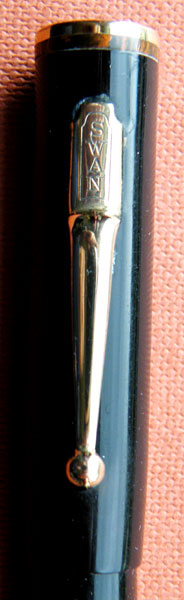
The clip is a slightly smaller version of the stepped clip Swan had been using for some years, with the word “Swan” imprinted on it rather than the patent date used earlier. With three bands, a stepped clip and a cap insert, this wasn’t one of the company’s cheaper pens. Though it has the comparatively small No 2 nib this pen probably sat above the middle in the Swan price range.


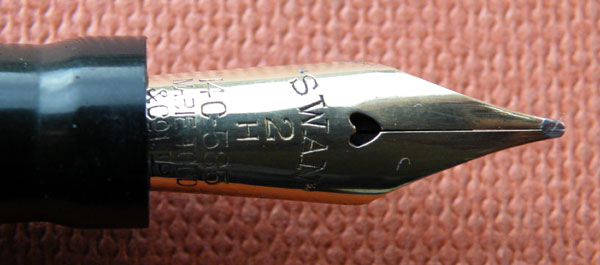
As is so often the case with Swan pens of this date, the beautifully engraved nib has considerable flexibility. This nib has an ‘H’ designation. Anyone know what that means?


These 1920s Swan have it all for me. They’re light, they have perfect balance in the hand, the nibs are invariably splendid and the filling system, with its long lever, works very well. All in all, this pen must rank as one of the best ever made, by any manufacturer.