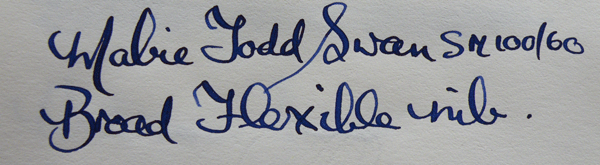
A Flock Of Swans

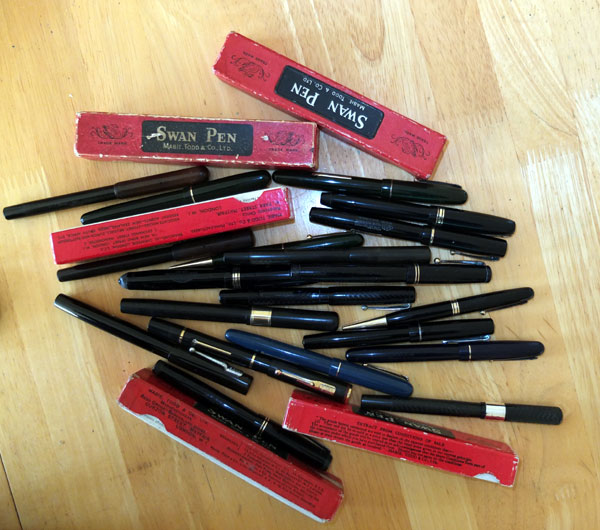
I’ve been concentrating on restoring Swans this weekend and here’s the result of my labours:
DSCF0917
There are a few more interesting examples to come in, so I’ll wait for them.  Then it’s write-testing, photography, writing descriptions and uploading to the sales site.  All being well, I should be listing these at the end of next week but I make no promises.  Life is so full of time-wasting interruptions!

I’m enjoying fixing the Swans.  There’s no better pen to work on.

A Swan No 6 Eternal Nib

DSCF0914

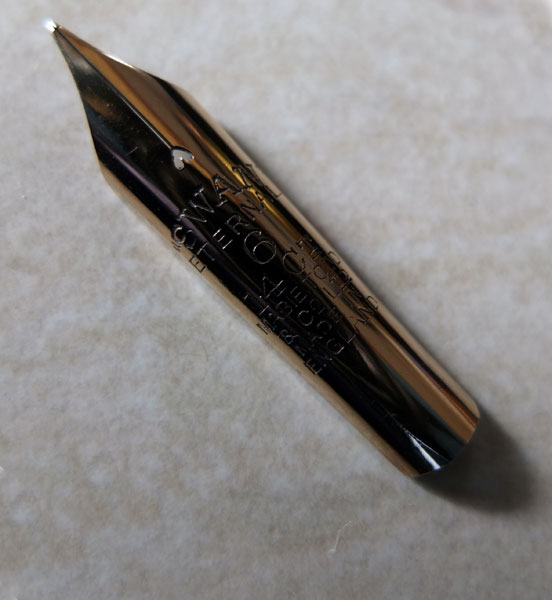
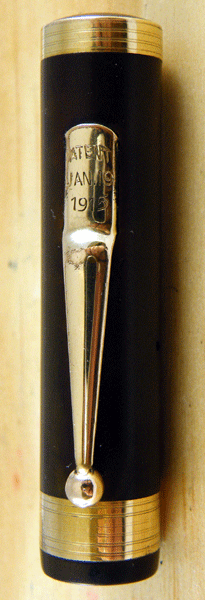
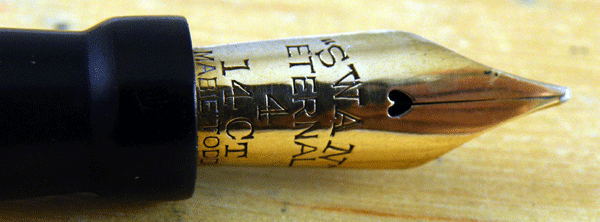
A No 6 Swan Eternal nib is a considerable lump of gold.  I’m sure you could make a respectable wedding ring out of one.  It’s not the biggest of the Swan nibs, of course.  There’s the No 8, quite a bit larger still.  I hadn’t seen one in the flesh, as it were, until recently.  Eric had a very fine example to show me.

I took the opportunity to photograph this one while I had it out of the pen as the sac was drying.  As many will be aware, re-saccing a Leverless makes for an unusual order of reassembly.  First, the shellac on the sac and section have to dry completely – no shortcuts with this one!  Then the sac has to be slid into the barrel with a dowel inside it to keep it extended and, last, the feed and nib can finally be fitted to complete the job.  All this is because to work well a Leverless needs a barrel-filling size of sac, unlike lever-fillers and button-fillers.  I used a No 22 sac on this 4660.  Necked sacs are great for Leverlesses if you can find them.

The nib has been reunited with the pen now, ready for write-testing.  A matching pencil goes along with this one.  It was all Swans I restored this morning.  I’m planning that my next upload to the sales site will be a Swan Fest!

Mabie Todd Swan SF 230/60

DSCF0404

I think many of you will know that I never let a Swan SF 230 pass me by if I can help it. This one’s a 60, in other words black hard rubber. I picked it up for a song because of the inscription. Most people, it seems, don’t want personalisations on their pens, especially if they’re picked out in bright yellow! Me – I’m the opposite. A good, professional inscription makes the pen for me and gives it extra interest.

DSCF0402

The pen just arrived this morning, hence its dull appearance. I haven’t begun to restore it yet. The pen dates to about 1925, and as it was given to R. Gwynedd Jones on his twenty-first birthday, he must have been born around 1904, plus or minus a few. What else does it tell us? Well, he’s Welsh, more than likely, with that name and he comes of a well-to-do family – this is an expensive pen. I hit Google and fairly soon had turned up two – or it might be one – R. Gwynedd Jones who would fit the description so far as age is concerned. There’s an author (or it might be two authors) who published Yr Offeryn – Ffars Mewn Tair Act (1953) and Y ditectif (1963). The first one seems to be The Instrument – A farce in three acts and the second – wild guess here – something about a detective. So is this our R. Gwynedd Jones, a mid-twentieth century Welsh author who – if my crude translations from the Welsh hold up – was also involved with poetry festivals and Eisteddfods?

DSCF0410

The other R. Gwynedd Jones (it really doesn’t seem likely that it’s the same person) was a solicitor living in Pwllheli on the Lyn Peninsula in North-West Wales. In 1935 he was Clerk to the Justices, a good job for a lawyer just starting out, and in the same year in private practice he managed the winding-up of the South Carnarvonshire Farmers Association. So is this my pen’s first owner? Or may it have been that he was part of the slaughter of World War II? Or was he someone else entirely, who lived a long life of pleasant obscurity and never did anything noteworthy enough to hit Google’s indexes?

We’ll never know. I might hang onto this one though. I’ve always wanted an SF 230 of my own and this one is especially endeared to me by the inscription.

A Brace Of Flexible Mabie Todds

DSCF0348

These two pens caught my attention when I was doing repairs at the weekend. They’re not outstanding examples of their kind in terms of quality (though the Blackbird’s pretty good) but they both seemed to have a bit of flex in the nib.

DSCF0351

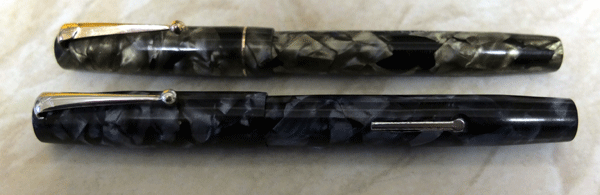
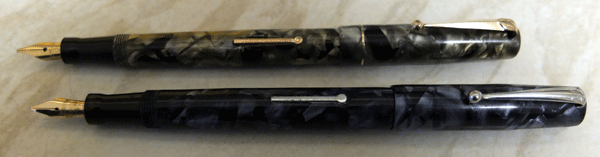
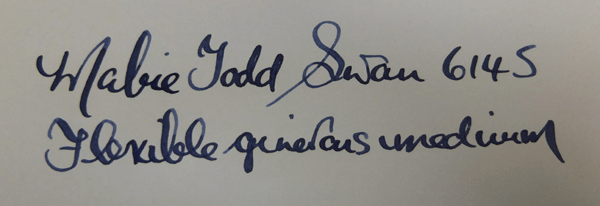
They’re pre-war or wartime pens and I suspect the Blackbird – that’s the blue one – is a few years newer. The Blackbird’s a 5242 – the 42 being simply blue marble. The Swan is a 6145. I confess that the significance of the ‘6’ continues to elude me. I have no idea what it means, but I have a suspicion that it dates the pen to wartime. The 1 is the nib size and 45 indicates pearl grey. It looks a little greenish to me but that may be discolouration. Or it may be that it’s perfectly grey and I suffer from a tad of the colour blind where some shades of green, blue and grey approach each other.

DSCF0355

DSCF0356

Anyway, it wasn’t until today that I got the chance to write-test them and they lived up to their promise. These aren’t wet noodles (what a ridiculous term!) but they’re pens that have a lot of easily induced flexibility and snappy return. For the past few months I’ve been using and enjoying stiff-nibbed Sheaffer Imperials, but I think that these pens may draw me back into the flex camp – especially the Swan.

The Swan Calligraph Revisited

1949, 1951 and 1952 were important years for Swan, and not all of them in a good way. 1949 was certainly good as it ushered in the long-awaited series of cigar-shaped pens. 1951 brought the Calligraph and the redesigned Leverless to the market, both very good ideas, just perhaps not as well implemented as previous designs. And, of course, in 1952, Biro took over Mabie Todd. There were not many years left for the company, and the years that remained were not of their best.

DSCF0246
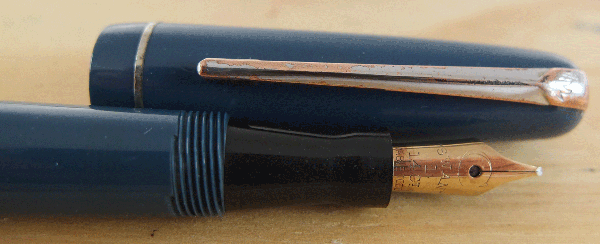
It’s the Calligraph I want to look at today. This example is, I think, an early one. The reason I say so is that it’s an italic with flex, a decided nod in the direction of producing calligraphy with a fountain pen. In fact, this nib was advertised as being perfect for Chancery Script. This is, I have to say, only the third Calligraph I have handled with an italic nib. Most Calligraphs seem to have had perfectly ordinary fine or medium nibs. Broad, stub and italics appear to be very much in the minority.
DSCF0249
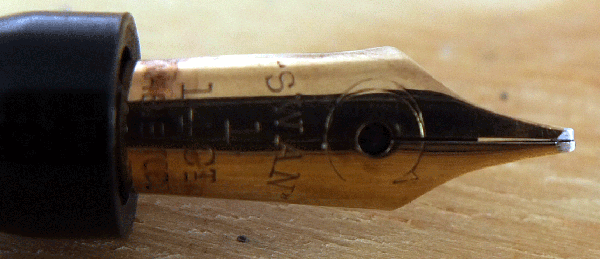
This happened, I believe, because demand was low for real calligraphers’ pens, and the company made a school pen of the Calligraph. I say that because so many of those that arrive on my bench have been chewed and mishandled. They belonged to kids, those pens. They have thinner gold plating that the other models of the time, and seem to have been placed a little lower in the market from the outset. There’s a hint of flimsiness about the Calligraph which I think increases with time. The later, leverless Calligraphs seem more poorly made, to me. Some of those have disappointing nibs and whatever the faults of the earlier ones might have been, their nibs – like this one – are superb.
DSCF0250
So whenever a Calligraph arrives, I get out the heat gun and the abrasives to remove the worst of the chomping and the scraping. If I’m unlucky, I have a so-so pen with an adequate nib, but if fortune smiles on me, I have a pen with a nib like this. Who cares about worn plating or a few scratches when the pen has a nib like this one?

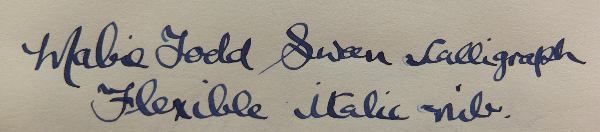
That said, italics don’t sit well in my hand, as I’m sure you can see from this writing sample. I prefer a more rounded stub, myself.
DSCF0256

I’ve written about Calligraphs on a couple of previous occasions.  The search facility will find them for you if you’re interested.
The Mabie Todd Blackbird BB20/61 Eyedropper Filler.

DSCF0150

I like MHR in a wood grain pattern, and I especially like it when it comes in the form of something unusual. This is a Blackbird BB20/61 Fountpen. The BB means Blackbird, the 20 means a No 2 size nib and no bands, and the 61 is for wood grain. This is an eyedropper filler. It’s pre-screw-cap but post over-and-under feed. It has a slip cap and a spoon type of feed. So what date does that indicate? Actually, it’s surprisingly late. This version of the Fountpen was introduced in 1921, so it’s a mere youngster of 92 years.

DSCF0153

These long, slender, elegant pens are quite uncommon. It may be that the public wanted self-filling pens by 1921 and so the Fountpen never took off. The black hard rubber version, the BB20/60, is marginally more common but I’ve seen only a couple of them in the last five years. This is the first mottled hard rubber Fountpen that has come my way.

It survived the first ninety or so years in perfect condition. Recently, some cretin had difficulty opening it and resorted to his pliers. I’m not a violent woman but I could think of some uses for those pliers that would make the thickhead think twice before he dug them into the section of a fountain pen again.

By dint of incantations and sacrificing a chicken I’ve been able to reduce the scratch to a less offensively obtrusive level. ‘Scuse me, I’ve got to go now and make gravy for the chicken.

A Swan Surprise!

I wasn’t expecting any pens in the post today. I had bought some over the weekend but it was too soon for them to arrive, but the post-lady had left a decidedly pen-like package on the doormat. A cursory glance showed that it wasn’t UK, but from the USA. The mystery deepens…

DSCF9211

It turned out to be a gift from a customer who has become a friend, and a wonderful gift it is too!

DSCF9215

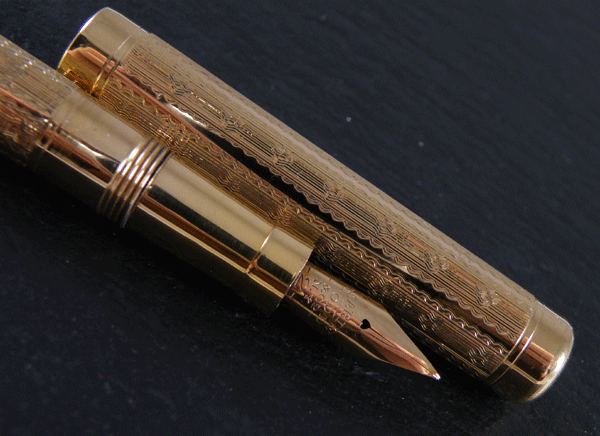
Pens of this type, some with a fixed clip, others, like this one, without, were produced by Mabie Todd USA for what seems to have been quite a short period in the early nineteen twenties.

DSCF9218

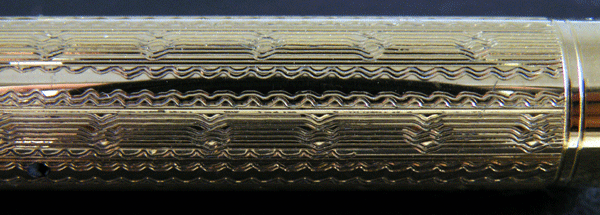
These gold-filled pens were made in a variety of eye-catching machine-chased patterns. So far as I can discover, no-one has taken the trouble to list all the patterns and link them with their original names, as David Nishimura has done for the gold-filled Wahl pens. This is a lined pattern with a twist every few millimeters. At a distance of a few inches, these appear star-like and twinkle in the light. It makes for a stunning pen that changes as you move it in the light, and defies the camera to catch all its beautiful effects.

I will always treasure this pen.

The Mabie Todd Swan 444C/60

DSCF8986

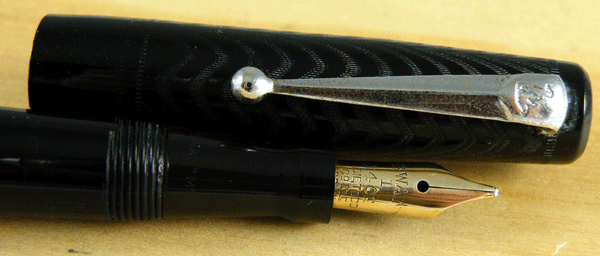
I haven’t seen one of these before and a Google search and a search of my printed materials didn’t throw one up either, so I think it’s fair to say that it’s quite uncommon. The “S.F” which began the number on older pens has been dropped, which would place it, I believe, in the late 1920s. The first 4 denotes the nib size, the second indicates unusual bands, in this case “stacked coin” bands at the crown and near the lip of the cap. The third 4 shows that this pen began life with an Eternal nib, which it still has. I don’t know what the suffix “C” is for. The “60” is for the material the pen is made from, black hard rubber. It’s a little faded, to dark brown, and it shows the wear one might expect from a long life of hard use. The barrel imprint is worn away and the gold plating is worn in several places.

DSCF8993

At 13.3cm capped and 17.cm posted, this is a big and bulky pen, though it isn’t heavy. Even posted, it’s light and well-balanced in the hand, and the big Eternal nib skims over the paper smoothly. With this size and the “stacked coin” bands it’s a pen made to be noticed but it’s fully practical as well, as shown by the use it has had over the years. By the time this pen was made, there were already colourful plastic Swans available, so the 444C/60 was quite a conservative choice.

DSCF8989

These elegant, robustly made pens of the twenties and early thirties often gave many years of work for their first owner and are ready to start all over again today. This is the kind of pen that one expects – with some justification – to go on writing forever.

An Unusual Swan 1500

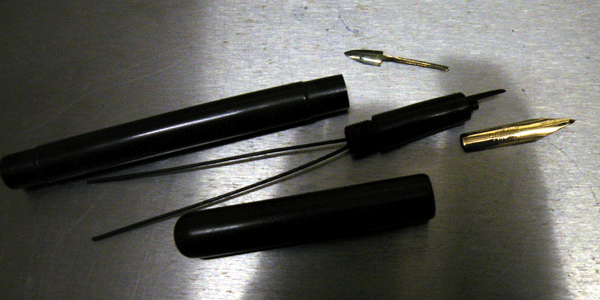
I bought this pen as a Swan 1500 eyedropper and maybe that’s what it is, but it isn’t a normal one. The pen was in a poor state when I got it, filthy and ink-stained and it will still need some more work to make it presentable. Excuse the rough pictures, just snaps I took as I disassembled the pen.

DSCF8894

None of the features I’m seeing here are entirely new to me but this is the first time I’ve seen them together in one pen. I’ve seen the long wires which almost to the barrel end in over-and-under feed eyedroppers before. They’re intended to lead the ink in smoothly to the feed, in which these wires are embedded. The feed is altogether more complicated than the usual over-and-under, and really is something different. It’s a composite of several parts and I think it will take some playing around to make it work well.

DSCF8899

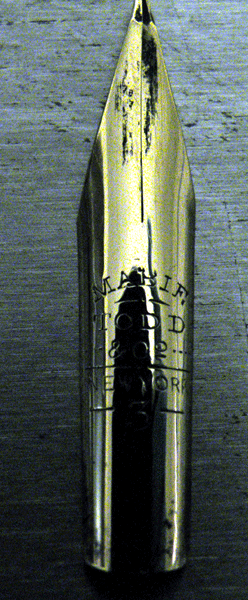
The nib is unusual in that it has no breather hole. I have a nib like this and had assumed that it was meant for a dip pen, but it seems that’s not so. Unless, of course, this is a replacement, but the encrusted ink of ages says that it has been in this section for a long time.

No conclusions at this point. I’ll be working with this pen for a while.

The Swan SM100/60 And The Persistence Of Black Hard Rubber

DSCF8437

The SM100/60 doesn’t stand out on the Swan range of the thirties but in its unassuming way it’s a milestone of the brand. It’s down at the bottom of the range, medium-sized, chrome plated and placed in the clerical and school area of pen sales. It’s just as well made as its more upmarket brethren, though, a sturdy and reliable pen that has lasted well through the decades, and was often fitted with exceptional nibs – flexible, stubs, broad and obliques.

DSCF8444

Though this pen has been moved from the traditional black hard rubber to celluloid, the cap and barrel are still machine-chased, perhaps the last Swan to be decorated in this way. Black hard rubber is still present in the lever, a feature unique to Swan, so far as I know. Did Swan employ BHR for the lever to use up stocks they had? Looking at the smooth outline of the barrel, I think it’s rather a carefully considered design element. Doubtless the BHR lever cost less that a chrome plated metal one but it can be argued that sitting flush with the barrel it looks better and is easier to grip than the usual filler lever.

DSCF8432

Mabie Todd Swan had a longer association with black hard rubber than any of the other British manufacturers. A decade before this pen was made, a large proportion of the range was made from this material, still holding its own among the brightly-patterned celluloid. A decade later it would be reintroduced at a time when most of the competition had given up black hard rubber, and it would sell very successfully.

The lever on this modest pen means that until the very end of production there was never a time when Swan didn’t use black hard rubber.