Mabie Todd Swan 3261

Though there are always exceptions to surprise and delight you, you can guess what most British pen nibs will be like in advance of testing them. English Parker Duofolds are nails, but good nails, and Mentmores and Summits are likely to be quite similar. Conway Stewarts mostly have a small amount of flexibility, with less than one in fifty being a full flex or a stub. Many Onotos are flexible, and stubs are far from uncommon, including a gorgeous broad oblique stub I had a few years ago. Nothing beats Swans for line variation, though. Over the years of restoring pens, I would estimate that around a third of Swans have been either full flex or some variety of stub. Buying a Swan fifty or sixty years ago must have involved a lot of choice for the discerning writer, and not just in the top-price, large-nibbed models either. Writing perfection was available all the way through the range, as this humble Self-Filler 3261 shows.

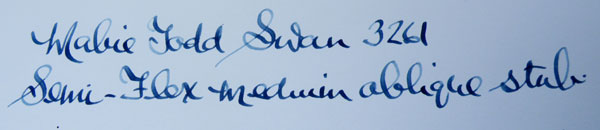
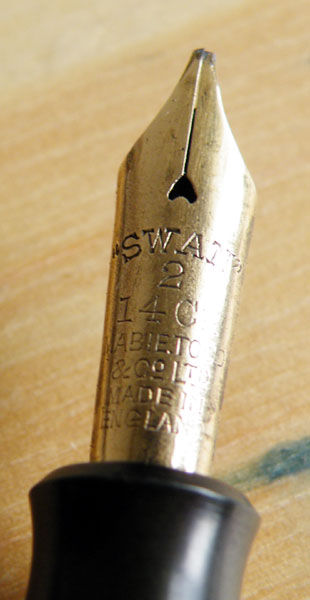
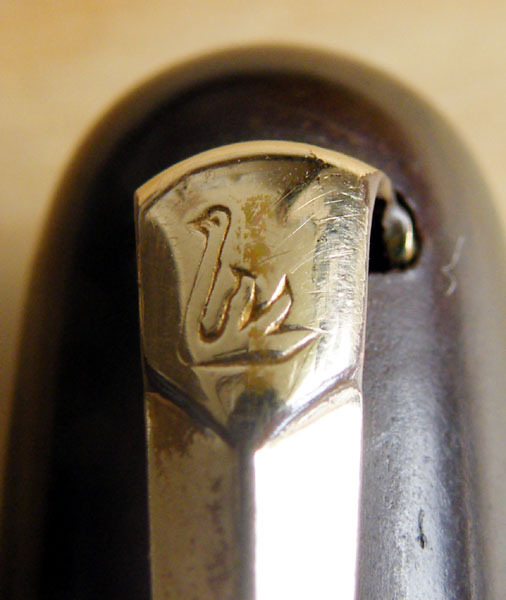
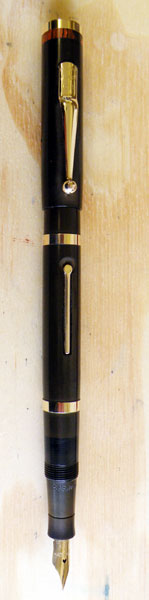
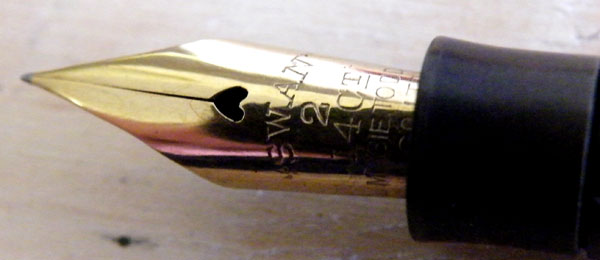
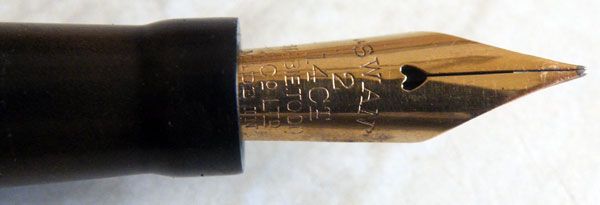
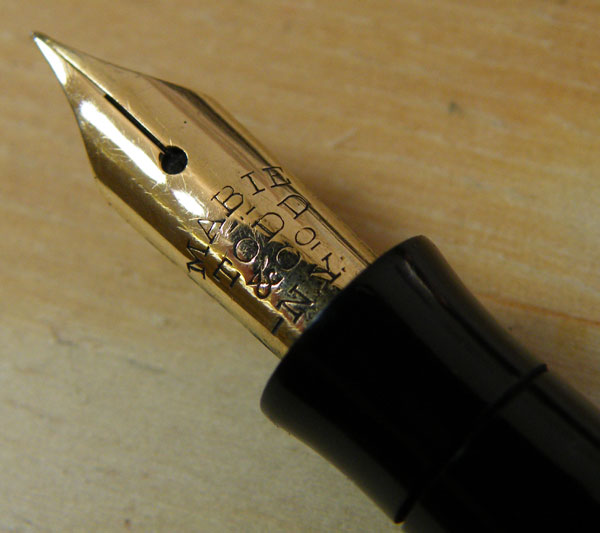
This is a 1940s black hard rubber pen, and with a No2 nib and two narrow cap rings it wouldn’t have been very expensive. The BHR has faded quite evenly, to a pleasing chocolate brown but otherwise the pen’s pretty much as new. The high-shouldered medium oblique nib is very attractive. That said, it’s a fairly ordinary pen that isn’t likely to draw admiring attention. The line it produces, though, is the picture of elegance:

Mabie Todd Swan 3261

After World War II, Swan tooled up for a new product range and went from slightly streamlined, flat-topped pens to fully streamlined torpedo-shaped ones. These were self-coloured in black, dark red, dark blue, dark green and, strangely, black hard rubber. This material appears to have been reinstated after a gap of many years during which the company made celluloid pens. Beautifully machined and finished, the BHR has worn well, though by now most have faded to brown.

One may well wonder why Swan chose to revert to the long-superseded black hard rubber at this date. Perhaps it was to make up a shortfall in the supply of plastic that old stocks of ebonite were used up. Maybe someone felt that the time for BHR had come again, though this seems less likely. Most decisions in the wartime and immediately post-war years were driven more by shortages than style. For myself, I’m just glad they made them. I like black hard rubber, and these are good pens, often with exceptional nibs.

This one has a No2 oblique semi-flex stub, a very nice nib indeed. Throughout its history, Swan seemed to make a greater effort than other British manufacturers to supply customers with nibs that suited their writing style, hence the number of stubs, obliques and flexible nibs that turn up on Swan pens today.


These were the last really high-quality pens that Swan produced. Within a few years, competition from ballpoints laid the company open to takeover by Biro. Swans continued to be made, but the historic Mabie Todd name disappeared, and the pens showed the decline in investment. After a few years of poor sales of pens that would have been better not to have been produced, the Swan story was over.

You’ll notice that I resisted the temptation to make reference to Swan’s swansong. I’m so proud.

The Swan SF230


When I think of Swans, this is the pen that comes to mind. This is THE Swan for me, the epitome of the brand. The SF230 also came in mottled hard rubber and, a little later, in a variety of celluloid patterns including green jade and lapis lazuli. They are very attractive, but the black hard rubber version is the one that works best for me, as there’s nothing to distract from the splendid design. It’s a big pen -17.5cm posted – and it’s designed to impress, with its three bands and large gold-filled clip. It isn’t the most expensive pen in the range. There were very highly-priced overlay pens, pens with very much larger nibs – this has a No2 – and the ETN range with their Eternal nibs was higher priced.


This was the pen that the company pushed hardest, though, and it featured in many advertisements, especially in Britain and France. I think Mabie Todd recognised that they had a winner in this one, with its perfect proportions and harmonious design. Always the writer’s pen, practicality was never sacrificed to aesthetics in Swans, and this pen is no exception. Though the cap may look large and imposing, the pen is perfectly balanced in the hand. This nib is fine, and it has a little flexibility. As always with Swans, it’s a delight to write with.


There is a case that can be made for saying that fountain pens reached their peak in the 1920s. The technology of nibs, feeds and filling systems was mature. The ergonomics of a comfortable writing instrument were well understood. Many of the “improvements” that followed were illusory, and from a purely practical point of view we would have lost little or nothing if pen development had frozen here. I’m not saying that would have been a good thing. There are so many delightful pens that we would not have had. What I am saying, though, is that it would be hard to find an objectively better pen than this.

Restored Swan Minor SM2-57

Here’s the restored Swan Minor SM2-57, which I posted about yesterday.


Both as a repairer and a writer, Swans are my first choice of pen, and of all the Swans, I like Minors, whether SM1 or SM2, best of all. They’re an adequate size and the design is very pleasing, with the flat-topped (or in this case very slightly domed) cap, the inserted clip and the hard rubber lever, which breaks up the line of the barrel much less than the usual metal one. And then there’s the nibs… Minors almost always have exceptional nibs. Far more often than in any other model, Minors have oblique, stub or very flexible nibs. Perhaps it was the real “writer’s pen” of the Swan range. I haven’t tested this pen yet, but it seems to be at least semi-flexible.


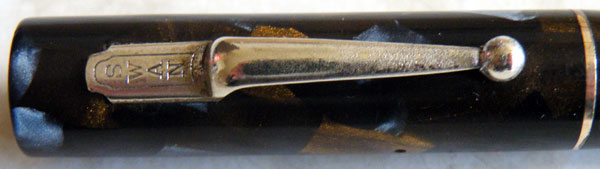
The pattern of this pen is very beautiful, with bronze and blue in different shades mixed with black. The colours are muted and there are quite large areas of each colour. Most unusual. I haven’t seen this pattern before.

Swan Minor Clip Replacement

I bought a Mabie Todd Swan Minor 2-57 with a missing clip. Luckily, there was no damage done to the cap when the old clip failed, and luckily also, I had a spare clip. These are superbly beautiful pens with a chunky pattern in muted colours – a perfect example of Swan’s understatement! This one was well worth the painstaking business of replacing the clip.

First the cap gets a good session in the ultrasonic cleaner to remove encrusted ink and get the water to penetrate behind the inner cap. Then heat is applied. Another ultrasonic bath and yet more heat. Then the inner cap puller is brought into play, with continual heat playing on the cap. With this preparation, it takes little effort to remove the inner cap – always preferable. You can apply a lot of pull with these things comparatively safely, but the less effort needed the safer the process is.

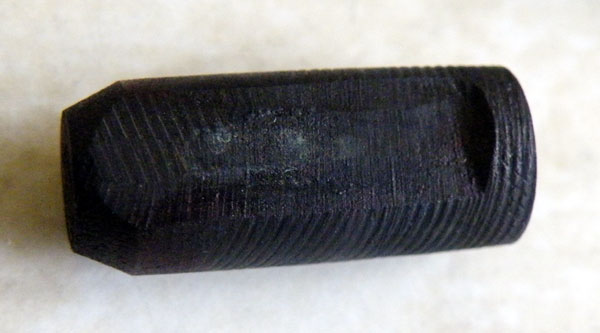
I love working on Swans because the quality is so good, and the hand-finished inner cap is just another example of that. To ensure proper clearance of the inside of the clip assembly, the craftsman has filed away a few strokes more, and you can see the file-marks there on the flat of the inner cap.


The part of the clip that goes inside the cap has shallow lips, and the little metal tab you see there is forced between them to lock the clip in place. That’s a tricky job, a bit like threading a needle while wearing mittens. And doing it through the keyhole. It gets done (eventually) and all that’s left to do is to refit the inner cap, so it’s back to heating the cap again, and tapping it in to the correct depth with an appropriately-sized piece of dowelling.

I’ll maybe get a picture of the restored and cleaned up pen tomorrow.

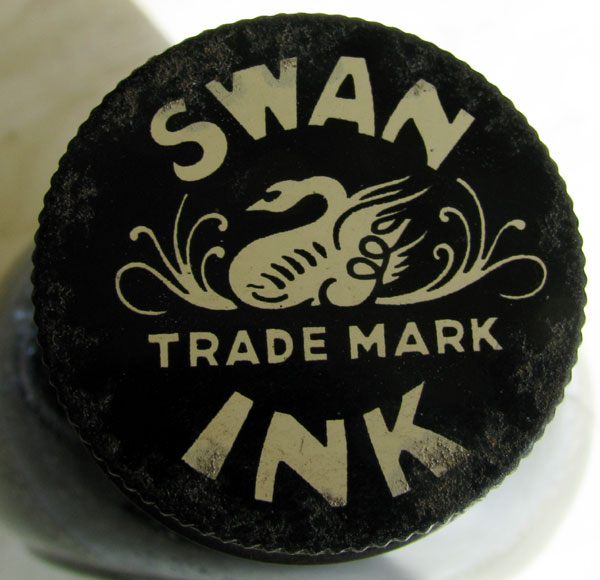
Mabie Todd Swan Ink

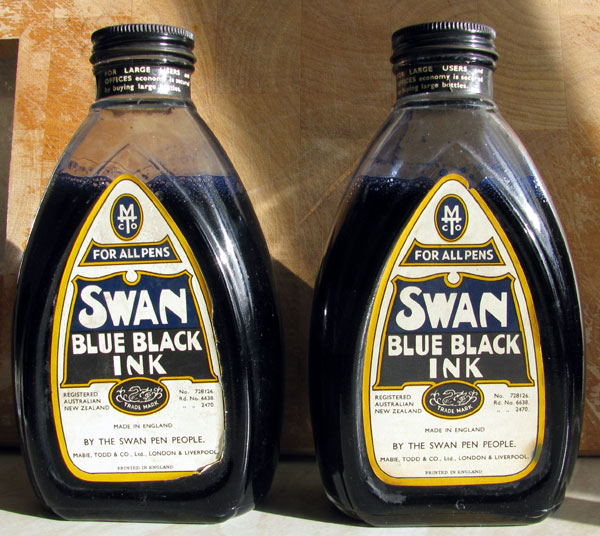
What with testing pens and one thing or another, I get through a lot of ink, but this should keep me going for a while!

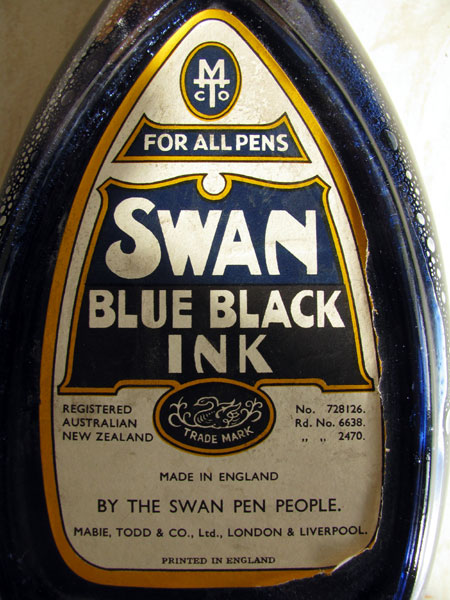
I was amazed to see full, unopened bottles of Swan ink for sale in eBay. So far as I remember, Swan went out of business around 1956, so these bottles are at least 54 years old. Maybe more. There appears to have been a little evaporation, but the ink is still in perfect condition. The bottles are nine and a half inches high and must hold best part of a pint of ink. One bottle will be kept unopened, but I’ll use the other. I don’t think I’ll need to buy any more ink. Ever.

Curious, I asked the seller how he came by these bottles and here’s his answer:


We own a stationers and when ink went out of fashion

these were put underneath the window staging. Because of the

spiders and damp under there the girls never ever

went under. It was only when I decided to have a clear out

that I discovered them. We put them on display for the

last 20 years and then decided to let them go to good homes

or to be used.

These are wonderful Mabie Todd memorabilia and as Swans are my favourite pens, it will be good to write with both Swan pen and ink.

These are still on sale in eBay, so if you are interested, search for Item 260741407084 on the UK site.

Mabie Todd Swan SF1

It’s hard to get a certain date for the introduction of Swan’s SF1. I’ve seen 1917 quoted and that’s possible. It’s obviously early because many examples come with New York nibs, so it pre-dates the establishment of Mabie Todd’s nib works in Britain.

Perhaps a little slender for modern tastes, in every other respect it’s a delightful pen. Though the illustrated example was a firm needlepoint, most SF1 nibs are flexible. Some are very flexible indeed. Posted, it’s a long pen with good balance. It comes as a plain black hard rubber pen, but also in mottled hard rubber and with a variety of gold trims. All in all, it’s one of the best and most practical of early lever fillers.

From my point of view, however, the SF1 has a down-side. It’s the only Mabie Todd pen I don’t like to work on. The tolerances on this pen are often very tight indeed, and it’s not difficult for the repairer to break one. The section fits into the barrel very snugly, and it requires a lot of heat and patience to get the section out. Putting it back in after the sac has been replaced is even worse, and it’s at this point that the dreadful “snap!” that can really spoil your day can be heard. It’s not that the pen barrel is especially fragile – it’s fairly robust, in fact, but the fit is unforgivingly tight. I’ve once or twice been tempted to plane the section down, but then I’d have to shellac it in, and it wouldn’t really be the same pen.

That’s the SF1 – a pleasure to use, a pain to repair!

Mabie Todd’s Swan Leverless

Mabie Todd’s Swan Leverless pens have a poor reputation in some quarters, due not to any intrinsic fault of the pens, but because they have been incompetently re-sacced. The bar in a Leverless does not flatten the sac as does the pressure bar in a lever or button filler. It entangles the sac and compresses it with a “wringing out” action. For this to work well – or indeed at all – the sac has to pretty well fill the barrel. As many Leverlesses have a comparatively small nipple, a necked sac is often needed. Re-sacced properly, a Leverless will hold a good quantity of ink. It is true that it holds less than a similar-sized lever-filler, but it will still hold a lot more than, for instance, a modern international cartridge. You’ll get quite a few pages from it.

The unskilled repairer fits a comparatively slender sac, as he would in a conventional lever or button filler, and the entangling bar compresses the sac poorly, or just rotates around it without compressing it at all. As you might imagine, fitting a sac that fills the barrel is nowhere near as straightforward, and a different method has to be used.

The Leverless has the advantage that it is one of the easiest pens to fill. Simply place the pen in the ink, rotate the turn-button anti-clockwise, then clockwise, give it a few seconds to complete filling and you’re done, and it’s all carried out at the end of the pen away from that messy ink-bottle. In addition, though there were economy Leverlesses, most were designed to be prestige pens, with two or three cap rings and the No 4 or larger nibs. They were the most successful Swan range for decades, and as long as there were skilled repairers to fit new sacs they gave no trouble as the design is strong and durable.

The Mabie Todd Swan 1500 Eyedropper Pen

By the time the 1500 came along – probably around 1910 – Mabie Todd had been making fountain pens for quite a while. There seems to be real confidence and assurance with this model. No longer was the company trying to get a pen to work reliably and well. That has been done, and now it could concentrate on meeting the various needs of users, so the pen was presented with all the possible nib options – fine, medium and broad, oblique and stub, flexible, semi-flexible and, less usually, firm. Though the rest of the pen was British made (with the exception of a period during World War I, when production switched to America) the nibs were still made in New York.

1500s are perhaps the most commonly seen eyedropper pen now, and that gives an idea of how successful this model was and how well it was made. It remained in production for at least a decade, and survived competition with more technically advanced pens at the end of that period. Quite simply, its reputation was so high that people saw no reason to change. It remains a perfectly practical pen to this day and because of the superb quality of the nibs it is an especial pleasure to use.
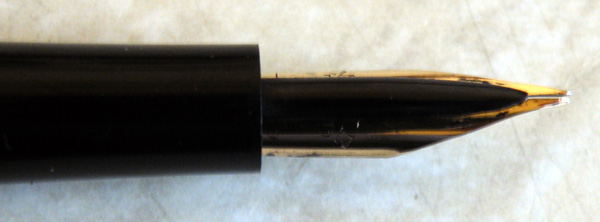
By this time, other manufacturers had begun to drop the over-and-under feed. Though it successfully delivered ink from the barrel to the tip of the nib, it didn’t regulate it well. Too much or too little ink might arrive on the paper, and blobbing was a problem. The 1500 doesn’t suffer from these deficiencies. Perhaps the inclusion of the twisted silver wire at the back of the feed helps to regulate flow, but a well-set-up 1500 writes as well as any pen fitted with a spoon or ladder feed.
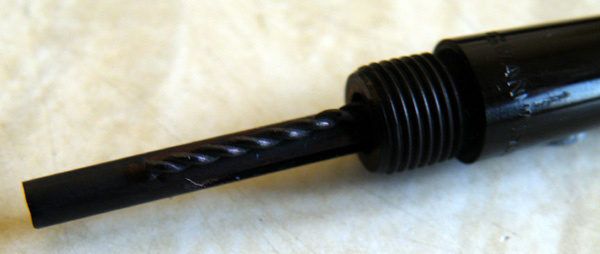
Like most pens made at that time, the 1500 is a slender pen. Most of its original purchasers would have been used to dip pens, so this would not have been seen as a disadvantage. The lack of a clip, however, was a nuisance, and Swan addressed this lack with the Swan Metal Pocket and a range of after-market clips. Though the slip cap fits securely, I suspect that clipping the pen to a pocket was never a very comfortable solution and there must have been accidents. It was only with the introduction of the Safety Screw Cap this issue was finally dealt with.


The 1500 comes in several guises. The most common version is the simple black chased hard rubber model, but more expensive 1500s had gold-filled barrel bands or even full overlays. This is the pen that helped to establish Mabie Todd’s early British market dominance, and it is said that fountain pens were referred to as Swans, in the same way as all vacuum cleaners were known as Hoovers.
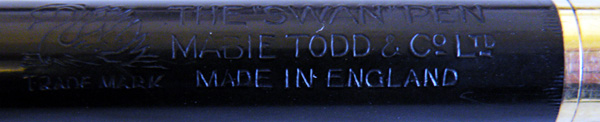
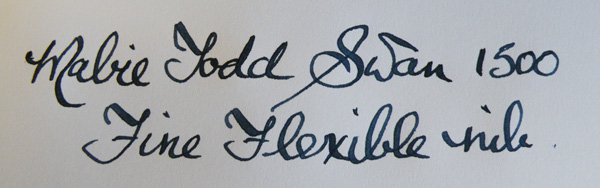
For me, a flexible 1500 is one of my daily users. It requires no noticeable pressure to invoke a broad down-stroke, and transports me back to the days when light upstrokes and heavy descenders were just how people wrote, rather than a calligraphic technique.
The Swan Metal Pocket

The first fountain pens just weren’t portable, unless you liked ink-stained clothes, but soon after the turn of the twentieth century improvements to feeds, screw-on caps and safety pens meant that they could be carried, provided they were kept upright.  As fixed clips hadn’t arrived on the scene, pen and accessory manufacturers tried various solutions.  In many ways, the removable accommodation clip was the most successful, but it did have a tendency to scratch caps.

Mabie Todd’s answer was the Swan Metal Pocket:

At first glance it seems like an unnecessarily clunky solution but actually it’s eminently practical.  Though well made it is light.  The clip will attach firmly to any thickness of material from cotton shirt to tweed jacket and the pen is held securely but lightly, with no risk of marking it.

The clip is stamped with a beautiful Swan emblem; as this part would be visible, Mabie Todd wasn’t going to miss the opportunity to advertise their products.

The proof of the pudding is in the eating.  These accessories sold in huge numbers, many of them still around today.  The proof that this one was well used is on the back, where it has been rubbed down to the bare metal with years of use.

Though almost completely superseded by the modern fixed clip, the Swan metal pocket will still provide a means of carrying our clipless pens today.