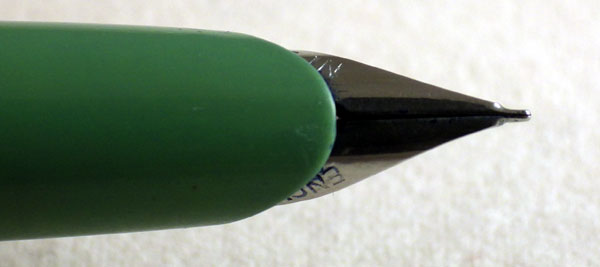
The Platinum Ten Year Pen RK14

IMGP6348

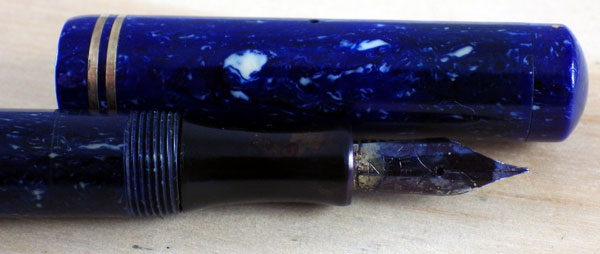
Sometimes you strike it lucky and I think I did with this Japanese Platinum Ten-Year Pen, for which I didn’t pay a fortune.  When it arrived I had a look at it and I wasn’t sure what it was, so I consulted the very knowledgeable Eric Wilson.  Eric said it could either be an inferior copy of the Onoto plunger-filling system or an eyedropper with a cut-off valve.  Having studied it again, I believe it’s the latter.
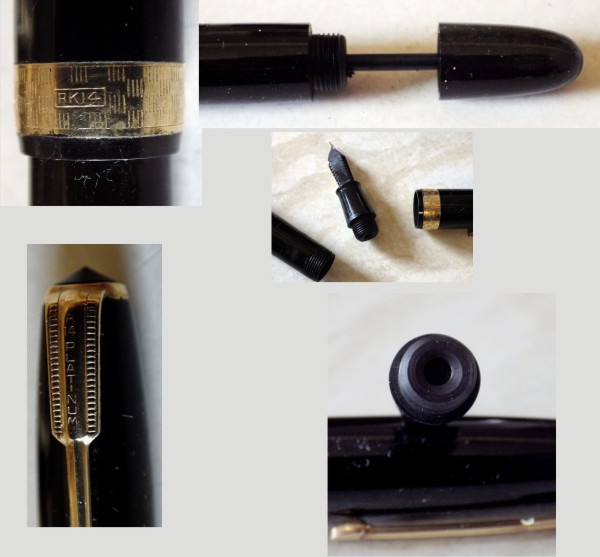
platinum
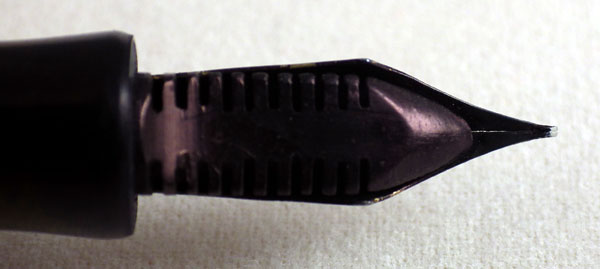
Judging by the amount of ink that went everywhere when I tested it, there’s a seal in there that has seen better days.  Still, I kept ink in it long enough to discover that it has a delightfully flexible nib.  Once it’s back in working order, I think this one will join my tiny collection.  I’m greatly taken with it.
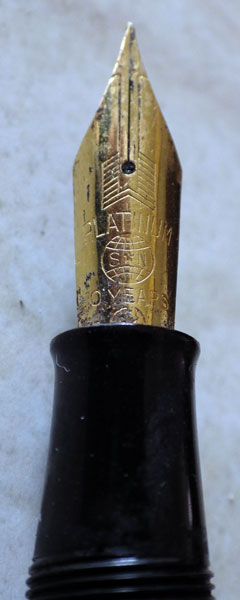
IMGP6350
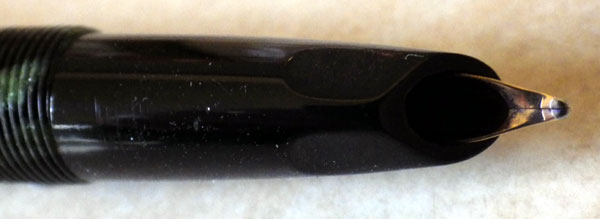
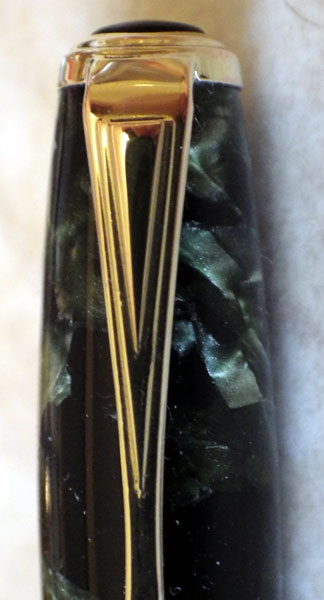
The pen’s 13.2cms capped and it feels quite solid though not unduly heavy.  Clearly, Platinum were admirers of the Vacumatic.  The Ten Year Pen emulates the Parker pretty closely.  The clip is a cheeky rip-off, as is the nib and even the shape of the pen.  The manufacturers weren’t content just to copy, though.  Whereas most Parker nibs are quite firm, this nib has a lot of flex.  I haven’t had the nib out to examine it properly but I can’t decide whether it’s gold or gold-plated.   Not that I care.  It’s the performance that matters.  Also, instead of copying the rather finicky Vacumatic filling system they went for a lower maintenance solution that had been long tried and tested in Japan.

IMGP6349
Finally, this pen has the shiniest finish I’ve ever seen, and towards the end of the barrel there’s an area where this lacquer has worn off or otherwise been removed.  The edges of the layer can be clearly seen.  Were these pens coated with urushi?

Langs Summit Cadet S100

IMGP6314

Langs knew how to make a good, solid, traditional no-nonsense pen.  This Summit S100 Cadet makes no pretence at modernity; no hoods or covered nibs here.  Though it was probably made around 1950 it remains the archetypal English pen, just as it would have been in the nineteen-thirties.  That’s no bad thing.  If we have a design that works as well as it can – and this one does – why change it?  There’s no merit in change for change’s sake.  It’s only appreciated if it’s an improvement and many of the desperately modernist styles that were appearing in Britain in those years were no improvement.  Many were a little weird and showed a lack of confidence in home-grown design.  The contrast with that is one of the things that makes the Summit so attractive.
IMGP6311
Another is the rose-marble patterned celluloid, which was used by several manufacturers in the post-war years.  Though the “Cadet” name implies a school pen, there is no diminishing of quality from the more expensive models.  This is a well and solidly made pen.  Perhaps there is a little saving in the use of chrome rather than gold for the plating of the trim but it goes well with the pattern and is very attractive.  The 14 ct gold nib is small but not as small as, say, some Wyvern nibs were at this time.
IMGP6317
In use it’s a good size of pen that fits the hand well.  The nib is a little more than springy, in fact it gives quite a noticeable level of line variation.  It’s a real pleasure to use.
IMGP6319
Langs and their Summits would not be around much longer.  This isn’t quite their last hurrah but it’s coming close.  This beautiful pen reminds us of how much we have lost with the passing of one of the great British pen manufacturers.

IMGP6318

More On THe Kingswood

If you look back through my various blog entries about the Kingswood, you’ll see that I started with some wrong ideas and gradually worked towards more apparently correct ones with the help of various readers.

There are still some questions, though.  It seems clear that at different times the Kingswood was manufactured by Valentine, Langs and Unique.  Regardless of who made them, they seem to share material with Valentine/Parker.  Not exclusively, I believe, as I’ve seen one or two patterns in Kingswoods that I haven’t seen anywhere else but in general there’s a lot of sharing of celluloid going on.  How did that work?  Were rods of celluloid handed over with the contract?

Why was the manufacture of the Kingswood contracted out at all?  It’s perhaps understandable that in the days when the brand was owned by Eversharp which appeared not to have manufacturing facilities of its own that the work should be farmed out to other manufacturers.  After Parker acquired the business, though, one would have thought it would be more efficient and economical to do the work in-house at Newhaven.

Any thoughts?

Unbranded Ivory And Black

IMGP5980

This little (11.7cm capped) pen arrived as part of a lot some time ago. At first glance the pattern suggested that it was probably an old Platignum but closer examination showed no indication of who had made it. I laid it aside to be worked on if I ever got the time. I suspected that it might be one of those foreign pens that resist every effort to repair them.

IMGP5982

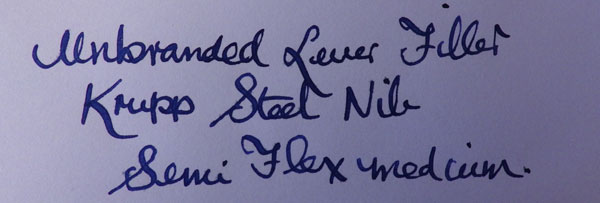
I found the time at the weekend. The section was ridged where it fits into the barrel like a late forties Waterman. This gave it a mighty grip as some mystery glue had been used. Heat and patience did the job, as ever. It had a j-bar which was in good order and it took a No 20 sac. The clip was missing but I found one to fit. The nib had once been plated but that was long gone. I examined it minutely in the hope that there would be some clue to the manufacture of the pen but there was nothing there. The nib was worn out. I could have fitted a gold nib as a replacement but it would have been like fitting a Rolls Royce hood ornament on a Ford Prefect. I bought some excellent Krupp nibs a few years ago and I still had one or two left, so that’s what went in the pen. Makes a great writer with even a touch of flex.

IMGP5993

Who made it? I literally don’t have a clue. The general shape and especially the ridged clip screw are an echo in miniature of the Duofold so it’s probably a thirties pen. It’s definitely not a Platignum as they weren’t shy about putting their name on their products. There’s nothing at all on the barrel or cap. It hasn’t been worn or polished out; there was never any imprint there to begin with. The striking ivory and black pattern has been used by many manufacturers so that doesn’t help. I still lean towards the idea that the pen is foreign, mainly because it bears no resemblance to the output of any of the British manufacturers. That’s purely speculative so it remains a mystery, but a most attractive one.

Unidentified Lapis Lazuli


IMGP5942What about this one? It’s a beautiful lapis lazuli and I haven’t had one of them recently. It has its faults – it’s missing a clip which is easily remedied, there is a little dark staining at the top of the cap and the nib has seen better days.

IMGP5943

The pen has no name. In fact there’s nothing engraved on either cap or barrel. The plated steel nib is a Milevia Duro 4. I’ve come across these nibs before, used as replacements. The question is, is this pen to remain forever unidentified or is it a Milevia? The nib fits very closely to the feed which suggests to me that it is original. Milevia pens were made in the former Czechoslovakia and are well regarded and quite rare.

IMGP5949

It would be nice if this pen is a Milevia but wishing won’t make it so and the evidence is thin. The nib is in a quite sorry state and will have to be replaced. I’ll hang on to the old nib and if I sell the pen I’ll include it. Regardless of who manufactured the pen it’s very well made and apart from the little bit at the top of the cap where ink has permeated the celluloid and darkened it, the colour has held up especially well. It’s a nice size at 13.4cm capped and the blue is wonderfully intense.

IMGP5945

The Wyvern 404

IMGP5705

While we’re on the subject of Wyverns,  how about this 404?  I confess I don’t know a lot about its history and I googled it this morning.  I found various dates quoted for its manufacture, the earliest being 1938.  That seems unlikely.  After all, it clearly shows the influence of the Parker 51.  It would be nice from a patriotic point of view if someone could show that the Wyvern pre-dated the Parker and was the real originator of the hooded nib but that’s not going to happen.  I think I’m right in saying that the Parker 51 went on sale in 1941 so this pen will have been made some time after that.  A date I saw repeated several times is 1949 and that seems quite likely.
IMGP5706
Seen from above, the hood is smooth and elegantly tapered.
IMGP5712
Underneath, it’s sculptured, though not quite as much as the contemporary Mentmore 46, perhaps.  As is often the way with these British hooded nib pens, the style is purely superficial.  Under that hood lies a normal feed and nib.  Apart from its appearance, the pen is a completely traditional lever filler.
IMGP5710
The handsome cowled clip is shared with other Wyvern models of the time, like the 60C hatch that I wrote about recently.  This is not Wyvern’s only hooded nib pen; the last version of the No 60 has a sort of semi-hooded nib, but it lacks the elegance of line of the 404.

At a time when other manufacturers were using wrapped sheet plastic or injection moulded plastic for their pen barrels and caps, this pen is still machined from rod stock and the wall of the barrel is quite thick.  This gives the pen a solid feel though it is not heavy.

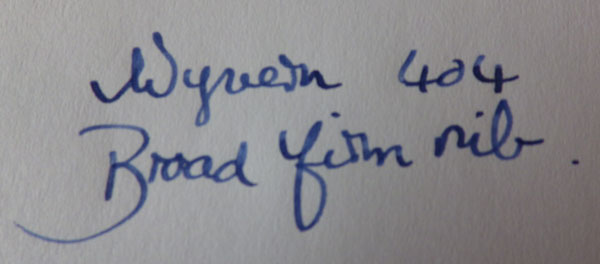
I’ve had several of these pens over the years and, curiously, they’ve all been broad-nibbed, this example being no exception.  It’s a splendid writer.
IMGP5715
Taken overall, this is an unexpectedly good and likeable pen.  I say “unexpectedly” because I don’t really favour hooded nib pens.  I like to see the nib and be able to align the pen with the paper instantly.  The nib can be, and often is, the most decorative feature of a pen.  That said, the build quality, the elegant design and the pleasure in using the pen have won me over.

Wyvern 60C Grey Hatch

IMGP5694

Someone recently asked for a step-by step of a repair so I’ll try to remember to point my trusty Pentax at things as I work on this Wyvern 60C.  It might not be the best example for a before-and-after because it looks pretty good for a start but we’ll see how we go.
IMGP5695
A little bit of heat to the barrel to free things up and it comes apart very easily.  That’s a thick old sac; it’s almost certainly older than I am.  Next job is to remove the remains of the old sac from the peg.
IMGP5696
The nib needs a little straightening so it will have to come out.  I use this bulb to get some water through the feed to make the nib/feed removal easier.
IMGP5698
I’ll use my little scrubbing brush to clean the feed and some cotton buds will get the old ink out of the section.
IMGP5700
The nib has been straightened and the pen’s ready to be re-sacced and reassembled.
IMGP5701
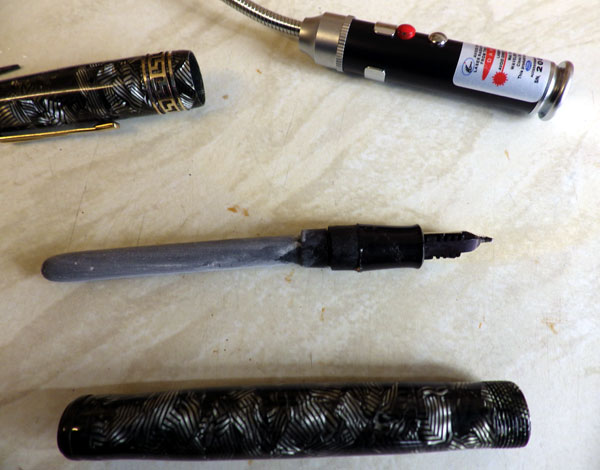
And that’s it!  All done except for a little work with the polishes and cloths.  A very nice Wyvern.  That little doodad at the top is a bendy laser-light to help with peering into barrels.
IMGP5702

A Late Roll-tip

IMGP5485

Roll-tip was a successful manufacturer of ballpoints, fountain pens and other writing instruments before it was caught up in the takeover fever of the 1970s and became part of the same stable as Conway Stewart.   Though this pen is marked “Roll-tip” it uses the same plastic as some of the Conway Stewarts, the 64 for instance.  The clip is quite similar to that of the Conway Stewarts of the same date, less the logo of course.  Essentially, it’s a re-badged 1970s Conway Stewart.
IMGP5486
It is quite likely that these pens were made in Germany to keep costs down.  Like the contemporary Conway Stewarts, this is a pretty bad pen.  Even Roll-tip, which was never renowned for quality wouldn’t want to boast about this offering.  The steel cap has the finish that Conway Stewart called Silvasheen.  It hasn’t worn particularly well.  The half-hooded nib is vaguely reminiscent of the Parker 45.
IMGP5493
To be fair, though, everything works and fits as it was intended to.  The clutch still keeps the cap firmly in place and the nib lays down a decent line.  I’m assuming that the pen takes Conway Stewart cartridges.  I think I have a few of those lying around somewhere so I must give it a try.

This pen, for me, evokes sadness for the depths to which the once-proud Conway Stewart company had fallen.  Despite desperate efforts, the firm failed to recover, as we know, and this otherwise insignificant Roll-tip pen becomes a final footnote in Conway Stewart history.

The Truepoint

Looking back on it you would say that 1948 might not have been the most auspicious year to launch a new high-quality fountain pen.  The ballpoint, which took off more quickly and more successfully in Britain than in the USA, was already making inroads into fountain pen sales.  The country was struggling to recover from World War II and there was strong competition from brands like Swan and Parker.  Nonetheless, it was in this year that Truepoint made their bid for a place in the market.  It was doomed to fail but it left us with an exceptionally well-made rarity that probably outshone its competitors in terms of quality though it never achieved the market share to succeed.
IMGP5468
This is a big pen, 14cms long capped, with considerable girth.  It’s a button filler.  The blind cap blends into the barrel seamlessly.  It’s a tapered pen, sharing a shape with the English Duofolds or larger Conway Stewarts of the time.  The cowled, ball-ended clip is stamped with their “coat of arms” logo, as is the huge semi-flexible gold nib.  Unusually, maybe even uniquely, the cap band configuration is a broad and a narrow ring.
IMGP5469
This was a pen that should have succeeded given its first-rate build quality but not only did it fail, the company appears not to have sold many pens.  It’s rare today; this is only the second one I’ve seen in my many years of of interest in fountain pens.  Perhaps the price was set too high; the only advertisement I’ve seen doesn’t show a price.  Maybe the capital wasn’t there to market the brand properly or to carry the company until sales would have taken off.  This pen and a few others like appear to be all that survives of this proud venture.