An Unusual Kingswood

I wrote about Eversharp Kingswoods before, back here: http://wp.me/p17T6K-3k but I found out two new things about them today.

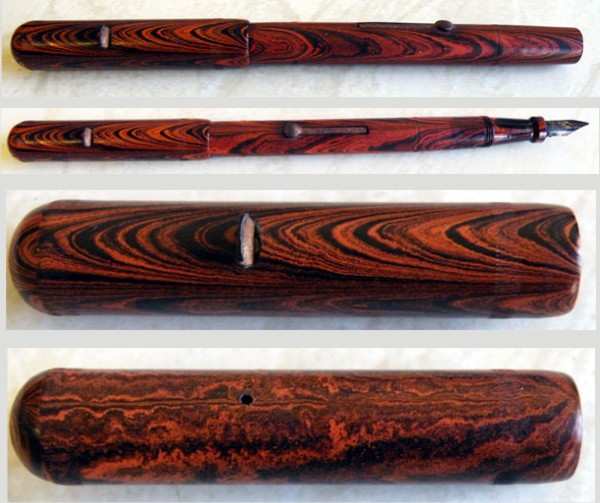
First, they were produced in this glorious pattern:

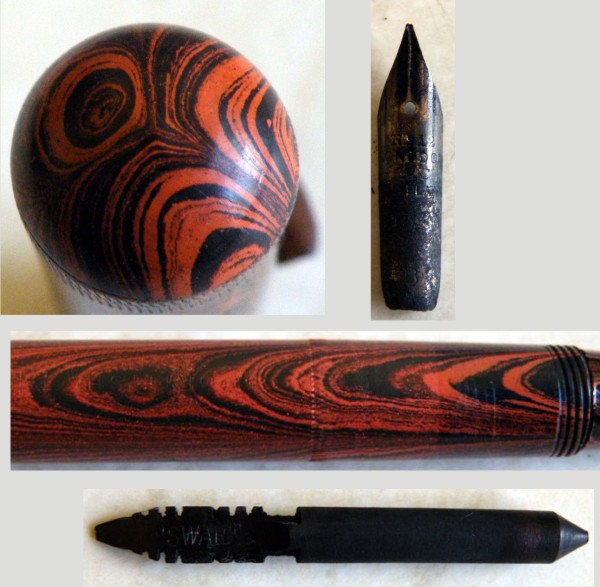
And second they were offered with this superb oblique stub:

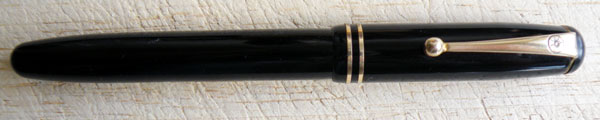
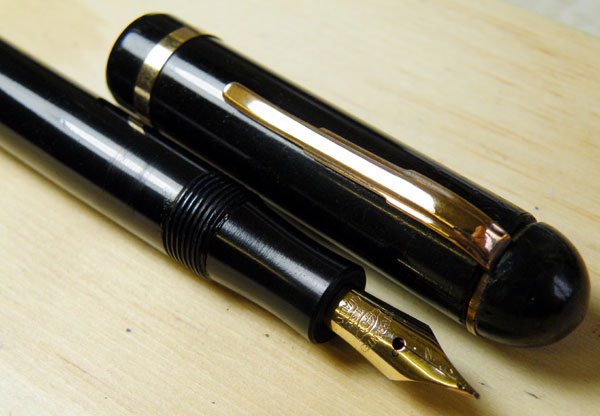
This is the earlier Kingswood with the Art Deco stepped clip and the pierced cap ring. The section is black hard rubber but, oddly, the clip screw is plastic. It shows the results of time and hard use. The plating (which is thin on these pens) has completely gone from the lever and the clip is little better. More remains on the cap band. The BHR section is a little faded and there are some nibbles on the clip screw. The nib has been bent and straightened. None of that makes much difference; this remains a glorious pen.
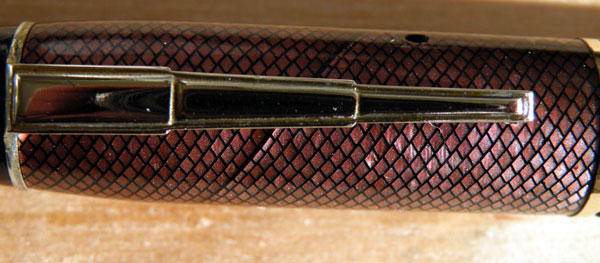
This pattern, in various forms, appears on several makes of pen: Swans, Blackbirds, Summits and Wyverns to name but a few from the British manufacturers. It’s sometimes called brickwork, I’ve seen some American collectors describe it as web, and here it’s mostly known as lizardskin. The fact that the pattern varies from dark to light is, I think, meant to evoke reptile skin. Here, it’s at an angle, whereas on Swans it tends to run parallel to the pen. I think this is because, rather than being machined from the rod, this cap and barrel are made from wrapped celluloid sheet. The pattern ran along the sheet, but the forming of the pen has set it at an angle.

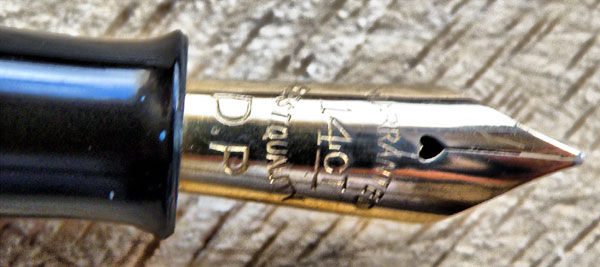
The nib is unlike the Eversharps I’ve seen in previous Kingswoods. “Eversharp 14K 0.585 Flexible Made In USA” is stamped on the nib. Along one side of the nib, in tiny writing is “A 14. 585©”  and on the other “WECO” .  I’ve long suspected that Parker began making Kingswoods to use up Eversharp nibs. Maybe this nib appears in other Eversharp models. Tell me if you’ve seen it elsewhere, please. The nib is soft rather than flexible (which might be because it has been bent and straightened) but the shape of the stub imparts some line variation.

In conclusion, this pen has caused me to reassess Kingswoods. I thought of them as no more than competently made workaday pens with really good nibs. This strikingly beautiful pen suggests that, on occasion at least, they could be more than that.
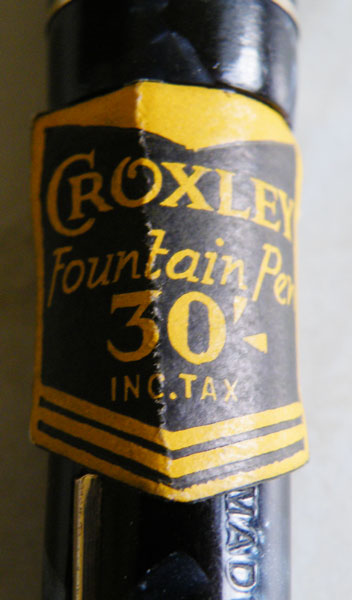
 

A Boxed Crox

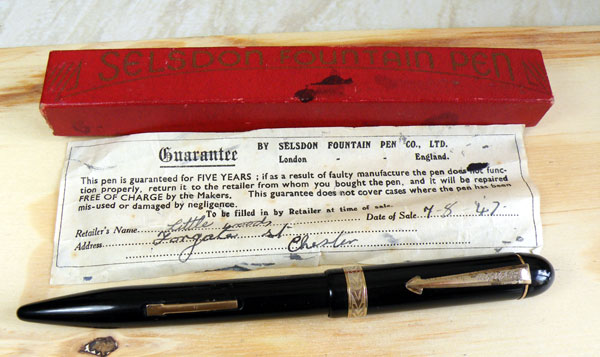
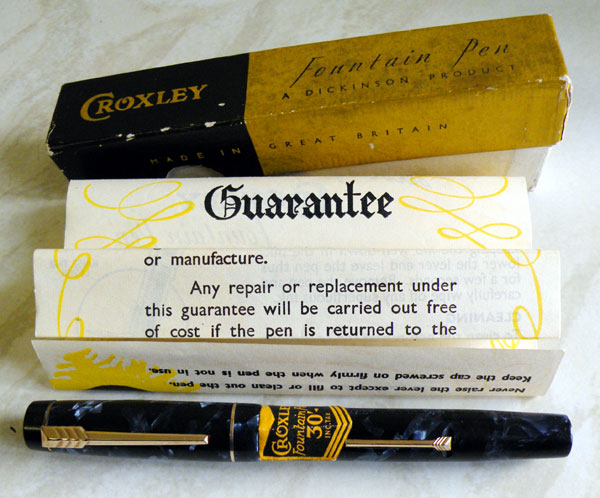
I’ve written about Dickinson Croxleys before, so you’ll know that I greatly approve of them. They’re well made, they write well, the gold plating is better than that on many of the larger manufacturers, and they’re stylish. If I have a complaint at all, it’s that 99% of their output seems to have been black. A colourful one does turn up sometimes, though and it’s all the better if it still has its box, guarantee and price label!

I’m guessing that this is quite a late example, because 30/- (£1.50) was a lot of money back in the day.

That clip is, to my mind, one of the best ever made, and the arrow feature is echoed in the lever. Like I said, stylish! The box is complete and sound but a little shop-soiled. I imagine it gathered dust on a shelf somewhere for a very long time…

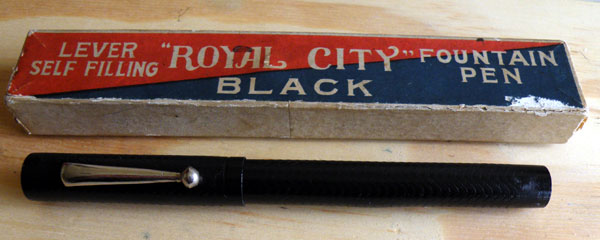
The Royal City Fountain Pen

These pens turn up occasionally in eBay, usually black chased like this one, but sometimes marbled. I wouldn’t intentionally buy one, but this one came to me as part of a job lot I bought for the sake of another pen that was included in it.

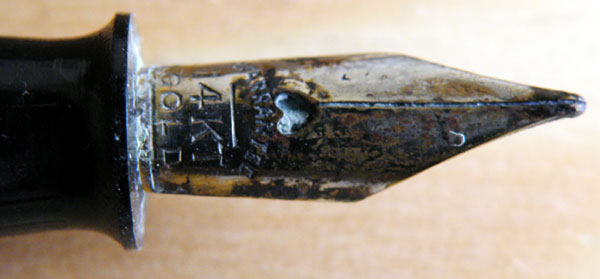
The pen could date as early as the late twenties, but I suspect that it’s later. Makers of cheap pens were often conservative in their designs, and this pen is about as cheap as pens of that period get. That said, it probably worked well enough when it was new. The nib is actually tipped rather than having a doubled-over end, as you see on many very cheap nibs. It was gold plated, though most of the gold-wash has gone. It’s marked “Warranted 14k Gold”, with the additional and important word “plated” sneakily hidden under the section. This was a trick that manufacturers of low-cost pens used extensively in the USA, but I don’t think this pen’s American.

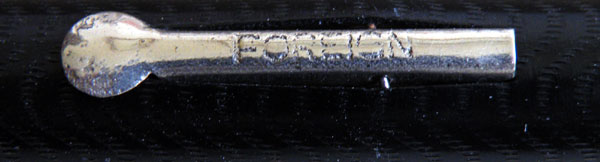
The pen has no barrel or cap imprint but the word “foreign” is stamped on the lever. In those protectionist days, such a label doubtless had tariff implications that escape me, but it does narrow the field a little. Most imports were marked with their country of origin, like “Made in Germany” or “Swiss Made” for instance. Then there was “Empire Made” or “Commonwealth Made” which implied Hong Kong or India, among others. This elimination doesn’t leave many other countries that were capable of mass production in the nineteen-thirties, so I think we may assume Japan to be the most likely source of this pen. Maybe it’s a stretch, but I think that “Royal City” sounds like the kind of appellation that would have seemed dignified and impressive in Japanese but loses something in translation and becomes meaningless in a British context.

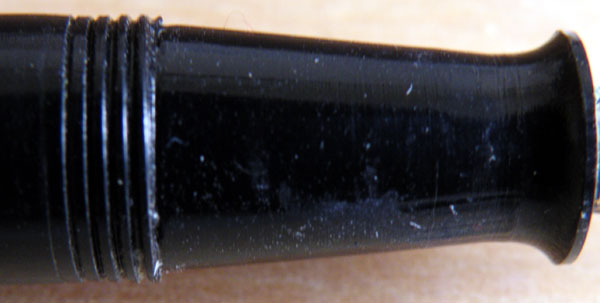
The pen is made from, I think, chased black plastic, rather than hard rubber. It shows little signs of use, but there is swelling of the barrel and the lever cut-out gapes. Either the threads are poorly cut or there is shrinkage of the barrel, as the cap doesn’t fit well. There’s no inner cap, so the nib would have tended to dry out and there was the possibility of leakage. To top it all, the pen was made in such a way that it cannot be taken apart to replace the sac.

If you see a Royal City pen offered for sale, don’t buy it. Really.

The Conklin Endura Symetrik

Though I mostly write about British pens, imports can be interesting too. German pens, for instance, fluctuated greatly in popularity. Their quality was admired but there were periods when it would have been seen as unpatriotic to use a German pen. I’ve had an inexpensive glass-nibbed piston filler German pen that had the maker’s name roughly scratched out, doubtless for this reason.

Throughout most of the period when pens were the main writing tool, there was no market here for French or Italian pens. They turn up, but are not at all common. In the fifties and sixties, as demand for fountain pens plummeted, cheap, poor quality fountain pens from Italy flooded the market.

American pens were popular. Parker, Waterman and to a slightly lesser extent, Sheaffer all had a big presence. Pens like the Duofold and the Waterman 52 sold in huge numbers. Wahl Eversharps sold quite well too, and Conklins were much appreciated in the crescent-filler days. Thereafter, Conklins were pretty thin on the ground in Britain. Perhaps there was no importing agency later, or maybe the pens were no longer sufficiently different from the home-grown brands, but it’s always interesting when one does turn up.

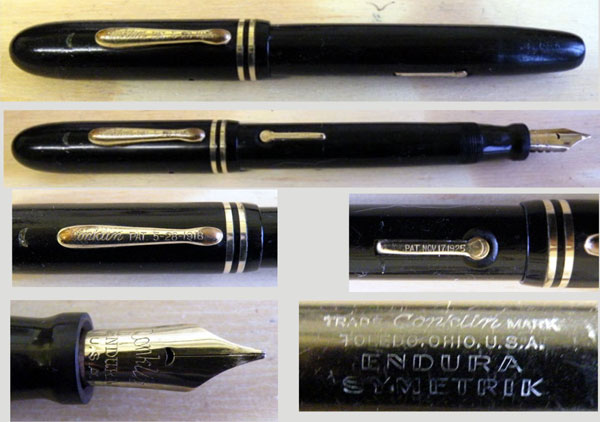
This is an Endura Symetrik, made from 1931 until the company was taken over in 1938, and it’s therefore among the last of the high-quality Conklins. Both well designed and well made, the Symetrik is unexceptional at first glance but has subtle features that are unique. The patented clip is spring-loaded and the short lever is attractive. The Endura nib differs from the Toledo in my old crescent-filler in that it is no super-flex, but it’s not a nail either. There’s a little line variation there, just enough to make it pleasurable to use.

This example is basically sound but it has had a hard life. Though the cap rings and the lever are holding up well, the plating on the clip is showing signs of wear. When I got it, the pen was incredibly dirty, as if it had been dipped in something sticky and left to gather dust. It looked like it had been dropped nib-first on a concrete floor, and straightening the nib was a challenge. There are nibbles, particularly on the end of the barrel, but actually all over. I think it had ended its early life as a kid’s pen, poor thing!

Ford’s Patent Pen

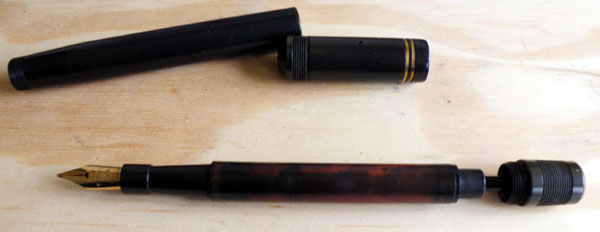
By any standards, the Ford Patent Pen is a mighty beast. I have a Standard, and it measures 14.7cm capped and has a considerable girth. The Magnum version is 15.9cm long. Unlike the Sheaffer Vacuum-Fill or the De La Rue Onoto Plunger Fill, the pen fills on the upstroke and the ink is transferred past the seal to the ink chamber on the downstroke. The “valve” (actually part of the seal) remains open in use to allow passage of ink to the nib and the long breather tube allows air in to equalise the pressure. Because it was recognised that pens which held ink in the barrel were particularly subject to blobbing because of the transfer of heat from the hand, the whole assembly is housed in a sleeve. This makes it a thick pen and it’s quite heavy when filled with its large capacity of ink but it feels quite comfortable in use.

T.B. Ford Ltd. made blotting paper, and had no previous experience of making fountain pens. George Stewart Vivian, who had previously worked for Valentine, was employed by Ford and developed this pen in 1930, bringing it to the market in 1931. There is some debate about who actually manufactured the pen. It may have been Wyvern or Valentine and even De La Rue has been suggested. In any case, the standard of workmanship is very high. For a large and expensive pen, it was a sales success and these pens are not uncommon. They do have some failings, though, and parts are extremely scarce, with the result that a good Ford in working condition fetches a high price. The earliest ink chambers, like my one, were made from celluloid, and they have proved durable. Later ones were made from perspex and they tend to craze and crack. Cap lips are thin and fragile, and some of the internal parts can also break.

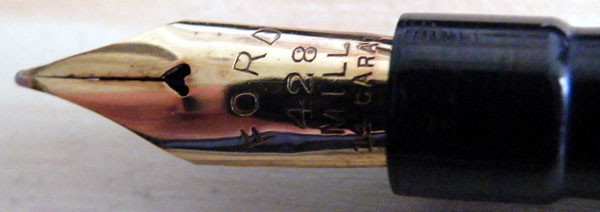
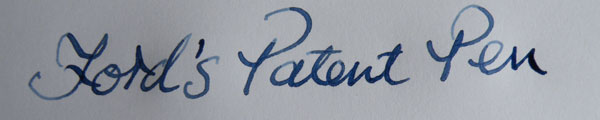
Most Ford nibs are rigid but my one has some softness. There’s a little flexibility and enough “give” to make it a pleasant writer.

A Burnham Opus

As you may remember from an earlier post I made on the subject, I’m not a big Burnham fan. That said, Burnham holds an important place in British fountain pen history, and the best of their pens – especially the earlier ones – are pretty good. They could always make a good nib, and their casein pens employ some of the most beautiful patterns ever seen in a pen.

In case you haven’t already seen a reference to it in the pen forums, I thought I would bring this to your attention:

The Burnhamography http://www.pengrauncher.co.uk/

Alan Charlton has created a fascinating and informative history, not of the company but of the pens they produced. He has disentangled the ties between the various British companies Burnham was associated with at different periods. The confusing Burnham numbering system is clarified, too. There are many Burnham pens here that I haven’t seen before.

This is the first major work on the output of a British pen manufacturer to appear on the internet for many years, and it will provide a fine reference for those interested in Burnhams and in the wider history of British fountain pens. I commend it to you and I am thoroughly grateful to Mr Charlton for his scholarship and generosity.

The Gilbert Duplicate Posting Manifold Pen

Like the Kenrick and Jefferson range of pens, this Gilbert Duplicate Posting Manifold Pen was produced by a stationery seller for use with their multi-part forms. Gilbert pens are nowhere near as common as Kenrick and Jeffersons, though, and they only turn up once in a blue moon.

The sunburst logo on the shoulder of the clip, together with the general style of the pen, strongly hints that it was made by De La Rue for Gilbert. The plating of the trim and manufacturing quality is comparable with the very best of De La Rue’s non-Onoto output. It’s in a very traditional style, the only point of note being the shallow domed clip screw. A very handsome pen, nonetheless.

I suspect that the Alfred Gilbert company, which was based in Edgware Road, London, is long gone. Their main claim to fame was a simple and efficient pre-computer-age accounting system. Not being an accountant myself, I can only work up a limited amount of enthusiasm for that particular achievement, but I will remember them for this very nice pen.

Unique

Of all the common pens, the Unique is the least written about. In my various reference books, it is never accorded more than a passing mention. There may be lots of information on the brand on the Web, but try Googling “Unique Pen” and check through the five million or so results that you get. Few of them refer to the actual Unique pen. “Unique” must be one of the most overused words in the English language. One it might it say it was uniquely overused, were “iconic” and “surreal” not equally hurled around without regard to their meaning. It is rare indeed, in discussing fountain pens, for the writer to mean “Being the only one of its kind; unlike anything else”; it usually implies “I think this pen is quite nice” or “I bought this barely operable piece of Chinese crap and I badly need your approval”.

All that having been said, the problem remains that though there are plenty of Unique pens out there, without any hint of a company history it’s hard to get a true picture of what was going on. There have been periods when Uniques were plentiful and clearly somewhat popular and others where they are very uncommon indeed.

Unfortunately I don’t have photos of all the pens I wish to discuss, but the most recent Uniques will be quite familiar to most people. They don’t have a strong collector or user following and I think they’re probably a little under-appreciated. They’re actually quite good pens, or at least those ones that have survived well are.

I have heard it said that they were made at Newhaven, first by Valentine and later under Parker ownership, and it is likely that there was never a Unique manufacturing plant. The late forties pens, slightly streamlined, with a curved stepped clip and a slightly tapered clip screw, closely resemble the Kingswoods of the period and they were certainly made at Newhaven. The clip is identical, I believe. The main difference is that the Uniques have either warranted nibs (often bearing a unicorn image), or nibs marked “Unique” rather than the excellent Eversharp nib of the Kingswood. That these pens continued to be made into the early fifties is shown by the fact that Unique Juniors in this style were presented as commemorative pens for the 1953 coronation.

Their later pen, and probably their last one, is the commonly seen fully streamlined pen that bears more than a passing resemblance to Conway Stewarts and Burnhams of the time. Made in a range of attractive marbled patterns, these pens were successful, if one can judge by the numbers of them that still appear. Probably aimed at the student market, they were made from thin, wrapped celluloid sheet, a common practice which produced a less satisfyingly solid pen than those machined from the rod.

The earlier model than either of these pens, produced during the thirties and early forties, is a conventional, straight-sided pen, quite similar to a lever-fill Mentmore. These pens don’t turn up often. Either they haven’t survived well or they weren’t particularly popular in those years.

That’s not the whole Unique story, though. They’ve been around quite a long time, and in the twenties and thirties were producing higher quality pens than we see later.

This Unique No46 appears to date to the nineteen-twenties and is a pocket or purse pen. This one – the only example I have seen – has had a hard life and is in fairly poor condition, but that does not disguise the quality of the design or the machining.

This No51 is probably a little later, and is a thoroughly superb pen of the highest quality. The nib, which is stamped “Unique 14ct” is very flexible, and this pen is joy to use.

I realise that this is a very patchy and incomplete account of a quite major company. I have held back from writing about Unique because of the lack of information. However, it’s a subject I can always return to, and this brand is an especial interest of mine.

Less Common British Pens: Selsdon

Not exactly rare but by no means common, Selsdon pens don’t attract a lot of attention when they do appear. They’re not without their points of interest, though.

The most commonly seen Selsdon is a late forties pen, quite large, with a straight barrel and a curved stepped clip. It can appear with either a warranted 14ct nib or a plated one, and I suspect that the company had no nib-making facility of their own, but bought them in.

The other Selsdon that appears quite frequently has a strong resemblance to the Eversharp Skyline, with its tapered barrel and domed cap. Again, this appears to be a nineteen-forties pen.

These designs were not exactly inspired, and the execution was not quite in the first rank either. The pens would be without interest were it not for the plastic they are made from. I can’t identify what it is, except to say that it is heavier and more dense than celluloid, and appears to have been machined from the rod rather than moulded. I haven’t seen anything quite like it elsewhere. It has lasted well, without the barrel distortion one sees on some other economy pens of the period.

Selsdon made a number of commemorative pens for the 1953 coronation, both fountain pens and ballpoints. Unlike the earlier pens, which were invariably black, some of these pens were produced in attractive, colourful patterns. Boxed pen and pencil sets were also on offer.

In 1958 the company faced court action over unpaid copyright fees relating to a mechanical pencil, and later that year the company accounts were questioned, giving rise to another court case which changed the role of company auditors. That, I think, was the end of the production of Selsdon pens.

Oddities: The Primo Pen

How often do you come across a true red ripple pen from the nineteen-twenties that wasn’t made by Waterman? Not often, I’d say, and I’ve never seen a British example before. There are some French overlay pens that emulate Waterman models quite closely and are sometimes made in red ripple hard rubber, but those are the only non-Waterman examples I’ve seen. Until now…

This is a British-made Primo. I have seen slight references to this company as a 1920s manufacturer but I’ve never seen one of their pens before. I suspect that they were one of those companies that didn’t survive for very long. It’s not an especially well made pen. The machining is no more than adequate. It’s hard to judge it in its entirety as some of the parts have been replaced. The plated, crimped-end nib is marked “No 12 London 14ct Gold Plated” and the lettering looks familiar though I can’t place it for the moment. It may or may not be original; the feed certainly isn’t as it’s marked “Swan” and looks like it came from an eyedropper.

The pattern isn’t completely consistent. On the side that carries the broken inserted clip, the cap is red ripple; on the other side it has a wood burl appearance.

Restoration of this pen won’t be easy. The lever is so rusted that I suspect that it will have to be replaced. The inserted clip is held by a very flimsy inner cap, and there’s much encrustation of rust there as well. Repair will be a delicate task, given the thin walls of the cap and barrel.

Not a high quality pen, but an interesting one. If anyone has information on the Primo pen manufacturing company, or on non-Waterman red ripples, I’d love to hear from you.