The Slippery Slope: The Onoto K2 And The Conway Stewart 150

These pens have something in common: they were made by companies in decline. Their dates of production are different, the Onoto being launched in 1955 and the Conway Stewart some eight years later, but the position that their respective companies found themselves in were quite similar. Sales were falling inexorably. Costs needed to be cut in a desperate attempt to regain market share and both companies also made an attempt to turn out a product that was more in tune with the the times.
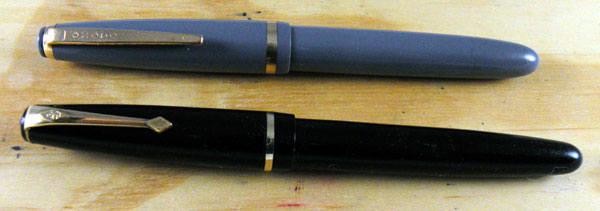
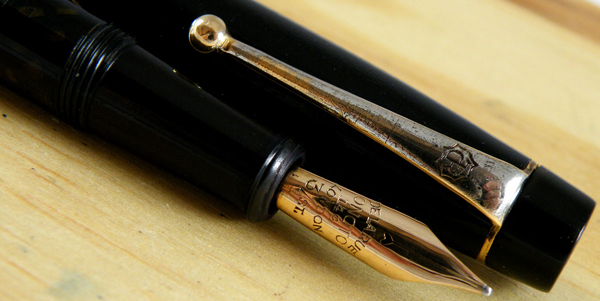
In introducing the K series of pens, De La Rue threw the baby out with the bathwater. Whatever this K2 may be, it’s not an Onoto, that elegant pen with its plunger filling system. It’s something quite different. That said, despite some faults the K series are good pens. Their piston filling system is generally in excellent working condition today without any servicing. The gold plating is very good, the clutch still closes the pen firmly, the ink-view area of the barrel is still clear and it writes well. These pens were a limited success, but it wasn’t enough to save the company. De La Rue, after all, was not entirely dependent on pen production and they pulled the plug when the profit and loss statement said it was time.
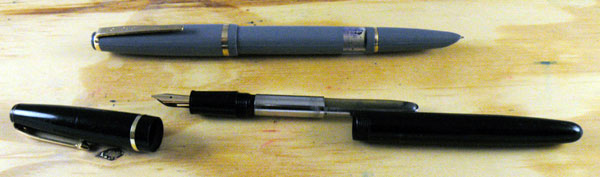
The Conway Stewart 150, I would maintain, is still a respectable pen but it contains the seeds of decline. At first glance it’s little different from its illustrious forerunners of the fifties, but when you handle it you feel the difference. The pen feels a little slippery, a little waxy. Gone are the glowing celluloids and caseins; this is injection moulded plastic. No doubt it was the right decision from a cost point of view, but self-coloured pens don’t have quite the attraction of the patterns that made Conway Stewart what it was. There’s no lever. Now you have to screw off the barrel to find a metal squeezy device, the Conway Stewart Pressac filler. This, like the shape of the pen, is an attempt to emulate the Newhaven Parkers, but this isn’t like Parker’s Aerometric filler. It’s an older technology and you can squeeze away all you want, you’ll never fill the sac. Unlike the Parker, this system has no breather tube. It’s just a squeeze-filler like the Macniven & Camerons of 45 years earlier. In other respects it’s not too bad. The gold plating is, perhaps, not as good as the Onoto’s but that was always how it was. The nib is conspicuously small, but it’s still gold. On my example, the softness of the plastic has allowed a groove to develop around the cap where the clip was allowed to spin. However, it’s still quite a sound pen that would give good service.

Onoto at least got a clean, relatively quick death. The coup de grace was administered in 1958. Conway Stewart staggered on, turning out poorer and poorer pens until it ground to a halt in 1976.

Onoto The Pen

Sad to say, and much to my own disappointment, I’ve never been in a position to list every Onoto made (as I try to do with Swans and Blackbirds). I think I may have written about an Onoto once before in this blog and that’s all so far. This is because when I decided to switch to pen restoration I limited the number of kinds of pens I was prepared to fix to reduce the costly spares holding. However, when you buy pens in lots as I do, anything can turn up, and I recently ended up with a very shabby Onoto. I’m not really up on these pens and I can’t say for certain, but I believe it might be an Onoto Minor dating to around 1938. I should have taken some photos when I got it but of course I didn’t, but I can tell you that the shaft was broken off the blind cap, it had no clip and it was generally decidedly the worse for wear.

I passed the pen to the estimable Eric Wilson ( http://eckiethump.webs.com/contactdetails.htm ). As always, the turnaround was very fast, the work was superb and copious notes were provided on what had been done on the pen. Here it is, now:

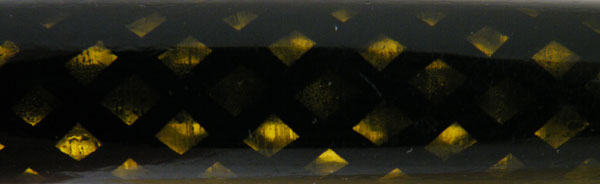
It’s a beautiful middle-sized pen and the lattice-work celluloid barrel is what really sets it off. The point of that, of course, is to show the ink remaining in the pen, and with the wonderful Onoto plunger filling system even a little pen like this holds about a bucketful. On lengthy consideration, I think I would have to say that the 107-year-old plunger-fill remains the best filling system there is. It’s so satisfying to immerse the pen in ink, push that plunger down once and know that you have taken on enough ink for the next fortnight. Or in my case, a month, because I don’t write much.


There can be no doubt that Onotos were the top of the league of British pens. I hugely admire them and I try always to have one of my own. My particular preference, as you might guess, would place 1930s Swans above Onotos, but that’s just me. They are among the best pens ever made.

Uniquely Unique

Uniques, it seems, are not well regarded. Even good examples sell for very little in eBay and most retailers avoid them. I think this is because of a reputation for poor quality, which is not entirely deserved. Unique, like many another pen manufacturer, made pens to suit all pockets and purposes, and in the 1930s they turned out pens that were the equal of any produced by the better-known manufacturers. By the post-war period it is true that they did not set their sights so high, but nonetheless they were still capable of producing good pens that are still available to the pen buyer with a discerning eye.


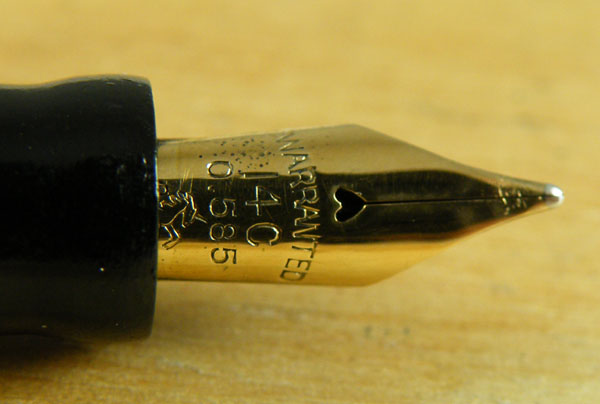
I don’t suppose that this was an expensive pen, and no more was spent on fripperies like gold plating or 14 carat gold than was absolutely necessary. In other words, the trim has a gold wash and the nib is quite small. In reality, of course, the only bit of the nib that does any work for you isn’t made of gold and it’s that little grey bit at the tip, so the size of the nib is much less to do with practicality than with bling. The gold wash, sadly, is another matter. It is disappointing that such an otherwise beautiful pen should be spoiled for what must have been comparatively little outlay. There’s an element of “the ship was lost for a ha’pworth of tar” here. However, the gold has lasted on the lever and the cap band and the clip is not unpleasant to look at, being bright and shiny though devoid of any hint of gold.


But look at that pattern! It may be wrapped celluloid sheet rather than machined from the rod as would have been the way in earlier days, but Unique is far from unique (oh stop it!) in that cheese-paring saving. Such highly respected manufacturers as Conway Stewart and Valentine did it, too. Unique, it has to be said, has done it rather well. Putting the pattern on the slant looks very good, and what a pattern it is, somehow combining both marbling and hatching. Also, there is no sign of the unfortunate delaminating that so often afflicts Valentines made by this method, and sometimes even Conway Stewarts.


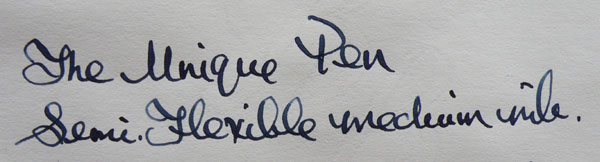
But this is a pen made probably in the 1950s, not a limited edition of today, so it isn’t just about appearances; it’s expected to work. And work it does, very well. It has something of the Long-Short about it. Capped, it’s a modest 11.7cm but posted, it’s a quite practical 14cm. The small nib is a delight to write with, as smooth as one could wish and with enough flexibility to satisfy those to whom a firm nib is anathema.


There are good pens that will never appeal to collectors. The Dickinson Croxley is such a pen; well-made, an excellent writer, but because there is such a paucity of models it would form one of the world’s smaller collections. Croxleys, therefore, sell well as writers’ pens. Unique on the other hand, in its much longer history, produced a great many models and in its later days used some very fine plastic patterns. I would guess you could fill a display case or two with Uniques. The writing sample above speaks for itself. It’s a writer’s pen, too. If you want to snag an excellent and decorative British pen for very little money, get yourself a Unique. Buy with caution, I hasten to add, because some of their cheaper pens truly are shoddy, but there are fine bargains to be had.

The Lizard Skin Summit Again

You’ll probably remember this beautiful lizard-skin Summit which I wrote about recently. I was fairly wide of the mark in the date I assigned to it then but I’ll excuse myself by saying that some Summit models didn’t change much over the years, to the casual eye at least.

The correct date is likely to be 1947, when much of the pen-making equipment that was used to produce Summits was sold to Dickinson Croxley. Some incomplete pens may have formed part of the deal. They were later fitted with Osmiroid 35 nibs and the “Summit” imprint on the clip was crudely over-stamped so that they could be sold off. That’s the story and it seems completely plausible to me. It’s certainly true that this is not the only Summit to have been altered in this way.

(My thanks to Paul Martin at Rutland Pens for this information. His excellent Summit website is here: http://www.summit.ch944.net/section13.php)

A Wyvern 707 Pen And Pencil Set

By 1940 Art Deco was a thing of the past, except in one area: fountain pen design.


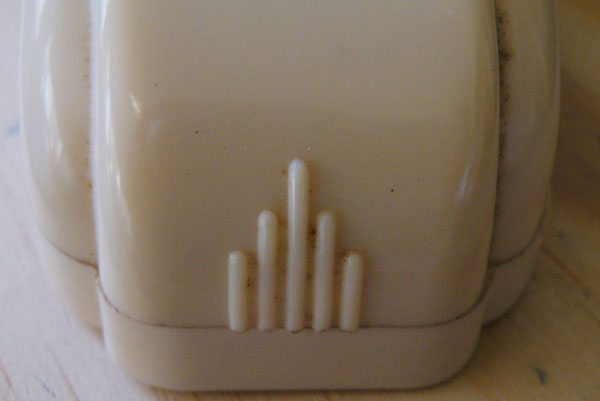
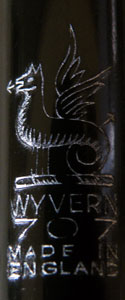
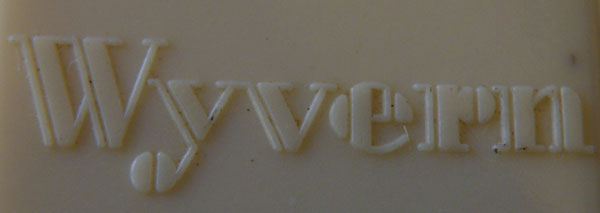
This case holds a Wyvern 707 pen and pencil set. The 707 went into production in 1949 and appears to have proved popular. There are still quite a few of them around. That said, it’s not the pen that grabs me here so much as the presentation box. It’s made of ivory-coloured plastic with a strong metal hinge. It’s altogether impressively well-made. The thing is heavy.


Where did you last see a design like that? On a Wurlitzer Juke Box? Or a nineteen-thirties cinema foyer? Or a snazzy gangster-era car? Though it might be a little anachronistic, it impresses. This set would have made a nice Christmas or birthday present, just as the second half of the twentieth century was about to begin.


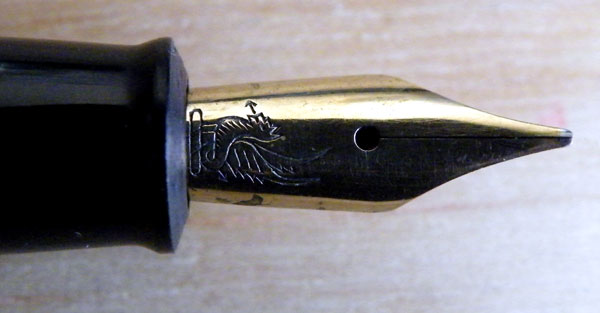
The Wyvern 707, unlike its box, looks forward. It’s Wyvern’s shameless reinterpretation of the Parker 51, a design that would still have appeared futuristic then. It’s not quite what it seems, though. Concealed beneath the blind cap is the same old button filler that Wyvern had been making for years. So under the hood it maybe is more of the Art Deco period than of post-war Modernism.  And the little Leicester dragon is still around:


In reality, it’s a pretty good pen. It writes well, which is what matters when you get past the veneer of style. If I’d been around in 1949, I think I’d have wanted one. This set has survived in such an “as new” state (except for the shedding plush) that it’s like it’s 1949 all over again.


Brown Marbled Wyvern Perfect Pen No81

Wyvern numbering puzzles me more than a little.

This is a Wyvern Perfect Pen No81. So is a more slender, longer pen. How does that work? Anyway, though they can be troublesome in some respects, I have a soft spot for Wyverns. They tend to lose gold plating on the clips, like this one, and not infrequently they display gaping lever apertures. This one has a touch of it, but it isn’t too bad. What makes up for these faults is that they make a pen that’s shaped well for the hand, comparatively wide in the centre of the barrel, narrowing just a little at each end. Then there’s that brown/gold/black pattern which I’m very fond of.

Finally, they have these beautiful nibs with the perky little Leicester dragon. They’re not just for looking at, those nibs. Some, like this one, are flexible, with excellent return.

The Atlas Pen

This black chased hard rubber flat-top turned up in a collection of pens I bought last week.

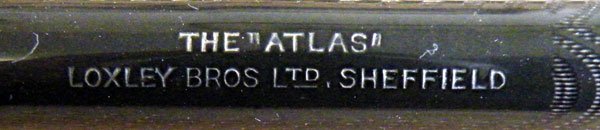
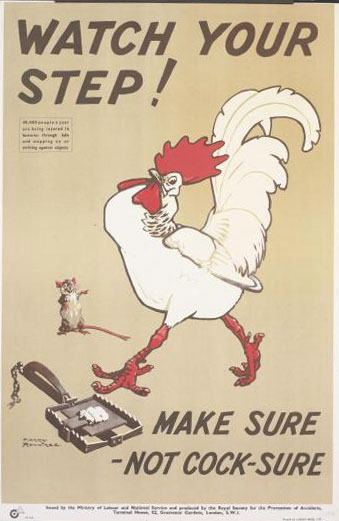
When I checked out the imprint neither “Loxley Bros, Sheffield” nor “The Atlas” appeared to have any connection with pen manufacture. Loxley Bros. turned out to be a large printing firm which had been liquidated a quarter of a century ago. In their day, they produced a range of materials from books to wartime propaganda and safety-at-work posters as well as greeting cards which appeared to be their mainstay.

Credt: Imperial War Museums


The promotional pen for a firm of printers is quite a common theme in British pens, Kenrick & Jefferson being a good example. As the pens reflected on their business, regardless of whether they were sold or given away, printers’ pens tended to be a cut above the average, as this one is. Whereas cheaper pens of the day (perhaps the late twenties) had straight-sided barrels and caps, this one is noticeably streamlined, in the barrel at least. Despite being well-used the chased pattern is clear, as is the barrel imprint. The threads are well cut and everything goes together very well.

But why “The Atlas”?

This is the stately entrance to Loxley Bros’ Atlas Works, proudly illustrated in one of their later promotional leaflets. Happily, though Loxley Bros. is long gone, this dignified building remains and it’s still a printing works.

My enquiries didn’t get anywhere in establishing who made this fine pen, but did uncover a corner of history.

A Green Marbled Croxley

I was going to write about a different pen today but it was uncooperative and wouldn’t come apart for me, so that’s for another day. It takes time, patience and an absolute determination to have one’s way. In the end I will prevail and that uppity Wyvern will surrender to my will (cue evil laughter here).

I’ve had a lot of Croxleys lately, which is a good thing. They’re great pens with extremely good nibs, sometimes oblique, generally at least semi-flexible and often more. There are a couple of other Croxley models, but it’s this, the most common one that interests me today.

I suspect that these pens were made over a lengthy period. At first glance they’re all the same but on closer examination they’re not. There’s a noticeable difference in capped length between the longest and the shortest. To a degree, that’s almost universal in older pens. Measure twenty Waterman 52s and you’ll be unlikely to get two exactly the same. The difference I’m seeing in the Croxleys is greater than those minor variations, though.

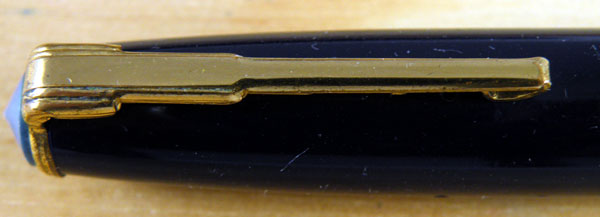
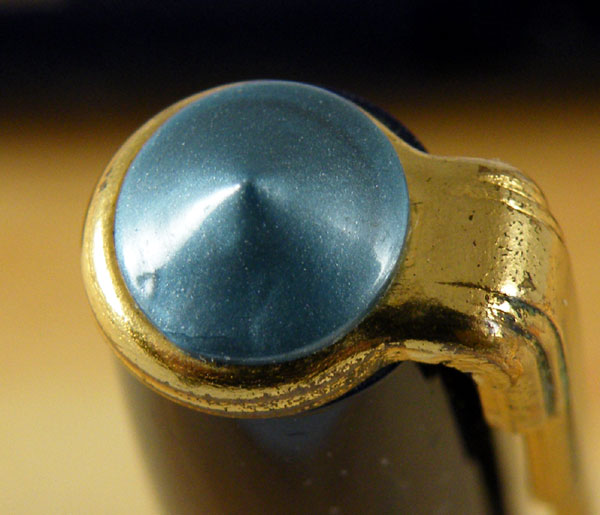
Not infrequently, I take the clip screw off so that I can clean the cap and trim properly. Turns out there are two types of clip screw, one with an extremely long thread and the other much shorter. As the clip screw acts as an inner cap and determines where the pen will close firmly, there’s probably a relationship between pen length and which clip screw is used. Duh! I’ve been seeing this for a while without coming to any conclusions. Note to self: Try to be a little more observant!

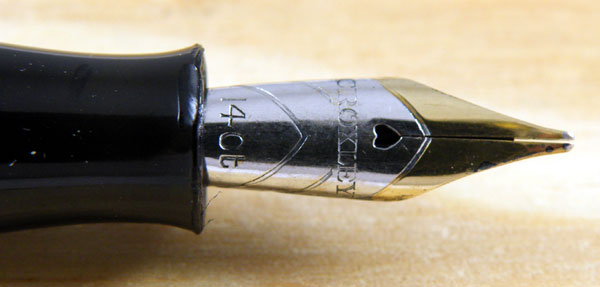
And (you’re not supposed to start sentences with “and”. But I defy you, Syntax Police, and I might even start a sentence with “but”) here’s another thing. I haven’t missed this one by leaving the brain in neutral, I’ve just never seen one before: a two-tone 14ct gold Croxley nib. Two-tone nibs are uncommon in high-quality British pens, though plated ones are sometimes seen in low-cost pens. I would take them to be later rather than earlier, but perhaps that’s because they’re so common today. Regardless, it seems there was a period when Croxley nibs were plain gold and another time when they were two-tone. Whichever came first, there’s the possibility of a dating sequence there, which may combine with the long and short clip screws to give us a better idea of how this excellent pen developed.

My suspicion that the two-tone nib is later is immediately contradicted by the condition of this pen. It has some of the most worn plating I’ve seen on a Croxley, which would suggest that it had been around longer. Or maybe they scrimped on the plating on the later models. I don’t know, but I think some of these questions may ultimately be capable of being answered.

Anyway, I like the dark, almost bottle green in this pattern. It’s a nice pen and it will be a little nicer by time I’m done with it.

A Late Macniven & Cameron Waverley

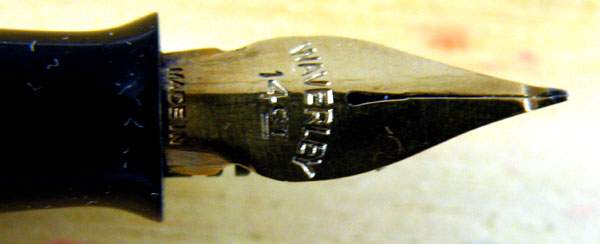
Several years ago the market was suddenly flooded with black chased Macniven and Cameron eyedropper fillers. Boxed, and with an eyedropper that still worked, these pens were clearly New Old Stock. The story – or at least one of them – was, so far as I remember, that a crate of these pens was found when clearing out Macniven & Cameron’s old premises in Edinburgh. Whether or not that’s the true explanation for the sudden appearance of those pens, I suspect something similar is needed to explain these late lever-filler Waverleys with the stepped clip and leaf-shaped nib.

I’ve had several of these pens over the years, always showing little or no signs of use. Some, like this one, appear to have been filled with ink but I suspect that was done in very recent times, and these pens were unused until lately, so they may have formed another cache of NOS pens.

This midnight blue pen is a mixture of tradition and innovation. The pen closes with a clutch rather than screwing shut and the bright blue clip stud is shared with other very late M&C pens. On the other hand, the leaf-shaped nib harks back to the early days of the company and the stepped clip is in the Art Deco style, quite an anachronism by the post-war period.

All in all, it’s a beautiful pen and a pleasure to use. As is so often the case, the leaf-shaped nib flexes from fine to broad and a little more with minimal pressure. However, it is a pen of its time, and the castings of the clip and lever lack the hard-edged precision seen on M&C’s pens of the thirties. That said, if this is, as I suspect it may be, the last Waverley, it went out with its head held high. This is still a very fine pen. Macniven & Cameron seem to have avoided the ignominious fate of some of their rivals, turning out ever poorer and cheaper pens in a desperate attempt to hold on to a disappearing market.

I used to think that Macniven & Cameron were the only manufacturers who made the leaf-shaped nib, but not so. Perry had one in the twenties and there was the strangely-named Gaynor Swas-Tika, a very high quality pen whose spear-shaped nib had a bar over the top to reduce drying out of the ink. Lastly, I have a similar no-name one. There was a fashion for these nibs, it seems, but they all died away, leaving Macniven & Cameron to produce the last version, probably in this pen.

The Fleet Pen

Fountain pens do not exist in isolation: they have a rich cultural context if you can only find it. As more and more information finds a repository on the Web, individual pens can be understood in a way that transcends the usual discussion of materials, filler type and nib performance.

The Fleet Pen is often seen passing through eBay, in either this lever-filler form or the earlier eyedropper filler. It’s an unexceptional pen, well below the first rank of its day, but not at the bottom either. It’s quite well made, clearly capable of giving good service for years, as many of them clearly have done. At first glance, there’s little to distinguish it from the many other mid-range BCHR pens of the twenties.

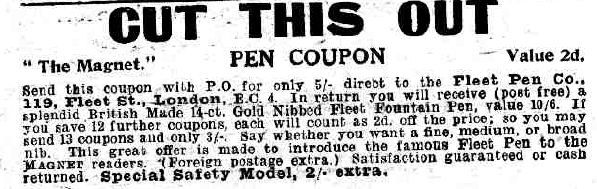
But then there’s this:

which tells us that it’s a school pen because it’s advertised in a children’s comic paper. Comparatively complex calculations endeavour to convince the prospective customer that this pen is a bargain – and perhaps it is, as it’s to some degree a sales promotion for the paper. However, it isn’t quite a purely promotional pen. The Typhoo Tea pen was sold in this way, as were a host of other pens sold under the names of newspapers. Unlike them, the Fleet Pen is not named for the product, and it has similar promotions in other children’s papers. It stands as a pen brand in its own right but in a clever association with these papers gets right to its target audience and doubtless recoups some of the cost of discounting by giving the paper an opportunity to promote itself. Three shillings and thirteen coupons for a gold-nibbed self-filling pen sounds like a pretty good deal!

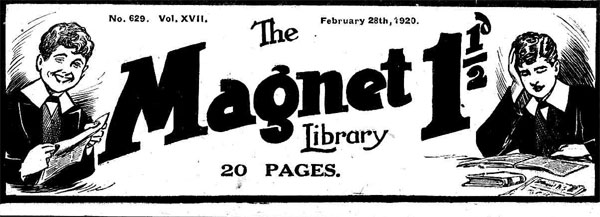
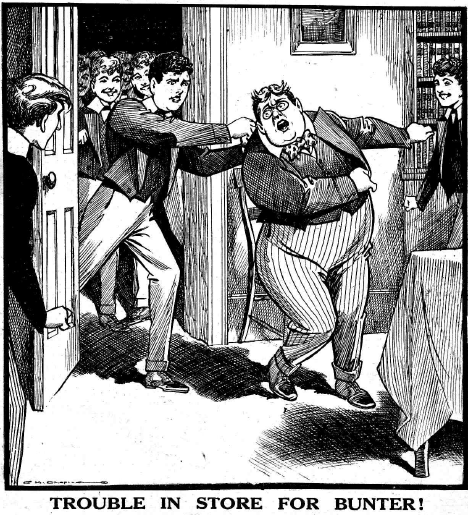
The advertisement is from The Magnet, a paper for boys that was at the height of its popularity in the 1920s, when it featured tales of Greyfriars school and the clownish gourmand, Billy Bunter. These characters will be well known to British pen collectors of a certain age and will mean not a thing to our American and Canadian counterparts. The Magnet, from a sociological viewpoint, was an odd publication. It appealed to a wide audience, but its stories were set in that bastion of moneyed privilege, the public (i.e. private) school. Some of the readily accepted views of those times might cause a raised eyebrow now. They were commendably free of racism but the basis of the Bunter tales was rampant fatism! Still as long as they all had their Fleet pens…

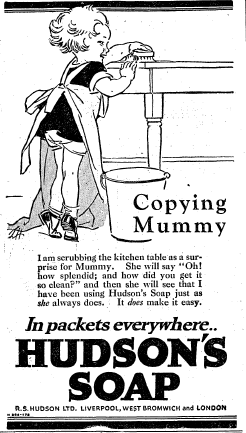
The other paper I found advertising for The Fleet Pen in was The Children’s Newspaper, a more serious, perhaps more democratic publication that catered for children of all ages. On the same page as the Fleet Pen advertisement, there’s this one for Hudson’s soap. It has lots of charm but I wonder how it was meant to work – were little girls expected to plead with their mothers to buy Hudson’s soap?

So that’s The Fleet Pen. It took me on a wander through the children’s literature of ninety years ago. I’ll never think of Fleet pens in quite the same way again.