Do Filling Systems Become Outdated?

I think the answer must be that some do, but different forces like cost and fashion intervene in other cases. Take, for instance, Conklin’s crescent filler. This was an undoubted improvement over the eyedropper filler, in that it was self-contained and efficient. That its utility was appreciated is shown by its longevity – from the last years of the nineteenth century to the early nineteen thirties. During most of that period it was competing successfully against the lever filler. In the end, though, the crescent filler died and the lever filler triumphed. This may, at the margins, have been influenced by production cost, but I think it was mostly fashion, in the sense that the protruding hump of the filler began to be seen as clunky and old-fashioned.

Another early filling system, De La Rue’s Onoto plunger-filler, pre-dated and competed against the lever filler in a similar way. It lasted much longer, until 1955 in the UK and a few years longer in Australia. I have seen it asserted that production of the plunger-filler ceased because the filling system had become outdated, but I don’t think there’s any truth in that, or at least not in the normal sense. The reality, I believe, is that the shrinking market for fountain pens caused De La Rue to try to find a way of reducing production costs. Manufacture of the K-Series piston-fill Onotos was subcontracted to a German firm which had much more modern machinery and could achieve large productivity savings. Only final assembly was done in Britain. De La Rue was not alone in using this solution. Later, Conway Stewart would follow the same route. One might say, then, that the high production costs of the plunger-filler became outdated, but not that the system failed from inefficiency or unpopularity. It was, and remains, one of the most popular and effective filling systems – the high price of restored Onotos is evidence enough.

There are some filling systems that became largely rejected by the industry. The blow-filler, an inelegant and inefficient method, had a short life, its only real benefit being the low cost of production. Syringe and bulb filling are almost in the same category, but not quite. Neither is intrinsically a bad method, though one might say that the syringe filler lacks elegance as a solution. Nonetheless, it’s the basis of many converters today. The bulb filler, with a breather tube, is a highly efficient way of getting a lot of ink into a pen. The problem for these filling systems was that they were cheap to implement and were taken up by companies selling pens at the bottom of the market. Often poorly made, they led to customer dissatisfaction that, a little unjustly, caused to these systems to be rejected.

What about the lever-filler? Did it become outdated? In truth, I think it did, though its demise was from several causes. By 1960 or so, the fountain pen itself was no longer the first choice of writing instrument. Led by Waterman, pen companies saw an opportunity to salvage profitability by producing pens that would accept only a cartridge made by them, a modern marketing concept that had been pioneered by Gillette with its safety razors and continues today with inkjet printers. A pen with no moving parts was cheaper to make, too, and so the lever filler faded away, the end of a very long tale.
Tools: Sac Removal

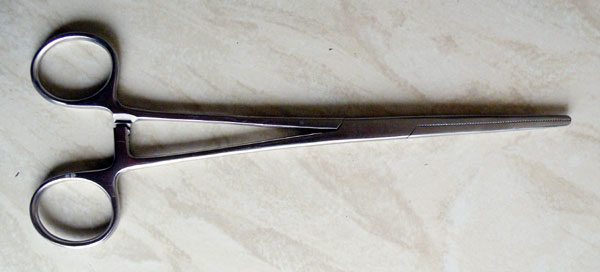
Most decayed sacs come out of the pen without any difficulty. Often, the sac is virtually whole, though ossified, and falls out of the barrel. Mostly, the sac has disintegrated into flakes and again, can be knocked out of the barrel. There are those, though, that have assumed the consistency of very tough chewing gum. It refuses to let go and if it moves at all, it goes deeper into the barrel. That’s where these handy forceps come in. They’re remarkably cheap and worth their weight in gold!

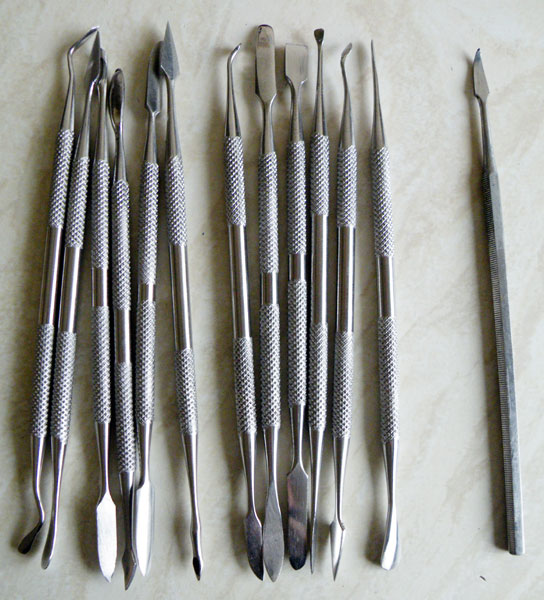
The other nasty situation is where the sac has virtually bonded to the inside of the barrel. Sometimes heat will help in dislodging this kind of debris, but other times it continues to stick like a thick coat of paint. A standard dental pick will help here, but it isn’t very efficient, and there are areas, especially around the pressure bar, that it doesn’t reach very well. Often the decayed sac is holding the pressure bar in place at this point. I found this set of picks:

which, because they have a range of shapes, will, with persistence, get every last bit of sac. They’re sold either as dental picks or as modelling tools and, again, they’re inexpensive. The one on the right is a standard dental pick.

These have a secondary use: because they come in a variety of shapes, they can be very useful in helping to burnish bent nibs back into shape.

Pen Books – Juan Manuel Clark: Collectible Fountain Pens

This book is unusual in a couple of ways: it’s one of the few I actually found in a bookshop, and it was very moderately-priced at the time that I bought it, perhaps seven or eight years ago. It was £9.95 then, making it a real bargain among pen books. It formed part of Flammarion’s “Collectible” series, and is perhaps aimed more at a general audience, rather than pen specialists. Outrageously, it’s now on offer in Amazon UK at a mere £132.25 new or £44.42 used! With the best will in the world, I can’t really recommend it as a good buy at that price!

This is a small format book, around 5 ½ inches square but quite thick, with 363 pages and a comprehensive index. It’s organised into an introduction and and five sections: Vintage, Modern, Precious, Thematic and Unusual. The introduction runs through a brief history of writing and the development of writing instruments; interesting and adequate, but the kind of thing you’ll find in numerous other books. The photography is excellent, with the pens represented life-size. It’s pretty much one pen per page, with a very brief textual explanation. Not quite as brief as a caption, but not a whole lot more. Though far from comprehensive, there are examples of the output of many of the main American and European companies, together with many pens you’re unlikely to see elsewhere.

To my mind, this is a very general and slightly eccentric introduction to the world of fountain pens. I’ve had my copy for many years and it looks like new. That’s an indication of how little day-to-day use it has been for me. Despite the good index, it’s nowhere near comprehensive enough to be used as a reference book. Yes, it has quite a few pens that aren’t covered elsewhere, but they’re all pens that I’ll never see in reality anyway. It lacks the depth to interest anyone enough for a second read, I think.

All in all, at the original price, this book was probably a good introduction to the pen world for the absolute novice. It genuinely celebrates the fountain pen, with its superb photography and interesting (if lightweight) text. It may well have kindled an interest that would only be satisfied by more scholarly works, and by the pens themselves.

Lapis Lazuli

I’m having a lapis lazuli period at the moment. Months can go by without sight of a lapis pen, then they come flocking in. I’ve had four in the last three weeks, which is a record for me. I’m especially fond of lapis lazuli, in all its surprisingly varied forms.

In the 1920s, as the potential of celluloid began to be understood and more adventurously developed, a vogue for gemstone-themed patterns began. Jade and lapis lazuli, the earliest examples of this trend, were never very true to the appearance of the gemstone, but were more patterns in their own right. A little later, Waterman’s patterns such as Red Quartz or Onyx were very close to the original. Not just pretty patterns, these gemstone colours were at the heart of the spirit of the time. The use of gemstone in statuette bases, desk sets, clock cases, bookends and the like is very much an Art Deco expression, and these pens formed part of the same taste. By the late thirties the fashion was largely over, but in the intervening years some of the most beautiful and striking celluloid pens were produced. Lapis lazuli, along with the rest, disappeared from the pen catalogues until recently, when it was brought back as a revival by several modern pen companies, most notably by Kaweco and Cross.

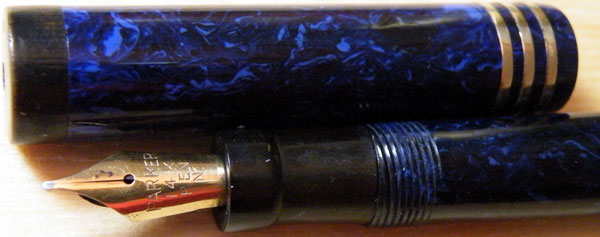
Parker, I believe, began the fashion. They had two main patterns, one dark blue with light blue inclusions, the other dark blue with off white inclusions. A third one is sometimes seen, a more marbled dark blue/light blue pattern, as in this Lucky Curve Parker Lady:

It was the one with the light blue inclusions that was copied most, and many manufacturers like Conway Stewart and Swan had versions. Here’s a classic example in an English Jewel pen:

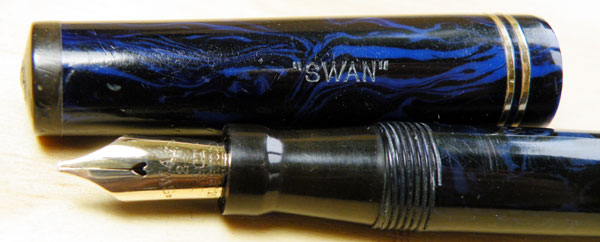
Some, such as Swan, went for a blue and black streaked version, which seems to me pretty far from the gemstone original, but is nonetheless accepted as lapis lazuli:

As I’d never seen an example, either illustrated or in reality, I long believed that Swan didn’t make lapis lazuli pens. They do, of course, both in Leverless form and in their self-fillers. A Swan 230 in a good lapis pattern would be pretty much my ideal pen.

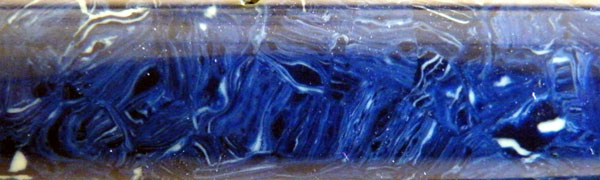
The most authentic-looking pattern I have seen so far is in an English no-name lever-filler flat-top:

That really does evoke the gemstone.

Though it doesn’t discolour as readily or as badly as some other celluloid patterns, like jade, black and cream or onyx, lapis lazuli can be spoiled by an out-gassing rubber sac, and should always be repaired using a silicon sac.

The Conway Stewart 286

The Conway Stewart 286 had a long production run, from 1930 to 1945. For strict accuracy, one would have to say that it wasn’t quite the same pen throughout the whole period. There were a couple of redesigns. It was always the same type of pen, though, a quite large pen, in the middle of Conway Stewart’s price range, bearing a single narrow cap ring and a big No5 nib. It was always a big seller, probably the company’s biggest seller during the years it was in production. The 286s are well-made pens and they survive in large numbers. Of all the CS pens of that period, I find that these are the ones I have to do least remedial work on. Yes, there can be nib repair and replacement to be done, because people drop pens, but the main components survive better on this model than on most others. The lever, often a problem on Conway Stewarts, rarely is on the 286. It seems to be a little sturdier.

The 286 comes in wonderful colours, including the ever-desirable cracked ice, blue rock-face and the wonderful toffee swirl. Most 286s that turn up, though, are black. Much as I enjoy the colours, I like black pens too. With no distraction of pattern or colour, the proportions of a pen really show in black. I realise that it’s a personal preference, and there’s no mathematical or scientific formula that can be applied to back up what I say, but I think the 286 is the most handsomely proportioned of all Conway Stewarts. Barrel to cap length, clip to cap length, nib to the pen as a whole, all seem more satisfying than on any other Conway Stewart model of the time.

This harmony of proportion makes for a comfortable and well-balanced pen in the hand. Again, it’s a personal preference, but I find the 286 a better pen to use than, say, the 55, which is a little chunky and top-heavy when posted, or the very popular 388, which is just a bit too slender for extended periods of writing.

It’s a good thing, then, that 286s were so popular and have survived so well. For the time being, at least, there seems to be a near-endless supply of them.

Mottled Hard Rubber

I had my say about black hard rubber the other day. Now let’s look at mottled hard rubber in its various forms including red ripple and woodgrain. Visually, MHR tends to survive in a more pleasing condition than may be the case with BHR. Yes, the blacks can fade but the pattern always remains clear. Often the surface has become dull, but a gentle polish with one of the usual proprietary polishes like simichrome will improve things. Even that abrades the surface a little, as you’ll see if you look at your polishing cloth, which will have picked up some colour from the pen. Myself, I prefer a non-abrasive solution like museum wax. It would always be my choice to stop at that. Any fading of the pattern is a reflection of the pen’s age. Unless it has spent the intervening years enclosed in a box, it isn’t reasonable to expect the pen to look as it did when it was new in nineteen-twenty-whatever.

Not every collector, user or restorer will agree with me, though, and that’s where radical solutions that I would reject come in. I only discuss them here because it’s better to cause less damage rather than more.

Restoring the original strong colours of the pattern can only be achieved by abrading the surface away. Metal-work such as levers, rings and clips must be removed. Imprints must either be sacrificed or saved at the cost of showing a different pattern colour from the rest of the pen. The surface of the material is evenly planed away using a medium grade of micromesh. Once an unfaded layer has been reached, successively finer grades are used to restore a smooth finish, and the pen can be reassembled.

Don’t try to do this with proprietary polish. Yes, polish is an abrasive, but it is a comparatively inefficient one, which is why we can use it on something as delicate as a fountain pen without causing damage – or at least visible damage. It won’t reduce the surface of MHR evenly, as an efficient abrasive like micromesh will. Using polish, the softer black areas will be reduced more than the harder red ones, producing an ugly, uneven surface which can only be repaired by further abrasion with micromesh.

As a conservative restorer, all of this falls outside what I do. Nonetheless, people do many things in the name of restoration, whether it be of paintings, buildings, motorcars or pens. Better that it be done properly if it is to be done at all.

Hard rubber is not especially fragile, except in the Red Hard Rubber form, which does merit particular care. MHR is little different from BHR in terms of strength, but it does get used for quite delicate pens, like the half-sized Watermans. Treat it with the respect you’d give to any old pen and you’ll be fine. Also, despite the surface, aesthetic effects of oxidisation, hard rubber is comparatively stable, more so than many celluloids or caseins, which were often poorly cured, or early injection-moulded plastics which had a tendency to shrink. Oxidisation does not weaken a pen; “curing” oxidisation by reducing component thickness may do. Remember, too, that the moment you have finished returning the pen to its original colours, the process of fading begins all over again.

Mabie Todd Swan 3261

After World War II, Swan tooled up for a new product range and went from slightly streamlined, flat-topped pens to fully streamlined torpedo-shaped ones. These were self-coloured in black, dark red, dark blue, dark green and, strangely, black hard rubber. This material appears to have been reinstated after a gap of many years during which the company made celluloid pens. Beautifully machined and finished, the BHR has worn well, though by now most have faded to brown.

One may well wonder why Swan chose to revert to the long-superseded black hard rubber at this date. Perhaps it was to make up a shortfall in the supply of plastic that old stocks of ebonite were used up. Maybe someone felt that the time for BHR had come again, though this seems less likely. Most decisions in the wartime and immediately post-war years were driven more by shortages than style. For myself, I’m just glad they made them. I like black hard rubber, and these are good pens, often with exceptional nibs.

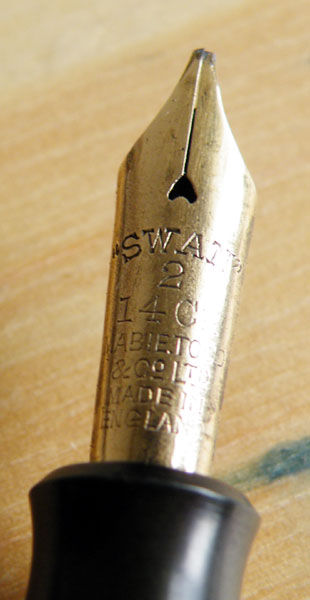
This one has a No2 oblique semi-flex stub, a very nice nib indeed. Throughout its history, Swan seemed to make a greater effort than other British manufacturers to supply customers with nibs that suited their writing style, hence the number of stubs, obliques and flexible nibs that turn up on Swan pens today.


These were the last really high-quality pens that Swan produced. Within a few years, competition from ballpoints laid the company open to takeover by Biro. Swans continued to be made, but the historic Mabie Todd name disappeared, and the pens showed the decline in investment. After a few years of poor sales of pens that would have been better not to have been produced, the Swan story was over.

You’ll notice that I resisted the temptation to make reference to Swan’s swansong. I’m so proud.

Reblacking Revisited

I’ve touched on the subject of reblacking black hard rubber pens before, but today I’m going to rant.

I’m a conservative restorer. I don’t try to make a silk purse out of a sow’s ear. I produce restored pens for people to use, but my pens must also be in a condition acceptable to a collector. Not only do serious collectors reject reblacked pens, some, in recent times, have even given up collecting BHR pens because of the spread of the practice of reblacking.

I buy pens wherever I can, but mostly my choices are made on the basis of photos. Unless it’s an exceptionally good photo, you can’t tell that a pen has been reblacked. The minute it’s in your hand, of course, you are in no doubt. The most common reblacking agent is Syd Saperstein’s Pen Potion No9, which is only marginally better than black shoe polish. It does not come anywhere near replicating the original appearance of a black hard rubber pen. The best thing about Potion No 9 is that it is reversible. It can be removed. Trouble is, old pens have lots of surface imperfections that the potion penetrates, making it really difficult to remove the coating completely. It can be done, but it often requires hours of work. I could leave it, of course, but then I would be colluding in the fraud on the end buyer perpetrated by the person who reblacked the pen in the first place.

If you buy a faded black hard rubber pen and choose to reblack it, that’s your business. The pen is yours and neither I nor anyone else can tell you what you may or may not do with it. However, if you subsequently decide to sell it, there’s an ethical duty on you to declare that this is not a pristine pen that has retained its original colour, but a pen that has been artificially blackened. Worse still are the people who routinely reblack pens, not for their own pleasure, but to fraudulently sell them as having retained their original black colour. They never (or at least never in my experience) make it clear that these pens have been reblacked. It may well be that there is a subset of users and collectors who will be perfectly happy with these pens. There are others of us who don’t want them. It is only fair that we should be informed.

My own view is that reblacking should never be done. Even when it is carried out with the best of intentions, it will ultimately lead to someone taking ownership of a pen that is not what he or she believes it to be. Mostly, it is not done with good intentions, but purely to line the pockets of the unscrupulous. Aesthetically, it is not an improvement. All the reblacked pens I have seen have uneven colour, the machined patterns have soft edges and you can see brush strokes. Every one, without exception, and I test every black hard rubber pen I buy for reblacking. If it’s there, it comes off. So far, not a single reblacked pen would have fooled me – or anyone else.

My view will not prevail, of course, but I think the minimum the hobby should accept is disclosure, and disclosure in a permanent fashion that is attached to the pen. After all, there is another reblacking agent, Giovanni Abrate’s G-10, which was brought to market in 2007 and rapidly removed from general sale following an outcry of concern from the hobby. It was, I believe, then made available to one American restorer who will reblacken any pen and who has resisted requests for disclosure. I don’t know whether any of these pens have come my way or not. Unlike Syd’s potion, this stuff is irreversible and undetectable by normal means.

All of which, of course, has us doubting the validity of any shiny, black BHR pen we see. And that’s a problem.

Pen Books – Frank Dubiel: Fountain Pen Repair and Restoration

The much-loved “Da Book” ( Fountain Pens The Complete Guide to Repair and Restoration) has been around for a long time now. It was first published in 1995 and the most recent, revised edition came out in 2002. As in any other activity, things have moved on in pen repair, and in some cases there are better repair methods now than when Frank was writing. To some extent, this book has been superseded by Marshall & Oldfield’s Pen Repair. Also, I think Frank’s devotion to the use of a naked flame rather than a heat gun or hair drier raised eyebrows even when this book was new! That said, there’s a wealth of useful information in here. If you concentrate on repairing British or European pens, you may feel this book is not for you, as most of the pens discussed are American, but there’s much general advice on all sorts of topics, and explanations of techniques that can be applied to the repair of most pens.

It’s a brave thing to be a pioneer, and that’s what Frank was. He opened the door to a whole generation of pen repairers and to great degree set the standards on what was and was not acceptable. As first in the field, you take the chance of setting yourself up to be knocked down, and the surprising thing is how well his judgement has endured. Yes, there are some practices outlined here that many of us might find fault with now, but for the most part, Frank’s methods and ethics hold good.

When Frank began this work, there was very little around to assist the pen repairer. There were some company repair manuals but they often provided little help, as they referred to spares parts and sub-assemblies that were no longer available. Open-minded and inventive, Frank developed repairs using parts and materials that are on sale everywhere. He was undaunted by the most difficult of repairs.

It’s a good many years since Frank went to The Big Repair Shop In The Sky, but he’s still fondly remembered by those of us who benefitted from his generosity. He was active in the usenet pen group; indeed for years he was the usenet pen group. Often a little testy with those who asked questions without having first checked the archives for an answer, he freely shared his experience with all, and it was rare indeed for Frank to be stumped by a technical issue. He had strong likes and dislikes. He was very much a Sheaffer man, and he had an undying hatred (I never understood why) for the inoffensive Onoto cut-off valve.

Frank’s untimely death in 2003 was a great loss to the fountain pen hobby, but at least his book survives. If you repair pens or only want to understand them this book’s essential. It’s still available from Tryphon Enterprises priced at $20.00.