I’d Rather Break My Pen Than Yours

What I do is I buy in pens from wherever I can, restore them and sell them on. I don’t repair pens for other people and there’s a reason for that. You see, you’ll send me the precious pen left to you by your beloved grandmother, positively dripping with sentimental value, or that one very special pen you’ve spent half your life and much of your disposable income hunting down and acquiring, and I’ll break it. Irreparably. Nothing left but a sad little pile of useless fragments. And that’s absolutely certain to happen.

I’ve broken a few pens in my time. Ask any repairer and he’ll tell you the same, if he’s honest. I haven’t broken any in quite a while, though, several years in fact, she said, touching wood. To some degree, that’s luck, but mostly it’s patience and method. When I became serious about mending pens, I spent a while working on low-value to no-value old hacks – Platignums, Queensways and the like and pens that were irredeemably damaged, stained, faded or worn. I made my mistakes, I broke many pens and I gradually refined my methods of working. Most of all, I learned to reject The Demon Impatience and all his destructive ways. I like to keep up a good work-rate, but I don’t have deadlines. The recalcitrant pen that wants to hang onto its section can be put aside until tomorrow and the next day and the day after that. There are days when I’m not at my best and I know it would be a mistake to start on that fragile-barreled Eversharp. It can wait for a better day. There will be one along soon.

Having thusly retrained myself in pen repair zen, there’s nothing I’d rather do than fix pens. When I set up a line of pens to be restored, get all the tools I’ll need arranged just so and my boxes of spares and consumables are conveniently to hand, a peace descends upon me. I’ll be as happy as a sand-boy* assessing, disassembling, cleaning, adjusting and so on until there is a line of gleaming, restored pens and the whole day has passed by in a blink.

But I’d still break your Granny’s pen, so don’t ask me.

*Yes, I wondered what a sand-boy was and what he had to be so happy about too. It seems they were young lads who delivered sand to public houses, where it was used as a floor covering. They were often rewarded with glasses of ale, hence the happiness. Such a regime would not be conducive to good pen repair, I fear.

The Conway Stewart 24

By the 1950s, Conway Stewart had overcome the postwar material shortages, and once again offered such a range of choice to buyers that selecting a pen must have been quite a task. There were prices to suit all pockets, a dazzling variety of colourful patterns and a selection of trim levels. If, for whatever reason, having two cap bands was important to the potential purchaser, there was only one choice: “The Conway Stewart” No24. Introduced around 1949, the 24 was the only model with two rings, but it came in two different forms; one had the rings narrowly spaced, in the slightly later version the rings were noticeably further apart. This example is one of those with the closely-spaced rings:

Some of the plastics used in the 24 are quite stunning. As well as burgundy, green and grey hatched, the now much sought-after tiger’s eye and cracked ice patterns were available. It was often sold together with the No18 pencil as a boxed set.

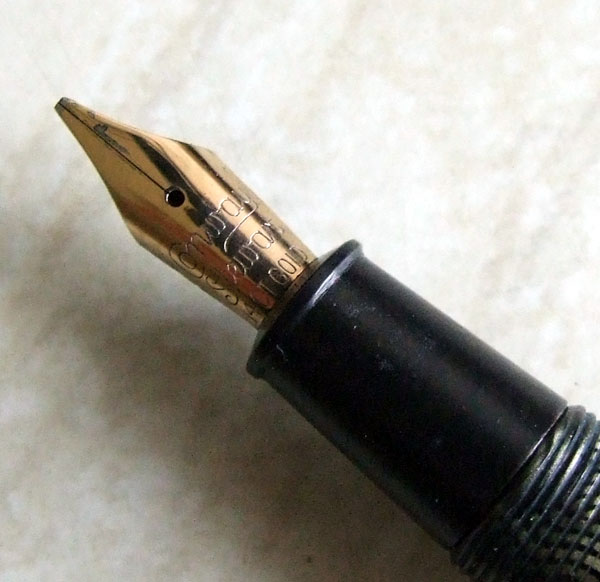
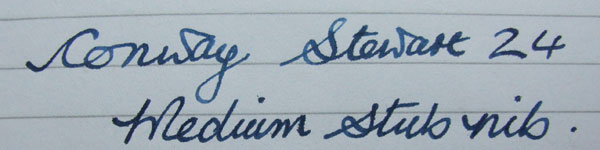
Though obliques and stubs are less common among Conway Stewarts than they are among Swans, they do turn up, and this pen has an excellent factory medium stub which imparts appreciable line variation to the writing.

Though not rare, 24s are less commonly seen than, for instance, 58s and 27s.

Comments

I reply to all comments.  However, WordPress runs a spamtrap called Akismet which deletes everything it determines to be spam.  I don’t get to see those things it deletes, so it does concern me that there might be false positives.  If you leave a comment and don’t get a reply, contact me by the email address in the sidebar.  It’s munged to fool address-collecting bots, but just substitute @ for (AT) and it’ll work.

The Royal City Fountain Pen

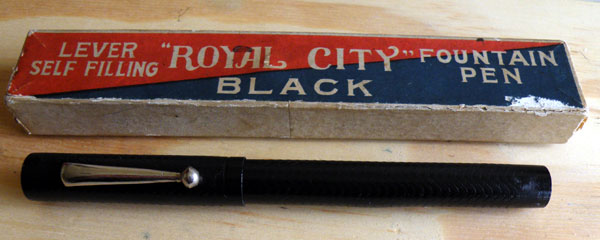
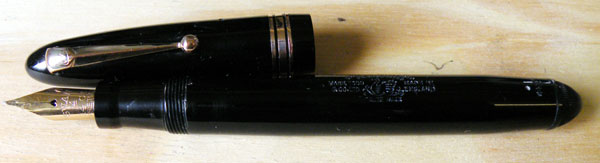
These pens turn up occasionally in eBay, usually black chased like this one, but sometimes marbled. I wouldn’t intentionally buy one, but this one came to me as part of a job lot I bought for the sake of another pen that was included in it.

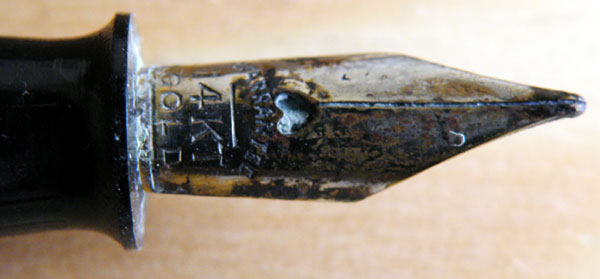
The pen could date as early as the late twenties, but I suspect that it’s later. Makers of cheap pens were often conservative in their designs, and this pen is about as cheap as pens of that period get. That said, it probably worked well enough when it was new. The nib is actually tipped rather than having a doubled-over end, as you see on many very cheap nibs. It was gold plated, though most of the gold-wash has gone. It’s marked “Warranted 14k Gold”, with the additional and important word “plated” sneakily hidden under the section. This was a trick that manufacturers of low-cost pens used extensively in the USA, but I don’t think this pen’s American.

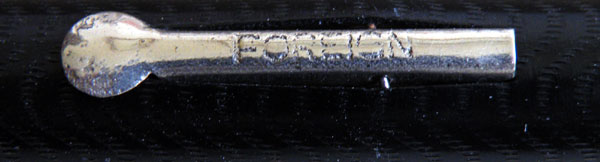
The pen has no barrel or cap imprint but the word “foreign” is stamped on the lever. In those protectionist days, such a label doubtless had tariff implications that escape me, but it does narrow the field a little. Most imports were marked with their country of origin, like “Made in Germany” or “Swiss Made” for instance. Then there was “Empire Made” or “Commonwealth Made” which implied Hong Kong or India, among others. This elimination doesn’t leave many other countries that were capable of mass production in the nineteen-thirties, so I think we may assume Japan to be the most likely source of this pen. Maybe it’s a stretch, but I think that “Royal City” sounds like the kind of appellation that would have seemed dignified and impressive in Japanese but loses something in translation and becomes meaningless in a British context.

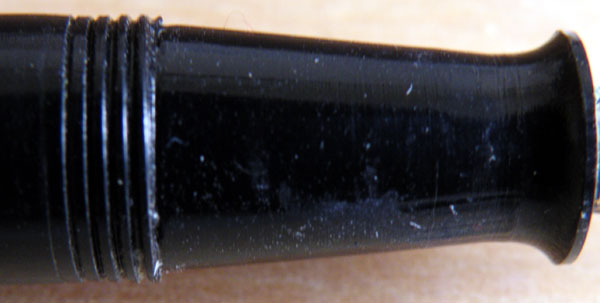
The pen is made from, I think, chased black plastic, rather than hard rubber. It shows little signs of use, but there is swelling of the barrel and the lever cut-out gapes. Either the threads are poorly cut or there is shrinkage of the barrel, as the cap doesn’t fit well. There’s no inner cap, so the nib would have tended to dry out and there was the possibility of leakage. To top it all, the pen was made in such a way that it cannot be taken apart to replace the sac.

If you see a Royal City pen offered for sale, don’t buy it. Really.

Mabie Todd Swan 3261 (Again!)

I note that this is becoming something of a Swan blog. That’s not really my intention, but I suppose it does reflect my own preferences. Also, I think I’ve written about the Swan 3261 before but as it’s the model I restore most, I think I can risk writing about it again.

The 3261 was at the lower end of the Swan price range. It’s a close relative of the pen I wrote about last, also designed in 1948 and produced from then into the early fifties. Judging by the numbers I see, it was probably Mabie Todd’s most popular pen of the time. It was fitted with some of the most delightful nibs too; stubs, oblique stubs and flexible nibs abound among 3261s.

After a long period when Swans were made only in celluloid, the 3261 and some of its larger siblings reverted to black hard rubber. Why this should be so remains a mystery. Perhaps there were large stocks of it which needed to be used up. Maybe it was customer demand, though this seems quite unlikely. It’s unlikely too – though I suppose possible – that among the other post-war shortages was a dearth of celluloid. Whatever the reason, I think we have cause to be grateful. BHR is warm and pleasant to the touch and it makes for a light pen, which I prefer.

These pens were exceptionally well made. In a sense, they’re over-engineered, with the brass threads and screw-in section. They’re not without their faults, though. Many of these BHR torpedo-shaped Swans have cracks in the cap lip. They fade, though in most cases the fading is slight, to a pleasant chocolate brown which only serves to remind us that this is a natural substance, which weathers in a natural way. The barrel imprints wear away much more than is the case with earlier BHR or celluloid Swans, and most show some wear on the gold plating, especially on the cap rings. Though it doesn’t concern the user or collector, repairers need to be careful with this one, as the peg that the sac attaches to is fragile and will break easily if care isn’t taken with the knock-out block.

When everything else has been considered, the final approval of any pen lies in whether it is good to write with, and the 3261 certainly is. Light and perfectly balanced, well-shaped for the hand and equipped with superb nibs, these are fine writing instruments. These torpedo-shaped pens were just about the last of the great Swans. We’re lucky that there are so many of them around.

Mabie Todd Swan Leverless 4460

Mabie Todd’s administrative headquarters and their main factory were bombed during World War II, which led not only to the loss of capital equipment and production, but also irreplaceable records were destroyed. This makes an overview of their pre-war, wartime and immediately post-war production a little hazy, to say the least, and dating of several models from around those times remains in debate.

We do know, however, that the company re-tooled for a new product range in 1948, and went on to release their new torpedo-shaped pens soon after. The Leverless pens in this style are usually dated to 1949. The change is purely stylistic; in every other respect this remains the same Leverless Swan that had been so successful for the company since 1932. Strangely, Mabie Todd reverted to Black Hard Rubber for some of these pens, the others being in self-coloured celluloid.

This example is in the middle of the range, a 4460 which has a No4 nib. The largest pens in the range have a No 6 nib. This is a large pen at 13.7cm capped, and it’s a good handful with a girth of 1.3cm. That’s longer than a standard English Duofold of the time, and thicker too, so all in all it’s a very substantial pen.

It was the cleanliness and ease of use of the filling system that sold the Leveless in its thousands, but people often have trouble with it nowadays. It is said that it doesn’t hold as much ink as a comparable lever filler, and that’s true, but the difference is insignificant. The dissatisfaction with Leverless arises from re-saccing by repairers who don’t understand the filling system, resulting in a pen that holds very little ink, or, at worst, will draw none at all. With the right type of sac, properly fitted, the Leverless will give no cause for complaint and will hold at least as much ink as a short international cartridge, usually rather more.

This pen is the celluloid version, and I suspect that it hasn’t been used very much, as it’s immaculate. The beautiful nib with its heart-shaped breather hole and long tines hints at flexibility. As you will see from the writing sample, it’s no superflex, but a moderate amount of line variation is easily induced.

It’s always a joy to find a sixty-year-old pen that looks as if it came off the production line yesterday, and that it should be one of this high quality is an added pleasure.

The Early Adopters

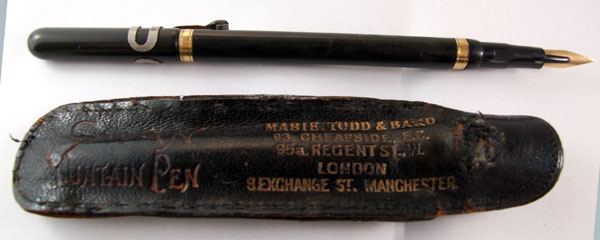
The Swan 1500 was, to my mind, Mabie Todd’s first fully practical fountain pen. Despite still using an over-and-under feed, ink delivery was fully under control. You can write as well with a 1500 as with any later pen. The same is not really true of earlier Swans, nor of the early output of other companies of the time. I’ve had several Mabie Todd & Bard pre-1900 pens, of which this is one:

It was made around 1895 and it’s in excellent condition. There’s every reason to believe that it writes as well now as it did when it was new. Like others of its age that I’ve used, it’s very wet, constantly hovering on the brink of dropping a blob of ink on the paper. It can be used to write well, but it takes a very delicate and steady touch. Not especially practical or easy to write with, then, and yet these pens sold in considerable numbers, judging by how many have survived.

It’s listed in the 1895 Harrod’s catalogue with the following description: “The ‘Swan’ Fountain Pen: a Vulcanite reservoir, holding a sufficient supply of ink for many days’ use, and a Gold Iridium-tipped pen, with apparatus for ensuring an even and ample flow of ink.” It came in fine, medium and broad points, and was priced at 9/0d (9 shillings) plain or 10/6d with gold plated bands. That’s a lot of money! By comparison, a box of Gillot’s gilt nibs was 4d, and you could buy a dozen cedar penholders for 5 ½d. Writing with a dip pen is clearly very, very much cheaper. True, once you had bought your fountain pen you wouldn’t have to buy any more nibs, but their price was really quite insignificant in comparison with the outlay you would have had to make on a fountain pen. If you were a really conservative stick-in-the-mud you could still buy quills in 1895, at 2/3d for a bundle of 25 of the highest quality!

Given that it was so much cheaper to write with a dip pen than with a fountain pen, why did they take off in the way they did? I think the answer is that, despite the shortcomings of these early pens, they conferred a hugely significant advantage over the earlier technology. Though it’s true that those who wrote regularly with dip pens were very fast, the constant need to refresh the ink was a real nuisance. It slowed the writing and broke the train of thought. The ability to write continuously without interruption was worth the high cost of a fountain pen. Though the technology was not quite mature and was still a little imperfect in use, it’s such a leap forward from what has gone before that it was the “Killer App” of its day. A more modern comparison might be with the dedicated word-processors of the late nineteen-seventies: somewhat clunky and not quite right, but still an immense improvement upon the electric typewriters that preceded them.

There can be no question that the fountain pens of this date were being bought by the more affluent end of society. In a few short years ever more efficient mass production would make them available to all.

The Homage, The Copy and The Fake

The history of the fountain pen is one of the transfer of ideas, whether as homage, copy or fake. For example, the Parker Duofold is probably the most-copied pen ever. Within a year or two of its appearance, almost every American pen maker, and many elsewhere, had produced a very Duofold-like pen. Homage? Hardly. That’s the excuse the copiers might give, and Parker might have felt mildly complimented by the fact that their flagship pen was so appreciated, but in reality those Duofold-alikes were made to invade the Duofold market. The fountain pen world was a dog-eat-dog one, and the ethics of the industry were always a little shaky. Actual theft of original technical ideas was intended to be prevented by patents, but such was the ingenuity of the industry that ways were quickly found to adapt new ideas sufficiently to avoid the provisions of patents. The industry was hair-trigger litigious, but even aggressive use of the courts couldn’t stop the spread of good ideas. Most of what was done – or had to be allowed to continue to be done, at least – was legal.

So it is that you find lesser (and sometimes not so much lesser!) pens that look like Patricians or Skylines or Parker 51s. If you were a pen manufacturer who believed that the Parker 51 was the way that pens were going to go in the future, you would be foolish not to emulate that style, while keeping clear of the specific patents that related to that pen. That’s not so different from what’s happening today in China, where they make all those pens that look suspiciously like Parker 45s, Sheaffer Triumphs or various Montblancs, but carry the Chinese manufacturer’s name and are therefore copies or homages, and not fakes. There’s nothing new in pendom. The Chinese are only doing today what American, British and Italian manufacturers did long ago.

True fakes are another matter, and are a modern phenomenon, only possible because some highly-regarded pens sell for many multiples of the cost of production. It is that huge margin that opens the door to the fake, or at least to the fake that will convince beyond the first glance. Tooling up to produce a fake costs little or no less than it would cost to make an original pen. Certainly, savings are made in using cheaper materials throughout, but the more convincing fakes have to be at least adequate pens in their own right. Selling those pens in huge numbers with a more slender margin is where the profit lies. The absence of any real warranty or after-sales service also keeps costs down, and as with fakes of other labelled goods, the amount of money that can be made ensures that they will always be with us.

I concentrate on pens made before 1960, for the most part, and fakes aren’t really a concern for me. Some older pens are faked, of course. Very ordinary older pens are covered with fake overlays, for instance, but these are a bit outside what I usually handle, and the collectors of these items are pretty perceptive. Those fakes are quickly identified whenever they appear. Among more ordinary pens, you won’t find fakes. In recent weeks, I’ve seen buyers of a Stephens Leverfill and a Swan Calligraph expressing concern that their purchases were not as they expected and might be fakes. They weren’t, of course. No-one’s going to tool up to fake £35.00, sixty or seventy-year-old everyday pens. There’s no money in it.

What can happen, though, is that inappropriate parts will be mated together to make a pen look like something other than what it is. Be on your guard against that, especially with 1920s Swans. Ask questions and if the answers don’t satisfy you, don’t buy. A clearly genuine example will be along soon!

It’s All About Efficiency – Or Is It?

Technological progress, one might say, moves from less efficient to more efficient. That would seem reasonable. I often think about this in regard to the history of the fountain pen. It seems to start well, but by the latter end it tends to fall away. Perhaps in the later years of the fountain pen the target was not so much efficiency as something else.

The eyedropper filler was certainly a step up from the dip pen, in that you only had to mess around with ink occasionally instead of constantly. It was still a decided hack, though. Unscrewing the section (can be messy), loading the pipette, filling the barrel, screwing the section back on, tapping or shaking the ink through, rinsing the pipette. It’s all a bit of a distraction. The various coin fillers, match fillers and especially the admirable crescent filler were a notable improvement. Plunger fillers and syringe fillers are convenient and clean too. The button filler, especially the larger ones like the bigger Duofolds, are exceptionally convenient to use – were it not for the possibility of losing the blind cap. Pens with a fixed button filler, like the Stephens stud filler, may be among the most convenient pens of all. In the main, the industry settled for the lever filler. It’s a good system, but it can be messy when the ink is low in the bottle, and some of those levers seemed designed to do injury to the thumb. Later pens, like the Parker Aerometric fillers, seem like a cop-out from the struggle towards greater technological efficiency. Unscrewing the whole barrel to operate a squeeze filler works well enough, but it’s not elegant. I suspect that the unbroken line of the barrel trumped efficiency of use here.

Finally, we have the cartridge filler. Frankly, it has little to recommend it. You unscrew the barrel, remove the old cartridge (distinct risk of ick at this point), push another cartridge in, put the barrel back on and tap or shake the ink through. It’s not a self-contained system. We’re three-quarters of the way back to the eyedropper filler! The cartridge filler, it seems to me, is the means whereby very small quantities of ink can be sold at a premium to the gullible.

For myself, I love the elegance of Stephens’s clever button filler, but the pen that keeps returning to my desk is my old Conklin Crescent filler. It’s simple, intuitive, efficient and it has the technology on the outside, like a Richard Rogers building. That’s style!

The Mabie Todd Swan 3230

Grey is an unfortunate colour for fountain pens. It discolours, almost always. The pre-war celluloid grey/black marbles didn’t show the yellowing quite so much, and even when it did, the marbling reduced the unpleasantness of the effect. In the post-war period there was a fashion for self-coloured pens. Quite a few manufacturers, including Mabie Todd, Parker and Wyvern had self-coloured model ranges in the late forties and early fifties. All included grey as one of their colours, and all dropped it quite quickly and reduced the range to the burgundies, blues, greens and blacks that retained their original colours. Small wonder, because the self-coloured greys invariably discoloured, often very badly.

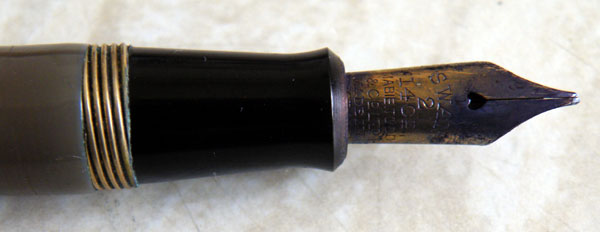
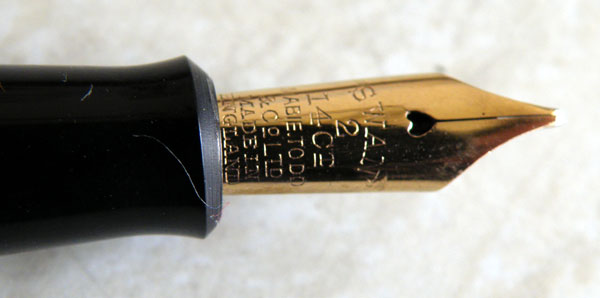
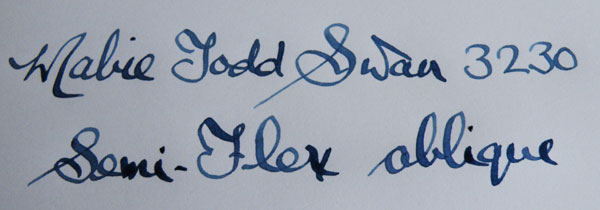
This is a Swan 3230, made between 1947 and 1950. Mabie Todd was still a maker of very high quality pens in this period, though I think the gold plating on these pens is thinner than it would have been fifteen or twenty years earlier, and there has been some plating loss on this example. It’s a well-made pen, though, comfortable and well-balanced in the hand – a real writer’s pen. The stubbish nib is a medium oblique. The pen is, of course, discoloured, with an obvious difference between the cap and the barrel. It’s by no means the worst I’ve seen – these pens can become a hideous muddy yellow.

Though it confers no obvious benefit, Mabie Todd went to the added expense of threading the sections of these pens, rather than making them a press fit. The brass threads and the two cap rings place this pen in the middle of the price range. As always with Swans, it’s an easy repair and it’s the work of a matter of minutes to return the pen to working condition. I pop in a silicon sac to prevent further discolouration. When tested, the nib is decidedly flexible. It’s a real pleasure to write with.

Like black pens, grey pens are often cannibalised to provide spares for more colourful pens that will sell for a higher price. That’s something I try to avoid. True, if a pen is extremely discoloured to the point where it looks repulsive, I’ll strip it for spares but otherwise I’ll repair it. After all, they’re not making any more 60-year-old Swans, and these pens are splendid writers. I’m not in the business of reducing the numbers available. Yes, it may sell for rather less than a more a colourful one but I didn’t pay much for it and it didn’t take a lot of my time to put it right. It’s not going to have collectors fighting over it, but someone who wants a thoroughly excellent writer and doesn’t care too much about its appearance will treasure this pen.