When I was buying and selling fountain pens, first in eBay and later from my own sales site (now closed) I avoided these colourful post-war post-war Burnhams. I was right to do so; many are subject to casein rot and the photographs weren’t always good enough to tell which were the good ones..

However, it meant that I missed out on such beauties as this one. Post-war Burnham patterns are absolutely unequalled. It is something of a paradox that Burnham’s casein was more attractive than anyone else’s, even Conway Stewart’s, while being much less stable. Burnham and Conway Stewart were the only major UK users of casein. The other large manufacturers gave up on it despite the wonderful colours it is capable of because of its instability.
The damage that damp and temperature change can cause to casein is not superficial. It penetrates the entire piece and is irreversible. That, one might think, would have been enough for all pen makers to reject it, but not so. The casein that Conway Stewart used both before and after World War II is considerably more stable. This may have been a matter of better curing or it might have been due to a difference in manufacture.
I believe that casein rot may be infectious. I was once given a box of around twenty-five casein Burnhams. Most parts were crazed though one or two caps and barrels were not. As there wasn’t a complete pen among them I set them aside. Later the parts that had been in good condition had become crazed and fragmented like the rest despite being kept dry in a place that had an even temperature.
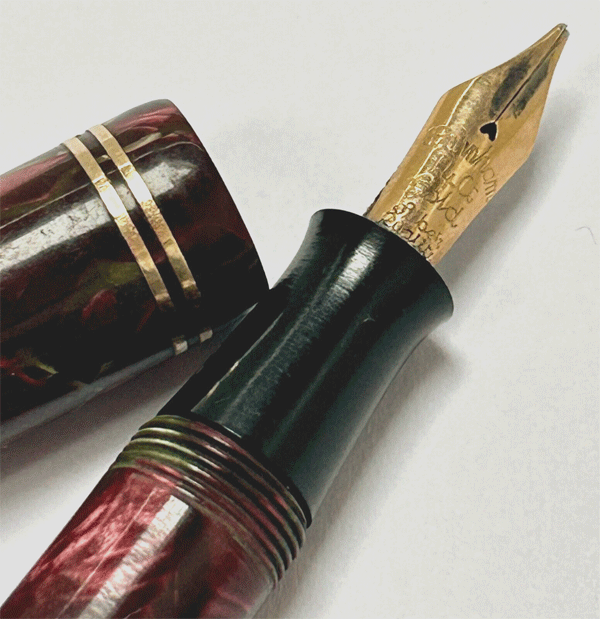
I would like to emphasise that the pen illustrated is absolutely clear of the problem and is a real gem, one of the more expensive Burnhams of the period, with a splendid 14ct gold nib and neat cap rings. Pens like this are among the very best of post-war British production.
I am grateful to alsretro for permission to use the eBay photographs of his lovely pen to illustrate my article. https://shorturl.at/jlJUY will bring you to his auction.
 Goodwriterspens's Blog
I have several post war Burnham’s put by. I’ll have to check them out. It’s a while since I last saw them.
It’s worth taking a look at them.
Excellent write up. It explains why finding a good casein pen is a challenge. The idea that “casein rot may be infectious” is an interesting concept. The material is organic opposed to petroleum based and vegitable,s etc, give off gasses that impact other veggies and fruits…. BTW I am writing with a CS casein Nippy.
As I said in the article, CS pens and pencils are less susceptible to casein rot than Burnhams and I believe this is down to longer and more thorough curing. The jury is still out on whether or not the rot spreads from one item to another. I believed that some of the caps and barrels I stored along with fragmenting ones were clear of the damage but it may have been there already, just not visible.
It is said to be possible to make water-proof casein. As it has been made in the past, casein is a square sheet. When it gets wet it tries to return to that shape. It is possible to “train” it to be stable by repeatedly reshaping it over a long period before using it in a pen.
Thanks Deb for the info. This is really quite amazing to me.
Bernard Hawkins and Henry Simpole were masters at reshaping distorted casein pens. Bernard in particular was good at removing the ‘banana effect’ and the frequently-seen swelling around the lever pivot, often caused by leakage of ink rusting the pivot ring and trapping moisture between the ring and barrel. I believe he would remove the pivot ring, moisten the casein and gradually persuade it back into position by tightening a dental clamp around the barrel. Sounds simple, but it requires a great deal of experience to get it right. One of Henry’s more impressive efforts was to take a broken casein pen barrel and reshape it by repeated soaking and rolling to turn it into a flat piece to replace the missing casein cladding on a Conway Stewart penknife. He said it was like working with a piece of wet fish!
Regarding your casein Burnhams, the crazing is caused by excessive moisture causing the casein to swell a tiny amount, then drying out. A similar effect is seen in when wood dries out after suffering a period of wet rot. As you say, it is likely some of them just appeared to suffer later because they dried out at different rates.
I’m not sure about totally waterproof casein, but more water resistant than some vintage examples seems possible. When the Conway Stewart name was revived by Don Yendle in the 1990s, his first pens were very colourful casein models, and I haven’t heard of any water-related problems with those after around 30 years.
Thank you for that, Andy. I know how difficult reshaping distorted casein barrels can be as I’ve tried it several times – with limited success, I have to say!