A New Old Stock Osmiroid 65

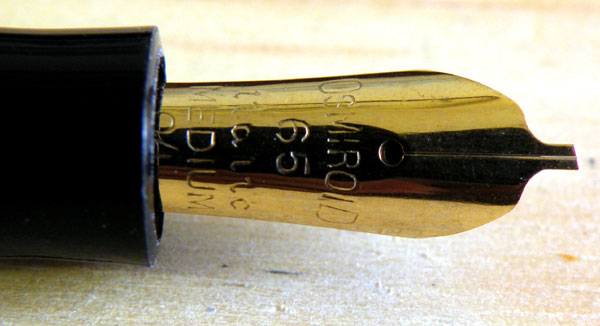
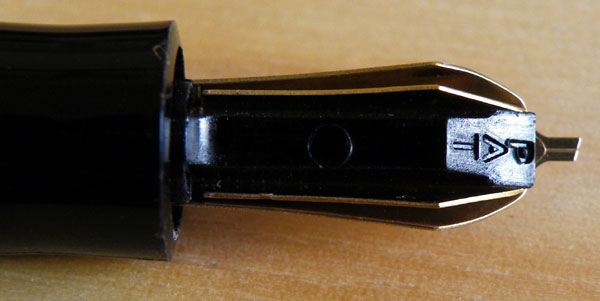
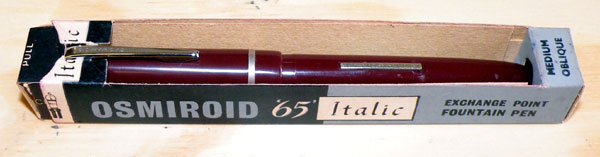
I recently bought a job lot of fountain pens and mechanical pencils. There were a few interesting writing instruments among the lot, some of which will turn up here soon. One unexpected thing was this Osmiroid 65 still in its original packaging. I discussed Osmiroids in general terms back here: http://wp.me/s17T6K-osmiroid and I illustrated that article with a picture of an Osmiroid 75. This pen I have today is the earlier lever-fill No 65.

I don’t have exact dates for the Osmiroid 65 and 75. My husband, who started school in 1955, remembers the 65s being used then or soon after, so it seems that this unused example has been around for fifty years or more.

Normally, new old stock pens will disappear into a collector’s cabinet never to be inked. They fetch a premium as perfect examples of their kind. With an Osmiroid, I suspect the rules will be a little different. While the fact that it is “new” and in pristine condition will still be appreciated, the buyer is likely to be a calligrapher rather than a collector, and the pen will certainly be inked and used.

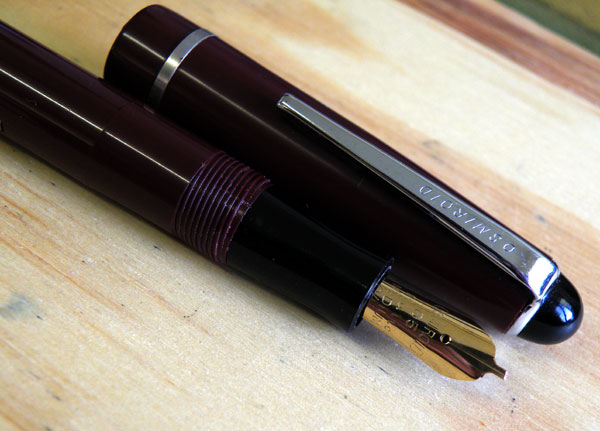
The left oblique italic nib is a beautiful thing, and one of the less common Osmiroid nibs. I haven’t seen one before.

The Regalia Pen

I see these Regalia pens passing through eBay from time to time. They’re not really uncommon, which implies that they must have sold quite well. They’re clearly of a lesser quality than the pens we usually discuss here, but if you’re interested in pens it pays to be interested in all pens. You never know what you might learn.

“Regalia” is quite a strange name for a fountain pen. It’s defined as:

“The emblems or insignia of royalty, esp. the crown, sceptre and other ornaments used at a coronation.

The distinctive clothing worn and ornaments carried at formal occasions as an indication of status.”

Nothing much of a penly nature there, then, but I suppose it’s no worse than Unique, Kingswood or even Onoto. Because the name sounds a bit like it was ill-translated from another language, I initially suspected it might have been foreign made, but no; both box and barrel insist that it’s an English pen.
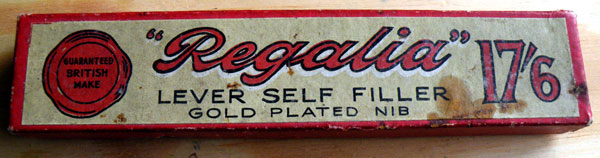
The second thing that’s a little strange is the price. This is, I should think, a nineteen-twenties pen. By a stretch, and allowing for the most backward-looking of conservative design, it might creep into the thirties, but I doubt it. At that time, 17/6d was a lot of money. In 1928 you could buy a high-in-the-range Conway Stewart 212 with two gold-filled barrel bands for 12/6d (Oh, how I want a time machine!). The Regalia isn’t at the top of any range – everything about it says “cheap pen”. The metal trim has at best a gold-wash. The nib is plated, or once was. The design is two tubes, one large enough to screw onto the other, and the barrel end is threaded. That’s pretty crude. Despite being quite a good idea, the barrel end thread is practically diagnostic of cheap pens. Even by the end of the thirties, 17/6d was still the price of a luxury pen, a cracked-ice Duro-nibbed Conway Stewart 1203, for instance. So I can’t really explain the price, unless maybe you got a small car free when you bought it.
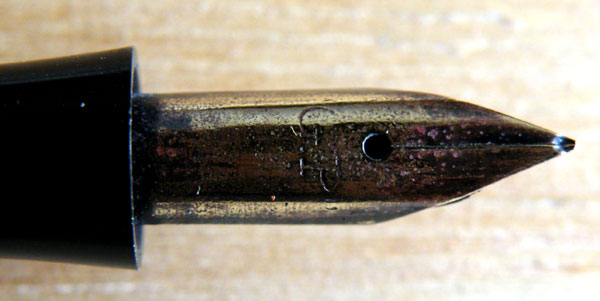
So what’s the upside of the Regalia? Actually, it’s a quite competent pen. The spoon-ended nib, though a bit worn, still writes quite well and although it could hardly be described as flexible, I was able to squeeze a little line variation out of it. The black chased hard rubber remains black and the chasing is sharp. The box is gorgeous, very bright and colourful and completely of its time. Both pen and box provide historical documents that fill out the context of the time in which they were made.
Mabie Todd Swan Leverless L212/66

It would be nice if Mabie Todd had used a little more consistency in assigning numbers to their different designs of pen. That said, they were less of a riddle than Conway Stewart or Burnham, but still a little confusing. The second design of Leverless Swans, which was issued in 1938 and remained in production until 1942, were mostly designated in the form L—/–, the rare L645/88 in green lizard skin celluloid being an example. Some broke the rules by having no number, of course, like the even rarer garnet lizard. And just to confound us completely, a few of the earlier, 1933 to 1938 design also bear the L—/– range of numbers!


There’s no L-range of Swans, then, just some Swans that bear the L-designation. That said, the later L-designated Leverless pens are some of the most beautiful that Mabie Todd ever produced. The lizard skin pens are well known, but there are also pens in subtle and lovely mixed celluloid colours like this L212-66. It is a sad fact that the most common colour for Leverlesses is black, and the comparatively few patterned ones that appear tend to sell quite high.


This pen, I suppose, must go under the general description “green marbled”, but if you think of what a Conway Stewart, Waterman or Burnham green marbled pen looks like, you appreciate how subtle and understated this pattern is.

That’s class.

A Colourful Platignum

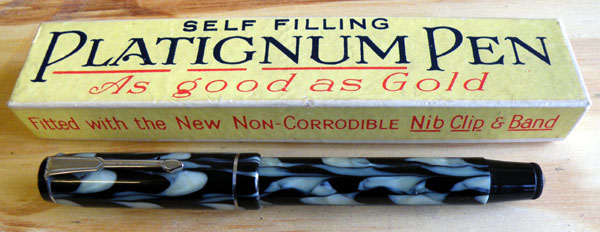
There are Platignums and Platignums. There’s the very basic sort that your parents bought you for school if you were like my husband, who says his pens were lucky to last the week, and were broken or lost by time Saturday came around and another one would have to be bought. No point in buying Parkers for a kid like that, and that’s where the basic Platignums excelled: cheap and just about capable of writing with. No-one’s collecting them.

There were other rather surprising Platignums, though. They were boxed rather than stuck on a card and they came singly or in a pen and pencil set. As well as being adequate writing instruments, they came in stunning colour patterns. These ones do have a following with some serious collectors of other more prestigious pens among them.

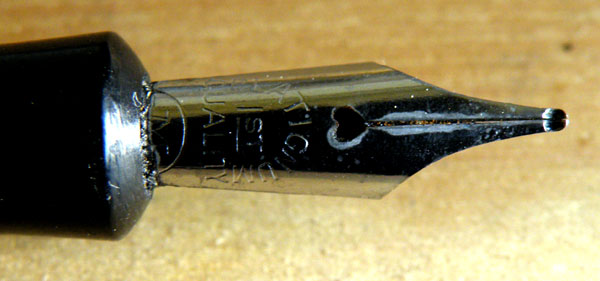
This pattern is called “Black and Pearl”. The “As good as gold” tag that you see on the box dates back to the 1920s, when Platignum was born as an offshoot of Mentmore. It was the company’s assertion that their steel nibs were as good as anyone else’s gold ones, a claim you don’t really have to believe. That’s not to say that they didn’t make many good pens. It was really only in the post-war period that some of their lower-priced pens went from economical to downright cheap.

This one’s quite a well-made pen. It uses Mentmore’s patented screw-in plastic button and Platignum button fillers are efficient. I haven’t tested its writing abilities yet, but if previous Platignum steel nibs I’ve tried are anything to go by, it will write perfectly well, provided you don’t want too much in the way of character from your nib. These spoon-ended nibs have a shorter life than a properly tipped nib, but as most people don’t use their pens very much nowadays that’s no longer as important as it once was. In any case, I suspect that this pen will be bought more for its appearance than for its utility.

A No-Number Swan Leverless

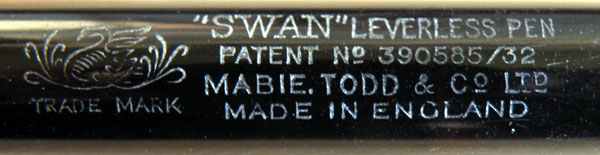
This no-number Leverless looks to me to be one of the earliest, so it probably dates to about 1933. It’s a big pen: 13.5cm capped and a very long 17cm posted. These pens had quite a few price gradations and this one isn’t at the top of the scale, having only one narrow cap ring and a medium-sized No3 nib. It’s a serious and imposing pen, all the same. It has survived the passage of time well. There’s some fading of the black hard rubber cap top and turn-button.

The ridges that were once on the turn-button to make rotating it easier have worn down, and there’s quite a bit of plating loss and even pitting on the clip. The pattern on the cap and barrel is still there, though, and the barrel imprint is nice and clear.

It’s a superb writer, smooth and semi-flexible. It’s solid but not heavy, and even with that large cap, the balance in the hand is good. Though it perhaps holds a little less ink than a button-filler of the same size, you’ll still get several pages out of a fill with this pen, and when you do have to fill it, it’s easier than either a button-filler or a lever-filler. All your activity takes place at the end of the barrel, far away from that messy ink bottle.

These 1930s Leverless Swans, like Swan lever-fillers, have never been surpassed, whether for elegance, utility or durability.

Back At Last!

Here I am again! I was offline for almost a month, the longest I’ve been without an internet connection since 1993. The withdrawal symptoms were harsh, especially when I couldn’t remember some detail which I could have found out instantly by using Google. The reason I was without a connection was the old story, not really worth repeating, of an ISP gone bad. Suffice it to say that I wish bad and unrepeatable things on the senior management of TalkTalk, may they rot in heck.

I’ve spent the day updating logins and contact details for all my various accounts. I last had to do it five years ago and it seems all too soon that I’m plodding through it again. Still, it’s done now and it will be back to the pens again tomorrow.

Several of you have sent me messages backchannel and I’ll be in touch in the next few days.