Some time ago I wrote about a red and black hard rubber Primo pen that I’d found. It was an interesting pen and like so many of the smaller, more obscure brands, I couldn’t find out anything about the company or their output. A few days ago, Steve Falkner told me he had another Primo, the Ladies’ Pen, as it is named on the box or The Dainty according to the barrel inscription. Steve very kindly sent me some photos and gave me permission to use them here.

“Dainty” immediately reminds us of “Dinkie” and that’s appropriate. Whoever began the fashion for tiny beautiful pens, Conway Stewart became the best known for it.
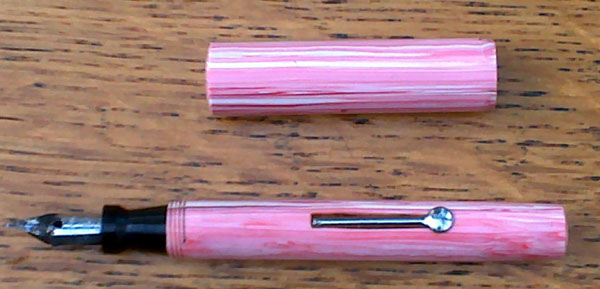
The pen is essentially two tubes, one of greater diameter than the other. That design, also used for the Conway Stewart Dinkies and the small Rosemary pens dates it to around 1930. The box, with its various fonts and its seal is a masterpiece of graphic design and the style coincides with that date. The manufacturers made a virtue of necessity in asserting that their “non-corrosive” nib is “as lasting as gold,” a claim similar to that made for the new Platignum range of pens around the same time. With its simple, clean lines and shocking striated pink, the Primo Dainty holds its own with its Rosemary and Conway Stewart competitors, even though it has a steel nib as against their gold ones.
So we know a little more about the Primo company. A short-lived and minor one, perhaps, as it turned out, but they made some very attractive pens. Thanks very much, Steve, for moving our knowledge forward a bit!
 Goodwriterspens's Blog
The only other reference I’ve come across to the “Primo” was in a series of adverts in the “Journal of the Jamaica Agricultural Society” [1934] in which the “Primo Writing Set” was listed along with (possibly significantly) the “Platinum Supreme”, the “Iridio Writing Set” [a sub-brand of Wyvern], and the “Wyvern Ladies Set” [in silver].
The Primo set was blurbed as “with new guaranteed non-corrosive Nib, assorted coloured holders 4/-; Post Free 4/3.” – which makes it comparable to the Iridio set (also 4/-).
The source is a Google Book snippet, I fear, so not enormously informative … but at least it gives a date for the Primo’s export marketing and some notion of the company it was keeping at the time…