A Burnham Opus

As you may remember from an earlier post I made on the subject, I’m not a big Burnham fan. That said, Burnham holds an important place in British fountain pen history, and the best of their pens – especially the earlier ones – are pretty good. They could always make a good nib, and their casein pens employ some of the most beautiful patterns ever seen in a pen.

In case you haven’t already seen a reference to it in the pen forums, I thought I would bring this to your attention:

The Burnhamography http://www.pengrauncher.co.uk/

Alan Charlton has created a fascinating and informative history, not of the company but of the pens they produced. He has disentangled the ties between the various British companies Burnham was associated with at different periods. The confusing Burnham numbering system is clarified, too. There are many Burnham pens here that I haven’t seen before.

This is the first major work on the output of a British pen manufacturer to appear on the internet for many years, and it will provide a fine reference for those interested in Burnhams and in the wider history of British fountain pens. I commend it to you and I am thoroughly grateful to Mr Charlton for his scholarship and generosity.

Back To Work!

I took a break from pen repair and pen sales for about six weeks. Sales tend to fall away a bit in the spring, for some reason, so it’s a good opportunity for me to get the garden in good shape after the ravages of the winter. It meant that I could spend a bit more time on this blog too, so the frequency of posts has been a bit higher of late. Also, I needed to build up stock again, which I have done. I have a pile of pens to repair. I’m itching to get at them, so I expect I’ll be posting a little less, but who knows what interesting things may turn up among my pile of pens!

Pen Books: The Chronicle Of The Fountain Pen

There wasn’t room to list the authors in the title above, but here they are: João Pavão Martins, Luis Leite and António Gagean.

This book, published in 2007, is still in print and is available from different sources. Prices vary a lot, so it’s worth shopping around. One passed through eBay recently and sold for £34.88 plus postage of £8.00. Andy’s Pens (http://www.andys-pens.co.uk/books.shtml) offers it at £79.00 plus postage, and Amazon lists it at £44.86 new or, bizarrely, £77.56 used.

I can’t praise this book highly enough. I’ve had mine for about two and a half years, and it’s severely tattered and in danger of falling apart, which is a good indication of how useful I have found it to be. It’s a large (and heavy!) book of 352 pages, profusely and beautifully illustrated, laid out in the chronicle format, a year by year account of the history of the fountain pen. No general pen book can ever be totally comprehensive but this one gets close. All the major companies are covered well, and you’ll find a great many pens that are less common. This makes the book an excellent research tool, and the profusion of excellent photographs is very useful for identification.

This is an entirely different type of fountain pen book from most of the others I have, several of which are, frankly, lightweight and exploitative. This one was written by people with serious intent, and it is a marvel of unstinting research and rigorous scholarship.

Putting a date on a particular pen is always difficult, and the authors state that, having studied the available dating information, they have, in many cases, made a best estimate. Generally, I find their dates credible.

The book is well indexed and there is a fascinating and informative bibliography.

To my mind, this book is essential for anyone who has a serious interest in fountain pens. Though comparatively expensive, it is worth every penny and will soon repay itself in the ease of research that it provides.

The Gilbert Duplicate Posting Manifold Pen

Like the Kenrick and Jefferson range of pens, this Gilbert Duplicate Posting Manifold Pen was produced by a stationery seller for use with their multi-part forms. Gilbert pens are nowhere near as common as Kenrick and Jeffersons, though, and they only turn up once in a blue moon.

The sunburst logo on the shoulder of the clip, together with the general style of the pen, strongly hints that it was made by De La Rue for Gilbert. The plating of the trim and manufacturing quality is comparable with the very best of De La Rue’s non-Onoto output. It’s in a very traditional style, the only point of note being the shallow domed clip screw. A very handsome pen, nonetheless.

I suspect that the Alfred Gilbert company, which was based in Edgware Road, London, is long gone. Their main claim to fame was a simple and efficient pre-computer-age accounting system. Not being an accountant myself, I can only work up a limited amount of enthusiasm for that particular achievement, but I will remember them for this very nice pen.

Soaking

Removing sections from barrels is one of the more difficult jobs restorers do. More than any other operation, it’s the one where you can ruin a pen in an instant. You have to be careful – you don’t necessarily know how that section is fitted in there. Is it a friction fit or a screw-in? Might it even be a left-hand thread? At the same time, you have to exert a considerable amount of pressure on that delicate joint. And then there are the sections that don’t want to let go, the ones that feel like they’re welded in.

“How do I remove this section?” is a regular enquiry on the fountain pen forums. One of the common responses is to soak the pen at the area of the section/barrel joint. Personally, I would never do this. I have done, in the long ago, and soon learned that it didn’t slacken the joint and, if the section was made of hard rubber as they usually are in pens of the period I deal with, the HR was often faded by the soaking.

What is it that the soaking is supposed to achieve? Is it believed that the water will penetrate the joint and lubricate it? Frankly, it doesn’t. Water isn’t penetrating oil. It doesn’t find its way into every nook and cranny. Perhaps it’s intended to dissolve any adhesives used. Actually, it’s quite uncommon to find sections stuck in with adhesives (1940s Watermans excepted) and where they are, water is unlikely to dissolve most adhesives. How about warm water, then? Well, it might be a little more penetrative, but only marginally, whereas it’s guaranteed to discolour BHR in the worst way. Add a few drops of dish soap, some say. Again, it might make it a little more penetrating but it’s excessively harmful to HR. Try this. Take a piece of scrap BHR and soak it in warm, slightly soapy water for a couple of hours. Dry it with a kitchen towel as best you can. You’ll find that it doesn’t really dry at once, and has a slightly slimy feel for a while. The surface of the BHR has been penetrated by the soap solution, with what long-term effects I know not, but I suspect it ain’t good.

From my own experience over the years, I would say don’t soak sections. There’s no evidence that it does anything useful and it can do harm. Use dry heat instead. It doesn’t take a lot – a hair drier will do. Heat softens the material a little, making it less brittle and so less prone to breakage. Even when both section and barrel are made from the same material, there will be a tiny bit of differential expansion, breaking the seal. On those few occasions when the section is glued in, heat will soften the adhesive. As I always say (and it’s worth repeating again) patience and persistence are the watchwords. Some pens – plastic Watermans, some Wahl-Eversharps and lizard or snakeskin-patterned Swans among them – may take days of repetitions of the application of moderate heat and careful force to separate the barrel and section, but if that’s what it takes, that’s what it takes. Impatience will break the barrel.

For sac-filler or eyedropper pens, I’d say soaking should play no part in repair. Plunger filler or piston-filler pens are another matter, but I don’t intend to discuss them today. “How about ink-encrusted cap interiors?” I hear you ask. “Don’t they need soaked?” If they’re hard rubber, black or coloured, absolutely not. Get to work with cotton buds and do the best you can. If they’re plastic, a short spell in the ultrasonic cleaner followed by more cotton bud work will do a great job. In my opinion, it’s best to avoid the soap here, too. Pen caps are designed to handle a certain amount of liquid, but soap will leave a residue that will do no good, especially to metal parts like clip fitments.

Remove the most of the water with the hair drier and leave the cap to air-dry for a few hours.

If you’re going to knock out the feed and nib, it’s essential to get water through the section to dissolve hardened ink deposits. No need for extended soaking here either, though. Run it under the tap until water is passing through the section and that’s all you need. Dry off a hard rubber section at once, before you knock out the feed and nib, to protect the colour.

Thoughts On This Blog

When I began this blog, a large part of my intention was to get some information about British pen brands out onto the Web. Our American colleagues have been much more successful in making brand information available online than we have on this side of the Atlantic. All the US major brands are very well covered and there are many sites devoted to lesser manufacturers. If you want to know about a Wearever, you can find quite a bit of information. If your interest is in a Nova, you can pretty well forget it. Sadly, for the Nova, I can’t add a thing to the sum total of human knowledge; it’s a total mystery to me, but I have managed to at least put together a few words about some of the other minor brands.

It is a sad fact that for British pens we only have two authoritative sites. For Conway Stewart there is the late lamented Jonathan Donahaye’s superb list: http://jonathandonahaye.conwaystewart.info/

The Parker pens made at Newhaven are well covered in Tony Fischier’s wonderful Parker site:

http://parkercollector.com/index.shtml

That’s more or less it. If you want comprehensive web-based information on such industry giants as De La Rue, Mabie Todd, Burnham or Mentmore – never mind the host of smaller firms – you won’t find it. Why should that be? Why are we so far behind in celebrating our great fountain pen industry online?

I’m sure there are many reasons. It’s not that the information isn’t available. It is, but it’s locked up in an earlier paradigm of hobby activity: the magazine. I hesitate to be critical of The Writing Equipment Society, an estimable organisation much loved by a large and wide membership. The best British research and writing on pens goes into their magazine, and there it sits, in dead print. The only way to access the wealth of knowledge that the WES has accrued over the years would be to buy all the back issues, an impossibly expensive exercise. How much better served would we all be if that treasure-house of knowledge was web-based!

I cannot compete with the historical rigour of Donahaye or Fischier, nor with the breadth and depth of scholarship in the WES Journal, but I am not discouraged. I am no historian but I have maintained an interest in fountain pens for several decades. It would be nice if I could cite sound sources for every statement I make, but usually I can’t. The snippets of information I string together about the various pen manufacturers come in part from my reading, but much more from the pens themselves and from discussions with other collectors and repairers. I try to be accurate but sometimes I have to speculate, though I try to do so responsibly. In the end, if what I have written here will give someone a clue about their recently-acquired old pen I am satisfied. If my statements give rise to discussion that furthers our knowledge, I will be delighted.

The Mabie Todd Blackbird Self-Filling Pen 1914-1925

In the hierarchy of Mabie Todd pens, Swan was the top and Blackbird came next. There must have been a degree of crossover though, in price at least, at the bottom of the Swan range and the top of the Blackbirds. The decision to buy a Blackbird might not just have been made on price alone, but on actual preference for the style of the pen, because there have always been some pretty nice Blackbirds. This Blackbird Self-Filling Pen, made in the years 1914 to 1925, isn’t exactly an economy model. True, the barrel bands are plated rather than solid gold as they might have been from the middle of the Swan range upwards, but it is nonetheless a prestigious pen.

These no-number Self-Filling Pens closely resemble the BB2/60. They pre-date that model, but, so far as I can see, they overlap and must have been on sale at the same time by the 1920s. They’re not quite the same; the shape of the cap differs slightly, with the Self-Filling Pen’s cap tapering more elegantly toward the barrel. This particular example was well but carefully used. Though there is some wear on the rearmost barrel band, otherwise the pen is immaculate and the black chased hard rubber is unfaded. It is a large pen, measuring 13.5cm capped and 16.4cm posted. As usual with Blackbirds of this period, the manufacturing quality of the barrel, cap, section and feed is the equal of any Swan, but a saving is made on the nib. Blackbird nibs are shorter in the shank than Swan nibs and the gold is thinner. In use, they are superb nibs, almost invariably with some degree of flexibility, but a light touch is advised because with the thinner material it is possible to bend or crack the nib.

These early Blackbirds are among the great flat-top classics. Many are, like this one, clipless but some have inserted clips. I’ve even seen a couple with riveted clips, and I suspect that these were after-market add-ons. Big, but light and well-balanced, these pens make practical and enjoyable daily writers.

Modern Nibs: The Dissenting View

There may well be some among those of you who read these witless ramblings of mine who buy modern pens as well as old ones, or even (heaven forfend) only buy new pens. If you count yourself among this number, stop reading now. Pass by on the other side of the road and don’t look. It’s going to get messy in here and it will upset you. Why expose yourself to that?

Almost all of my interest in – indeed, obsession with – writing instruments resides in those made before the ballpoint watershed: around 1965 or 1970. After that, whether at work or at home, whenever you needed to jot something down, you reached for a ballpoint pen, and such fountain pens as continued to be produced were no longer quite the same as they had been. The market became a collection of niches: pens were made for school students, for people of a resolutely conservative nature and for collectors. The very economic basis of pen production changed. I would contend that the nature of the pens produced changed too. The mainstream primary writing instrument form of fountain pen had gone, never to return.

There are a number of problems with modern fountain pens that I could take issue with (and may on a future occasion) but they all pale into insignificance compared with the worst one: nibs. Many, indeed most, modern nibs are as rigid as a ploughshare and just about as thick. Often they are unnecessarily large. This, I suspect, is to provide a surface for the badly-executed, childish curlicue engravings that deface almost all modern nibs. The most egregious fault, though, is the application of a huge, globular blob of tipping material. I look at these spherical tips and fear that the stocks of rare platinum-group metals they are composed of will not see out the decade. Maybe not even the year.

It is as if these nibs were made by someone who had never actually seen a nib, but had had one described to them, though not particularly well. They have many of the characteristics of a traditional nib, and even look like one, from a distance, if you half-close your eyes. They do, in many cases, get the ink from the reservoir to the paper but that’s about it. Because of that tipping blob and their rigidity, they write like a ballpoint, in both feel and line. My view would be that if you want to write like that, stick with the ballpoint. It’s better at it. Why, one asks, have nibs come to this? The answers seem to be (a) cost and (b) demand. We are told that it would be too expensive now to produce a nib of yesteryear. Frankly, I dismiss that argument. Modern pens cost a lot. In moments of foolishness (to which I am prone) I have bought a few. All have cost more than my television set. Many cost more than good second-hand motorbikes I’ve bought. At those prices they could hand-make the nib from smelting the metal up to the final polish and still have a monstrous margin. Secondly, we’re told that people don’t want nibs of character or flexibility. They want pens that write like ballpoints. That’s what they’re used to and they would break a more delicate nib. That’s a little insulting to the fountain pen user, isn’t it? I know quite a few pen people. They’re generally intelligent and have pretty good manual dexterity. This argument, it seems to me, goes along with the one that says that writing with a flexible nib is incredibly difficult, requiring the precision of hand and lightness of touch of a brain surgeon. These are bogeyman tales told to frighten fountain pen buyers away from demanding that manufacturers make a decent nib, it seems to me.

Instead, having re-mortgaged their house to buy the latest Italian or Japanese offering, the poor fountain pen user must spend even more money to have the pen made usable. He sends it away and waits six months until the “nibmeister” of choice deigns to hack at his precious nib with a grinder. All of that keeps the nib mechanic in yachts and 30-bedroom mansions, but what does it say about the pen manufacturer? And even worse, about the pen buyer who tolerates this nonsense?

I contain my amazement as best I can and return to the safe haven of my old pens. Even there, to my horror, the blight of the modern nib causes trouble. Now and again, an aficionado of modern pens will decide to try one of those “vintage” pens he hears so much about on the pen boards. And he buys one. From me, bless him. When his long-awaited antique treasure arrives, he examines the nib, sees how little tipping material there is on the nib, and accuses me of having sold him a worn-out pen. Case in point, some time ago I offered an English Parker Duofold Senior on eBay. The pen was in pristine condition, barely used, with all its original tipping material present. For their time, these pens sported a good lump of tipping material, but of course it is a mere fly-speck compared with a modern pen. The purchaser was much aggrieved with me and copied me a picture of a brand new Duofold to show me what the nib tip should look like. In reply, I sent him several images of 1950s Duofold nibs that I found in a Google search for comparison, but he remained unconvinced. My explanation that modern nib-makers apply tipping material with the profligacy of a lottery winner in a jewellery shop was dismissed as fiction. I took the pen back. So it goes.

If you ignored my warning at the beginning of this tirade and are now filled with ire and outrage, comfort yourself with the thought that my opinion is only one among many. I’m clearly an embittered old curmudgeon and there’s no truth in what I say. Return to your brand new Laban or Montegrappa and study your reflection in that shiny globe on the end of the nib. You’ll soon feel better.
Pen Books: Jim Marshall: Pens And Writing Equipment

This slender little book of of 64 pages cost around £5.00 when I bought in back in 1999. So far as I can see, there is no newer edition, and like most other things, it has gone up in price over the years. Amazon offer it new for £45.97 (!) or used for £12.19. In parenthesis, let me say this: I give the Amazon prices because it’s the easiest place to find these uncommon books, but I’m not a shill for them! Amazon prices for pen books alternately amuse and appal me. £12.19 for this book isn’t too bad, but please, please, please don’t spend £45.97 on it. It’s an excellent little book but it’s little more than a pamphlet. That price is madness. You could have an excellent Conway Stewart Duro 55 or an English Parker Duofold NS for that money!

Most fountain pen books have an introductory chapter or two that covers the history of writing equipment and alludes to the various writing and desk accessories that may interest collectors. This book does that, only very much better, and it gives a thorough grounding in mechanical pencils and collectible pens too. It isn’t anything like comprehensive, of course – it couldn’t be in this small compass – but it’s a wonderfully scholarly outline of the whole field of writing equipment. It’s well and profusely illustrated.

The author is English (and very well known in the fountain pen world) but the book is aimed at the American market, at least to the extent that the guide prices are in dollars. They’re dated now, of course, and like all of these guide prices, they’re something of an irrelevance in the real world. They do give a hint at the comparative prices of things, though, and it’s interesting to note, for example, that you could buy 21.5 Pelikan 100s for the price of a Sevres inkwell.  Or maybe not.  Maybe that’s just me…

Anyway, if your interest goes beyond just fountain pens into all the other paraphernalia of writing, this book is an essential. Even if you stop at fountain pens, it’s advisory, at the very least. But not at £45.97…

National Security and Rosemary

British Carbon Papers began selling pens in – so far as I can determine – the nineteen-twenties. Their brands were the oddly-named National Security and Rosemary (That’s For Remembrance). They had no manufacturing facility of their own, and contacted out production of the pens.

Button fillers, lever fillers and bulb fillers (some with ink-view) were all made under the National Security name. Quality varies, but there are many excellent National Security Pens. Rosemary, with its Shakespearian tag, was often presented in pen and pencil sets in colourful, attractive boxes. The pens are often ring-tops. Some of these are popularly known as “Rosemary Dinkies” due to their resemblance to Conway Stewart’s Dinkie range of small pens, and I think we’re on fairly firm ground in saying that many of these pens were actually made by Conway Stewart.

The attribution of National Security pens is a more difficult matter. If you read the comments about British Carbon Papers on the web, you’ll find production of these pens assigned to almost every British pen company. Two or three of these attributions are probably sound, some others are possible, and the rest are fantasy, based on some real or perceived resemblance. The 1920s and 30s pens were probably made by Henry Stark, Son & Hamilton, and their output will include the excellent bulb-fillers, some in mottled hard rubber, others in variously marbled celluloid. Then there is a range of very Duofold-like pens, which seem likely to have been been produced at Newhaven by Valentine. Also, there is a Summit-like pen which some attribute to Langs. That may be the case, or this, too, may be a Newhaven-made pen. The latter is more likely, I think.

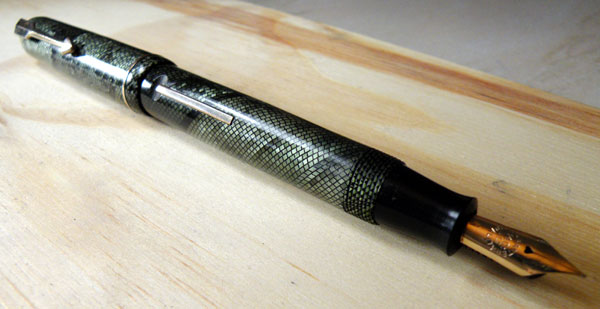
National Security pens appear in some striking celluloid patterns: turquoise and gold, lapis lazuli, snakeskin and lizard-skin. This lever filler is an example of the latter pattern.

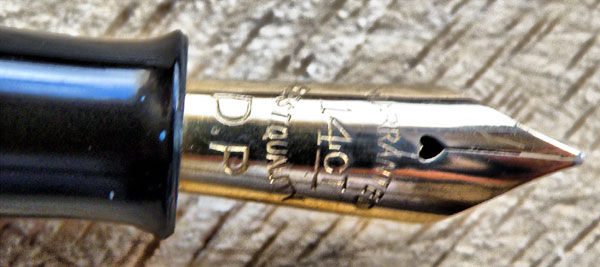
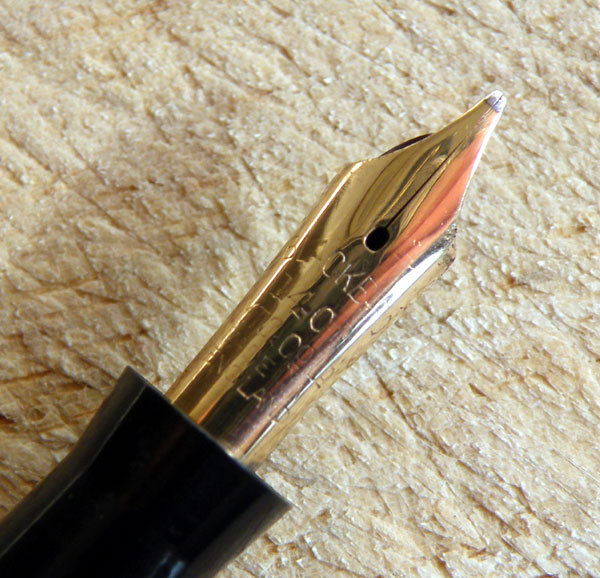
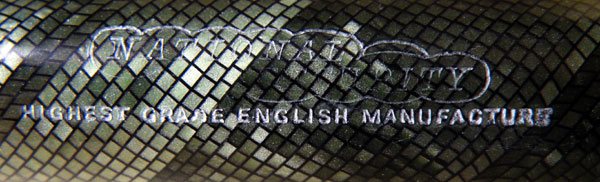
A well-made pen, quite substantial at 12.7cm capped, it is a handsome and striking pen. The arrow clip is held by a stepped collar and the nib is quite large and warranted 14ct. National Security imprints are usually shallow and therefore don’t wear well. They sometimes include their Lion & Pen trademark.