The Conway Stewart 485 Button Filler

During the years when it was an outstanding success, Conway Stewart was known for lever-filling pens. They did experiment with other filling systems such as the piston filler and, quite late in the company’s history, the Speedy Phil, a “one-click” filling system similar to Sheaffer’s Touchdown. These were not a great success. Perhaps they didn’t work very well, or perhaps the market just wasn’t there for that type of pen from Conway Stewart.

Around 1930, though, they introduced a novel and efficient button-filling system. It was quite different from the button-fillers made by their competitors. The pressure bar assembly screws into the end of the barrel and remains fixed there. This makes sac replacement very simple and the filling method works very well in daily use. Several of the Duro range were button fillers, as were some of the 226s and the 485.

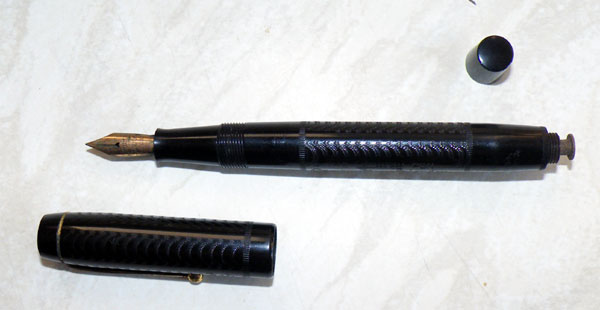
The 485 isn’t very common. Superficially similar to the Universal 479, it was in production from 1933 to 1940, but it is generally believed that not very many were made. Though it came in some attractive colours like toffee swirl and the various colours of the hatched pattern, it was clearly intended, like the Scribe or 475 to be a low-cost, practical, workaday pen.

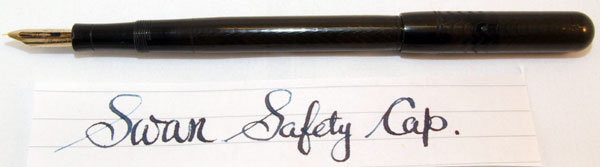
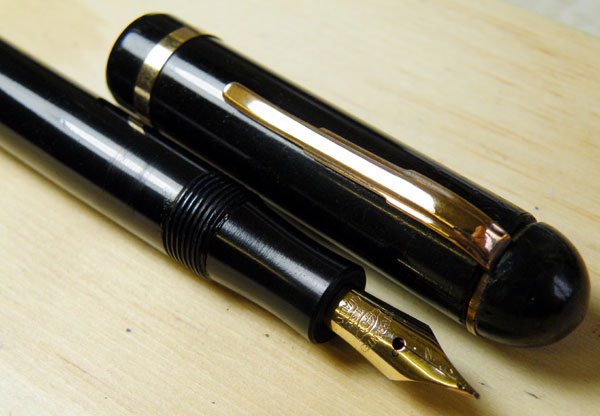
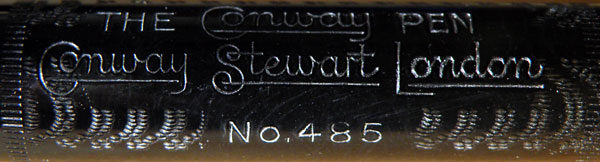
My example is in black celluloid with minimal trim, deep-cut chasing and flat top. The barrel bears the patent number 297194, which I assume relates to the filling system. The thin gold plating is well worn on the clip, but otherwise the pen is in pristine condition. Conway Stewart’s black celluloid of this date seems to be exceptionally hard-wearing.

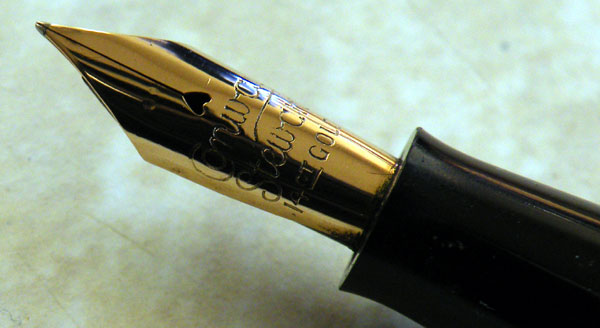
The nib is extra fine, quite an uncommon point-size in Conway Stewarts. The combination of the parsimonious trim and the fine point suggests to me that this might have been the type of pen bought by companies to supply to their clerks. With its highly efficient filling system (this pen holds a lot of ink) and the fine point, the pen would have filled many pages of columns of figures between fills.

In general, button fillers were very popular, and it surprises me that Conway Stewart did not continue with their excellent version. Perhaps it made more economic sense to concentrate production on lever fillers. Be that as it may, after the 485 went out of production, no more button fillers were made.

Beautiful though the more opulent Conway Stewarts are, there’s something very satisfying about these practical, minimalist pens, with the lines of the barrel and cap unbroken by lever or cap rings.

Fountain Pen Forums

When you think about it, online fountain pen forums are a surprising phenomenon. There aren’t all that many fountain pen fanciers in the world, and yet the subject has a considerable internet presence, a real tribute to the enthusiasm of fountain pen people.

Perhaps the oldest web forum still existing is Pentrace. Great pens, superb photography and a family atmosphere. Like most families, they have the odd entertainingly heated squabble. There’s sound scholarship here, but it’s worn lightly.

The Big Dog among pen forums is, of course, The Fountain Pen Network. It’s broad in scope in every sense – some very knowledgeable people, lots of novices and every stage in between. All types of fountain pen are discussed, though nowadays the balance has swung towards new pens. The standard of discourse is, shall we say, varied! If you ask for pen repair advice there, wait until a few have answered. Some of the first rapid-fire responses could be disastrous if acted upon, but sooner or later one of the more experienced people will give better advice. FPN is a tolerant, easy-going place. Yes, you can get kicked out, but you really have to work at it!

Several of the other pen forums arose as a result of disagreements or dissatisfaction with FPN. Lion & Pen was, I think, the first, beginning in 2005 if I remember aright. Intended as a scholarly forum, mostly on older pens, it more than fulfilled its potential for a few years, then was allowed, deliberately I fear, to wither on the vine. It has seen little activity in the last few years but I believe there are plans to resurrect it in the near future. I hope they are successful. The archive there is invaluable.

The Fountain Pen Board is almost a re-run of Lion & Pen, though with (mostly) different personalities. Like L&P, its major failing is that it is somewhat narrowly American, but given the wealth of knowledge there it has great potential. Early days yet.

The Fountain Pen Community is the project of another exile from FPN. It flourished briefly, but having no special direction of its own has gradually died away. There are very few posts there now.

The most recent forum is Fountain Pen Geeks, who assure us that they’re cool! Again, there seems little to differentiate this group from others, and the frequency of posts is not high. It hasn’t been around long, though, and may yet develop a new direction that will attract active membership.

Pen forums are, I believe, an invaluable resource. They can be a repository of knowledge and wisdom about pens. The fact that they’re on the web gives them immediacy, and those that archive posts (not all do) remain an excellent resource. I would much rather see the information made freely available in this way rather than squirrelled away in some expensive, glossy magazine. The pens cost money but the information should be free, I believe.

FPN hardly needs my good wishes – it goes from strength to strength. I would like to see the other forums – and many more – flourish too. There’s more than one approach to the study of the fountain pen, and the wider the discussion the more we all benefit.

Pentrace: http://www.pentrace.net/mboard.htm

Fountain Pen Network: http://www.fountainpennetwork.com/forum/

Lion & Pen: http://kamakurapens.invisionzone.com/

Fountain Pen Community: http://thefountainpencommunity.activeboard.com/

Fountain Pen Geeks: http://fpgeeks.com/forum/forum.php

Pen Books – Paul Erano: Fountain Pens Past & Present

This book was issued in 1999. I don’t remember what it cost me then, but it wasn’t expensive for a fountain pen book. You can buy now it at Amazon UK for £48.34 new or £33.12 used. A new edition was produced in 2004, and it is offered at £48.92. As always with these books, it appears from time to time in eBay and may well be purchased more cheaply there. It is the 1999 edition that I will be discussing here.

As fountain pen books go, this one has its good and bad points. In fairness, it should be said that most of the bad points can’t be laid at Mr Erano’s door, but arise from the nature of the book itself. It’s one of a large series of Collector Books by Schroeder Publishing, and it conforms to the format of the series. The most egregious fault is the lack of an index. Subtitled Identification & Value Guide, one would expect to be able to turn quickly to the pen of current interest, but without an index this isn’t possible. Secondly, British and European readers should be aware that this book is intended for the American market, and the pens covered in the historical chapters are almost all American. Finally, the pricing element is at best misleading. The prices are 1999 ones, of course, but even for that date they seem a little fanciful. I was an avid pen buyer in 1999 and I certainly wasn’t paying these prices! Mr. Erano doesn’t explain quite how he has arrived at these values. Certainly, eBay was not the mature market and arbiter of value then that it is now, so perhaps these prices were those set by retailers of restored pens.

The book begins with a chapter on the development of the fountain pen, and continues with advice on collecting. Though some of this shows its age a little now, it’s informative and well-written. Major (American) manufacturers are introduced. The historical chapters cover Early Fountain Pens, The Golden Age and The Modern Age. The final chapter is on contemporary fountain pens.

The pen photography is good and the book is profusely illustrated. Mr. Erano has used contemporary advertisements well. These are always welcome, as they’re a good source of information. A few have no indication of the date they were issued, which rather devalues them. Approximate production dates are assigned to the pens illustrated, and these are accurate, so far as I can judge.

In conclusion, I would say that though this book isn’t really a “must” for every pen collector’s bookshelf, it is, with all its limitations, an interesting and informative read. The biggest failing, as I have already noted, is the lack of an index in a book which is presented as a guide, which would lead you to expect it to be a reference. The structure goes some way to address this fault – all the Watermans of a period, for instance, are listed together, but it isn’t enough. This is more the kind of book you will read through when you first get it, and perhaps return to from time to time.

The Mabie Todd Swan Safety Screw Cap Eyedropper Filler

The dates given for the manufacturing run of the Swan Safety Screw Cap vary a little, depending on who you read. Some say it was introduced in 1910 and remained in the Swan catalogue until 1918, other give the dates 1911 to 1920. Be that as it may, this pen was made during an interesting period in the company’s history. The American parent company was declining during these years, whereas the British subsidiary enjoyed great success, and in 1915 it became independent.

The Safety Screw Cap marks a considerable advance towards the modern fountain pen. It had, in fact, a modern-style screw-on cap with an inner cap. The section widened at the nib end, and closed firmly against the inner cap, giving a reliable seal which prevented leaks into the pocket. Gone, too was the hard rubber over-and-under feed of the pen’s predecessors, replaced by a ladder feed.* For a time, the Safety Screw Cap featured a gold bar over the nib, often referred to as an overfeed. That’s not its purpose, though, as it doesn’t supply ink to the nib. Rather, I think, it was a device intended to prevent drying out. Other manufacturers employed a similar solution at the time.

The Safety Screw Cap came with either a No1 or a No2 nib, and was quite a large pen, measuring around 13.2cm capped and 16.4cm posted. I say “around” because, like many other pens, there was slight variation between examples. Nibs were, at first, still made in New York, though by the end of the period of its production, the British company made its own nibs. Like its predecessors, the Safety Screw Cap came in various states of trim. The unadorned black hard rubber version is most common, but examples are seen with gold barrel bands and partial and full overlays.

There is a vest pocket or purse version, though it turns up very infrequently. Measuring 11.7cm capped and 14.7cm posted, all those that I have seen have been made in America. That’s not to say there wasn’t a British-made example, just that none has so far come my way. It makes a neat little pen, beautiful in its understated way, with its crisp wave-pattern machining.

*To be scrupulous, the Safety Screw Cap may not have been the first model to bear the ladder feed. I’ve seen several Swan 1500s with ladder feeds. These may have been retrofitted, but there does seem to be a lot of them…

The Section

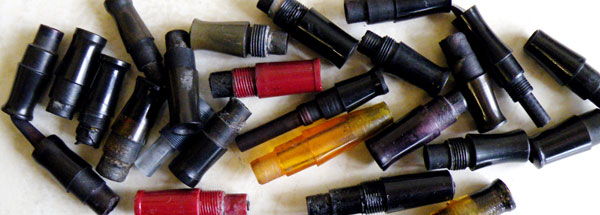
The section, at its simplest, is a tube that holds the nib and feed and contains the flow of ink from the reservoir to the point. It was originally known as the gripping section, not because that’s where we grip the pen (not everyone holds it so far down) but because it gripped the nib and held it in place. All but the occasional pedant calls it just “the section” now.
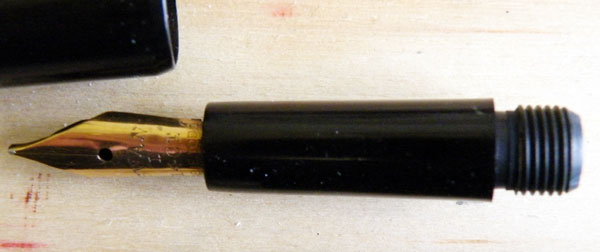
The first sections were tapered to accommodate a slip cap, and had a screw fitting to enable access for filling the eyedropper pen, and to seal it against leaks when closed. They were invariably hard rubber, which machines well, and the threads on traditional eyedropper pens are usually extremely well cut and remain ink-tight today. Some people apply silicone grease as a sealant but it’s seldom necessary. It will do no harm and may make unscrewing the section easier, but additional sealant is rarely needed. These early, tapering sections are often quite thin-walled, and it pays to treat them with care. Some, like the early Swans, will have slits in the section to accept the nib.
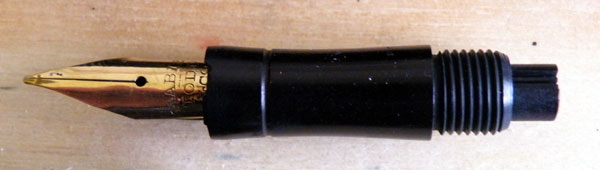
Swan was early in the field with a screw cap, and the section had to change to meet its needs. It’s still an eyedropper filler, so it, too, has the screw fitting to the barrel, but now the end nearest the nib swells out to provide a flat face, which makes a positive seal against the inner cap.
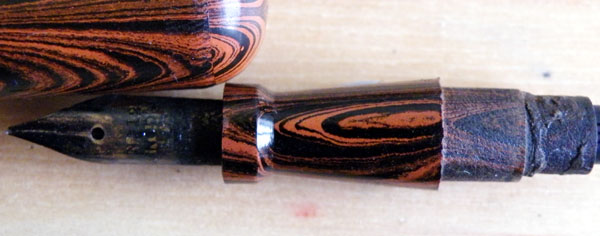
The next development changes the section to attach to a sac by a peg or nipple at the rear of the section. The “step” at the front of the section to meet the inner cap has become more accentuated. This form of section will remain unchanged for several decades. The nipple is the most fragile part of the section, and cleaning it of the remains of an old sac should be done carefully. If you should be unlucky enough to break the nipple on a rare section for which you can obtain no replacement, do not despair. They can be repaired, though it isn’t a job for the novice. Professional restorers can do it for you.

Even after hard rubber was superseded by celluloid for barrels and caps, most sections were still made from hard rubber. There were several reasons for this: it machined well, and sections have to be made to a fine tolerance. It is less brittle than celluloid and has some “give”, a necessary attribute, given the fact that a section is always containing the pressure of a nib and feed which are essentially wedged in place. Hard rubber sections contain that pressure well, but they do distort over time, ovalling slightly where the edges of the nib meet the section. For this reason, it’s a good idea, before removing the feed and section, to mark with a pencil where the centre-line of the nib is. Replacing the nib in exactly the same place will be much easier.

Sections come in for quite a bit of abuse. They are often quite difficult to remove from the barrel, and undue force may be applied with inappropriate tools. That’s a recipe for disaster, of course, and heat is your friend in removing sections from barrels. That, and a lot of patience. If you must use pliers, use ones with rubber on the jaws. Don’t use excessive force; it will free up after repeated applications of heat and moderate force. Never remove the nib and feed while trying to remove the section. Leave them in there, as they provide internal support for the section and prevent it from being crushed or cracked.

Some sections have a press (friction) fitting, some are screw-in. You’d think there would be some some kind of logic to which type was used for which purpose, but it isn’t so. Certainly, ink-in-the-barrel pens like eyedropper fillers and Onoto plunger fillers invariably have screw-in sections to contain the ink. Logically, button-fillers should have screw-in sections because they have to resist downward force from the pressure bar, and lever-fill pens should be friction fit as they don’t have any pressure to deal with. Would that it were so simple! Many button fillers are friction fit. It’s the cheaper fitting method, and, in truth, the force a button-filler’s section has to contend with is not that great. Then there are pens like the Parker Televisor that use the Parker anchor pressure bar which transfers the force to the barrel end, rather than down to the section. They have friction fit sections.

Surely, though, there’s no need for a lever filler to have a screw-in section? That’s right. There’s no real reason for it, but they do. Many Swans and Wyverns have screw-in sections, perhaps because they were seen to be an indication of quality, perhaps to reduce the number of different parts that were being manufactured. Just to make it even more difficult, some Wyverns have a left hand thread! You never know what to expect when trying to remove the section from an unfamiliar pen, so proceed with caution.

When pens like the tubular-nibbed Sheaffers and the Parker 51 came along, the design and even to some extent the purpose of the section began to change, as did the nomenclature, as that area of the pen became the “shell” or the “hood”. There were other changes, too, to accommodate the plastic cartridge, but all these interesting developments fall outside this discussion of the section.
Unique

Of all the common pens, the Unique is the least written about. In my various reference books, it is never accorded more than a passing mention. There may be lots of information on the brand on the Web, but try Googling “Unique Pen” and check through the five million or so results that you get. Few of them refer to the actual Unique pen. “Unique” must be one of the most overused words in the English language. One it might it say it was uniquely overused, were “iconic” and “surreal” not equally hurled around without regard to their meaning. It is rare indeed, in discussing fountain pens, for the writer to mean “Being the only one of its kind; unlike anything else”; it usually implies “I think this pen is quite nice” or “I bought this barely operable piece of Chinese crap and I badly need your approval”.

All that having been said, the problem remains that though there are plenty of Unique pens out there, without any hint of a company history it’s hard to get a true picture of what was going on. There have been periods when Uniques were plentiful and clearly somewhat popular and others where they are very uncommon indeed.

Unfortunately I don’t have photos of all the pens I wish to discuss, but the most recent Uniques will be quite familiar to most people. They don’t have a strong collector or user following and I think they’re probably a little under-appreciated. They’re actually quite good pens, or at least those ones that have survived well are.

I have heard it said that they were made at Newhaven, first by Valentine and later under Parker ownership, and it is likely that there was never a Unique manufacturing plant. The late forties pens, slightly streamlined, with a curved stepped clip and a slightly tapered clip screw, closely resemble the Kingswoods of the period and they were certainly made at Newhaven. The clip is identical, I believe. The main difference is that the Uniques have either warranted nibs (often bearing a unicorn image), or nibs marked “Unique” rather than the excellent Eversharp nib of the Kingswood. That these pens continued to be made into the early fifties is shown by the fact that Unique Juniors in this style were presented as commemorative pens for the 1953 coronation.

Their later pen, and probably their last one, is the commonly seen fully streamlined pen that bears more than a passing resemblance to Conway Stewarts and Burnhams of the time. Made in a range of attractive marbled patterns, these pens were successful, if one can judge by the numbers of them that still appear. Probably aimed at the student market, they were made from thin, wrapped celluloid sheet, a common practice which produced a less satisfyingly solid pen than those machined from the rod.

The earlier model than either of these pens, produced during the thirties and early forties, is a conventional, straight-sided pen, quite similar to a lever-fill Mentmore. These pens don’t turn up often. Either they haven’t survived well or they weren’t particularly popular in those years.

That’s not the whole Unique story, though. They’ve been around quite a long time, and in the twenties and thirties were producing higher quality pens than we see later.

This Unique No46 appears to date to the nineteen-twenties and is a pocket or purse pen. This one – the only example I have seen – has had a hard life and is in fairly poor condition, but that does not disguise the quality of the design or the machining.

This No51 is probably a little later, and is a thoroughly superb pen of the highest quality. The nib, which is stamped “Unique 14ct” is very flexible, and this pen is joy to use.

I realise that this is a very patchy and incomplete account of a quite major company. I have held back from writing about Unique because of the lack of information. However, it’s a subject I can always return to, and this brand is an especial interest of mine.

Rare Birds

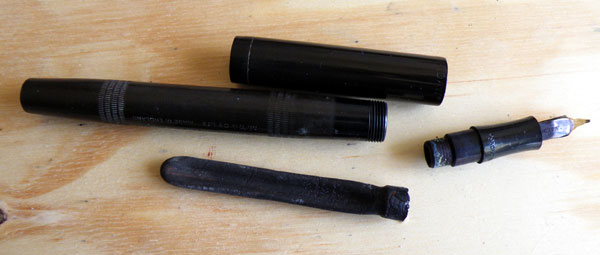
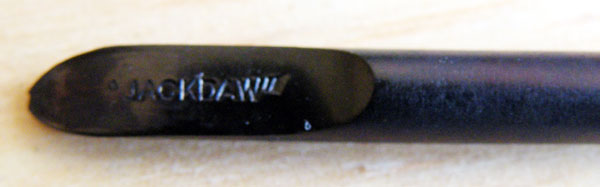
Here are two Mabie Todd lever-fillers in black chased hard rubber, one a Blackbird, the other a Jackdaw. Neither was assigned a model number and they’re the same length and thickness to the millimetre. The Blackbird’s cap tapers a little more than the Jackdaw’s and there’s less chasing on the Jackdaw. The Jackdaw has an unusually short lever. They’re both from the period around 1914-25, and are clipless, as was often the case in those days. We tend to think of the clip as an essential part of the pen but it wasn’t always seen that way. In advertisements as late as 1928, Conway Stewart made much of the fact that their washer-clips were easily removed!

I usually think of Blackbirds and Jackdaws as economy versions of the more expensive Swans. The trim is rather more likely to be chrome than gold, and on later Jackdaws even the chrome plating is quite thin. The nibs have shorter shanks, saving on gold, and they’re generally thinner than Swan nibs too. In technical terms, though, they’re pretty much the same pen, though not in this case.

Swans, and all the other Jackdaws and Blackbirds I’ve seen, have ladder feeds. These two pens don’t. In both cases, the visible face of the feed is smoothly curved. They’re not spoon feeds, like a Waterman, either. They simply have feed channels, and, as such, are decidedly primitive feeds. They’re not replacements, as they’re marked “Blackbird” and “Jackdaw”. I re-sacced and tested the Jackdaw, and the ink supply kept up with a generous semi-flex medium nib very well.

Though these pens arrived in my repair queue around the same time, they came from different sources. I haven’t seen a Jackdaw of quite this type before – the short lever is highly unusual and very attractive – but the Blackbird is of a common type, essentially the same as the BB2-60. All the other examples I’ve restored had ladder feeds.

Pens like these are at the lower end of Mabie Todd production, aimed at clerks and school students, but they have their points of interest and they’re excellent writing instruments, every bit as good as the most expensive models. They had to be, of course. Fountain pens were the primary writing instrument, and those who could afford to pay least were often those who had to write most.

Neither of these pens shows much wear. The Blackbird still has its original sticker. It’s hard to read now, but it looks like the pen cost seven shillings and three pence new. The Jackdaw’s nib has been replaced with a Blackbird one at some time.

Now that I’ve found Mabie Todd pens with non-ladder feeds, I’ll probably be finding them all the time. That’s how these things go…

Fountain Pen Books – Jonathan Steinberg: Fountain Pens

When it was published in 2002, this book sold for £8.95, a moderate price for a fountain pen book. Though it’s in the large format, it’s a thin book of 80 pages including an index. Unlike many other fountain pen books, this one hasn’t become more valuable as the years have gone by, not even by the rather optimistic prices that Amazon sellers hope to get. If you should want a copy, it’s yours from Amazon for £1.43 plus postage. It also regularly passes through eBay without attracting a bid.

It is subtitled The Collector’s Guide To Selecting, Identifying, Buying And Enjoying Fountain Pens.  This is a somewhat didactic book, and it’s likely you will either agree with the message Mr. Steinberg wishes to get over or, like me, you’ll profoundly disagree. In essence, if I may attempt to encapsulate what this book proposes, the best pens are those with most bling, and pen manufacturers come in handy tiers like a wedding cake.

There can be no doubt that early twentieth century gold or silver overlay pens in the Art Nouveau or (a little later) Art Deco styles are precious objects of great beauty and interest. Whether they were, and are, appreciated as writing instruments is debatable. They are, and always were, primarily pocket jewellery, I would suggest. It is these pens that are most discussed and illustrated in the early part of this book, to the exclusion of the simpler – but probably more interesting to most of us – bare BCHR examples that we are likely to see and purchase.

Then there’s the tiers thing. Mr. Steinberg confidently assigns pens to quality level by brand, an overly simplistic notion that is rather less subscribed to these days. There are numerous errors in this part of the book, too.

Though the book purports to cover pens of the world, it is decidedly US-centric, devoting many more images and pages of text to American pens than to the rest of the world put together. I suppose this is because Mr Steinberg felt that his largest market would be in America, so he concentrated on pens that would be familiar to to his readership. It gives a very unbalanced view, however, when entire industries like that of Japan, for instance, barely merit a mention.

Mr. Steinberg’s view of pen collecting is not one that has held true in the real world. Yes, there are some collectors who who buy at the top of the market, but they form only a tiny proportion of all collectors. In truth, there are as many types of collections as there are collectors. The most powerful contradiction of the Steinberg view of collecting is the immense popularity of the Esterbrook, an unashamedly practical, low-cost pen with plated nibs and no precious metal at all. It is worth asking, too, whether most buyers of old fountain pens actually see themselves as collectors at all.

In conclusion then, you can have this book for the princely sum of £1.43, but you might want to hang onto that money and put it towards a bottle of your favourite ink instead.

Less Common British Pens: Selsdon

Not exactly rare but by no means common, Selsdon pens don’t attract a lot of attention when they do appear. They’re not without their points of interest, though.

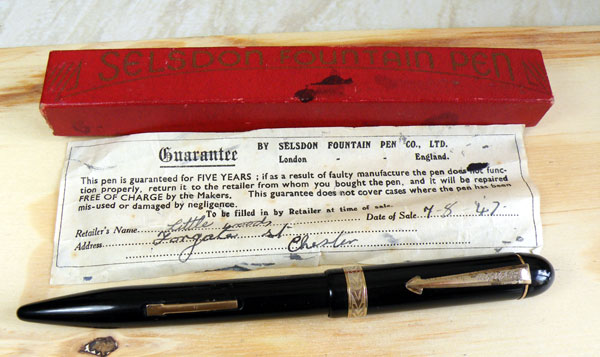
The most commonly seen Selsdon is a late forties pen, quite large, with a straight barrel and a curved stepped clip. It can appear with either a warranted 14ct nib or a plated one, and I suspect that the company had no nib-making facility of their own, but bought them in.

The other Selsdon that appears quite frequently has a strong resemblance to the Eversharp Skyline, with its tapered barrel and domed cap. Again, this appears to be a nineteen-forties pen.

These designs were not exactly inspired, and the execution was not quite in the first rank either. The pens would be without interest were it not for the plastic they are made from. I can’t identify what it is, except to say that it is heavier and more dense than celluloid, and appears to have been machined from the rod rather than moulded. I haven’t seen anything quite like it elsewhere. It has lasted well, without the barrel distortion one sees on some other economy pens of the period.

Selsdon made a number of commemorative pens for the 1953 coronation, both fountain pens and ballpoints. Unlike the earlier pens, which were invariably black, some of these pens were produced in attractive, colourful patterns. Boxed pen and pencil sets were also on offer.

In 1958 the company faced court action over unpaid copyright fees relating to a mechanical pencil, and later that year the company accounts were questioned, giving rise to another court case which changed the role of company auditors. That, I think, was the end of the production of Selsdon pens.