More About Handwriting

Just a few final thoughts about this subject. I do admire calligraphy. It’s an artwork, of sorts, and seeing a fine piece of copperplate almost inspires me to have a go myself. I say “almost” because I bought the books long ago and tried my very hardest to replicate what I saw on the pages but it was no good. I just couldn’t do it – not properly.

Calligraphy is a peculiar thing. It doesn’t carry anything of the writer’s personality. Maybe it carries something of the person who created the style. I’m not sure what I could compare it to. It’s certainly artistic but it bears no originality. It has to be an exact copy of a style created long ago.

That’s why ordinary handwriting is so much more interesting for me. When I see how the writer creates letter-forms, the size of their writing, the amount of care taken – or not – these things talk to me about the person who has written to me. It’s as much an aspect of who they are as the colour of their eyes or the sound of their voice.

The western type of handwriting is a fascinating thing – as are the other types. It’s a wonderful human creation and it amazes me how I can write at speed without ever having to think about the shape of a letter. My muscles know that. This is probably the last I have to say on the subject but it’s far from being the last to be said. There can never be an end to the wonder of handwriting.
Apology

I’m sorry if I haven’t replied to your comments recently. WordPress has taken it upon itself to mangle the order in which they are presented to me. I see your comments in email but cannot find many of them in the list.

Hi!

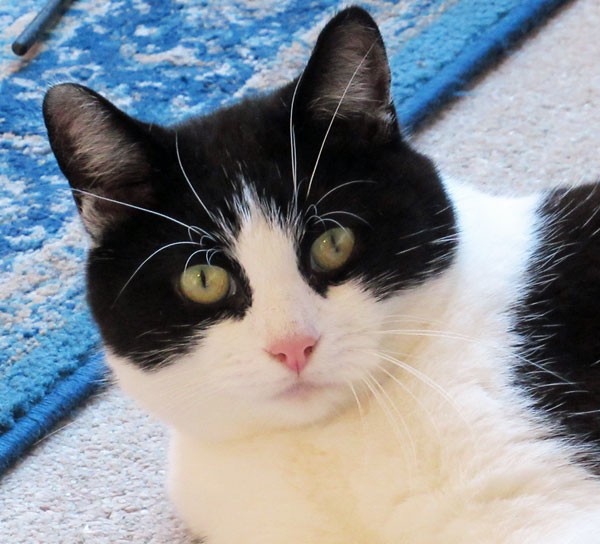
I’m The Boy or at least that’s what these humans call me as they don’t know my real name. My dear, departed grandmother Tuppence used to come here and I thought I would continue the family tradition. She was a Pen Repair Assistant but as the humans have retired from that business I’m just a frequent visitor.

They give me treats and something to eat (I’m a growing Boy) and they’re okay about me sleeping on the bed. They pet me a lot but not quite enough. I can take a lot of attention and affection.

It was a gale yesterday with 60mph gusts but in the evening I braved the storm and paid them a visit as I knew they would be missing me. I spent a while cruising the laps, then hit the sack for a few hours. We pussycats need our comfort and sleep.

So that’s the story. I expect you’ll be hearing from me again.

Calligraphy and Handwriting

Two of my correspondents do so in forms of calligraphy, and I love to see their beautiful handwriting, a true art form. Others write in their own handwriting, the adult development of the writing they were taught in school. I love to see that too. Their writing is an expression of their personality.

There was a time when companies employed handwriting “experts” who supposedly were able to determine the character of job applicants from their handwriting, and people were or were not hired on that basis. I think that was unutterable hogwash and I’m glad that its time is past now that handwriting is no longer used in that way as young people depend more on the keyboard.

There is, of course, some real analysis of handwriting though it couldn’t be used in that way. Such things as letter forms, angle of writing and its size can tell something about the writer. One can, in very broad terms, date handwriting. There was a period when handwriting was copperplate. After that a simpler hand was developed, making business correspondence and recording faster and easier.

When my husband was taught writing in the fifties, there was still an emphasis on light upstrokes and heavy downstrokes. Some of the letter forms he was taught varied from those in other areas. There are different forms of the letter “r” and the capital “Q” for instance. To some slight extend these might be a guide to where a writer comes from.

Do any of us write exactly as we were taught? I know that in my teens I began to change some letters to develop my own individual style. More recently, when I began to try to improve my writing reversing those changes were part of the process. It was hard to consciously make those changes. If writing fast I would often revert. Even now I sometimes slip back – hardly surprising after a lifetime of writing in one way.

What’s your experience of writing? Are you a calligrapher or a writer?

Pros and Cons of the Ultrasonic Cleaner

I’ve had an ultrasonic cleaner for fifteen years or so. In that time it hasn’t had a lot of work because I’m unimpressed with it. The one area I found it useful is with oxidation removal. Otherwise I go straight to full disassembly and cleaning with brushes. It does a better job. I’ve run parts through the ultrasonic, taken them out and removed more ink with a brush. That’s the test for me.

I only used it in the repair process. Some use the ultrasonic as part of their flushing of the pen. I wouldn’t do it that way, especially with hard rubber sections as it risks discolouration.

I suppose things have moved on in fifteen years and maybe small ultrasonic cleaners are better than my one. I hope so. I know that the bigger machines used for carburettors and other components work well.

What do you think?

Osmiroid 65

For those who don’t know the Osmiroid, it was one of the few big sellers of the declining years of the British fountain pen. I have written about the brand before. It had several iterations from the fifties to the nineties and was eventually bought up by a Far Eastern company and died a quiet death as interest waned. The best Osmiroids were the 65 and 75, both using the same range of nibs. Quite a range too! Whatever type of nib you prefer, Osmiroid made one.

The pens themselves are a mixture of good and bad. The 65 is a lever filler and the 75 a piston pen. A good example of either is a treasure but good examples are hard to come by as both suffer from plastic distortion. Just bad luck with the plastic chosen but I expect they served most buyers perfectly well. It’s just us second owners that have inherited the buckled pens.

I wanted an Osmiroid for myself; ideally it would have been a good 75. Those pens hardly ever need piston repair in my experience. They don’t seem to decay or stick like most piston fillers. Of course they suffer from plastic movement too. I bought two and they were both bad. The caps just didn’t fit at all. Then I picked up a 65 in a batch of pens and it was reasonable. The threads on cap and barrel don’t match properly but it closes reasonably well. If I leave it for too long the nib dries out but it’s okay for a few days.

It came with a medium italic nib which I like. These nibs are not tipped and can develop a sharp edge after years of use. That’s okay, that’s what Micro Mesh is for. I might pick up one or two different nibs. Their popularity has made them quite a bit more expensive than they used to be. They fit Esterbrooks as well, doubling the demand. There are many bad Osmiroids out there but the pens are still very cheap so you can take a risk on buying one or two. Mixing caps and barrels can often make a better pen. It’s unreasonable to expect perfection in pens that were priced for school kids seventy or eighty years ago.

Their manufacturer, James Perry, was motivated by two things: making a profit (of course) but also improving children’s handwriting and introducing them to calligraphic possibilities. As a result the writing of many kids of the day was good, an important matter when much communication depended on pen and paper. Things are rather different today. My husband’s granddaughter writes to him. It has been a charm to watch her handwriting improving; that’s probably the most writing she does in these days of keyboards and multiple choice,

She doesn’t use a fountain pen yet but if we can help to change that we’ll supply her with an Osmiroid. A good one.

Cheap Pens

Following on from my last post, there are plenty of cheap pens that are not of the throwaway variety. A good example is the Reynolds pen I wrote about some time ago. For pictures and details just search on its name. It’s a well-made cartridge pen aimed at the school student market and it has a very good nib that lays down an excellent medium line with no skipping or hard starting. Doubtless a few years old (it came to me in a batch of rather better pens) it is nonetheless modern and suffers from that failing of the modern pen, the consumption of lots of plastic in the form of cartridges. This fault can be corrected by the purchase of a converter or, if you are so-minded, you can refill your cartridge, a messy process that doesn’t appeal to me.

Such pens are ideal to wean the young off the pernicious ballpoints – or would be, if they had any interest in writing. Two of my husband’s grandchildren sneer at the very idea. The third does correspond but so far she sticks to her nasty Bic. Her writing is undoubtedly improving with practice but think how much better it would be if she used a fountain pen!

Fountain pens are collectors’ items or a hobby to those of us who stubbornly persist in writing. The day of their everyday practicality has gone by. Not so in the Far East where manufacturers compete to produce sound pens at affordable prices and that’s where we can source these excellent pens for pocket-change (for those who still use money). Or we can buy vintage self-fillers with splendid gold nibs for the same money and not have to fiddle with converters and cartridges.

Pilot V-Pen

It has been a long time since I have written here, for which I apologise. Family illness, including my own arthritis, has been the cause. It wasn’t that there was nothing to write about; interesting pens abound. It was just time that was always in short supply. I’ll try to do better. Though no luxurious and expensive pens have come to hand recently I do have subject matter. A friend gave me a pen as she couldn’t use it. I considered a quick tutorial in the use of the fountain pen but it was clear that she had made up her mind. Fountain pens are not for her – for the time being at least.

The pen she gave me is a Pilot V-pen, one of the erasable sort. It is a disposable pen, a pity as it has a very good medium nib. These pens are all about practicality with little attempt at aesthetics. Though I do appreciate a handsome pen I like this one as well. It’s a mixture of white writing on a black background and the reverse. The ends of the barrel and cap are domed and it has a perfectly practical plastic clip. What more could one want from a fountain pen?

The short answer is – a filling system. I understand that some people have converted these pens to eyedropper fillers but that’s a system that I’m not especially fond of in modern pens and anyway, life is too short to convert a disposable pen into something it wasn’t intended to be. I may try to salvage the nib when the ink is used up.

What is the purpose for the disposable fountain pen? Is it meant to occupy a similar place to the disposable Crystal Bic? Surely, as we become ever more aware of the damage disposable plastic has done and continues to do to our environment, another piece of throwaway plastic shouldn’t be welcome. I would like to have pens like this, that work so well and sit in the hand so comfortably, provided they were made to be refilled, therefore having a longer lifetime and thereby not adding so quickly to the problem we are trying to solve.

Where should the blame lie, with the manufacturer or the buyer? Both, I suppose.

A Final Poem

In 14 years we’ve sold thousands of pens,
Had lots of fun and made many friends.
But all things must end, which goes for us too,
It’s been a great time, and that’s thanks to you.

Goodwriters Pens will close down today,
If you’d like a pen, please do not delay.
Have a last look around, there’s a handful still there
Of these pens restored with the utmost of care.

The blog will continue, but sales close tonight;
Perhaps you will find one last pen to delight.
To customers old and to purchasers new,
We’re grateful for all of your custom – thank you!

https://www.goodwriterssales.com/