Mabie Todd Swan Military

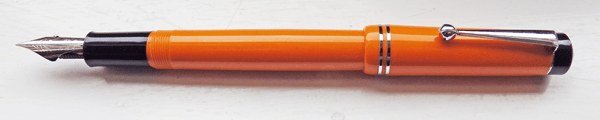
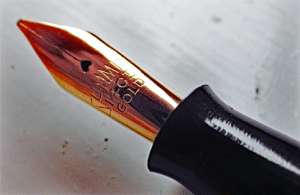
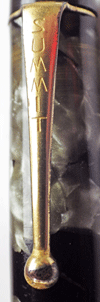
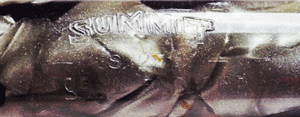
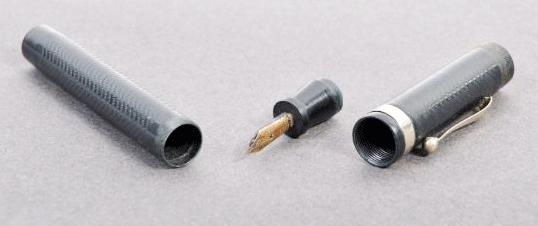
Having written about trench pens recently I am glad to be able to show this splendid example, the Swan Military. The ink pellets are stored in the base of the barrel but unlike other examples the blind cap does not need to be removed, just slid out to allow access to the pellets.

The pen is in what appears to be in used condition. The nib is flexible and, uncommonly, is marked “Toronto”. Swan nibs issued from that city are unusual but not unknown.

As I said previously trench pens are truly rare. Some were doubtless lost or destroyed in action but I think the conclusion is inescapable that they did not sell well. The pellets did, of course, but they could be applied equally well to any pen of the time.

There is much interest in trench pens though and between that and the shortage of supply together with its fine condition this is a very valuable pen.

Many thanks to Rob Parsons for pictures and information.

Trench Pens and Ink Pellets

Much has been written about the World War I Trench Pen and the ink pellets that supplied it. While it seems an eminently practical idea, the present-day rarity of such pens suggests that it never really caught on. Several US manufacturers made them. Some, like the Parker and Moore versions held pellets in an extended blind cap, others like the Diamond Point held them in a chamber at the top of the cap. The Swan Military, holding the pellets in a compartment at the base of the barrel, was, so far as I can establish, the only British manufacturer of Trench Pens though pellets were made by several companies including Onoto.

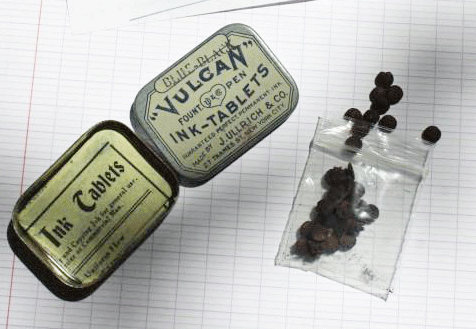
Perhaps one reason why Trench Pens were not made in great numbers is because the provision of a pellet container in the pen is not that great an advantage when one sees the tiny boxes that pellets were sold in. It didn’t exactly take up a great amount of room in a soldier’s pack and it is likely that he already had an eyedropper filler which would work perfectly well with the pellet.

Powdered inks were already available and continued to be used in businesses and classrooms at least up until the 1950s. The pellet is just a step further. Some pellets dissolved to make an ounce of ink, too much just to fill one pen. It seems likely that they were just another ink delivery system already in use before World War I and adapted to suit military needs. The British Postmaster General prohibited the shipping of bottles of liquid ink to the front and it may well be that US authorities took a similar line. Tiny tins of World War I ink pellets can still be found today. Some manufacturers, such as Visconti, have made ink pellets in modern times.

Restoration?

My husband tells me there is a discussion about restoration in Fountain Pen Network. He isn’t taking part in it as they are somewhat dogmatic and a trifle hot-headed. The consensus seems to be that the definition of restoration is to return the pen to new condition. As I’m sure you are aware, I take a different view. I have always made it clear that I do no more than is necessary to make the pen in working condition, clean, gently polished and with such faults as scratches and bite marks removed wherever possible. I don’t re-black or do gold-plating.

My view is that as old pens, often very old pens, there is a balance between restoring to use and honourably showing their age. Not many pens are in a condition to be restored to like new. I have seen the results of attempting to do this with worn pens and it isn’t pretty. Many of the pens I present for sale, of course, look very good. Chased celluloid pens restore especially well, and those black hard rubber or mottled pens that have not faded or worn too much can naturally look splendid. That’s quite a contrast with the poor things that have suffered the buffing machine for far too long!

There must, at least, be some people who agree with my conservative restoration as my pens are in demand and have been for eleven years now. I suppose my method falls between those conservators who see every scratch as bearing historical significance and the restorers who overdo it. I have some sympathy for the view that a pen should be left as it is, so far as possible, but I also accept that no one wants a really ugly pen.

I am aware of three or four eBay sellers with a strong following who make a beautiful job of restoring pens to new condition. Their pens sell for very high prices. Their way is not my way but I admire what they do. The discussion of restoration is one that will attract varying views. It may continue unresolved for ever.

Fountain Pen Revolution Giveaway

You may remember the Fountain Pen Revolution Darjeeling that I wrote about recently, fitted with a successful modern flexible nib. It is a pleasant and useful pen, though not absolutely faultless.

I found that whether using flex or not, it began to dry up at about half of an A4 page. I am sure that problem could be solved with some dickering. It would not do to be over critical; even Swan and Waterman classics can suffer from drought when deploying flex.

As I have said – probably many times – I’m not a flex fan so I have no use for this pen. I will be happy to pass it on, free of charge, to the first reader who requests it. It will be good – though not a condition – if the recipient would let me know about their experience with the pen.

Edit:  The pen has been awarded to the first applicant.  My commiserations to those unsuccessful.

The Mayfair


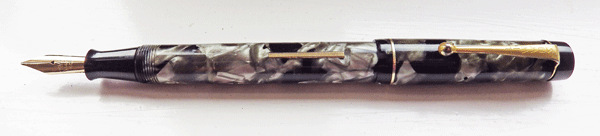
I don’t remember having seen a Mayfair before. A few possibilities: it looks like a European copy of the Waterman 52.

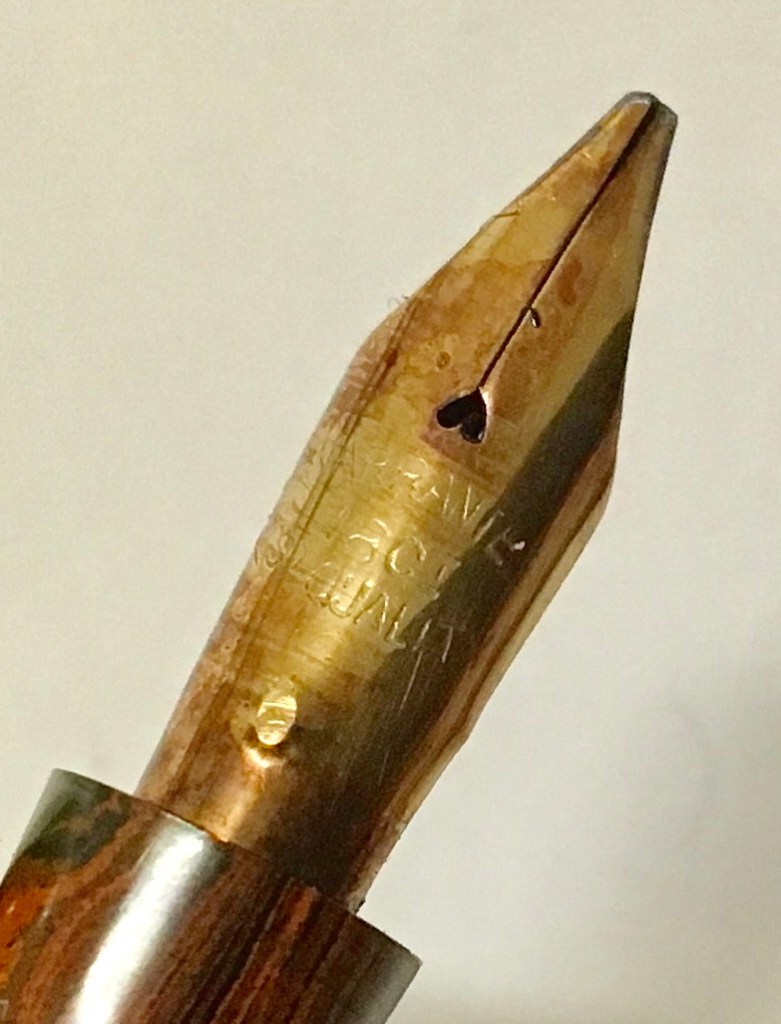
The nib is an 18 carat warranted, so possibly a British-made nib for the French market. Nibs can be replaced of course, so not always a guide to the origin of the pen.

Langs named several of their pens after London locations. Did Langs ever use a box lever? (This would be a much better blog if my memory worked better.)

With the box lever and the broad cap ring it is clearly a high quality pen. I’m told that the nib is a very pleasant broad stub.

The Roman Numeral IV is on the cap top. The lever has what appears to be a castle on a hill (?), with the word WIZ over it , and a crescent moon.

Thanks to Rob Parsons for photos and information.

Not Fountain Pens

I am indebted to Andrew Hooper who kindly indicated these interesting items to me. They are at present displayed on an auction site.

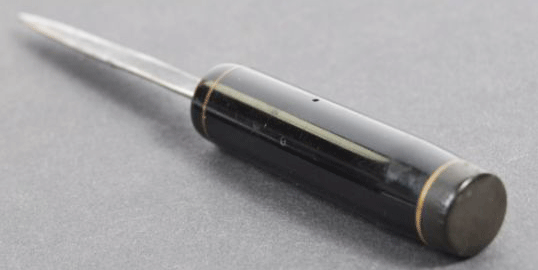
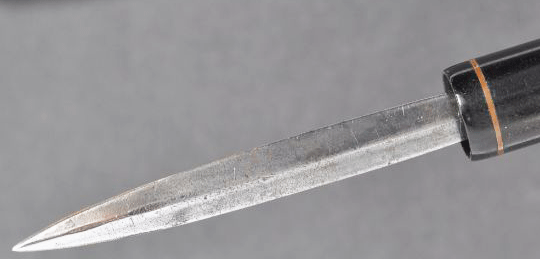
These are a dagger and a compass in the guise of fountain pens, and were provided for the use of undercover agents in World War II. Many of us will be aware of Platignum versions. This dagger pen was made in England but I cannot be sure of the manufacturer. The compass is placed in a foreign-made pen.  Unfortunately none of the pictures actually show the compass.  I guess that it is attached to the inside of the section.

They are an interesting insight into a not very distant world of espionage and sabotage. I can imagine that the compass would be immediately consulted by an agent parachuted into occupied France, for instance, but were the daggers ever used? This one looks capable enough!

The Platignum versions appear to have been made in that factory. This compass appears to have been added later to a normal pen. This hints at a Q-like technician in a room full of lethal gadgets.

Fountain pens are, of course, no longer expected to be in everyone’s pocket. The most recent lethal delivery system (that we are aware of) was an umbrella. It’s sad that fountain pens are even superseded as a means of killing people!

My apologies for the photos.  I borrowed them from the auction site.

Content of the Blog

As you know, I decided a few months ago that I would restrict myself to Mabie Todd pens for restoration and sale. That suits me very well, working on the pens I like best but it has consequences for this blog. I’m sure that most of you will want to read about pens other than Swans and Blackbirds. Of course, I occasionally buy small lots of pens because there is a good Swan included but that doesn’t happen very often.

I will therefore be grateful for photos and information about interesting pens that may come your way.

Polishing

Polishing is an issue that comes up often on the pen discussion boards. My own practices have changed and become more conservative over the years. Unless there are scratches to be removed or oxidation to be ameliorated I don’t use polish at all. A good, thorough rub with a soft cloth is enough for most materials. Hard rubber responds especially well, as does celluloid and casein. My modern pens – mostly eighties and nineties Japanese pens – are probably acrylic, I should think, and they polish up very easily in the same way. Metal parts do need some actual polish to look their best. I use Simichrome, very sparingly.

When there are scratches to reduce or oxidation on hard rubber I use the three-part Novus abrasive polish. This is a tool like any other and should be used in the way intended; beginning with the No 3 coarse scratch remover, going on to the No 2 and finishing with No 1. Used in that way it is very effective, restoring old pens to something approaching their original appearance without falling into the trap of producing an unnatural glaring shine on a buffing machine. I have tried other polishes over the years but I only use Novus now as it has the reputation of being harmless to the materials I work with. I hope that’s true. I’m not a chemist and I have to go by the experience of other restorers as well as my own. As I said above, most of the pens I restore don’t have any chemical polishes applied to them at all apart from a little metal polish.

In the same vein of trying to avoid harm, I never use wax of any kind. Even pure beeswax is hard to remove and will provide a coating that prevents the escape of any gases produced, to the detriment of the materials. Other waxes such as the popular Renaissance Wax are said by those who know better than me to contain chemicals that may be harmful to the materials pens are made from.

I have always restored conservatively. More and more I subscribe to the advice, “first do no harm.”

Update on the Mabie Todd Pen List

It’s been quite a while since I’ve said anything about John Brindle’s Swan and Blackbird list. That doesn’t mean that nothing has been happening, though. Tony Lancaster has done an enormous amount of sterling work in getting the site together. It was something that was well beyond my capability and without his very welcome help I think the site would have fallen by the wayside.

There are one or two things that need to be done on the coding side but the major work now lies with my husband, editing the data that is there. It’s always the case that when you take over a work in progress there are things that you don’t fully understand, things that you don’t quite agree with and amendments that need to be made for the sake of accuracy. John always said that he couldn’t guarantee the accuracy as it was always a work in progress.

So that’s where we are now. My husband intends to amend things that are clearly wrong and once that has been done I think the site can go live. There will still be detail in the contents that may need to be amended and we will depend on you to point those out. The majority of the entries don’t have photographs attached and that is something we would like to see improved. Also, there are lots and lots of models yet to be included, to make the site useful for ready identification of pens. I may have some of them. I expect that you will have some of them too. When the site is up it will include a method for contact and providing information and I hope to hear from you.