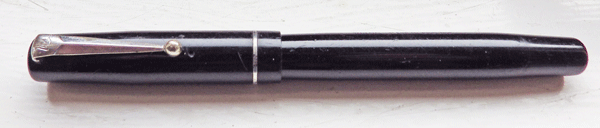
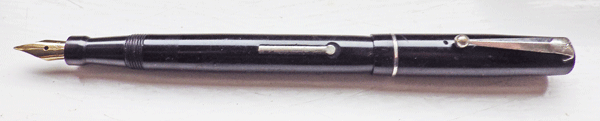
Clips

I don’t clip pens to my clothes but they are useful – though not essential – in keeping pens in place in my wrap. They also stop pens rolling around – and off – my desk.

The occasional portable dip pen, often combined with a pencil, has come down to us but they were mostly quite expensive and never common. The great majority of dip pen handles and a supply of steel nibs remained at home and there would be a similar kit in the workplace. Dip pens were not for carrying in the pocket.

The first fountain pens were modelled on dip pens, essentially dip pens with a reservoir and a cap, so means of carrying them were not at first considered. Again, most people working in offices would have a pen at home and another in the workplace. Indeed it took quite a long time for the dip pen to be replaced at work. As the first pens were eyedropper fillers most people wouldn’t have wanted to carry a large and poorly contained volume of ink in a pocket!

There were jobs, I suppose, that needed a portable pen and manufacturers came up with ideas like the accommodation clip and Swan or Conway Stewart metal pocket to make that possible. Means for making the containment of ink more secure in the pen were developed in tandem. Those clips were good ideas at the time but accommodation clips can rust in situ over time and can leave an unsightly mark if removed. The interiors of metal pockets also provide a fine home for rust that is hard to remove and can scratch pens,

For a long time – several decades – clips were an optional extra. It wasn’t until after World War II that pens were always issued with clips. They took several forms: piercing the cap and keyed in place inside, rivetted or held in place by a clip screw. During the years when manufacturers sought methods of depressing the pressure bar without breaching Sheaffer’s patent, one pen had a clip that was used for that purpose, like a fixed matchstick filler.

As clips became a usual part of the pen they were plated in gold or chrome to make them an attractive part of the pen’s furniture. Many brands used clips to advertise themselves. Several clips, like those of Parker and Croxley, were recognisable at a distance,

Restoration or Conservation?

For someone to say that they restore fountain pens seems a simple enough statement. It isn’t, though. There are two views of what should be done with valuable old things and there’s a whole spectrum of views in between. The two operative words are restoration and conservation.

Conservation has a variety of meanings as does restoration but I suppose its simplest definition would be along the lines of doing no more than is necessary to ensure the item remains stable in its current state.

How do we define restoration of pens? At one end there is the restorer whose intention is to return the pen to its condition when new using whatever means available. At the other end there is the restorer who sees the pen in its current state as a historical document, with its wear and scratches as a record of its “life”.

My own view of restoration lies toward the latter definition which shares some of the aims of conservation. That can be taken too far, of course. In reality the ageing and damage a pen has sustained is not history, or at least not a history we can read and understand. It’s more like a record of its bumps and scratches. Do they have any value? Maybe. Perhaps they have a negative value. Removing all the marks of a pen’s past presents a fake view of its age. We don’t expect eighty-year-old people to look like twenty-year-olds. I would say the same is true of vintage pens.

What I do to each pen is determined by its condition when I receive it. In general I return the pen to good working condition and, as far as is reasonable, to a pleasing appearance. I don’t remove every last scratch, I don’t remove personalisations , I don’t re-black and I don’t re-plate.

Years ago I saw all of this in an ethical light. I believed it was unethical to re-black faded hard rubber pens because it was misleading the customer. Polishing off every scratch and re-plating all metal trim to return an old pen to a false picture of its original state seemed equally reprehensible to me.

I’m older now and, if not necessarily wiser, I’m at least less condemnatory of the practices of some other restorers. In eBay, particularly, I see three or four “restore as new” sellers of old pens. That the job they do is appreciated by a proportion of the old pen market is shown by the number of bids they get and the eventual price paid for each pen. Good luck to them, I say, and I even admire the skill with which they make old look new.

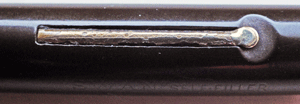
I no longer feel I’m taking the moral or ethical high ground as a conservative restorer. In actuality I turn out pens the way I like them. The SF230 I’m drafting this with has black hard rubber faded to a pleasing rich chocolate brown. The plating on the barrel and cap bands is reasonably good but the lever is pitted. Though it takes a good shine – brighter with all the handling – there are the minor scratches of ninety years of use and the barrel imprint is shallow but legible. It isn’t at all like the year-old Waterman Carene also on my desk and that’s entirely as it should be.

The wear on my SF230 isn’t history. History is something written and read. My pen shows that it was worked hard and probably loved by its first owner. I know, from actual history, that this pen was probably in use during the slump of the thirties followed by Hitler’s war. Maybe it continued in use thereafter and maybe it lay in a drawer. These things – for me – give this pen a richness of association that my Carene doesn’t have. Not yet, and not for a few decades. The SF230 is an old and valuable thing and much of that value, for me, comes from those signs of age and the times during which it was used.

I make sure each pen does what it was originally intended for: write well. I think my sales say that restorers like me also meet with the approval of a segment of the old pen market.

Mabie Todd Swan 6160

During all the years that Mabie Todd made pens there must have been a succession of employees entrusted with the job of stamping a model number on the barrel of each pen. So many operatives and yet they all had the same failing: lots of pens got past them without being stamped. Several explanations have been put forward for this omission – a factory romance, perhaps, or a tendency to overindulge in lunchtime pints of a Friday. We’ll never know.

Had this pen been stamped as it should have been if the fellow’s mind had been on his job it would have been with the number 6160. It isn’t an outstanding pen. It’s at the bottom end of the Swan range of the time with it’s chrome plating, just a workmanlike instrument of the late thirties, one of the best sellers of the time.

The only notable thing about it is that the nib is a sweet semiflex. Looking back through my blog I see that these pens are often flexible. As we have discussed recently Mabie Todd offered quite a range of nibs for their Swans and it may be that these flexible nibs were a matter of customer choice.

In Praise of the Ballpoint

Or at least an honest assessment…

If you’re fond of fountain pens you may well avoid ballpoints. Indeed many express a hatred of them and refuse ever to use them. I reserve my hatred for more worthy targets but I don’t use ballpoints now.

They have a long history in Britain, being adopted by the RAF during WWII because of their convenience and permanence. Those first reliable ballpoints were sold under the name Biro which remains the usual name for a ballpoint in the UK. When they first went on commercial sale they resembled the fountain pens of the day, with a threaded cap and usually a gold plated clip.

Soon however, ballpoints broke free from the influence of the fountain pen with the development of the ‘clicky’ retractable point. As demand rose so did competition and the ballpoint’s price fell from its luxury writing instrument level by a long way.

The Bic, of course, revolutionised both ballpoint sales and the view of it presently held, as a very cheap and completely disposable note-taker. It is as a note-taker that the ballpoint is most successful. When I worked in an office there was always a Bic on the desk, capless as the cap had been discarded as unnecessary because a Bic doesn’t dry out in normal use. It was instantly ready to take a note in a way that no fountain pen can ever be, not even the Pilot Capless.

When a longer spell of handwriting is required – something not often called for in the modern office – the ballpoint fails. Its design demands that it be held vertically and pressure must be applied. This leads to discomfort quite quickly. In this situation the fountain pen does a far better job as does the felt tip or gel pen.

Bics dominate the ballpoint market to a huge extent but there are other very cheap pens which some favour. Also there are those committed ballpoint users who want something ‘better’ and more permanent. Most of those companies that make fountain pens also make high quality ballpoints. Those pens are not disposable and take replacement refills. Like the fountain pen, expensive ballpoints are a niche market.

There are situations that demand a ballpoint – some documents are quite specific about that. Should I come across one of those I would be at a loss; there isn’t a ballpoint in the house!

The fountain pen had completely lost its place as the pen of business by 1955. Managers, lawyers and doctors hung onto it for a bit longer – some still prefer it. The fact that the fountain pen is an altogether better writing instrument is of no consequence. The Bic writing stick and similar ballpoints ruled the day for a long time and even their use is in decline in today’s digital office.

Happy New Year

Or, as the song says,

A guid New Year tae yin an’ a’ an’ monie may ye see,

An durin’ a’ the years tae come O happy may ye be.

An’ may ye ne’er hae cause tae mourn

Tae sigh or shed a tear.

Tae yin and a’ baith great an’ sma’

A hearty Guid New Year!

I realise that some of my non-Scottish readers may have a little difficulty with that! It should be sung in a Fife accent.

I have a collection of Mabie Todd and Mabie Todd & Bard advertisements. I’m sure they must have been famous in their time both for the quality of the copy and especially for the delightful illustrations. The names of the talented artists responsible have sadly been lost.

This is a splendid example and the advice is very good to this day. A well-restored Blackbird is as fine a writer today as it was when new and it is available at a fraction of the price of today’s equivalent.

Most Blackbirds are lever-fillers. I find the lever-filler a good system, quite clean and convenient in use. However I read recently someone reporting that they avoid lever fillers because they almost always get ink on their fingers and they fear an accident with the ink bottle. Though I don’t have that difficulty I understand why they feel that way. Such a pity though, they deprive themselves of some of the best fountain pens ever made.

Filling any pen requires a little thought and preparation. Glass ink bottles are slippery things and it’s best to find some way of preventing them slipping around while filling the pen. I set the bottle on a small rubber mat. Someone else I know uses a piece of Blu Tack. Kitchen towel should be to hand to wipe the nib. It’s best to lift the lever before inserting the nib into the ink; you don’t want to be fiddling with the pen while the nib is in the ink. Release the lever and give a slow count to ten to ensure a good fill. Remove from the bottle, re-cap pen and bottle. What could be easier?

Swan Nib Types

I mentioned to Jens that I had seen a large list of the types of nib offered by Mabie Todd in years gone by. I had a search through my collection of Mabie Todd advertisements but no luck. I did find this one. Interesting, but it doesn’t show nearly as many as the one I had seen.

Note that in those days nibs were known as points. There’s at least one contributor to the pen groups who insists upon still referring to them as points. I feel that’s a bit affected. After all, many things have points but only pens have nibs.

Paul Leclerc has pointed me in the direction of a small 1951 nib chart on page 278 of The Swan Pen by Stephen Hull. It adds Eternal, Callighraph, Philatelic and Shorthand.

Season’s Greetings

I do hope you all had a happy and safe Christmas despite the Omicron pestilence stalking the land. It was just us two and phone conversations with my mother in Pennsylvania and Gordon’s daughter in Cumbria.

I didn’t buy pens over the Christmas period as they would just get hung up in the madness of the Christmas mail but I’ll be hunting down Swans and Blackbirds come the New Year. I’ll also have some restored pens to upload to the sales website in the New Year.

This week I’ve been making use of my own pens, catching up on correspondence and just generally enjoying them. Best of course are my vintage pens of all brands and dates. I have two moderately expensive modern pens, a Waterman Carene and a Platinum 3776 Century. Both are good pens which work well with great ink delivery – no hard starting or skipping but both are too smooth and slippery for my taste. A little nib work is in their future. Some careful, gentle work with Micro Mesh will improve them to the pencil-like feedback I prefer.

I have several Sailors, Platinums and Pilots from the later decades of the twentieth century. The Japanese pen makers of those years understood that over-slippery nibs made for hard work. All of those pens that I have captured from that country and time write just the way I like.

I realise it’s just a matter of preference and choice but we are provided with so many pens, vintage and modern, that suit our hand so well, whatever our nib preference. And even those of us who hesitate to broach nib-work ourselves can find nib-meisters who can change a nib to suit exactly our requirements. I suspect that in previous decades people bought a pen with the nib of their choice – fine, medium, broad, stub or oblique – and just got on with it. Does that mean we are spoiled and pampered? I don’t think so. I think we’re lucky to live in a time when a nib can be customised to our requirements.

Filling Systems (2) The Button Filler

The other main use of the latex sac is the button filler. Parker developed the idea from previous patents, most notably that of John T. Davison (1905). Parker used that design almost exclusively for several years. The idea caught on in the UK; Summit and Mentmore produced excellent examples of the button filler. Conway Stewart produced an elegant version with a fixed pressure bar which made sac replacement simpler and straightforward. They used it on various Duros as well as the 226 and 485.

The button filler works very well if it is set up properly. The very short travel of the button is enough to flatten the sac completely and allows for a full draught of ink. Problems can arise if a replacement pressure bar is not cut to the exact size required. Sometimes people have trouble removing the button. Mentmore recognised that difficulty and made removal and replacement easier using their threaded button.

The first version of the button filler flexed the pressure bar between the button and the section which had to be threaded to resist the force. Later Parker Duofolds used an anchor bar which moved the pressure of depressing the button from the section to the end of the barrel enabling the use of a friction fit section, a saving in the manufacturing cost.

Novices get into trouble by unscrewing the section first, twisting the pressure bar against an old, possibly hard sac. The proper way to disassemble a button filler is to remove the button and slide the section out, then unscrew the section to give access to the old sac.

Parker’s last version of the button filler was the elegant solution known as the AF or aluminium filler produced at Newhaven. Though the principle is the same the aluminium button and housing gave a modern appearance.

One of the benefits of the button filler (apart from ability to shoot ink at your classmates) is that the barrel is not pierced as with the lever filler and a pattern is unbroken from the section to the blind cap. Some pens such as the Mentmore Autoflow continue the pattern into the blind cap itself.

There was always the possibility of losing the blind cap. Mont Blanc and Stephens solved this problem in different ways, both utilising a fixed blind cap. Is the button filler a better filling system than the lever type? It’s a matter of personal preference, I suppose. I find it a more efficient engineering solution and I prefer it.

Filling Systems (1)

The eyedropper filler was never a successful solution and there was a scramble to come up with a better arrangement, which Sheaffer won. Their lever filler depended on a pin drilled through the barrel, a system that was not entirely satisfactory and which they dropped later.

Nonetheless it was the first working self filler of the latex kind and Sheaffer guarded their intellectual property fiercely. They produced superb pens which have survived in large numbers and continue as first class writing instruments today.

Due to Sheaffer’s litigiousness other pen-makers continued to try to find another way, most based on the pressure bar means of deflating the latex sac. Some of these solutions appear eccentric to us now, thumb fillers, matchstick fillers, clip fillers and so on through an almost innumerable list of clever ideas. Odd they may appear now but most worked, and worked well. The crescent filler made by Conklin was very successful. It may even have been a better filling system than the lever filler in some respects – it couldn’t roll of the desk, for one thing – and it was adopted by the Japanese.

Seeing the sale of Sheaffers, several companies concentrated on making a lever filler that was sufficiently different not to have their makers hauled into court by Sheaffer. Watermans box lever was very popular though it has proved fragile in later years. It was copied by Conway Stewart, whether or not by license is unrecorded. Snapfil developed another type of lever filler and beyond that the door opened to everyone. Companies like De La Rue and Wyvern had their own versions of the box lever which proved more durable than Watermans.

Though it seems an imperfect method of filling a pen, the lever filler was adopted generally. Other filling systems sprang up too but that’s for another time.

Inky Fingers

Numerous factors played into the development of fountain pen filling systems. One among them was avoiding contact with the rim of the ink bottle, and the transference of ink to the fingers. That blot of ink on the thumb and index finger is not a good look.

The lever filler with, in most cases, the lever halfway along the barrel, seems to have been a major offender. The button filler was altogether better, keeping the hands well away from the bottle. The Leverless was similar in this respect. Of course all filling systems left the user with the necessity to wipe the nib once filled, with the risk of collecting some unwanted ink on the fingers.

The ultimate solution to the problem was that eccentricity, Sheaffer’s Snorkel, which completely isolated the fingers from the ink at all stages but at the cost of only containing a thimbleful of ink. This worked well for needle points and extra fines but any broader nib required many visits to the ink bottle.

Some fountain pen users don’t mind a little ink on the fingers, regarding it as a badge of honour. I hate it and I’m very careful around ink. I wear disposable nitrile gloves when I fill a pen and when stripping one down for repair. Some old inks redefine the word ‘permanent’ and have to wear off over time. Some others seem to have decayed over the decades since they were last used and smell absolutely dreadful.

I don’t have water on tap in my work area and I keep a container of water handy. I flush nib and section unit with a rubber bulb before removing the nib and feed. It is amazing how much ancient ink is stored therein. A good scrub with a brush and cotton buds restores the parts to a pristine condition.

It’s the nature of ink to permeate everything it touches and even ‘washable’ is only a relative term. There’s always the risk that a moment’s inattention can cause a horrible accident. That’s the price we pay for the pleasure of using fountain pens.