The Regal Spot

I’ve written about the Spot pen before. The search box above right will find those articles if you’re interested. These pens sell well, better than the average Mentmore. In terms of build quality they’re about the same as the Mentmore Autoflow but they are attractive to collectors as something different with their white dot and leopard imprint. That’s the story up to now…

A few days ago a Spot went through eBay and sold for a price in excess of £700. It is solid gold, beautifully designed and in perfect condition. Unusually for a Spot, Mentmore put their name to this pen, appropriately named the Regal Spot. It bears the leopard imprint on the nib.

Perhaps Spot collectors were aware of this pen but it was completely unknown to me. Everything about the pen adds up to a very harmonious design and it makes me reconsider the places of Mentmore and Spot in the vintage pen world.
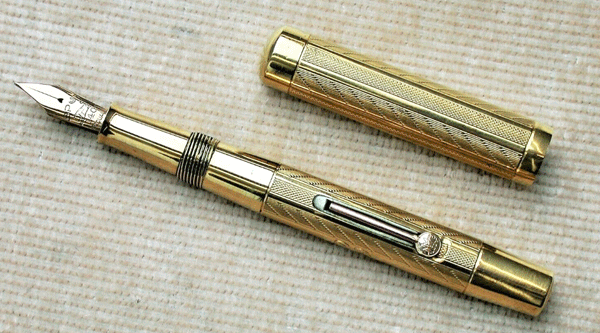
It would be instructive to more about this very rare pen. How many were made? What were the circumstances that gave rise to its production? When was it made? Was it produced by the usual Mentmore team or was an outside designer brought in?
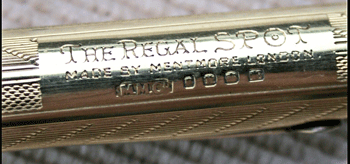
I would go so far as to say that it is the most handsome metal pen I’ve seen, even apart from the precious metal. If only I had £700 lying around not needed for anything else!

With thanks to Rob Parsons.

The Starling Pen

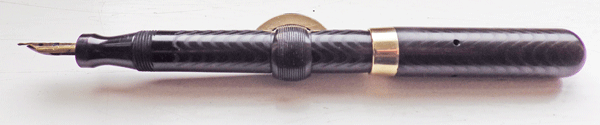
I’ve written about the Starling before – the mystery pen of the Mabie Todd range. It has been a few years since Don Powell gave me one with two cap rings. I no longer have that pen and I can’t say for certain which nib it had but I suspect that it was a Warranted one.

Rob Parsons has kindly told me about one that has appeared in Australia. It’s very similar to the other but has no cap rings. It has a Warranted nib, whether original or a replacement. My own opinion of these pens is that they are probably intended to be cheaper than the Blackbird but they are still high quality, well made pens.

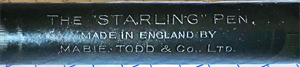
So how do they fit into the Mabie Todd range – or are they intended to fit into the range at all? The barrel imprint would seem to me to indicate that they are just usual Mabie Todd products. Stephen Hull describes the Starling as an ‘own-brand pen’. I don’t know what that means but I see no indication that the Starling was made for sale by another company. There is no other name apart from Mabie Todd to suggest that it is an advertising pen.

The most obvious thing about the Starling is its rarity. Though I haven’t been especially looking for them I have a constant search for Mabie Todd pens and this is only the fourth or fifth I’ve seen in the last decade. Only one, the pen that came from Don Powell, had a box. I had high hopes that the box might help to place the Starling but it didn’t, not a bit!

So is the Starling just another Mabie Todd range like Swan, Blackbird or the American Swallow? If not, on whose behalf was it made, and in what circumstances? Were Starlings issued with Warranted 14ct gold nibs? Enquiring minds wish to know! Thanks to Rob and credit to Stephen Hull’s The Swan Pen.

Help!

I sometimes forget that some of my customers are new to fountain pens as I was once myself. When I remember I include a sheet explaining the use of the eyedropper filler but all the other types of vintage pen can be a little intimidating on first use too. I mostly sell lever fillers and Leverlesses. I need to develop instruction sheets for them too. Boxed pens often come with the original instructions, and that’s the best. I might copy them.

Of course I can’t cover everything and in any case people may have questions ahead of purchase. I’m always happy to advise and inform. If you need help just contact me on goodwriters@btinternet.com.

Conklin Crescent 2P

We don’t see many vintage Conklins on this side of the Atlantic, more’s the pity. Invented in 1898 by Ray Conklin and patented in 1903, it is the first practical self-filler. The crescent-filler’s huge success made Conklin one of the Big Four in sales in America until 1920 or so.

This one is a short pen at 11cm though it becomes good-sized when posted. The black hard rubber has held its colour well and the chasing is sharp. It has its original Toledo nib which is fully flexible.

I’ve had two or three Conklin Crescents over the years and I rate them very highly. The filling system is among the most efficient with its direct pressure on the sac – better than any lever or button filler at compressing the sac. The Toledo nibs are outstanding and are usually flexible.

Conklin’s competitors maintained that the Crescent was bulky and old-fashioned compared with their “smooth-barrel pens”. A century too late, I would dispute that claim. As I said above it is a more efficient system, elegant in its simplicity. The protruding crescent does not hinder the grip and stops the pen from rolling off the desk. Mark Twain praised it. No doubt he got a free pen and a few dollars for doing so but his words have the ring of truth.

Conklin is one of the many vintage pen manufacturers whose name has been revived. There is even a modern crescent filler. Unfortunately the pens the new Conklin company produces are a pale shadow of the great originals. I’ve had one or two of them and to my mind they are just another very ordinary Asian pen. They even pretend that they are a continuation of the original company. However, their pens sell within the same price range as the true Conklin would have done had the company continued, unlike, for instance, the revived Conway Stewart which sold very expensive pens, unlike the original company.

Waterman 32 1/2

It’s quite a while since I’ve had a Waterman but when I saw this little beauty I had to have it.

The Waterman 32 1/2 was issued in the mid-thirties and remained available for the rest of that decade. It filled a niche in the market for a cheaper pen aimed at the school student market. At 12.1cm capped it’s a little shorter and more slender than the 52 but shares the same much admired Ideal nib.

This is a flat topped pen but a slight softening of the angles is occurring: the top of the cap and end of the barrel being very slightly rounded. The rivetted clip worked well but would be replaced in later models.

Waterman’s patterns of those years are outstanding. I was immediately attracted by this blue marble, quite different from those of Conway Stewart or Mabie Todd. There is such depth and it almost glows.

Of course with pre-war Watermans it’s all about the nib and this pen does not disappoint. It is a splendid writer with considerable line variation.

A Biro Swan Box

You don’t see these boxes often; I’m not sure I’ve ever seen one before. It’s similar in dimensions and simplicity of design to those made by Conway Stewart at the time, i.e. the mid-fifties. The only praise I can give it is that it has survived well and the sans-serif font is clear and suitable for purpose. Otherwise it’s charmless, especially compared with the boxes turned out by Mabie Todd some years prior. Those exuded confidence and pride in the product whereas this is a cheap afterthought made by a company that no longer believed in fountain pens

Luckily the pen that it contained when it came to me is inappropriate to the box, a sound, efficient and beautiful late thirties Swan.

Scribbling and Scratching

A few more words on the subject of the dip pen. I have come to the conclusion that a large part of my recent success is down to preparation of the nib. I had been putting a new nib in my mouth as a method of preparing it but I read that some of the coatings used were not conducive to good health if licked so I looked for another way of making the nib ready for use.

I read somewhere on the internet that one method was to pass the nib through a flame. I hunted through the house and found a cigarette lighter that had been kept since my husband stopped smoking ten years ago. I never throw anything away that might be useful which is why we live in incredible clutter.

Anyway, I immersed a nib in the gas flame. Burned my fingers the first time and held the nib with pliers after that! It was a resounding success! I then tried it with a nib that did not have any kind of reservoir: an Esterbrook Relief. On immersion it picked up a good supply of ink and delivered it to the page as evenly as one could wish. I’m delighted as this suggests that I can use most nibs.

At first I used a vintage ink, a very old Stephens in a glass bottle, which might have evaporated a little over the 90 or so years it has been around. That was quite messy and not really a success. I might take advice I have kindly been given and water it down. Waterman’s Absolute Brown was my next choice and that worked perfectly.

This blog is about fountain pens and I don’t intend to be a bore about the dip pen but I am enjoying learning something new. I may report from time to time about my progress in the hope that it may help others who take an interest in the dip pen but that will be all. It might be indicative of where my real interest lies that I’m drafting this article with a 1980s Platinum long-short rather than a dip pen.

Swan Safety Screw Cap 4

Mabie Todd never rested on its laurels. The long success of the company was largely due to its constant determination to improve. One example of that is the increasing efficiency of the eyedropper filler. The apex of that range is the Safety Screw Cap, the last big seller before the introduction of the lever filler. It became evident that people wished to carry their pens with them wherever they went. The major difficulty was the danger of a large quantity of ink escaping into shirt and jacket. Such ideas as the bayonet closure were not reliably successful. The Safety Screw cap finally solved the problem. Using a fixed or accommodation clip, held vertically in the pocket, nib up, the SSC came as close as it was possible to protecting clothes from accidents.

Feeds had also been improving, leading to the ladder feed used in this pen. It was such a good method of transferring ink from the reservoir to the nib that it remained unchanged until the demise of Mabie Todd.

The SSC was a huge seller and it remains widely available today, mostly with the No 2 nib, a comfortable and efficient pen. The larger versions are much less common. I was fortunate in obtaining a very nice version of the No 4. The pen measures 13.5cm capped. It is in excellent condition more than 100 years from its manufacture. The large No 4 nib is very flexible.

Dip Pen Days

Some among us fountain pen users take the matter very seriously and regard the use of a ballpoint as a form of treachery. What, then, do we think about using the earlier technology, the dip pen? Am I now a miserable traitor to the fountain pen cause because I have dipped into dip pen use?

In truth I’ve tried to use a dip pen before. Unlike those a little older than me I didn’t use one in school but I bought a few nibs and a handle a few years ago and proceeded to make a terrible mess. Very disappointed, I laid them aside.

Recently a friend (thanks Paul) gave me a variety of nibs and a different style of handle. The handles I had used before were very thin. less than a wooden pencil. This one has the girth of a fountain pen – much better. However the nibs didn’t work for me, not even the famous Macniven & Cameron Waverley. They took enough ink to maybe write a three-syllable word and perhaps a conjunction or an article and then it was time to dip again. Also, after dipping, even after removing the excess ink against the top of the bottle, the nib at first laid down too much ink, then too little. I’m sure the expert dip nib writers among you are holding their sides laughing by now.

Then I saw a nib with a curved piece of metal over the nib itself. I tried that one and the difference was immediate: the sun came out from behind the dark clouds and I faintly heard Beethoven’s Fifth! Each dip of the ink provided enough ink for a line and a half. The ink was laid evenly. No great streams of ink on the page.

I wrote a letter; two sides of an A4 sheet. Not a blot! I have mastered the dip pen! Of course the ethics and morality of what I have done is another matter. I do hope that hundreds of you are not leaving my blog in disgust at my infidelity, never to return…