My Winter Break

There comes a point in mid-December when eBay sales tail off. Buyers abroad stop bidding because they don’t want their pens caught up in the Christmas mail madness. That seems to have happened now, so I can heave a sigh of relief and put my feet up for a month. Not quite, actually. I’ll have a batch of pens to upload to the website later this week, and I’ll continue to buy and repair throughout the festive period.

Last week I had two pens with serious undisclosed faults. Today’s only Monday and already I’ve received a Duofold Senior with a crack in the cap. My assistant is very displeased.


DSCF8886

The Section And Nib Flushing Bulb

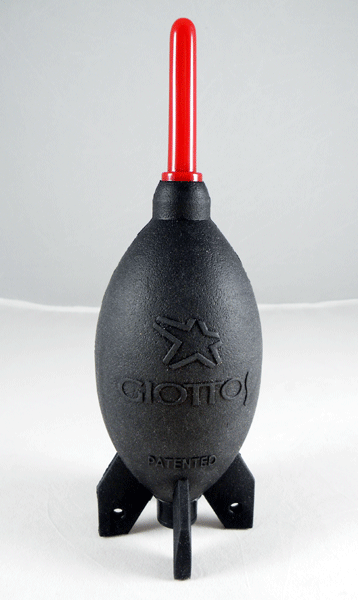
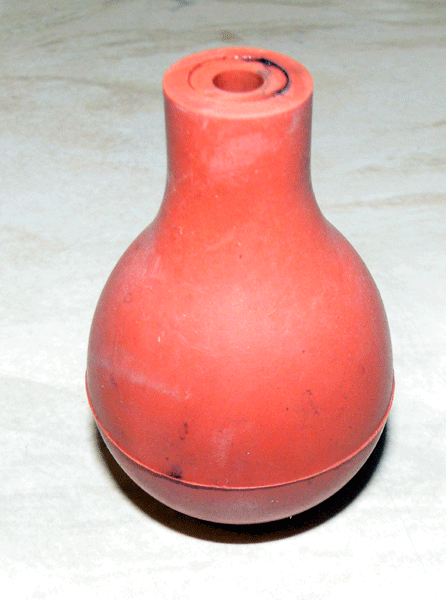
My last puzzle didn’t trouble anyone very much, though no-one guessed what I actually use it for, as opposed to what it was intended for. I might now and again blow the odd stray speck off the lens of my camera with it, but the real bane of my life is lint on dark pens and the little bellows makes a fine job of blowing that away.

DSCF8624

It somewhat resembles this thing, which is a very useful and time-saving tool. I don’t believe in knocking out nibs and feeds unless there’s a very good reason to do so. It’s never easy to re-seat a nib precisely as it should be, and some nibs – Parker Duofolds for instance, and some all-metals Wahls – can make your life quite a trial when you come to refit them. Best to leave them where they are except in cases of absolute necessity. After all, they were probably factory-fitted and those guys had the tools and the experience to do it right.

The cases of absolute necessity for me were where nib repair necessitates removal, where the nib and/or feed have become seriously displaced, or where old dried ink has totally clogged the feed. This little nib and feed flushing bulb removes the latter necessity in almost every case. A little gentle pumping gets the water moving through the feed and soon the assembly is as clean as a new pin.

Once you’ve done it a few times, knocking out a nib is an easy procedure, but as with any procedure with old pens, there’s a risk of damage, however small. Anything that minimises that risk is a bonus and it saves the time that would be spent resetting the nib too. It’s all good!

The Swan SM100/60 And The Persistence Of Black Hard Rubber

DSCF8437

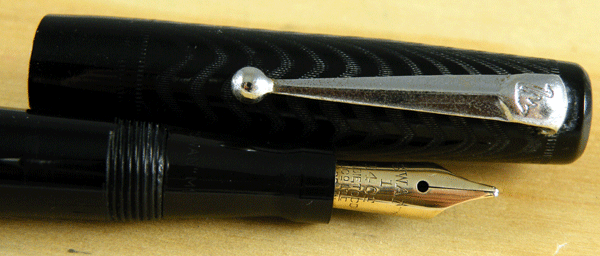
The SM100/60 doesn’t stand out on the Swan range of the thirties but in its unassuming way it’s a milestone of the brand. It’s down at the bottom of the range, medium-sized, chrome plated and placed in the clerical and school area of pen sales. It’s just as well made as its more upmarket brethren, though, a sturdy and reliable pen that has lasted well through the decades, and was often fitted with exceptional nibs – flexible, stubs, broad and obliques.

DSCF8444

Though this pen has been moved from the traditional black hard rubber to celluloid, the cap and barrel are still machine-chased, perhaps the last Swan to be decorated in this way. Black hard rubber is still present in the lever, a feature unique to Swan, so far as I know. Did Swan employ BHR for the lever to use up stocks they had? Looking at the smooth outline of the barrel, I think it’s rather a carefully considered design element. Doubtless the BHR lever cost less that a chrome plated metal one but it can be argued that sitting flush with the barrel it looks better and is easier to grip than the usual filler lever.

DSCF8432

Mabie Todd Swan had a longer association with black hard rubber than any of the other British manufacturers. A decade before this pen was made, a large proportion of the range was made from this material, still holding its own among the brightly-patterned celluloid. A decade later it would be reintroduced at a time when most of the competition had given up black hard rubber, and it would sell very successfully.

The lever on this modest pen means that until the very end of production there was never a time when Swan didn’t use black hard rubber.

The Pricing Puzzle.

I’ve discussed the mystery of price in here before, but I’m going to ramble on about it again today. The reason that it’s a problem – and therefore interesting – is that there is nothing that even remotely resembles a market price for the kinds of pens I deal in. If I were to be in that part of the market that buys and sells the highest of high-cachet pens, I would have something approaching a market price to refer to for my solid gold Balances and Parker Red Giants. It would be fluid and changeable, to be sure, but provided I kept myself well informed, I’d have a ball-park figure for my sales items. For average-to-excellent run-of-the-mill Swans, Parkers, Conway Stewarts and the like, no such thing exists.

If you’re a classical economist (i.e. someone with graphs for everything and knowledge of nothing) you’ll say that the market will dictate the price. The nearest we have to a market for old pens is eBay. I’ve bought and sold in eBay for years and it doesn’t help much. The variation in price between two items as identical as seventy-year-old pens can be is enormous. Is a standard Waterman 52 with some fading and a semi-flexible nib worth £35.00 or £78.00? I don’t know, but I’ve sold those pens at both those prices in eBay this year.

This concern over prices arises from something that happened a few days ago. I’d been on the look-out for a Mentmore Supreme for a customer and I found one in eBay. Reading through the listing, I discovered that the pen, along with many others, was being sold by an online retailer of old pens. Someone like me, in fact. A little worrying, that! This retailer was selling off all his stock as he was taking down his sales website. So I went and had a look at the site, which was still up, and it didn’t take a lot of puzzling to work out why he’d gone out of business. His prices were almost beyond belief! What calculation makes a green marbled Dinkie 550 worth £100.00? Together with a pencil in a presentation box these things often fail to make £30.00 in eBay! A black Parker Moderne is worth £160.00? Fact is surely stranger than fiction, and this guy had actually been selling pens at these elevated prices. Not many, of course, probably not enough to justify his expenditure, but some.

Now I can’t tell you what a black Parker Moderne is worth (see above) but I could tell you what I’ve bought and sold them for and it’s a fraction of £160.00. In a way, it’s a worrying thing. It suggests that the commercial end of our hobby slides ever nearer to the practices of the antiques trade where dealers think of a number, double it, double it again for luck and write a price ticket. Most of the pens we deal in aren’t intrinsically valuable and you can’t make them so by wishing, hence this particular trader’s exit from the old pen marketplace. With the odd exception, they’re at the useful end of the pen spectrum, or at least that’s how many of my customers express their appreciation for pens they’ve bought.

So what’s fair? How do I determine a price? Essentially, it’s buying price plus a moderate profit to cover time, parts and fixed costs. Works for me and seems to work for my customers – long may it do so! All I’m saying, I suppose, is look around. Despite the great number of helpful and generous people there are in our hobby, these waters are not without the occasional triangular fin cutting the surface. Don’t buy the first example of the pen you want that you see. There might be a better deal around the corner.

Waterman Junior

DSCF8317

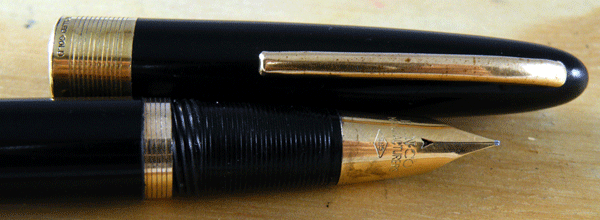
I’m always pleased when there’s a Waterman Junior coming my way. They’re superb pens, often in glowing colours like this iridescent green marble, and they have very, very nice nibs. I can’t find it in Max Davis’s Waterman book but looking at the very neat chrome-plated lever box, I’d guess that it was made in the late 1930s.

DSCF8319

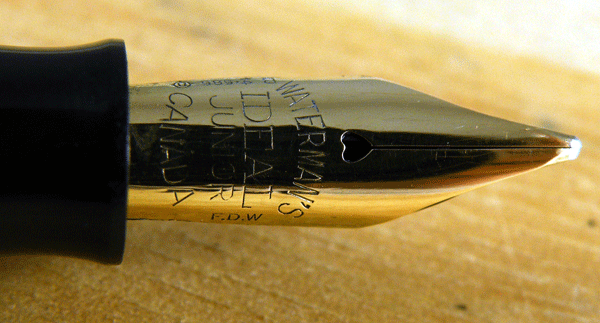
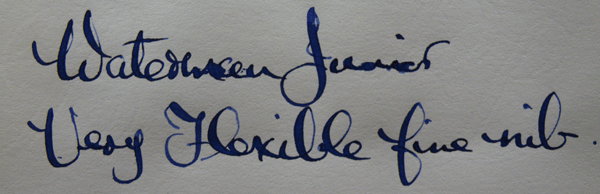
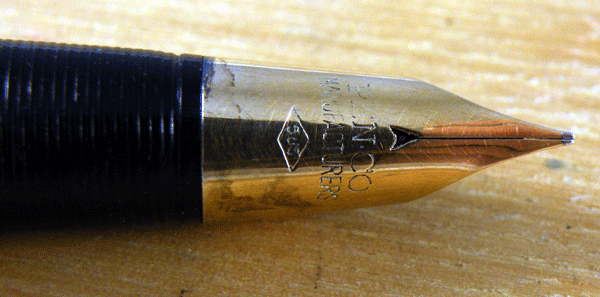
Invariably, in my experience, these pens have superflex nibs. A glance at the nib would give you no clue to the decorative line that resides in there. It just looks like another ho-hum Ideal nib. But it’s not…

DSCF8323

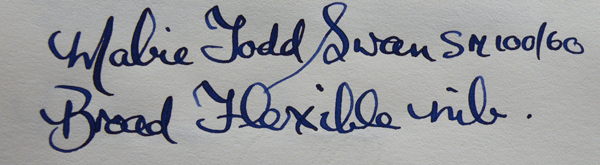
Forgive the hasty and somewhat blotted writing. I closed the page before the ink was dry, but you get the idea.

Penco No 53B

It’s not often I get my hands on a high-quality Italian pen and I think I only got this one because no-one else knew what it was when it was listed on eBay. I watched it for several days, expecting the price to take off but it never did and mine was the first and only bid.

The Penco name was adopted by the Rossi Brothers in 1952 after a couple of decades as FRV. It was a period in which English or English sounding names went down well in Europe. This pen was their much-advertised No 53. The resemblance to a Triumph-nibbed Sheaffer is obvious and clearly no accident. It’s a copy but it’s also something more; the Rossi brothers admired the Sheaffer Balance and had the confidence to believe that they could produce something even better. The 53 is the result. The filling system with which this pen was fitted when first issued was quite complicated and bore some resemblance to Parker’s Vacumatic. Between 1953 and 1954 the first version was replaced by the 35B which had a version of the Touchdown filler. That’s the pen I have here. All in all, this was beginning to look very like an infringement of Sheaffer’s patents and legal action was threatened. In response, the pen was fitted with a piston filling system, but this was not enough for Sheaffer and in the face of expensive legal proceedings the Rossi Brothers withdrew the pen and, indeed, the company didn’t survive much longer.

So how do you classify this pen? Given the build quality it’s far from being a cheap knock-off. There was no suggestion that this pen was a Sheaffer, so it isn’t a forgery. It is, in a sense, an homage and there can be no doubt that it’s a copy, too. So what’s the difference between this pen and all the – for instance – Duofold copies that appeared under a variety of names in the twenties and thirties? Not much, one might say, except that perhaps the concept of the Duofold was less unique and identifiable than that of the Sheaffer Balance 1000. Also, Sheaffer was renowned for being hair-trigger litigious.

It’s a curiosity for the use of three filling systems in the short period of its production. It’s also notable as the height of cheek, but it’s also a superbly well-made pen.


Thanks to Abrate G. (2004) Article 416, Pentrace.

Mentmore Autoflow And The Spares Chaos

Yesterday was a pen fixing day. I was getting along great guns until a Mentmore Autoflow stopped me in my tracks. The weak point in Autoflows is the feed. The teeth are very thin in the comb at the sides of the feed and often break off. A comb feed with missing teeth can have very uneven flow, so it isn’t just a matter of appearance. I tried a spare Autoflow feed or two but they were too slim for this particular model. It was a rather nice raspberry marbled button filler. I’m slow, but eventually I catch on. Perhaps the button fillers took a thicker feed than the lever fillers!  Well, to cut a long story short, some do, others don’t. To expand on that, none of the lever fillers have the thicker feed and some of the button fillers have a slightly thicker one; others have a considerably thicker one, it seems.

The trial and error took quite a while. It took much longer than it need have, of course. This is because of my lack of organisation. My Conway Stewart and Mabie Todd spares are reasonably well arranged. Everything in else is in a large wooden box, all jumbled together – bits of every make of pen you ever heard of and some you probably haven’t, caps, barrels, sections and miscellaneous components. It takes some time to take each one out of the box, look at it, lay it aside or add it to the “possibles” pile. Then you have to put it all back again…

I know that this is no way to work. I’m very organised in every other respect. All my stock of pens is stored according to their status: awaiting repair, repaired, listed on the website and so on. My spreadsheets enable the calculation of annual taxes in an hour. My image files are regularly archived and my description files save reinventing the wheel for every pen I repair. All of those things are fine, but my spares have been a blind spot. One day soon I must amass some containers and bring order and convenience to the chaos.