I somehow managed to catch the reflection of my strip-light in these photos. Please forgive.

Stephens had a 106 in their line-up from 1935 on, but this pen is clearly not of that date. There’s no black art about Stephens’ numbers, unlike Conway Stewart or De La Rue. A 106 cost ten shillings and sixpence. It’s as simple as that.

The pen is sturdily made with quite thick material in the barrel and cap. This makes it feel a little more solid than some pens of the time. The metal trim is generally good, though there’s a little bit of plating loss on the high points of the clip. The nib, though a warranted one, is clearly good quality. The streamlined shape of the pen suggests that it’s later than the more angular Stephens pens we usually see.
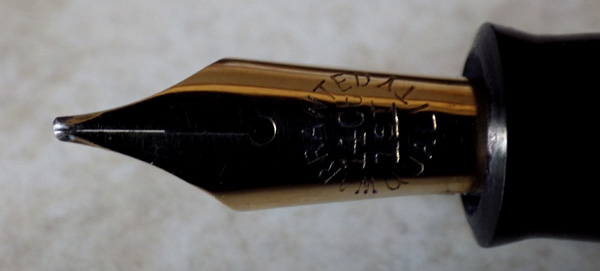
From 1950 Stephens withdrew almost entirely from the production of gold-nibbed pens and concentrated on their inks and ballpoint pens. In the late fifties, when there were talks between Stephens and Waterman with the possibility of a merger, Jif Waterman produced some colourful pens for Stephens, and I suspect that is what this is.

It’s a beautiful pen with glowing patterned plastic. It’s a pity that so few of these pens were made with the result that they’re not often seen now.
Stephens
Stephens Leverfil No 76 in Dusty Rose and Black Marble
Stephens had a comparatively short but very productive period as a seller of gold-nibbed fountain pens. Beginning in 1935 with their stud fillers, this period in their much longer history was pretty well over by 1955. Though details of their later history when they were involved with Jif-Waterman are confusing, the earlier chronology of the company is, in general terms, quite well known.

For instance, this beautiful Leverfil No 76 was introduced in the autumn of 1941, a period when Stephens used some very lovely patterns of celluloid that seem to have been unique to them.

Though at seven shillings and sixpence it was their second cheapest pen it is well made with admirable attention to detail, such as the nib that was made specially for this pen.

What remains a puzzle, to me at least, is the variety of clips that Stephens used over a short period, apparently without much consistency. There’s this clip with “Stephens” stamped into it, a similar ball-ended clip in either gold or chrome plating without the lettering, and sometimes an arrow clip appears.
The greater mystery that has yet to be resolved is the extent to which Stephens own employees were active in the production of these pens. It is possible, though unlikely, that they were entirely made under contract by some other company, with Langs being the most obvious choice. The early stud fillers were made to a Langs patent and bore a striking resemblance to that company’s other output. The component parts of these wartime lever fillers also resemble other Langs pens. It may well be that parts were manufactured by Langs and the final assembly was carried out by Stephens. Stephen Hull mention (in Stephen Hull: The English Fountain Pen Industry 1875 – 1975) that when their head office was bombed in December 1940, work continued at their main factory at Highbury. Prior to that, customer repairs seem to have been done at the head office, so it is fair to assume that the main factory may have been devoted to assembly if not complete manufacture of the pens.
My thanks to Stephen Hull for the factual information quoted above. The speculation is my own.
Stephens Leverfil 270

This handsome Stephens 270 has yet to be restored, always a finicky job with a pen that still has its price label, so you see it with the grime of decades still in place. Quite a few decades actually, because the 270 was issued in 1946 and as I will go on to show, it probably didn’t remain in production for long.
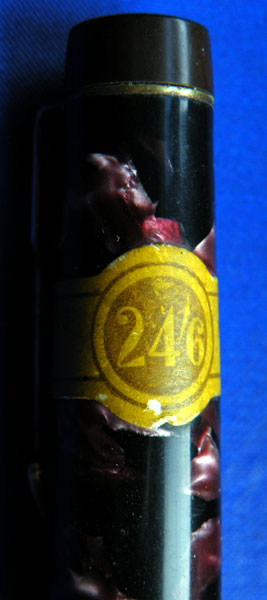
At first, like Sheaffer, Stephens had numbered their pens by their price, so that the 76 cost 7/6d, the 106 cost 10/6d and so on. If the company had not already abandoned that naming policy it did so now as the 270 was first priced at 20/- (£1.00) and later it rose to 24/6d as this price tag indicates.

This is essentially the same Leverfil pen as Stephens had been selling with varying degrees of trim since 1940, the main difference being the introduction of an arrow clip instead of the previous ball-ended clip. By 1951, it seems, Stephens had ceased selling gold-nibbed pens and had begun to concentrate on plated-nib fountain pens and ballpoints*.
Who made these pens? Stephens does not appear to have had a pen production facility of their own and must therefore have bought in parts for assembly or whole pens made by some other manufacturer. I assume that it was Langs of Liverpool who made all the Stephens pens until this post-war period, though, so far as I know, there is no direct evidence that this is so. The indirect evidence is strong, though. Stephens first pen, the excellent stud-filler range of 1935 used a mechanism developed by William Livesey, a Langs employee. Given that and the resemblance of the stud-fillers to Lang’s known production, it seems reasonable to assume that Langs did indeed make them. The later Leverfils resemble the stud-fillers quite closely so again, by inference, one may, not unreasonably, take it that they were made by the same firm.
The early fifties plated-nib Leverfil pens I have seen are essentially the same model too. Did the reduced contract from Stephens hasten Langs’ end? It is certainly the case that by 1954 they had withdrawn from pen manufacture.
*Stephen Hull: The English Fountain Pen Industry 1875 – 1975 p51.
The Stephens 76 Stud Filler

I’ve written about Stephens before, in a general way. They’re best known for their ink, for their good-but-plain Leverfill school pen and for this admirable stud filler.
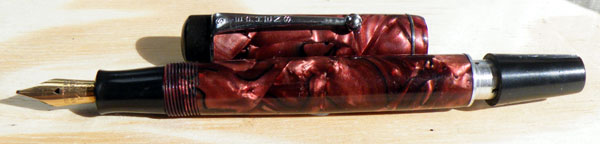
They have quite a strong following and the most colourful ones get snapped up pretty quickly for a good price. The most sought-after patterns include burgundy and black, blue and gold, jade and blue, green or rose marbled, like this present example.

This is a 76, in the middle of the price range. The model numbers reflect the cost, for example the 56 cost five shillings and sixpence, the 76 seven shillings and sixpence, and the 106, which had gold trim instead of nickel, cost ten shillings and sixpence. Though I haven’t seen one, I believe there was also a 210 with three gold bands and a larger nib.
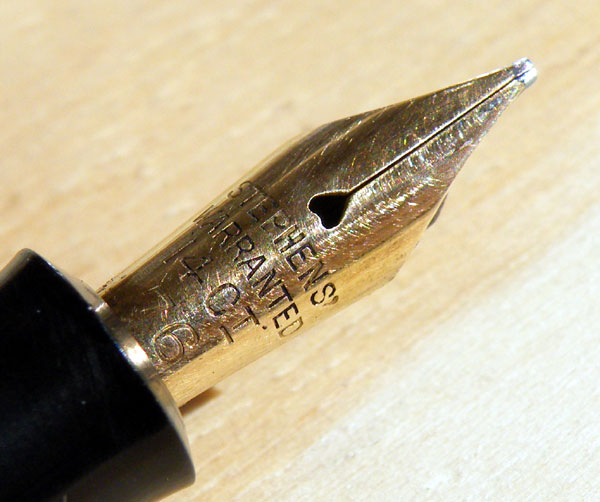
The nibs in Stephens pens may bear the company name or just be warranted 14ct gold. Both appear to be original. In general, they have some flexibility and are often broad.
Stephens Pens
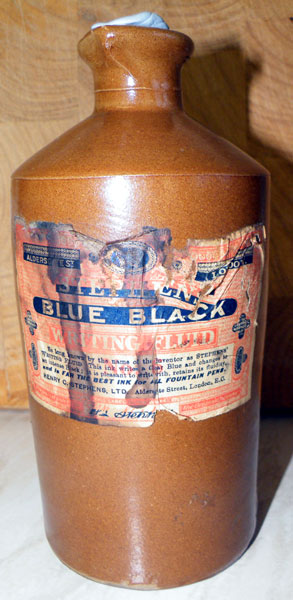
How old would you say that stoneware ink bottle is? I can’t say, though I do know that they were in use from around 1860, and might have continued to be made as late as 1950. What I can tell you is that there is blue/black ink in there that’s still perfectly usable! Though the label is damaged it can be seen that this ink was made by Stephens, and I would guess that it was probably a school ink bottle. They’re moderately common.
Stephens made ink from the middle of the nineteenth century and they were by far the most successful ink manufacturer, being seen as the automatic choice for schools, government offices and many businesses. They had their competitors, some very good, like Diamine, which is still around, Colliers and Watsons, both long gone.
It was not until the 1930s that Stephens put their name to a fountain pen. I believe all Stephens pens were manufactured by Langs, who also made the Summit and Savoy pens, and there is a strong resemblance between all of these pens, with their traditional lines, machined patterns and good quality build. Best known is the Leverfill range, issued with different levels of trim to suit different pockets. Most seen today are in black celluloid with an engine turned pattern, but marble-patterned examples in a variety of colours are not uncommon. Stephens clips appear in several shapes – tapered, stepped and in an arrow shape.

Stephens also produced an excellent stud filler, a button-filler with a fixed plunger button. This efficient and durable filling system had been patented by Langs but was employed (so far as I know) exclusively in Stephens pens. It also came in a range of prices, from seven shillings and six pence to twenty-one shillings and was made in the same range of colours as the Leverfill. The nibs were either marked with the Stephens name or warranted 14ct.

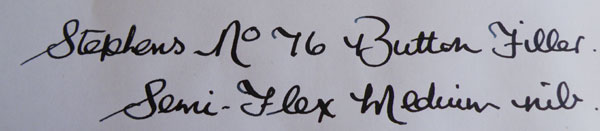
I’m fond of Stephens pens, particularly the stud fillers. The nibs are good and often semi-flex. Many of them are broad. They’re reliable and comfortable to use. The patterned examples and the stud fillers sell well, and there are quite a few Stephens collectors around who appreciate their quiet, unpretentious quality and the company’s long history.
 Goodwriterspens's Blog