Black Is Black.

From the 1930s to the late 1950s, pen manufacturers produced pens in a stunning range of colours and patterns that has never since been equalled. There were marbled patterns in all the colours of the rainbow, candy-stripes, herringbones, lapis lazuli, jade, snake-skin and cracked ice, to name but a few. So which of those glorious colour-schemes was the most popular? None of them. In Britain, at least up until the introduction of self-coloured injection-moulded plastic in the sixties, black was king.

Why should it be that black pens were vastly more popular with pen buyers than any other colour? It wasn’t price. Coloured pens and black pens cost the same. To a large degree, I think, it was what people were accustomed to. Before celluloid and casein became commonly used, pens were made from vulcanised rubber, and that mostly came in black. Yes, there were red hard rubber pens and the various versions of mottled hard rubber. There were overlays in gold and silver too, but these were the exceptions. Most pens were black, and it was accepted that black was the colour for fountain pens in the same way as refrigerators were white or later, desk-top computers were beige. Then again, I think, there was the implication that if you were a person to be taken seriously, you would use a black pen. This intensified in the post-World War II period, when men (and it mostly was men) avoided colours in their dress and accoutrements. Suits were black. Shirts were white. Any deviation from that pattern reflected badly on the wearer. Even cars were black.

Things have changed today. If we had the full nineteen-fifties range of the original Conway Stewart company available to us now, we’d all be buying cracked ice, tiger’s eye and red herringbone. Instead, the majority of Conway Stewarts that appear on eBay are black. They’re beautifully designed and excellent writers, but we may feel justified in wishing that the buying patterns of their original owners had been different.
Restoration.

Restoration is a thorny issue within the fountain pen community. For discussion of the ethical problems involved, I refer you to Fountain Pen Network and especially Lion & Pen, where this subject has been thoroughly debated.

I restore conservatively, and I think it’s worth going into a little detail of what that means to me so that you will know what to expect if you buy a pen from me.

The pens I sell almost all date from before 1970 and they are usually in need of repair when they come to me. It is my aim to do no more than return them to good working order and an acceptable cosmetic condition. Perhaps I should clarify that by saying what it is that I don’t do.

I don’t use a buffing wheel or strong abrasive polishes. I clean the pen thoroughly and polish it lightly. I don’t try to disguise its age or remove the surface scratches that it has accumulated over time. Sometimes heat will make tooth marks pop out and I do that, but I don’t grind indentations or scratches out.

I don’t replate metal trim. I will polish trim but make potential buyers aware of plating loss.

I don’t re-black faded black hard rubber pens.

Replacement sacs are new, of course, as are pressure-bars when the original is damaged. I will replace damaged nibs, levers, clips, feeds or sections with spares from pens of the same model and date.

My aim is to present a good honest pen that doesn’t pretend to be what it’s not. Old pens that are found in an unused, perfect condition naturally fetch a premium price from the collector. Over-restoring a well-worn pen to resemble one that hasn’t been used is, in my opinion, a fraud on the buyer. Further, if a pen has been well-used for many years, its scratches and wear have been honourably come by, and are, to some at least, part of the attraction of owning the pen.

There are collectors who go further and believe that you should do nothing at all to an old pen. It is a collector’s item and should remain in the condition in which it was found. I don’t agree with that. I think people should have the option of using old pens, which write quite differently from modern ones and are an especial pleasure in themselves. After all, collectors can choose, if they wish, to buy the unrestored pens before I get my repairing hands on them.

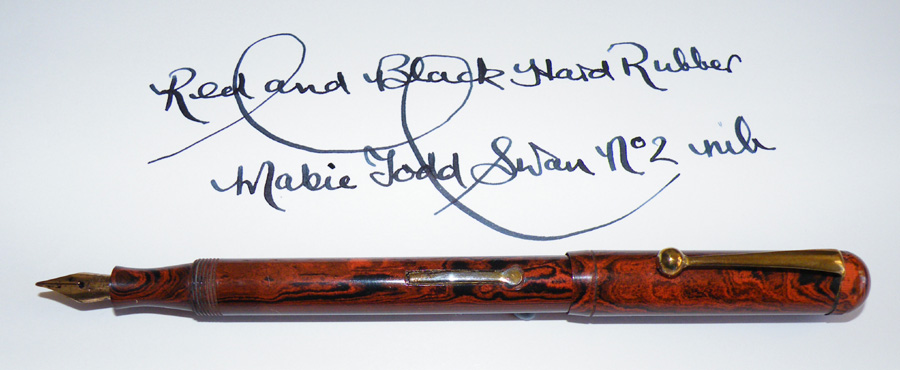
Red And Black Hard Rubber

This is my current daily user.  I keep a pen for a few weeks until something even better comes along, but I’m really enjoying this one.  It’s one of those well-made no-name mottled hard rubber pens that turn up fairly frequently, probably dating to the early thirties.  All these years later, it’s impossible to guess who made it, with any degree of certainty.  The machining is good, the parts fit together very well and it’s a very useable pen.  On the other hand, the plating on the metal parts is little more than a gold wash, and the nib it had when  it came to me was an un-tipped steel one which had worn down to a paper-cutter edge.  I replaced it with a Swan No2 from the parts box as a temporary measure until a suitable warranted nib comes along.

As you might guess from my eBay account name, I’m fond of red and black hard rubber, whether in the Waterman Ripple style, or in this very pleasing woodgrain.  Though I suppose they might have been a little brighter when the pen was new, the colours are mellow and the material is warm to the touch and pleasant to handle.  I have seen red and black hard rubber described as fragile and I suppose it may be where the pen parts are delicate, but in general I’ve found it pretty robust – more so than some of the celluloids that Waterman and Eversharp used a few years later.

The pen is quite substantial and thick enough to give a comfortable grip.  The nib is semi-flexible and the line variation is easily invoked.  I keep a full flex pen for those special jobs like invitations and place-settings, but for everyday use a semi-flex suits me better.