Ink Flow And The Unanswerable Question

Occasionally, looking at one of my listings, an eBay member will ask, “How wet is this pen?” That’s an impossible question to answer well, for a couple of reasons. One is that, simply, there are no adequate standards of comparison. I can’t say, “It’s as wet as a…… “ or “It’s as dry as a……” because there are no recognised standards of wetness in the pen world. Nor is there ever likely to be. I can refer him or her to my writing sample but he or she has already seen that. The result is that we both end up a little frustrated, due to the impossibility of conveying the information.

Secondly, in a sense, it’s the wrong question. No pen is (barring a fault) intrinsically either dry or a gusher. Ink flow is a setting. Particularly with traditional pens with a simple feed like the Mabie Todd ladder feed or the Waterman spoon feed, there are a number of ways to adjust flow. As part of testing and adjusting a pen, I set the flow to provide an unbroken line in which the ink shows its natural colour, in other words, not paler than usual, which would indicate that the flow is too dry. The line should not be raised, nor should it spread or feather on my testing paper. If it meets those tests, the flow is right for the pen, allowing for whichever nib size it – fine, medium or broad.

Those pens that have more complicated feeds, like the Sheaffer multi-finned feed, the Parker 51 collector or the complex feeds that Waterman made in the late forties, can also have flow adjustments made but – again barring faults – it’s rarely required. Those feeds were designed to deliver exactly the amount of ink the nib needs, and they do it very well.

Any pen that flexes, whether semi-flex or super-flex, makes special demands on flow. If it’s set to deliver the correct amount of ink in an unflexed state, it may rapidly run dry when the much greater demands of flexing are applied. Conversely, if it’s set to handle maximum flex, it will be too wet in an unflexed state. I try for the best compromise. It usually works, provided the user slows for the flexed lines and allows the flow to keep up.

After the pens are restored, I test them, but only for about half a page or so. That’s enough to use up the residual ink in the feed and test the actual flow. All being well, I flush the pen, give it a final wipe clean and I’m done. Flow’s a funny thing, though, and if you buy a pen from me and find that after a few pages of writing the flow is clearly wrong, either gushing or not giving an unbroken line, I’ll take the pen back and put it right at no expense to you. I’ll pay postage both ways, as I would with any fault that’s my responsibility. If, on the other hand, the pen that you bought from me writes properly, but you would like the flow increased or decreased, send it back to me and I’ll alter it to suit you, but you pay the postage in that case. The adjustment, however, is free.

One final thing. Don’t perform surgery on a feed. The well-known pen makers knew what they were doing when they made those feeds. They had infinitely more experience than any of us can ever have. Gouging deeper channels is not the way to increase flow.


Pen Photography

I’ve taken photographs for many years but I’m no more than averagely competent. That’s not false modesty; I only have to look at some other people’s photographs, whether of pens or landscapes, and I can see how much better they are. That doesn’t matter a great deal. I don’t need studio-quality pen photographs. I need ones that show the pen and its condition clearly to illustrate my descriptions and I can manage that.

When I started taking pen photos, I discovered that neither of the cameras I had were really suitable for the type of close work I wanted to do. After asking around and checking out what was available, I settled on a Fujifilm Finepix S8100.

It has a good lens, a two-level macro capability, it takes an SDHC card and it’s light and easy to use. After 18 months of use it has fulfilled my requirements very well. I photograph between fifteen and twenty pens every week. That’s at least 90 photos. It takes a while and it’s surprisingly tiring. For the sake of speed I dispense with a tripod, which means returning to the same shooting position and holding still, time after time. Gets a little wearing by the end of the session…

Light is the most important thing. Wherever possible I use natural daylight, but in winter in the north of Scotland that’s not always easy. The sun is low in the sky, and the light’s either low-level or beating straight in the window, creating deep shadows, so I diffuse it as much as possible and fill in with white lights. I have a light box, and I do use that method on occasion, but it slows things down a lot. It’s not a practical solution for me.

Despite these restrictions, it works quite well, due to the forgiving nature of the camera and its light-gathering capability. If I can show a barrel imprint, the condition of the nib, plating loss on the clip or a scratch on the barrel, that will do for me.

Editing – cropping, resizing, colour correction – gets done in PhotoShop. PhotoShop’s overkill really. I could do what I need to in a less expensive – or even free – photo editor, but I’ve used the program for a long time and I have a routine that speeds the work along.

Though I do get quite a bit of satisfaction from seeing useful photos at the end of it all, I must admit that photographing and photo-editing the pens is more a chore than a pleasure. I’d much rather be restoring!

Nibs: Does Size Matter?

In one sense it does. A big Swan No 6 nib is a glorious sight, but that’s purely aesthetic appreciation. It doesn’t really do anything more or better than a smaller nib.

In the case of a rigid nib, that expanse of gold between the tipping material and the section doesn’t really do very much. It provides an anchor point for the tipping, it covers the feed and aids capillary action. You might as well make a short, slender tube to enclose the business end of the feed and apply hardened tipping material to that. Wait a minute! Did I just reinvent the Parker 51 nib?

With a flexible nib, the metal does a bit more. It’s the springiness of the tines that enables the line variation. Again, though, large size isn’t really an advantage. One of the flexiest nibs I ever had was a Wyvern, one of the tiny ones the company was infamous for in the early fifties. The little thing would safely flex to a fishtail shape – four or five times its original width which was fine – and snap back instantly. I’ve had other, larger nibs that were as good, but none that was better.

I’d say nib size doesn’t matter except as eye-candy.

But eye-candy’s important too.

Firm-Nibbed Pens

I don’t write well with a rigid-nibbed pen, so for that reason there are many pens that I admire for their quality that I don’t use myself. Many nibs are firm because they’re made from thicker material. Those nibs contain more gold, in other words, so they’re invariably among the higher-priced pens.

For years I kept a Swan Leverless L642 E/60, the early thirties straight-sided Eternal. It’s a beautifully-crafted pen but I couldn’t write well with it. Similarly, Conway Stewart’s Duro-nibbed 55, though not quite of the same quality as the Eternal, is a superb pen that didn’t work for me.

I also have great admiration for the quality of almost all pre-1965 button-filler Parkers, whether made in Janesville or Newhaven, but it’s very rare to find one that has any appreciable flexibility. If I were to find, say, a mid-twenties Duofold with some flexibility I would pretty much have my ideal pen. I know they exist but none has ever come my way. Though it’s a little small for complete comfort, I have a Televisor that has some line variation. It may be one of Parker’s more economical models but the build quality is superb.

Walter Sheaffer was a jeweller before he began manufacturing pens and it shows in the precision and attention to detail of the company’s pens right up until they were taken over and ceased to be real Sheaffers. Unfortunately they, too, are generally rigid-nibbed. I also have my doubts about the unnecessarily complex filling systems Sheaffer adopted at times, but never about the manufacturing quality which remained superb. I persisted with a fine-nibbed Vac-fil as a note-taker for a while because I could cram a lot of writing in a page and not have to fill the pen very often, but it was never my choice for any other form of writing.

None of those pens, then, are included in my collection of everyday writers but they are all pens I enjoy working on and feel I can recommend without reserve to those who like and can use a pen that produces a consistent line.

Hard Rubber Ramblings

Though it’s mostly only used for feeds on the better pens nowadays, hard rubber is a wonderful substance ideally suited to making pens. It’s light, durable, warm to the touch and easily machined to a fine tolerance. That being the case, why did it give way so rapidly and completely to celluloid? A large part of the answer, I think, lies in its lack of versatility. Once you’ve made red hard rubber, the various Waterman Ripples, Wahl Eversharp’s delightful Rosewood and the array of machined patterns, where do you go? It’s often repeated that machining curves into hard rubber was difficult and this was another reason for change, but I think that’s just one of the perpetuated myths of pen history. The black hard rubber torpedo-shaped pens that Swan made in the nineteen-forties have as extreme curves as anything ever made in celluloid. No, I think the search for a new material was driven by the lack of options hard rubber offered, especially in colour.

Celluloid really was the answer. Any colour in the spectrum, any pattern that could be designed was possible using celluloid. It, too, machined well, and took a wonderful polish. The lustrous marbles of the the nineteen-thirties cannot be bettered, even using today’s acrylics. It is true that it had a tendency to burn near-explosively and it required many months of curing in a controlled atmosphere, but these were difficulties that the industry was prepared to deal with. A few manufacturers like Waterman, Wahl-Eversharp and De La Rue persisted with hard rubber for a while because they had made a substantial investment in it, but the clock could not be turned back. In a few short years celluloid was king.

It doesn’t do to be too radical, though, especially in the British pen market. You may lose the more conservative among your customer base. Though celluloid was welcomed, there was continuity with the old hard rubber designs. The machined patterns that were applied to black hard rubber pens were copied on celluloid models. In some cases, like Conway Stewart’s No 479 Universal Pen, it takes more than a cursory glance to decide which examples are black hard rubber and which are celluloid.

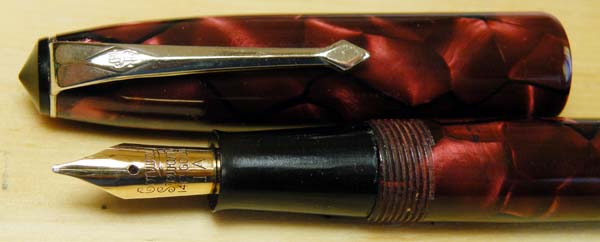
Which brings me to this pen:

It was advertised as a mottled hard rubber pen, and at first glance appears to be so, but it’s actually celluloid in a pattern that fairly faithfully replicates MHR. In shape, if you ignore the Art Deco stepped clip, it’s vaguely Duofold-ish, and was probably made in the early nineteen-thirties. It’s an English pen called “The Britannic” and I suspect it’s really a Platignum. Why would Mentmore/Platignum, a very commercially astute company, produce such a backward-looking pattern if not to cater to the taste of their more traditional customers?

Though it has never regained its earlier preeminence, hard rubber has never quite gone away. It remained in use for clip screws, sections and feeds on most pens, and it was revived by Mabie Todd for a range of lever fillers and leverlesses in the nineteen-forties. Some European companies have experimented with it in modern times and it has remained popular in India. I’m very fond of it myself and my small collection of user pens includes several hard rubber examples, favourite among them a Mabie Todd Swan Leverless 4461.

A Working Tool

Our view of fountain pens has changed enormously in the years since they ceased to be the main writing instrument. Today, very few of us truly need to use a fountain pen. It’s a luxury or hobby item, and whether new or old, is priced accordingly. Fifty or more years ago, a fountain pen was essential for work, if you were in a clerical, administrative or managerial job and even if you weren’t, you probably needed one for everyday correspondence. The price in those days reflected what the market would bear. A mid-fifties, middle-of-the-market pen that I have at the moment bears a label with the price of 18/6d, including purchase tax. A little googling around assures me that at the end of that decade the average weekly wage was £7.15/-, so a moderately-priced pen cost an appreciable lump of income. For most people, then, a pen was working tool that you expected, accidents aside, to last for a long time. It was a serious investment.

So how long could a pen last, heavily used every working day?

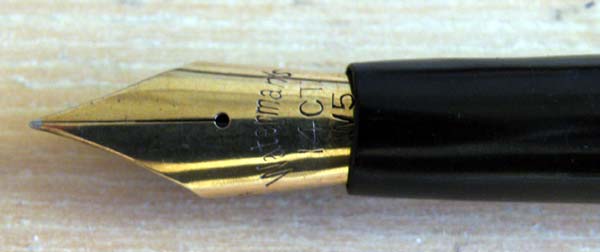
This is the most worn pen I’ve had pass through my hands. It’s an American Waterman 12. The cone cap has long gone, donated to a No12 that was in more saleable condition. Not only has the gold been worn off the barrel bands, the base metal itself is worn down. Even the black hard rubber itself is subtly indented where the user’s fingers gripped the pen. That’s serious use! Waterman 12s were in production up to the early 1920s, but the slightly rounded barrel end of this one marks it as an early example, before 1910. It has a replacement nib, a Waterman W5 that dates to around 1945. When I disassembled the pen, the staining on the shank of the nib indicated that it had been in place for a long time. Could it be that the original nib had worn out after thirty-five years of use and been replaced with whatever was handy and vaguely appropriate by a repairman?

Given the barrel wear, I think that scenario isn’t entirely beyond the realms of possibility. Would the original nib have survived thirty-odd years of use? I think it’s quite likely. Waterman No2 nibs were well made with a generous amount of tipping material, and they were often flexible, requiring a light touch in use. My own experience of pens that I bought twenty or more years ago (and were far from new then) and have had extensive use without visible wear bears that out.

In any case, that old Waterman 12 served its owner well and didn’t owe him or her anything when it was finally laid aside in a drawer. It’s exceptional, though, and that’s a very good thing, or we wouldn’t have all the old pens in very good condition that we do. In a way, that’s even more of a mystery. Why were excellent and usable pens set aside and forgotten when they represented a considerable investment to the average buyer? In the case of eyedropper fillers, I suppose convenience dictated that they be replaced with one of those snazzy new lever fillers. What about all the excellent 1920s and 1930s pens, though? They were too early to be superseded by ballpoints. Perhaps their owners were given a new pen for Christmas. Maybe they couldn’t resist the advertising for a state-of-the-art Swan Leverless or a colourful Conway Stewart.

All I can say is thank goodness those old pens were laid aside in good condition, and that they come to me to be restored and sent on their way out into the world for many more years of use.

Problems With Your Pen

If you have a problem with your old pen, would like to know more about it or want advice on a repair, use the “Leave A Comment” button to ask and I’ll try to help.

My main area of knowledge is British pens before 1970, but I have worked on most American and European pens too. I’m not an expert on fountain pen history but I can usually place a pen in its historical context and at least take a stab at the date.

Feel free to ask and I’ll do my best to give you a useful answer.

Casein

Casein found more favour as a material for pens in Britain than elsewhere. Sheaffer used it briefly in America, but otherwise, so far as I know, pens were not made from it there. In Britain, Burnham and Conway Stewart used it extensively.

From 1900, casein was sold under the commercial names such as Galalith and Erinoid and was used to manufacture buttons, such household items as clock cases and desk sets and, of course, pens. Though it did not mould well, it could be machined with ease and its main attraction was how well it took colouring, whether as a surface dye or throughout the material. The colours were strong and the material appeared to have exceptional depth of pattern as well as taking a high polish.

It was supplanted by celluloid which was, in almost all respects, a better material, but memory of the lustrous colours that could only be achieved by the use of casein led to its revival. Conway Stewart used it for several ranges of brightly coloured pens both before and after the war, and Burnham made much use of it in the post-war period.

It is well known that casein and water don’t mix. Immersion in water for a few hours will ruin such a pen. It will expand by about 10% and soften, and it will distort on drying out. That’s not to say that we should overreact about it. A wipe with a damp cloth won’t harm a casein pen, but there is good evidence that use in a highly humid climate can lead to deterioration.

Related to the above is another major problem with casein – crazing. This surface cracking is a result of exposure over a long period to light and dampness. The cracking goes quite deep and cannot be polished out. It is unsightly and spoils the lustre of the pen. Jonathan Donahaye, the late, great Conway Stewart collector, believed that those casein pens that we now find in perfect condition are the ones that were forgotten in the back of drawers. There’s every indication that he was right, and therein lies the clue to keeping your casein pen in good condition. Keep it out of bright sunlight, keep it dry, and store it in a dark, dry place when it is not in use. Otherwise, use it and enjoy it – that’s what it was intended for!

Casein Conway Stewart 15 Plum with Black Veins

How do you know whether your pen is celluloid or casein? Dump it in a basin of water and wait for two hours. No! Really! Don’t do that! Supposedly, casein smells of formaldehyde whereas celluloid smells of camphor. Also, if you rub casein briskly, it gives off a milky smell. I have to say that these tests don’t work very well for me. If you have a brightly coloured post-war Burnham, chances are it’s casein. Several ranges of Conway Stewarts, including the 475, 15, 759 and several Dinkies and Dandies (by no means a comprehensive list!) contain casein models. If the colours are strong and the pattern appears to reflect light from the depths, chances are it’s casein. Against that, remember that even among Conway Stewarts, celluloid is much more common than casein. Perhaps the best answer is to treat all your Conway Stewarts and Burnhams as if they were casein. Then you’re safe!

Flexibility

Nib flexibility is a big topic and it’s likely that I will return to it again, but this is an outline of the subject.

The most rigid nibs are those that contain the most gold, quite simply. They’re made from thicker material, and include, for example, Conway Stewart’s Duro nibs, Mabie Todd’s Eternal and most Parker Duofold nibs. Those nibs were often housed in more prestigious pens, with a price to match. Though perfectly suitable for general writing, those rigid nibs were suitable for use with multi-part forms.

Next is the semi-flex. In my book, that’s a nib that expands by one nib-width with pressure, e.g. fine to medium or medium to broad. Semi-flexes are the commonest type of British post and pre-war nib. Most Conway Stewart nibs, I find, are semi-flex.

Flexible, to my mind, is a nib that expands two nib-widths with pressure – fine to broad or medium to double-broad. I most often find flexible nibs in Swans, Watermans and De La Rue Onotos.

The Super-Flex, then, expands more than two nib-widths. They’re not common, but in my experience they occur most frequently in Swans, Blackbirds and Watermans. My most flexible nib is a fine Whytwarth which will safely expand to five times its unflexed width.

Of course there’s more to flexibility than the width of the line that can be induced. There’s “return” – the alacrity with which the nib snaps back to its unflexed state when the pressure is eased. Without good return you can’t really achieve good calligraphic effects. Then there’s the amount of pressure that can be safely applied to induce flexing. Some of the larger Swans take quite a bit, others need a very delicate touch. It takes a lot of careful experimentation to explore the flex of your pen. Some excellent nibs can be easily cracked or sprung with too enthusiastic pressure – Waterman Juniors, Blackbirds and the thinner of the post-war Conway Stewarts fall into this category. Such damage can be repaired but as it’s expensive, it’s best avoided.

The ultimate, for many calligraphers, is the pen that is extremely flexible and takes little or no pressure to get there. Jocularly known as a “Wet Noodle”, such a pen can produce wonderful effects, if you have the ability to control it. I confess that I find it difficult. I use a fairly stiff full flex, slowly, for special calligraphic effects, and for daily use a semi-flex is enough. My current daily user is a Conway Stewart 85 that flexes from medium to broad with very little pressure, and it’s a real pleasure to use and imparts interest and character to my writing.

Quality – Some Preliminary Thoughts.

The issue of quality in fountain pens – or anything else – can’t be covered in a single blog post, so I’ll be coming back to this subject again. For the moment, though, I would like to tackle some of the mistaken ideas about quality that I often see, mostly arising from the various coffee-table books that purport to recount the history of the fountain pen.

The worst one, I think, is the confusion of quality with bling. Many of the illustrated fountain pen books show page after page of pens with precious-metal overlays, portrayed as the best exemplars of their kind. I believe that to be wrong-headed. Quality in a pen resides in fitness for purpose. A plain black hard rubber Waterman 52 is a better pen to use than one that has had a filigree or solid metal overlay applied. It has its original weight, balance and thickness and it will handle as it was designed to do. I understand, of course, that for many collectors the overlay pen is more desirable, and due to the inclusion of precious metal and admirable craftsmanship it is a more valuable object. That’s not an issue of quality, though, it’s an issue of opulence. I’m not disparaging anyone’s wish to own an object of great beauty for the beauty’s sake; I’m just making the point that opulence has no bearing on quality.

Another point of confusion is the long-held practice of assigning pens, by manufacturer, to first, second and third-tier quality. It must be clear to anyone who thinks about it for a moment that this has never worked and yet it persists. Almost all manufacturers, present and past, make a range of pens to suit different pockets and purposes. Many manufacturers have suffered declines in quality, only to rise again later. Most manufacturers produced some pretty awful pens when they tried desperately to compete with ballpoints at the same time as cutting costs. It’s easy to produce some amusing paradoxes by following the “tier system” with regard to particular pens. Belmont must have been a better manufacturer than Parker, as the top of the 1930s Belmont range is undoubtedly a more sound and enduring pen than Parker’s Parkette. If the only Waterman you’d ever seen was an economy-model Taperite, would you have any hesitation in consigning the brand to the third tier?

In truth, each model of pen must be taken on its own merits. We can all make the quality evaluation with the pen in our hands, and those of us who buy older pens have the opportunity of adding the final dimension to quality: durability. If it’s still a good-looking pen that works well after seventy or eighty years, its quality is proven. For myself, I’m happy to accept that, for example, Macniven and Cameron produced some of the best and worst pens ever made, as did De La Rue and Parker. There are no tiers.