Cheap Pens

Schools are conservative organisations; in the 1950s, long after everyone else had given them up, schools insisted on children learning to write with dip pens – to what practical end I know not. Later, when the ballpoint pen had become ubiquitous, fountain pens were the order of the day – a wise decision this time, as we all know that people write better with fountain pens than anything else.

As the adult market for fountain pens disappeared like water down the drain when the plug has been pulled, manufacturers took note of this profitable development, and the “school student” class of pen became decidedly important to them. From the fifties to the eighties, a huge range of these economy pens was offered, and it hasn’t entirely died away yet, though the source has changed.

As I buy pens for restoration and resale, these economy models are a little outside my field, but some of them pass over my workbench, having arrived among job lots of pens I buy. As fountain pen users and appreciators, I think these pens are well worthy of our attention. Many of them are excellent writers – though not all. Pity the poor child whose parents supplied a Platignum, a Queensway, a Universal, the last of the Conway Stewarts or any of the host of rock-bottom Italian pens that flooded the market in those years. Those were the pens that made their reluctant users fiercely loyal to the Bic in years to come. Sad to say, some of the cheapest Parkers were no better.

There were many good economy pens, though. I’ve referred to Osmiroids with a cautious thumbs-up elsewhere. Sheaffer produced some excellent economical pens, including the low-cost Skripsert range, with small gold nibs which wrote very well. I have an Australian-made example which I’m very fond of, one of the few cartridge pens I own. The pen we call “The Sheaffer School Pen” – as simple a cartridge filler as could be made, with an excellent white metal nib, was justly popular, as was the “No Nonsense” with its range of plain and calligraphic nibs. Waterman, too, turned out good, cheap cartridge and lever pens with plated nibs, perhaps a little less robust than the Sheaffers but well able to last the length of a school career if afforded a little more care and respect than I ever managed at that age.

Most of you will be more aware of the recent examples of this class of pen than I am, as I rarely handle anything newer than about 1960, but I have come across the excellent plated-nib Pilots of the eighties, near-indestructible pens of admirable quality. More recently, Rotring and Lamy turned out good pens well within the budget of school pupils. I’ve seen a few Walitys, too. The very large eyedroppers appear to have a bad habit of dropping blobs of ink, but the smaller, Parker 45-like piston fillers are really good pens – or at least the one I have is – and they are astonishingly cheap! The Chinese, of course, make more fountain pens than anyone else now. The prices are low and the quality variable, but the Hero 616 is a good pen of its kind, as is the Sheaffer-like, tubular-nibbed Hero 235. I’m sure there must be many others.

What’s It Worth?

In the various pen groups, you’ll often see someone asking for a valuation of their old pen. Faced with what must appear to them to be evasive answers, they often end the thread on a fairly disgruntled note. In reality, though, they’re asking a question that is impossible to answer with any reasonable degree of accuracy. How do you put a value on an old pen?

Looking at some of the British retail sites, there’s a huge variation in the price set for common pens. Some seem unrealistically high to me and one wonders whether they ever make any sales. At least one is clearly going for a high turnover, with prices set below what might be made for the same pen in eBay on a good sales day. Not all days are good sales days, though… In any case, checking the retail sites is unlikely to give you better than a fairly wide range of prices for a particular pen.

I suppose, if you were rather better at it than I am, there might be ways of querying recent sales in eBay that would give you enough occurrences of the sale of a particular pen to enable you to come up with a ball-park price. In my experience, though, eBay makes these completed listings available for too short a period to give you enough for a representative sample.

The one larger sample I do have access to is my own set of sales records. I’m not a retailer; all my pens are auctioned in eBay. For this exercise, I chose black Conway Stewart 286s. They’re quite common pens and popular with both users and collectors, and because they’re black, and therefore a little less interesting, they’re not prone to the bidding wars that can produce unrealistic prices. I sold seventeen in the last twelve months. There were some that were either in perfect condition or quite poor, so removing them from the sample I have eleven average-to-good black 286s which sold for £42, £28.50, £38, £31.99, £36, £26.99, £26, £36, £38.21, £46 and £36. Taking a simple average gives £35.06. Is that the current price for a black Conway Stewart 286?

No. Not really. It might be a working estimate for one that I sell, restored to the conservative standard I abide to, using my descriptions and photographs, but that’s about all that can be said. There are some eBay sellers I know who restore pens to a new appearance. Their work is aimed at a slightly different subset of eBay buyers than mine, but their work is excellent of its kind and well-appreciated. Their sale prices will be at least double mine.

My own prices vary because the market is full of variables, too many to calculate accurately but including such things as how many similar pens were available in the same period, which buyers were in the market, differing national holidays, and many other incalculables.

So what’s my average-to-good restored 286 worth? The truthful – if intensely annoying – answer is “whatever someone will pay for it”. If you like it better, going on my experience, you might say that it’s likely to fetch at least £30 and unlikely to reach more than £50. That may well be wrong, though…

Do Filling Systems Become Outdated?

I think the answer must be that some do, but different forces like cost and fashion intervene in other cases. Take, for instance, Conklin’s crescent filler. This was an undoubted improvement over the eyedropper filler, in that it was self-contained and efficient. That its utility was appreciated is shown by its longevity – from the last years of the nineteenth century to the early nineteen thirties. During most of that period it was competing successfully against the lever filler. In the end, though, the crescent filler died and the lever filler triumphed. This may, at the margins, have been influenced by production cost, but I think it was mostly fashion, in the sense that the protruding hump of the filler began to be seen as clunky and old-fashioned.

Another early filling system, De La Rue’s Onoto plunger-filler, pre-dated and competed against the lever filler in a similar way. It lasted much longer, until 1955 in the UK and a few years longer in Australia. I have seen it asserted that production of the plunger-filler ceased because the filling system had become outdated, but I don’t think there’s any truth in that, or at least not in the normal sense. The reality, I believe, is that the shrinking market for fountain pens caused De La Rue to try to find a way of reducing production costs. Manufacture of the K-Series piston-fill Onotos was subcontracted to a German firm which had much more modern machinery and could achieve large productivity savings. Only final assembly was done in Britain. De La Rue was not alone in using this solution. Later, Conway Stewart would follow the same route. One might say, then, that the high production costs of the plunger-filler became outdated, but not that the system failed from inefficiency or unpopularity. It was, and remains, one of the most popular and effective filling systems – the high price of restored Onotos is evidence enough.

There are some filling systems that became largely rejected by the industry. The blow-filler, an inelegant and inefficient method, had a short life, its only real benefit being the low cost of production. Syringe and bulb filling are almost in the same category, but not quite. Neither is intrinsically a bad method, though one might say that the syringe filler lacks elegance as a solution. Nonetheless, it’s the basis of many converters today. The bulb filler, with a breather tube, is a highly efficient way of getting a lot of ink into a pen. The problem for these filling systems was that they were cheap to implement and were taken up by companies selling pens at the bottom of the market. Often poorly made, they led to customer dissatisfaction that, a little unjustly, caused to these systems to be rejected.

What about the lever-filler? Did it become outdated? In truth, I think it did, though its demise was from several causes. By 1960 or so, the fountain pen itself was no longer the first choice of writing instrument. Led by Waterman, pen companies saw an opportunity to salvage profitability by producing pens that would accept only a cartridge made by them, a modern marketing concept that had been pioneered by Gillette with its safety razors and continues today with inkjet printers. A pen with no moving parts was cheaper to make, too, and so the lever filler faded away, the end of a very long tale.

Lapis Lazuli

I’m having a lapis lazuli period at the moment. Months can go by without sight of a lapis pen, then they come flocking in. I’ve had four in the last three weeks, which is a record for me. I’m especially fond of lapis lazuli, in all its surprisingly varied forms.

In the 1920s, as the potential of celluloid began to be understood and more adventurously developed, a vogue for gemstone-themed patterns began. Jade and lapis lazuli, the earliest examples of this trend, were never very true to the appearance of the gemstone, but were more patterns in their own right. A little later, Waterman’s patterns such as Red Quartz or Onyx were very close to the original. Not just pretty patterns, these gemstone colours were at the heart of the spirit of the time. The use of gemstone in statuette bases, desk sets, clock cases, bookends and the like is very much an Art Deco expression, and these pens formed part of the same taste. By the late thirties the fashion was largely over, but in the intervening years some of the most beautiful and striking celluloid pens were produced. Lapis lazuli, along with the rest, disappeared from the pen catalogues until recently, when it was brought back as a revival by several modern pen companies, most notably by Kaweco and Cross.

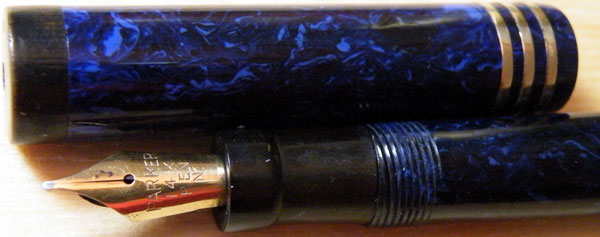
Parker, I believe, began the fashion. They had two main patterns, one dark blue with light blue inclusions, the other dark blue with off white inclusions. A third one is sometimes seen, a more marbled dark blue/light blue pattern, as in this Lucky Curve Parker Lady:

It was the one with the light blue inclusions that was copied most, and many manufacturers like Conway Stewart and Swan had versions. Here’s a classic example in an English Jewel pen:

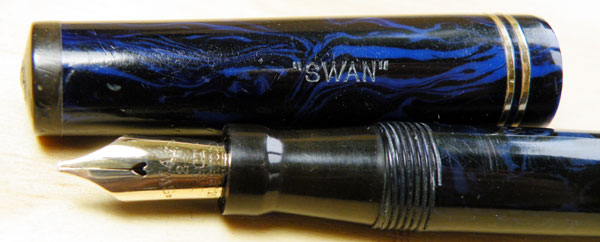
Some, such as Swan, went for a blue and black streaked version, which seems to me pretty far from the gemstone original, but is nonetheless accepted as lapis lazuli:

As I’d never seen an example, either illustrated or in reality, I long believed that Swan didn’t make lapis lazuli pens. They do, of course, both in Leverless form and in their self-fillers. A Swan 230 in a good lapis pattern would be pretty much my ideal pen.

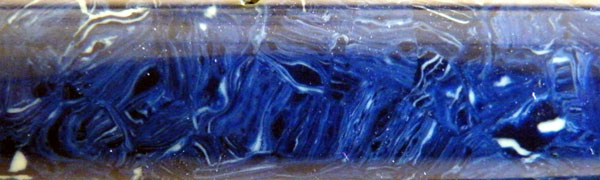
The most authentic-looking pattern I have seen so far is in an English no-name lever-filler flat-top:

That really does evoke the gemstone.

Though it doesn’t discolour as readily or as badly as some other celluloid patterns, like jade, black and cream or onyx, lapis lazuli can be spoiled by an out-gassing rubber sac, and should always be repaired using a silicon sac.

Mottled Hard Rubber

I had my say about black hard rubber the other day. Now let’s look at mottled hard rubber in its various forms including red ripple and woodgrain. Visually, MHR tends to survive in a more pleasing condition than may be the case with BHR. Yes, the blacks can fade but the pattern always remains clear. Often the surface has become dull, but a gentle polish with one of the usual proprietary polishes like simichrome will improve things. Even that abrades the surface a little, as you’ll see if you look at your polishing cloth, which will have picked up some colour from the pen. Myself, I prefer a non-abrasive solution like museum wax. It would always be my choice to stop at that. Any fading of the pattern is a reflection of the pen’s age. Unless it has spent the intervening years enclosed in a box, it isn’t reasonable to expect the pen to look as it did when it was new in nineteen-twenty-whatever.

Not every collector, user or restorer will agree with me, though, and that’s where radical solutions that I would reject come in. I only discuss them here because it’s better to cause less damage rather than more.

Restoring the original strong colours of the pattern can only be achieved by abrading the surface away. Metal-work such as levers, rings and clips must be removed. Imprints must either be sacrificed or saved at the cost of showing a different pattern colour from the rest of the pen. The surface of the material is evenly planed away using a medium grade of micromesh. Once an unfaded layer has been reached, successively finer grades are used to restore a smooth finish, and the pen can be reassembled.

Don’t try to do this with proprietary polish. Yes, polish is an abrasive, but it is a comparatively inefficient one, which is why we can use it on something as delicate as a fountain pen without causing damage – or at least visible damage. It won’t reduce the surface of MHR evenly, as an efficient abrasive like micromesh will. Using polish, the softer black areas will be reduced more than the harder red ones, producing an ugly, uneven surface which can only be repaired by further abrasion with micromesh.

As a conservative restorer, all of this falls outside what I do. Nonetheless, people do many things in the name of restoration, whether it be of paintings, buildings, motorcars or pens. Better that it be done properly if it is to be done at all.

Hard rubber is not especially fragile, except in the Red Hard Rubber form, which does merit particular care. MHR is little different from BHR in terms of strength, but it does get used for quite delicate pens, like the half-sized Watermans. Treat it with the respect you’d give to any old pen and you’ll be fine. Also, despite the surface, aesthetic effects of oxidisation, hard rubber is comparatively stable, more so than many celluloids or caseins, which were often poorly cured, or early injection-moulded plastics which had a tendency to shrink. Oxidisation does not weaken a pen; “curing” oxidisation by reducing component thickness may do. Remember, too, that the moment you have finished returning the pen to its original colours, the process of fading begins all over again.

Reblacking Revisited

I’ve touched on the subject of reblacking black hard rubber pens before, but today I’m going to rant.

I’m a conservative restorer. I don’t try to make a silk purse out of a sow’s ear. I produce restored pens for people to use, but my pens must also be in a condition acceptable to a collector. Not only do serious collectors reject reblacked pens, some, in recent times, have even given up collecting BHR pens because of the spread of the practice of reblacking.

I buy pens wherever I can, but mostly my choices are made on the basis of photos. Unless it’s an exceptionally good photo, you can’t tell that a pen has been reblacked. The minute it’s in your hand, of course, you are in no doubt. The most common reblacking agent is Syd Saperstein’s Pen Potion No9, which is only marginally better than black shoe polish. It does not come anywhere near replicating the original appearance of a black hard rubber pen. The best thing about Potion No 9 is that it is reversible. It can be removed. Trouble is, old pens have lots of surface imperfections that the potion penetrates, making it really difficult to remove the coating completely. It can be done, but it often requires hours of work. I could leave it, of course, but then I would be colluding in the fraud on the end buyer perpetrated by the person who reblacked the pen in the first place.

If you buy a faded black hard rubber pen and choose to reblack it, that’s your business. The pen is yours and neither I nor anyone else can tell you what you may or may not do with it. However, if you subsequently decide to sell it, there’s an ethical duty on you to declare that this is not a pristine pen that has retained its original colour, but a pen that has been artificially blackened. Worse still are the people who routinely reblack pens, not for their own pleasure, but to fraudulently sell them as having retained their original black colour. They never (or at least never in my experience) make it clear that these pens have been reblacked. It may well be that there is a subset of users and collectors who will be perfectly happy with these pens. There are others of us who don’t want them. It is only fair that we should be informed.

My own view is that reblacking should never be done. Even when it is carried out with the best of intentions, it will ultimately lead to someone taking ownership of a pen that is not what he or she believes it to be. Mostly, it is not done with good intentions, but purely to line the pockets of the unscrupulous. Aesthetically, it is not an improvement. All the reblacked pens I have seen have uneven colour, the machined patterns have soft edges and you can see brush strokes. Every one, without exception, and I test every black hard rubber pen I buy for reblacking. If it’s there, it comes off. So far, not a single reblacked pen would have fooled me – or anyone else.

My view will not prevail, of course, but I think the minimum the hobby should accept is disclosure, and disclosure in a permanent fashion that is attached to the pen. After all, there is another reblacking agent, Giovanni Abrate’s G-10, which was brought to market in 2007 and rapidly removed from general sale following an outcry of concern from the hobby. It was, I believe, then made available to one American restorer who will reblacken any pen and who has resisted requests for disclosure. I don’t know whether any of these pens have come my way or not. Unlike Syd’s potion, this stuff is irreversible and undetectable by normal means.

All of which, of course, has us doubting the validity of any shiny, black BHR pen we see. And that’s a problem.

The Standard British Pen

In my last post, about the Ingersoll pen, I mentioned how British-looking it was. Most British pens are pretty instantly recognisable as such, from the beginning of the thirties right up to the fifties, though of course many took new forms in the post-war period. By the latter end of the twenties a Standard British Pen was developing, and thereafter we see it among the output of most manufacturers.

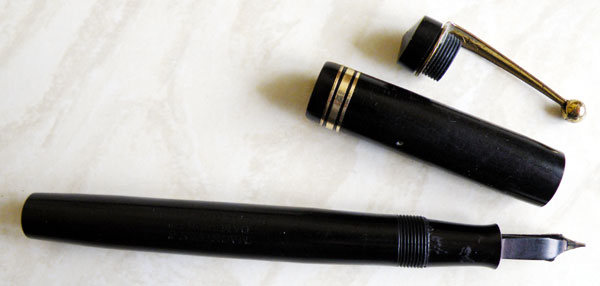
It’s straight-sided or only slightly tapered. Lever and button fillers both conform to the pattern. The clip is a washer type and it’s retained by a black hard rubber clip screw. Sections are also BHR and more often than not they will be either slightly stepped or concave. There will be either a ladder feed or some version of the spoon feed, always made from BHR. Almost all the common pens of the period conform to this pattern. Think of, for example, the Conway Stewart 286 or 475, a Stephens Leverfill or a Mentmore Autoflow. Though the filling system was different, even the De La Rue Onoto of the period had the same profile. In the fifties, Mentmore, Summit and Stephens were still producing pens like this, though they had more modern-looking models and some others, like Conway Stewart, had transformed their range except for the odd anachronism like the 388.

Why, when pen manufacturers elsewhere were enjoying success with more adventurous shapes of pen did the British trade remain so loyal to this pen type? The answer must be, simply that that was what the market demanded. The traditional shape sold. There were exceptions, of course, pens with visualated areas, and the odd rebellious baguette-shaped pen like the short-lived Croxley example. Then there was the biggest exception of all, the exception that proved the rule golden: Mabie Todd. They never produced a Standard British Pen, though they came close with some of their early Leverless pens. Not quite, though. Those pens had a washer clip of sorts, but it was manufactured as a unit with the clip. For the most part, Swan used inserted clips of one kind or another, and from the thirties on their pens were distinctly streamlined.

Weasel Words

Today, brethren and sistren, I am going to moan, grumble and groan about the language of our hobby. If this doesn’t appeal to you, pass on by. I expect the next post will have returned to the pens.

Those of you who are aware of my eBay listings as well as this blog may have noted that I never use the word “vintage” in my descriptions. Vintage, as I’m sure you are aware, originally referred to the annual crop of wine and on its own carried no note of approval or disapproval. However, if one were to say “Bordeaux, vintage of 1956” (I don’t know my wines from my Coca-Cola), those in the know would be able to determine whether in that context I was speaking with approval or disapproval. Then the word was hijacked by the old car hobby. First of all, they determined that cars that fell within a certain period were “veteran” cars. As time went on, this left another whole selection of not-quite-so-old cars that were also admired for their age and engineering quality. The hobby then sat down and decided that cars of a certain age could be legally described as “vintage”. If you tell me you have a vintage car, I will know exactly what you are talking about.

On the other hand if you tell me you have a vintage pen, the adjective carries no real burden of meaning because our hobby has avoided defining “vintage”. All I can take from it is that you have an old pen and the fact that you use that word suggests you want to sell it to me. Without definition it remains a junk word so far as our hobby is concerned. What I restore and what we all love are old pens. Mostly they are admirable old pens and often they are wonderful old pens, but that’s what they are. Old pens.

Even more appalling is the term “mint” and its variants, which we often see used to praise some piece of old tat. If it were to be defined as it is in numismatics, it would mean “completely unused and in perfect, unmarked condition”, but this is rarely the case with the pens that are described as mint. Then there’s “near-mint” which descends into the realm of utter meaninglessness. And worst of all, “minty”. What does that mean? Did the seller polish the pen with Colgate toothpaste?

Then (and this really gets my goat) there’s the habit of calling every mottled hard rubber pen “red ripple”. Red ripple applies to a particular flow patterning of the red and black hard rubber and in old pens, it’s confined to Watermans. It’s highly regarded, and red ripple Watermans tend to sell for more than mottled hard rubber Watermans, or, in most cases, mottled hard rubber pens by other manufacturers. Calling everyday mottled hard rubber or woodgrain red ripple comes very close to attempting to defraud the unwary buyer. “Woodgrain” is, quite simply, mottled hard rubber designed to look like wood. The best example is Wahl Eversharp’s wonderful rosewood pattern, but most later mottled hard rubber is in a woodgrain pattern. It carries no especial cachet or value.

I could get into “New Old Stock” but I won’t. That’s enough grumbling for today.

Flex Ramblings

In America, Parker and Sheaffer dispensed with flexible nibs early on. It’s sometimes suggested that this was to suit multi-part carbon forms, but it doesn’t seem likely that whole brands would become stiff-nibbed for that reason. I suspect that it was much more to do with lifetime warranties. Even in heavy hands, a rigid nib will survive when a flexible nib may crack or become sprung. Where the market leaders led, others followed, and flexible nibs became relatively uncommon in the USA, though there were exceptions such as Waterman and Wahl who still presented flexible nibs in their range.

In Britain, lifetime warranties never became a selling point, so most British nibs have some flexibility. Again, there are exceptions, like the Swan Eternal nib, Conway Stewart’s Duro and most Summits and Mentmores. Newhaven Parkers, too, are rigid, but I think that’s down to the influence of the American parent company.

As interest in writing with a variable line grows, people are increasingly turning to older, traditional pens, as contemporary pen makers seem unable to make a truly flexible nib. Even among those older pens, unless you are able to try before you buy or see a writing sample, it’s something of a lottery. Most Swan SM100/60s have some flexibility; many are very flexible indeed. Some are nails, though. Similarly, late forties Waterman 515s can be superbly flexible or rigid. This is why I include an example of the pen’s writing in my eBay listings – to eliminate the guesswork.

In the pen groups and on some websites you’ll see horror tales of cracked and sprung nibs, and the suggestion is regularly made that writing with flex is almost inhumanly difficult. It’s true that accidents will happen, and over-exuberance can destroy a valuable nib. I’ve done it myself. On the other hand, I have super-flex pens that I’ve used for years without any problem. With a little cautious experimentation you can find the reasonable limit of your nib. Thereafter, you stay away from that limit. As regards difficulty: perfect copperplate is difficult; enhancing your usual writing with a variable stroke isn’t. Practice makes perfect and it doesn’t take very much, either, before you begin to fall naturally into the rhythm of light up-strokes and bolder down-strokes. It’s how people have always written, until the advent of the rigid nib and the ballpoint pen. The quill was flexible, as were steel dip nibs.

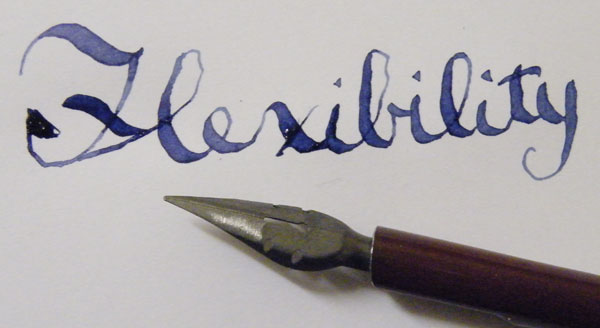
Indeed, if you want to try inexpensive and reliable flexibility, try a dip nib.

Excuse the scratching. I’m not at ease with a dip nib pen. In fact it’s not for me, with all that dipping and my unfortunate habit of digging into the paper with the steel nib! Good flex, though. This is a William Mitchell Panama No2 medium. I find it a bit of paper-cutter, but the Macniven and Cameron Waverley nib is more forgiving to a modern hand, in my experience.

The Biters, The Grippers and the Throwers Away

People do terrible things to fountain pens. When I examine a new arrival, the two things I look for are bite-marks and tool-marks. As a very general rule, with sadly too many exceptions, bite-marks tend to be on cheaper pens, the ones that were bought for school pupils. Chomping pens is a childish habit, though it isn’t entirely confined to children. If it’s no more than very shallow nibbles, I leave it alone. If the indentations are a bit deeper but there’s no savaging of the material, the application of heat can often work wonders. If it’s the “test the strength of my jaw muscles” gnawing, it’s time to look for another barrel.

Tool marks make me see red. They’re such an unnecessary piece of vandalism. If someone has used those old, worn pliers they had lying around, and the section moved easily, then there’s hope that heat will restore the section. That’s hardly ever the case, though. Usually, they seize the brand-new pliers they bought yesterday, the ones with razor-sharp jaws, and apply them with the grip of a demented gorilla. Nothing’s going to repair that, and there are only so many replacement sections. They’re not making them any more, for the pens I work on.

I’ve never used pliers on a section in my life. No, not even section pliers. Fingers are enough. We learn from an early age to control our fingers so as not to break things, but the moment we use something that will grip harder and apply more torque, we risk damage. Persistence, heat and judicious soaking (you don’t want to discolour black hard rubber sections) will eventually loosen all sections – even those glued-in Waterman Taperites or exceptionally-grippy lizard-skin Swans. Lest you imagine I do all this with the mighty power of my massive paws, I’m female, I have small hands and I don’t work out. I just have patience and perseverance. The section that doesn’t come out today will come out tomorrow. Or a week tomorrow. I do have a use for section pliers, but it’s not for sections. I use them to remove clip screws, where the thread is longer and deeper-seated and the part is not so fragile as a barrel. Even then, it’s with much preparation in the way of soaking and heating.

The other thing people will do is dismantle a pen they’re about to sell. That would be OK if they kept all the bits, but I not infrequently get button fillers with no pressure bar, and sometimes with no button either. I can only assume that they don’t like those nasty metal bits and they throw them away. I can usually find another button, but the loss of the pressure bar can be a problem. Modern replacement button-filler pressure bars aren’t very good. They are weak and don’t have the flexibility of the old ones. They have a tendency to stay bent when they should spring back. I’ve tried several sources but I think they must all be made by the same manufacturer. That means replacements have to be salvaged from somewhere else, and you can only do so much robbing Peter to pay Paul before you have a pile of inoperative button-fillers.