How Do I Find A Flexible-Nibbed Pen?

I’ll be discussing British pens in this context; finding flex nibs among American pens is different and I’ll leave that to someone else. Demand for flexible nibs never went away in Britain, and while there are many manufacturers who turned out firm-nibbed pens flex remained available until fountain pens began to go out of fashion in the mid-twentieth century. So there are plenty out there, but how do you find them?

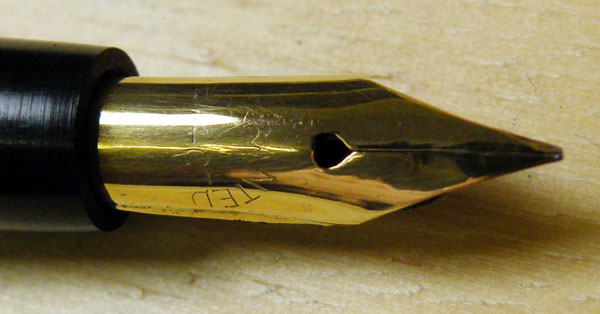
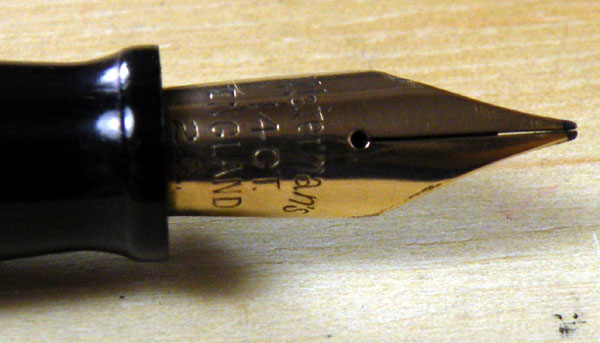
I think the only way you can be sure that you get a pen with the degree of flexibility that you want is to look for sellers who provide writing samples, or who give a good description of the writing characteristics of the nib. That said, there are areas of pen production where you’re more likely to be successful. Old pens, for a start: most eyedropper fillers and very early lever-fillers are more likely than not to show an appreciable level of flexibility. Flexibility was expected in a pen in those days. That’s just how people wrote. This old Wyvern 14B eyedropper’s nib is one of the most flexible I’ve ever had.

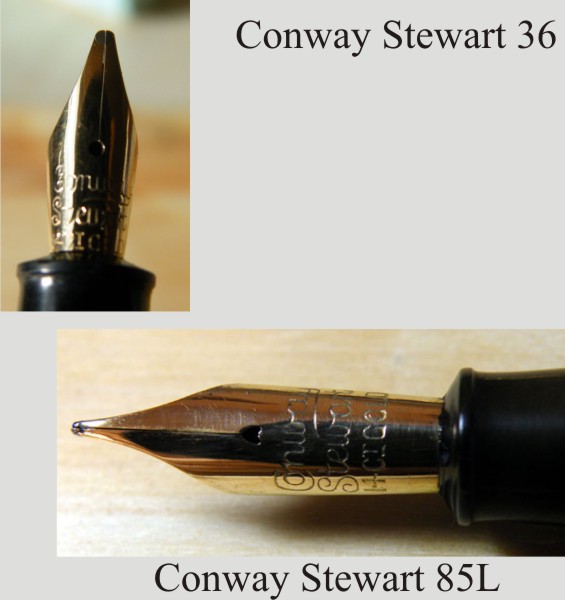
Most Conway Stewart nibs (Duros excepted) are slightly flexible. Looking back over the records of the hundreds I have sold, perhaps two in every hundred Conway Stewarts are really flexible. This broad No36 and the fine 85L were exceptionally flexible. Looking at them, you might just have guessed that the broad might be flexible but the fine looks like any other Conway Stewart nib. Its appearance gives no clue to its performance.

That’s a large part of the problem: appearance is no guide to nib performance. You would expect that any nib with long, slender tines would naturally be flexible, and sometimes they are, but equally often they’re not. This beautiful Swan Minor nib gives little variation.

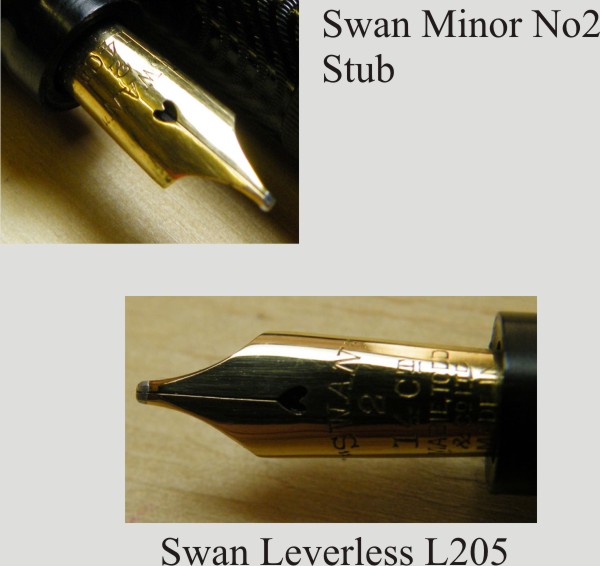
Counter-intuitively, those nibs with high shoulders and short tines are quite often super-flexes, like this Swan Minor No2 and this Leverless L205.

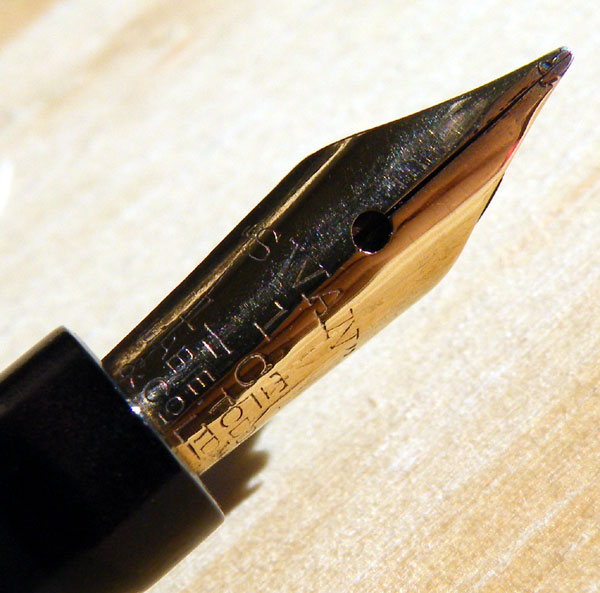
English Watermans of the nineteen-forties and fifties are about 50-50 flexible and firm. Most of those giving line variation are semi-flexible but some are really exceptional, like this 502.

As so many of the nineteen-thirties Watermans are of Canadian origin, it’s worth including them here. Many will have the flexibility you’re looking for, particularly the Waterman Junior, which is very often a full flex nib.

If you must have a flexible-nibbed pen – and their popularity seems to have taken off now – concentrate on the earlier pens, the Swans, the Blackbirds and the Watermans. Flex doesn’t always have to come at a high price, and many of these pens can be bought quite cheaply.

I’d Rather Break My Pen Than Yours

What I do is I buy in pens from wherever I can, restore them and sell them on. I don’t repair pens for other people and there’s a reason for that. You see, you’ll send me the precious pen left to you by your beloved grandmother, positively dripping with sentimental value, or that one very special pen you’ve spent half your life and much of your disposable income hunting down and acquiring, and I’ll break it. Irreparably. Nothing left but a sad little pile of useless fragments. And that’s absolutely certain to happen.

I’ve broken a few pens in my time. Ask any repairer and he’ll tell you the same, if he’s honest. I haven’t broken any in quite a while, though, several years in fact, she said, touching wood. To some degree, that’s luck, but mostly it’s patience and method. When I became serious about mending pens, I spent a while working on low-value to no-value old hacks – Platignums, Queensways and the like and pens that were irredeemably damaged, stained, faded or worn. I made my mistakes, I broke many pens and I gradually refined my methods of working. Most of all, I learned to reject The Demon Impatience and all his destructive ways. I like to keep up a good work-rate, but I don’t have deadlines. The recalcitrant pen that wants to hang onto its section can be put aside until tomorrow and the next day and the day after that. There are days when I’m not at my best and I know it would be a mistake to start on that fragile-barreled Eversharp. It can wait for a better day. There will be one along soon.

Having thusly retrained myself in pen repair zen, there’s nothing I’d rather do than fix pens. When I set up a line of pens to be restored, get all the tools I’ll need arranged just so and my boxes of spares and consumables are conveniently to hand, a peace descends upon me. I’ll be as happy as a sand-boy* assessing, disassembling, cleaning, adjusting and so on until there is a line of gleaming, restored pens and the whole day has passed by in a blink.

But I’d still break your Granny’s pen, so don’t ask me.

*Yes, I wondered what a sand-boy was and what he had to be so happy about too. It seems they were young lads who delivered sand to public houses, where it was used as a floor covering. They were often rewarded with glasses of ale, hence the happiness. Such a regime would not be conducive to good pen repair, I fear.

The Early Adopters

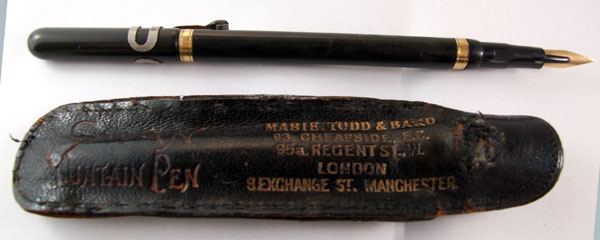
The Swan 1500 was, to my mind, Mabie Todd’s first fully practical fountain pen. Despite still using an over-and-under feed, ink delivery was fully under control. You can write as well with a 1500 as with any later pen. The same is not really true of earlier Swans, nor of the early output of other companies of the time. I’ve had several Mabie Todd & Bard pre-1900 pens, of which this is one:

It was made around 1895 and it’s in excellent condition. There’s every reason to believe that it writes as well now as it did when it was new. Like others of its age that I’ve used, it’s very wet, constantly hovering on the brink of dropping a blob of ink on the paper. It can be used to write well, but it takes a very delicate and steady touch. Not especially practical or easy to write with, then, and yet these pens sold in considerable numbers, judging by how many have survived.

It’s listed in the 1895 Harrod’s catalogue with the following description: “The ‘Swan’ Fountain Pen: a Vulcanite reservoir, holding a sufficient supply of ink for many days’ use, and a Gold Iridium-tipped pen, with apparatus for ensuring an even and ample flow of ink.” It came in fine, medium and broad points, and was priced at 9/0d (9 shillings) plain or 10/6d with gold plated bands. That’s a lot of money! By comparison, a box of Gillot’s gilt nibs was 4d, and you could buy a dozen cedar penholders for 5 ½d. Writing with a dip pen is clearly very, very much cheaper. True, once you had bought your fountain pen you wouldn’t have to buy any more nibs, but their price was really quite insignificant in comparison with the outlay you would have had to make on a fountain pen. If you were a really conservative stick-in-the-mud you could still buy quills in 1895, at 2/3d for a bundle of 25 of the highest quality!

Given that it was so much cheaper to write with a dip pen than with a fountain pen, why did they take off in the way they did? I think the answer is that, despite the shortcomings of these early pens, they conferred a hugely significant advantage over the earlier technology. Though it’s true that those who wrote regularly with dip pens were very fast, the constant need to refresh the ink was a real nuisance. It slowed the writing and broke the train of thought. The ability to write continuously without interruption was worth the high cost of a fountain pen. Though the technology was not quite mature and was still a little imperfect in use, it’s such a leap forward from what has gone before that it was the “Killer App” of its day. A more modern comparison might be with the dedicated word-processors of the late nineteen-seventies: somewhat clunky and not quite right, but still an immense improvement upon the electric typewriters that preceded them.

There can be no question that the fountain pens of this date were being bought by the more affluent end of society. In a few short years ever more efficient mass production would make them available to all.

The Homage, The Copy and The Fake

The history of the fountain pen is one of the transfer of ideas, whether as homage, copy or fake. For example, the Parker Duofold is probably the most-copied pen ever. Within a year or two of its appearance, almost every American pen maker, and many elsewhere, had produced a very Duofold-like pen. Homage? Hardly. That’s the excuse the copiers might give, and Parker might have felt mildly complimented by the fact that their flagship pen was so appreciated, but in reality those Duofold-alikes were made to invade the Duofold market. The fountain pen world was a dog-eat-dog one, and the ethics of the industry were always a little shaky. Actual theft of original technical ideas was intended to be prevented by patents, but such was the ingenuity of the industry that ways were quickly found to adapt new ideas sufficiently to avoid the provisions of patents. The industry was hair-trigger litigious, but even aggressive use of the courts couldn’t stop the spread of good ideas. Most of what was done – or had to be allowed to continue to be done, at least – was legal.

So it is that you find lesser (and sometimes not so much lesser!) pens that look like Patricians or Skylines or Parker 51s. If you were a pen manufacturer who believed that the Parker 51 was the way that pens were going to go in the future, you would be foolish not to emulate that style, while keeping clear of the specific patents that related to that pen. That’s not so different from what’s happening today in China, where they make all those pens that look suspiciously like Parker 45s, Sheaffer Triumphs or various Montblancs, but carry the Chinese manufacturer’s name and are therefore copies or homages, and not fakes. There’s nothing new in pendom. The Chinese are only doing today what American, British and Italian manufacturers did long ago.

True fakes are another matter, and are a modern phenomenon, only possible because some highly-regarded pens sell for many multiples of the cost of production. It is that huge margin that opens the door to the fake, or at least to the fake that will convince beyond the first glance. Tooling up to produce a fake costs little or no less than it would cost to make an original pen. Certainly, savings are made in using cheaper materials throughout, but the more convincing fakes have to be at least adequate pens in their own right. Selling those pens in huge numbers with a more slender margin is where the profit lies. The absence of any real warranty or after-sales service also keeps costs down, and as with fakes of other labelled goods, the amount of money that can be made ensures that they will always be with us.

I concentrate on pens made before 1960, for the most part, and fakes aren’t really a concern for me. Some older pens are faked, of course. Very ordinary older pens are covered with fake overlays, for instance, but these are a bit outside what I usually handle, and the collectors of these items are pretty perceptive. Those fakes are quickly identified whenever they appear. Among more ordinary pens, you won’t find fakes. In recent weeks, I’ve seen buyers of a Stephens Leverfill and a Swan Calligraph expressing concern that their purchases were not as they expected and might be fakes. They weren’t, of course. No-one’s going to tool up to fake £35.00, sixty or seventy-year-old everyday pens. There’s no money in it.

What can happen, though, is that inappropriate parts will be mated together to make a pen look like something other than what it is. Be on your guard against that, especially with 1920s Swans. Ask questions and if the answers don’t satisfy you, don’t buy. A clearly genuine example will be along soon!

It’s All About Efficiency – Or Is It?

Technological progress, one might say, moves from less efficient to more efficient. That would seem reasonable. I often think about this in regard to the history of the fountain pen. It seems to start well, but by the latter end it tends to fall away. Perhaps in the later years of the fountain pen the target was not so much efficiency as something else.

The eyedropper filler was certainly a step up from the dip pen, in that you only had to mess around with ink occasionally instead of constantly. It was still a decided hack, though. Unscrewing the section (can be messy), loading the pipette, filling the barrel, screwing the section back on, tapping or shaking the ink through, rinsing the pipette. It’s all a bit of a distraction. The various coin fillers, match fillers and especially the admirable crescent filler were a notable improvement. Plunger fillers and syringe fillers are convenient and clean too. The button filler, especially the larger ones like the bigger Duofolds, are exceptionally convenient to use – were it not for the possibility of losing the blind cap. Pens with a fixed button filler, like the Stephens stud filler, may be among the most convenient pens of all. In the main, the industry settled for the lever filler. It’s a good system, but it can be messy when the ink is low in the bottle, and some of those levers seemed designed to do injury to the thumb. Later pens, like the Parker Aerometric fillers, seem like a cop-out from the struggle towards greater technological efficiency. Unscrewing the whole barrel to operate a squeeze filler works well enough, but it’s not elegant. I suspect that the unbroken line of the barrel trumped efficiency of use here.

Finally, we have the cartridge filler. Frankly, it has little to recommend it. You unscrew the barrel, remove the old cartridge (distinct risk of ick at this point), push another cartridge in, put the barrel back on and tap or shake the ink through. It’s not a self-contained system. We’re three-quarters of the way back to the eyedropper filler! The cartridge filler, it seems to me, is the means whereby very small quantities of ink can be sold at a premium to the gullible.

For myself, I love the elegance of Stephens’s clever button filler, but the pen that keeps returning to my desk is my old Conklin Crescent filler. It’s simple, intuitive, efficient and it has the technology on the outside, like a Richard Rogers building. That’s style!

The Pen Conundrum

Paradoxically, though fountain pens feature large in my life nowadays, I rarely have an occasion to write with them. I restore fountain pens, sell them, write about them, talk about them, advise on them, but I hardly ever apply one to paper except for testing.

In reality, of course, few of us hand-write much at all these days. When I entered the world of work, there were armies of clerks charting production, commerce and finance by filling ledgers with advancing columns of figures. Since the late seventies, the hosts of pen-pushers have been replaced by a radically smaller number of keyboard jockeys. Even in those days, though, it wasn’t fountain pens the clerks used (I’m not quite that old); it was the ubiquitous Bic ballpoint. The hand-written business letter disappeared long ago, and social correspondence is conducted by email. This is not a complaint, by the way, or a yearning for the good old days that never were. It’s a huge and unalloyed benefit that people’s lives are no longer deadened by the crushing boredom of being a progress clerk or a commercial assistant, condemned to spending days shuffling figures from one ledger to another. That’s what computers are for; tedium doesn’t poison their lives. Email’s a lot quicker and more reliable than airmail, too.

I was rather lucky. In quite recent years, I had use for fountain pens at work. In one job, the use of a fountain pen with indelible ink was actually statutory, so that a permanent and unalterable holograph record was created. That function disappeared around 2003 when the powers-that-be concluded that the Portable Document Format file was equally secure and moved the work onto computer. Our £20.00 pens were replaced with £500.00 PCs in the interest of cost saving. You and I might be aware of how trivially simple it is to hack even a signed .pdf file, but my superiors and betters closed their minds to this possibility and progress marched inexorably on.

In a later job, I had colleagues and superiors who were tempted to edit my decisions and reports in pursuit of their own agenda, so I left my laptop closed and reverted to my fountain pen. It may not be impossible, but it’s well-nigh insuperably difficult to alter a handwritten script produced with a very flexible stub Onoto that leaves a line almost as individual and characteristic as a fingerprint.

Now that I restore pens for a living, I have neither time nor opportunity to write much. On the pad by my keyboard rests a Pentel Liquid Gel pen to scribble the odd note I might have to take. My correspondence is done in OpenOffice Writer and my accounts in Excel. All these wonderful old pens pass through my hands and once I’ve established that they write as they should, they’re flushed out and laid aside.

There’s something not right about that…

Weighty Matters

I’m returning to quality today, specifically the common modern equation of weight with quality.

First, to get it out of the way, I prefer a light pen. It seems to me that a pen should be as light as is reasonably possible, and that weight confers no benefit to the writer. That pen manufacturers agree is borne out by the fact that all pens made when they were the primary writing instrument were light, and the default writing instrument today, the Bic pen, weighs next to nothing. That said, many people today prefer a heavy pen. That’s fine. Why shouldn’t they? It’s not the preference for heavy pens I’m arguing with, it’s rather the assumption that a high quality pen will weigh more than a low quality one. Clearly, the reverse is often true, and in fact weight is an irrelevance in the assessment of quality.

To go straight to the extreme, some of the heaviest pens around are cheaply made in China, Dukes, for instance. Not all Dukes are heavy but many are, and in those, the weight comes from a brass barrel and sometimes a brass cap, too. These are just bits of tubing, not unlike the tubing used in a domestic heating system. They’re not expressive of high quality manufacturing, nor are they high quality materials. In fact, these are very poor quality materials used in a (at best) so-so pen.

Taking a less extreme example, which is better, a 1930s Sheaffer Balance or a Sheaffer Intrigue? I don’t have an Intrigue to hand, so I can’t give you their respective weights, but the Intrigue is very much heavier. Taken purely from the point of view of utility, the Intrigue was hardly an unalloyed success. From the outset, many buyers complained of the weight. Many were hard starters or did not write at all without work being done on the nib. The parts did not fit together very well, and the end button which opened the pen to put in a cartridge and doubled as a filling button when the captive converter was used was often offset to a noticeable degree. The weight came from the (mostly) metal construction and the complexity of the filling system. By contrast, the lever-fill Balance was feather-light, extremely well made and remains very popular and useful today. I would suggest that the old Balance is an immeasurably better pen than the Intrigue. Weight may confer the idea of quality in the minds of some, but the reality is a little different!

Quality lies in elegance of design, excellence of manufacture and usefulness. In a primary writing instrument, good design will aim to reduce weight, not increase it. However, fountain pens are no longer primary writing instruments. Most data entry is by computer these days, and letters and memos are written in word processing programs. No-one has a pen in their hand for the duration of a working day, as they once did. For some, at least, the modern fountain pen is an indicator of status, and once it has been noticed it has done its job. It doesn’t even need to be uncapped! For others, it’s an occasional note-taker. In these circumstances weight (though by no means an indication of quality) is an irrelevance.

Soaking

Removing sections from barrels is one of the more difficult jobs restorers do. More than any other operation, it’s the one where you can ruin a pen in an instant. You have to be careful – you don’t necessarily know how that section is fitted in there. Is it a friction fit or a screw-in? Might it even be a left-hand thread? At the same time, you have to exert a considerable amount of pressure on that delicate joint. And then there are the sections that don’t want to let go, the ones that feel like they’re welded in.

“How do I remove this section?” is a regular enquiry on the fountain pen forums. One of the common responses is to soak the pen at the area of the section/barrel joint. Personally, I would never do this. I have done, in the long ago, and soon learned that it didn’t slacken the joint and, if the section was made of hard rubber as they usually are in pens of the period I deal with, the HR was often faded by the soaking.

What is it that the soaking is supposed to achieve? Is it believed that the water will penetrate the joint and lubricate it? Frankly, it doesn’t. Water isn’t penetrating oil. It doesn’t find its way into every nook and cranny. Perhaps it’s intended to dissolve any adhesives used. Actually, it’s quite uncommon to find sections stuck in with adhesives (1940s Watermans excepted) and where they are, water is unlikely to dissolve most adhesives. How about warm water, then? Well, it might be a little more penetrative, but only marginally, whereas it’s guaranteed to discolour BHR in the worst way. Add a few drops of dish soap, some say. Again, it might make it a little more penetrating but it’s excessively harmful to HR. Try this. Take a piece of scrap BHR and soak it in warm, slightly soapy water for a couple of hours. Dry it with a kitchen towel as best you can. You’ll find that it doesn’t really dry at once, and has a slightly slimy feel for a while. The surface of the BHR has been penetrated by the soap solution, with what long-term effects I know not, but I suspect it ain’t good.

From my own experience over the years, I would say don’t soak sections. There’s no evidence that it does anything useful and it can do harm. Use dry heat instead. It doesn’t take a lot – a hair drier will do. Heat softens the material a little, making it less brittle and so less prone to breakage. Even when both section and barrel are made from the same material, there will be a tiny bit of differential expansion, breaking the seal. On those few occasions when the section is glued in, heat will soften the adhesive. As I always say (and it’s worth repeating again) patience and persistence are the watchwords. Some pens – plastic Watermans, some Wahl-Eversharps and lizard or snakeskin-patterned Swans among them – may take days of repetitions of the application of moderate heat and careful force to separate the barrel and section, but if that’s what it takes, that’s what it takes. Impatience will break the barrel.

For sac-filler or eyedropper pens, I’d say soaking should play no part in repair. Plunger filler or piston-filler pens are another matter, but I don’t intend to discuss them today. “How about ink-encrusted cap interiors?” I hear you ask. “Don’t they need soaked?” If they’re hard rubber, black or coloured, absolutely not. Get to work with cotton buds and do the best you can. If they’re plastic, a short spell in the ultrasonic cleaner followed by more cotton bud work will do a great job. In my opinion, it’s best to avoid the soap here, too. Pen caps are designed to handle a certain amount of liquid, but soap will leave a residue that will do no good, especially to metal parts like clip fitments.

Remove the most of the water with the hair drier and leave the cap to air-dry for a few hours.

If you’re going to knock out the feed and nib, it’s essential to get water through the section to dissolve hardened ink deposits. No need for extended soaking here either, though. Run it under the tap until water is passing through the section and that’s all you need. Dry off a hard rubber section at once, before you knock out the feed and nib, to protect the colour.

Thoughts On This Blog

When I began this blog, a large part of my intention was to get some information about British pen brands out onto the Web. Our American colleagues have been much more successful in making brand information available online than we have on this side of the Atlantic. All the US major brands are very well covered and there are many sites devoted to lesser manufacturers. If you want to know about a Wearever, you can find quite a bit of information. If your interest is in a Nova, you can pretty well forget it. Sadly, for the Nova, I can’t add a thing to the sum total of human knowledge; it’s a total mystery to me, but I have managed to at least put together a few words about some of the other minor brands.

It is a sad fact that for British pens we only have two authoritative sites. For Conway Stewart there is the late lamented Jonathan Donahaye’s superb list: http://jonathandonahaye.conwaystewart.info/

The Parker pens made at Newhaven are well covered in Tony Fischier’s wonderful Parker site:

http://parkercollector.com/index.shtml

That’s more or less it. If you want comprehensive web-based information on such industry giants as De La Rue, Mabie Todd, Burnham or Mentmore – never mind the host of smaller firms – you won’t find it. Why should that be? Why are we so far behind in celebrating our great fountain pen industry online?

I’m sure there are many reasons. It’s not that the information isn’t available. It is, but it’s locked up in an earlier paradigm of hobby activity: the magazine. I hesitate to be critical of The Writing Equipment Society, an estimable organisation much loved by a large and wide membership. The best British research and writing on pens goes into their magazine, and there it sits, in dead print. The only way to access the wealth of knowledge that the WES has accrued over the years would be to buy all the back issues, an impossibly expensive exercise. How much better served would we all be if that treasure-house of knowledge was web-based!

I cannot compete with the historical rigour of Donahaye or Fischier, nor with the breadth and depth of scholarship in the WES Journal, but I am not discouraged. I am no historian but I have maintained an interest in fountain pens for several decades. It would be nice if I could cite sound sources for every statement I make, but usually I can’t. The snippets of information I string together about the various pen manufacturers come in part from my reading, but much more from the pens themselves and from discussions with other collectors and repairers. I try to be accurate but sometimes I have to speculate, though I try to do so responsibly. In the end, if what I have written here will give someone a clue about their recently-acquired old pen I am satisfied. If my statements give rise to discussion that furthers our knowledge, I will be delighted.

Modern Nibs: The Dissenting View

There may well be some among those of you who read these witless ramblings of mine who buy modern pens as well as old ones, or even (heaven forfend) only buy new pens. If you count yourself among this number, stop reading now. Pass by on the other side of the road and don’t look. It’s going to get messy in here and it will upset you. Why expose yourself to that?

Almost all of my interest in – indeed, obsession with – writing instruments resides in those made before the ballpoint watershed: around 1965 or 1970. After that, whether at work or at home, whenever you needed to jot something down, you reached for a ballpoint pen, and such fountain pens as continued to be produced were no longer quite the same as they had been. The market became a collection of niches: pens were made for school students, for people of a resolutely conservative nature and for collectors. The very economic basis of pen production changed. I would contend that the nature of the pens produced changed too. The mainstream primary writing instrument form of fountain pen had gone, never to return.

There are a number of problems with modern fountain pens that I could take issue with (and may on a future occasion) but they all pale into insignificance compared with the worst one: nibs. Many, indeed most, modern nibs are as rigid as a ploughshare and just about as thick. Often they are unnecessarily large. This, I suspect, is to provide a surface for the badly-executed, childish curlicue engravings that deface almost all modern nibs. The most egregious fault, though, is the application of a huge, globular blob of tipping material. I look at these spherical tips and fear that the stocks of rare platinum-group metals they are composed of will not see out the decade. Maybe not even the year.

It is as if these nibs were made by someone who had never actually seen a nib, but had had one described to them, though not particularly well. They have many of the characteristics of a traditional nib, and even look like one, from a distance, if you half-close your eyes. They do, in many cases, get the ink from the reservoir to the paper but that’s about it. Because of that tipping blob and their rigidity, they write like a ballpoint, in both feel and line. My view would be that if you want to write like that, stick with the ballpoint. It’s better at it. Why, one asks, have nibs come to this? The answers seem to be (a) cost and (b) demand. We are told that it would be too expensive now to produce a nib of yesteryear. Frankly, I dismiss that argument. Modern pens cost a lot. In moments of foolishness (to which I am prone) I have bought a few. All have cost more than my television set. Many cost more than good second-hand motorbikes I’ve bought. At those prices they could hand-make the nib from smelting the metal up to the final polish and still have a monstrous margin. Secondly, we’re told that people don’t want nibs of character or flexibility. They want pens that write like ballpoints. That’s what they’re used to and they would break a more delicate nib. That’s a little insulting to the fountain pen user, isn’t it? I know quite a few pen people. They’re generally intelligent and have pretty good manual dexterity. This argument, it seems to me, goes along with the one that says that writing with a flexible nib is incredibly difficult, requiring the precision of hand and lightness of touch of a brain surgeon. These are bogeyman tales told to frighten fountain pen buyers away from demanding that manufacturers make a decent nib, it seems to me.

Instead, having re-mortgaged their house to buy the latest Italian or Japanese offering, the poor fountain pen user must spend even more money to have the pen made usable. He sends it away and waits six months until the “nibmeister” of choice deigns to hack at his precious nib with a grinder. All of that keeps the nib mechanic in yachts and 30-bedroom mansions, but what does it say about the pen manufacturer? And even worse, about the pen buyer who tolerates this nonsense?

I contain my amazement as best I can and return to the safe haven of my old pens. Even there, to my horror, the blight of the modern nib causes trouble. Now and again, an aficionado of modern pens will decide to try one of those “vintage” pens he hears so much about on the pen boards. And he buys one. From me, bless him. When his long-awaited antique treasure arrives, he examines the nib, sees how little tipping material there is on the nib, and accuses me of having sold him a worn-out pen. Case in point, some time ago I offered an English Parker Duofold Senior on eBay. The pen was in pristine condition, barely used, with all its original tipping material present. For their time, these pens sported a good lump of tipping material, but of course it is a mere fly-speck compared with a modern pen. The purchaser was much aggrieved with me and copied me a picture of a brand new Duofold to show me what the nib tip should look like. In reply, I sent him several images of 1950s Duofold nibs that I found in a Google search for comparison, but he remained unconvinced. My explanation that modern nib-makers apply tipping material with the profligacy of a lottery winner in a jewellery shop was dismissed as fiction. I took the pen back. So it goes.

If you ignored my warning at the beginning of this tirade and are now filled with ire and outrage, comfort yourself with the thought that my opinion is only one among many. I’m clearly an embittered old curmudgeon and there’s no truth in what I say. Return to your brand new Laban or Montegrappa and study your reflection in that shiny globe on the end of the nib. You’ll soon feel better.