The Army & Navy Stores Stationery Catalogue 1907

I picked up this Army & Navy Stores Stationery Department catalogue from 1907 recently, mostly because I knew there would be pens in it – and there were.


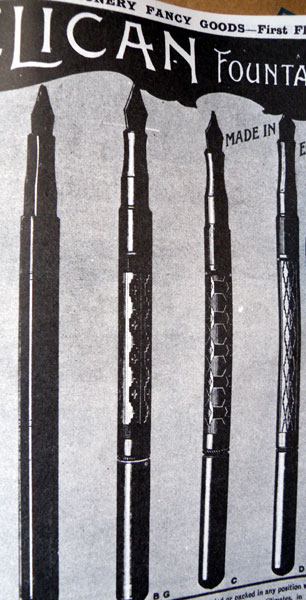
Here are some of De La Rue’s “Pelican” eyedropper pens. Always ahead of the field, these pens had a cut-off valve which enabled them to be carried without risk of leaking.


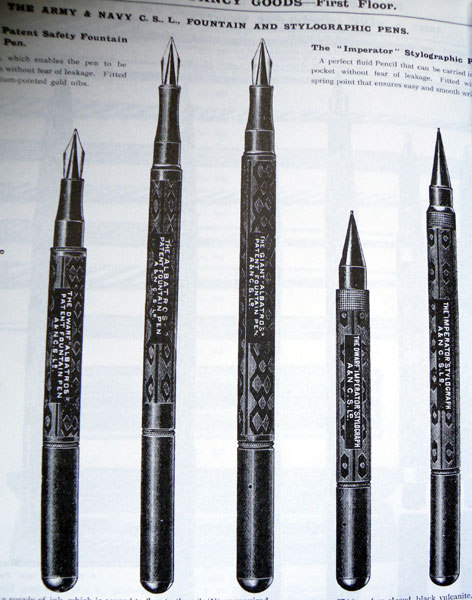
These are the Army & Navy Stores’ own-brand pen, some of which also had cut-off valves. Did De La Rue make these pens for the Army & Navy Stores? Pelicans are rare and expensive now but they do appear from time to time. The Army & Navy Stores pens seem to have disappeared without trace. I don’t remember ever seeing one for sale.

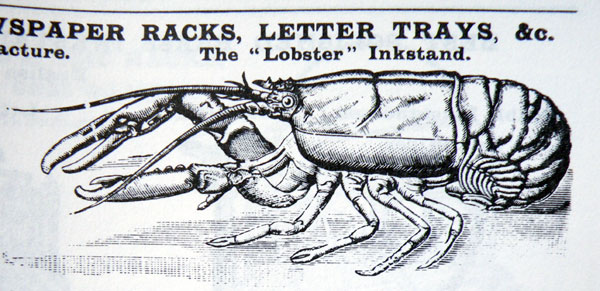
However, if you didn’t trust these new-fangled fountain pens and decided to stick with your dip pen, you could buy a nice polished brass lobster ink-stand:


What? You wouldn’t be seen dead with a lobster ink-stand? You think it’s a creepy horror from a sick mind? I concur, people. Indeed I do.

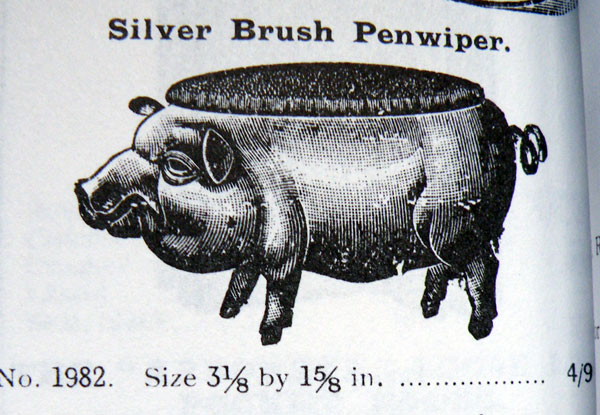
But if the lobster ink-stand made you shiver with revulsion, how about this cute piggy pen-wiper for only four shillings and ninepence?


The Cursed Polishing Wheel And Other Stories

Though I would never use one myself, I am sure that a polishing wheel, even in the field of fountain pen restoration, may be a useful tool in the hands of someone who can apply it judiciously and with restraint. Sadly, polishing wheels rarely fall into such hands; they’re usually employed by maniacs who, teeth and eyes gleaming madly, polish precious pens into shiny nubs.


This was once a Swan Self-Filler, most likely an SF2, before it was polished within an inch of its life. There is the barest ghost of the chasing and a very faint memory of the barrel imprint, but it’s shiny. Very characterless and very shiny.

I suppose it’s unlikely that the people who do these things read my blog, or even read at all, but if there’s any chance of penetrating the density of bone that surrounds the pea-sized object they call a brain, let me say this, “Step away from the polisher! Do it now!”

In all seriousness, old pens are a finite resource, scarcer already, perhaps, than we might think. Treat them with respect. They are fine instruments and an important part of humanity’s history.


Here’s me doing descriptions for next week’s pen sales. Except, of course, that I’m not in the photograph because I’m the one taking it, but you get what I mean. I don’t believe in re-inventing the wheel any more often than is forced upon me, so I save all pen descriptions. A Waterman W2 is a Waterman W2 whether I prepared it for sale a year ago or today (though the variation in sizes of some quite modern pens almost gives the lie to that statement) so I reuse the the file with minor modifications to allow for colour, condition, nib type and so on. Despite having sold many hundreds of pens, though, there are some weeks when at least half the descriptions have to be written from scratch. This is such a week. It’s more of a chore but it’s more interesting too. It’s an indication of the unending variety of old pens out there.

Some Thoughts I Thunk.

It has been a busy week for me with hardly a day at home, hence the paucity of posts. Nonetheless, there have been a few interesting things, some, at least, of which I hope to write about in the coming days. There’s a very early Fattorini piston filler – you don’t come across one of them every day! A delightful Wahl metal-bodied pen found its way to my bench and so did a 1920s De La Rue pen, as fresh as the day it was made, with chasing so sharp it would cut you.

In eBay this very day there’s a 1940s/50s English Waterman button-filler. Yes, that’s right. A Waterman button-filler! Such things are rarely seen. I had a mind to buy it but I think it’s going beyond my reach. Bear in mind that I at least have to get my money back to carry on, and the rarest of rare pens aren’t always the ones to make the money, especially when they’re rare enough that most people don’t know they exist. It’s the scarce-but-sought-after pens that make squillions.

Despite having been around for a few decades, there are signs that our hobby has yet to get beyond its mewling and puking infancy. There was a thread about the meaning of the word “vintage” with reference to pens in FPN this week. The standard of debate was such that I fear it will be a generation or two yet before our hobby is able to develop universally-agreed standards, and it will remain all the poorer for that. It is true that the worst elements of earlier years have been driven out, mainly by eBay’s presence establishing prices that reflect value a little better than those prevalent before it was around, but we still have a long way to go. A glance at the more mature hobbies like veteran and vintage motor-cars, numismatics and philately show where we might be some day.

The Blackening Rant

We’ve discussed the ethics of pen re-blackening on a previous occasion. Let’s now look at the practicalities. Unless there is a system so secret that we don’t know of its existence, re-blackening doesn’t work. Anyone who believes that a pen painted with Syd Saperstein’s noxious potion looks like black hard rubber did when it was new is suffering from a specially virulent strain of terminal self-delusion. The only difference that I can see between a pen re-blackened with that stuff and with boot polish is that the boot polish looks better. It does tend to smell of boot polish and come off on your fingers, but it looks better.

I would like to say in the liberal airy-fairy vacant-headed way that so many do that your pen is your own and you can do with it as you wish. You’ve got a fine old Waterman 52 that’s a tad brown. If you decide to re-blacken it, it’s nobody’s business but your own, n’est-ce-pas? Well, no. It may come as a shock to you but you’re going to die one day, and that Waterman 52 will go back into the Great Pen Pool and come back around to be a nuisance to someone like me. So I’m not going to be that wishy-washy liberal oh-so-fair-minded person. Indeed, what I would rather say to you is that if you have the least notion of re-blackening a pen, go out your front door, turn sharp right, turn sharp right again and beat your head on the wall until the idea goes away, or the proposition becomes impractical due to your vision being affected by the blood in your eyes and the onset of concussion.

Of course, most pens that are re-blackened aren’t re-blackened by innocents for their own pleasure. They are re-blackened by grasping, avaricious crooks, devoid of morality or ethics, just to make a few bucks more regardless of the damage that is done. I spent an hour tonight removing, as best I could, a heavy application of Syd Saperstein’s gunk from an otherwise excellent Swan Safety Screw Cap No2. It looked unbelievably dreadful, as re-blacked pens always do. It looks a lot better now, but nowhere near as good as it did before the paint-happy cretin went to work on it. The notion that you can completely remove re-blackening is a fallacy. Pens with chasing and with the scratches of a century of use will retain blackening, do what you will, to their detriment. Re-blackening a century-old pen of such a high quality as this is simply vandalism. It’s utterly inexcusable and anyone who would do such a thing is no pen lover.

In conclusion, in case you missed it, don’t re-blacken your pens. You are only their temporary custodian. Most of the pens I’m talking about are already older than you and they will outlive you. Treat them with respect. Polish them carefully, with good, appropriate polish. That will make even the most faded pen look more attractive. Use them. The more they are handled, the more they will darken, and the better they will look.

Old things are meant to look old. It’s one of the places where their charm resides. If you want a new pen, buy one and leave the old ones to those of us who appreciate them.

The Wind Of Change

I’ve started doing a couple of things I always avoided. Is that a gnomic enough start for you?

I’ve never used firm-nibbed pens all my adult life. In that distant time when I was a teenager I got hold of an old BCHR Onoto which I couldn’t repair but I could use as an eyedropper-filler. It was very flexible and that was the start of my life-long love-affair with such pens. Of course, I’m aware of how firm-nibbed pens behave. I test a few every week, but I’ve never really used one. It may be that by limiting myself in this way I’m missing out on something. There may be wonders of the consistent line that I have yet to experience.

The other thing, and you may have noticed this, is that I don’t do modern pens, and “modern” for me is anything after about 1965. It’s not that I haven’t tried. A few years ago, when they were the latest thing, I bought a Sheaffer Intrigue. It was a disappointment. The pen was as heavy as a similarly-sized lump of lead. It had a tricky filling system that allowed for the use of cartridges or a fixed converter. In the small size of the pen, this required the best of precision engineering. It didn’t get it; instead it was hacked together and it worked when it liked. At least it had a beautiful nib… which didn’t write on the upstrokes. It was a disgrace to the fine name of Sheaffer.

Some time after that I was foolishly attracted by a picture of a Laban Mento and I bought it. When I took it out of the crate-sized box I couldn’t believe how big it was, and the picture had done no justice to just how lurid the colours were. We called it the Clown Pen. I persisted in trying to write with it but it was like trying to write with a fence-post. It was a horribly bad starter too. Apparently the fix was to seal the inside of the cap with wax, but if you have to apply hacks like that to a new pen, it really is time the manufacturers gave themselves a good shake.

So I’ve stuck with pens that are my age or older, often quite a bit older. Until this week, that is, when I bought two new, firm-nibbed pens. Actually, I tell a lie. One is a Cross and it’s brand new. It was remarkably cheap because it is an advertising pen and it has a Ford logo on it and no-one wants a pen with a Ford logo. I can understand that but I’m not as fussy as some. The other’s a seventies pen, one of those cartridge-filler Sheaffers with the inlaid gold nib, the ones that immediately preceded the Targa, if I remember correctly. That may be an old pen to you but I regard such cartridge-filling cop-outs from a proper filling system as new.

In truth, I like them both. The Cross is purportedly a medium, but it’s a decidedly generous one. It worked straight out of the box, and worked well, something that I believe is pretty much regarded as a bona fide miracle in a new pen. The line it lays is nice and wet and my writing looks pretty bad. Oh well. I will persist. The Sheaffer has the same characteristics – newish and firm – but it feels very different, mostly due to that long inlaid nib changing the angle at which I write. It makes my writing equally atrocious but I avoid looking at it and I admire that beautiful nib instead.

To those of my customers who will be receiving this week’s pens around now and are looking at my covering letter with some worry and consternation: It’s OK. I haven’t had a stroke. I’m just trying out these rather different pens.

Pens, Nibs And Points.

I was sitting here thinking (as I do, from time to time) about the varying nomenclature employed in defining that bit of our fountain pens which does the actual writing. In the comparatively long ago, that thing that we call a nib was a pen. To quote from my 1895 Lloyd’s Encyclopaedic Dictionary (6 vols),

“An instrument for writing by means of a fluid ink. Pens (from Lat. Penna, a feather) originally were made of the quills of large birds, but now quill-pens are comparatively little used, being superseded to a great extent by metal pens. The latter were first introduced for sale in 1803; they are made principally of steel, but other metals, as gold, silver, platinum, aluminium, &c are also used.”

No mention of nibs there, you’ll notice. Not a word that sprang to mind in 1895. Consulting the same source, however, indicates that it was around.

“A small pen adapted to be placed in a holder for use. The usual form of steel pens. Quill nibs are also similarly made and held for writing.”

So, it would seem that when “pen” is used for “nib” it shrinks from the whole quill down to the cut tip, whereas nib pretty much retains its original meaning, that is, the prepared writing tip. Nib seems more apposite, yes?

A term that I see bandied about with unfortunate frequency as a synonym of nib these days is point. Frankly, this one seems perverse, dug up from the cobwebby depths of the early twentieth century just to be different. In my 1895 dictionary approximately sixty disparate meanings for point are given; none of them refer to the writing tip of a pen. By 1911, however, Mabie Todd & Bard were using it in advertisements to denote the nib. Thereafter it sank from sight as a redundancy. It has never been in common parlance. If you ask the man in the street what a nib is, chances are good he’ll be able to answer you accurately. If asked about a pen he’d be in no doubt. It once more refers to the whole writing instrument. A point? It’s a thousand to one against that he would define it as a nib.

Let’s drop the geekery. A nib’s a nib. Or, as they say in eBay, a knib or a nip.

The Pen Repair Fitness Plan

You might well imagine that pen repair is a sedentary occupation but that’s far from the truth. I’m sure there are people in training for the London Olympics whose regime is less rigorous than mine.

Some tasks need to be carried out at the bench where there’s very strong light and lots of magnification available. That’s where each pens starts as I assess its condition and what needs to be done to it. Then it’s over to the work area next to the sink where all the tools I might need for disassembly are laid out. A little further away from the sink I have the hair drier plugged in to help me release uncooperative sections and clip screws. I find it’s quite beneficial to separate electrics and water. The occasional good shock does keep one alert but it does nothing for the coiffure.

But you do need water. A lot of it. I’m glad our water isn’t metered because I’d have a hefty bill. Ink is great on the page. Elsewhere it’s a major nuisance, and it’s amazing how much ink is contained in a little pen that hasn’t been used in my lifetime! As well as removing the ink, water is useful in loosening the nib and feed in the section. I don’t soak things, but I encourage a little water to get through the section. If it doesn’t become free-flowing, then I encourage a lot of water to pass through the section. Then, if necessary, it’s over to another work surface to drift out the nib and feed. Does the nib need work? Back to the bench to work under the strong light and the magnification stand.

That done, it’s over to the shelves to select an appropriate sac, and back to my first work area to fit it. Then back to the bench for final assembly and detailing.

That’s one pen done. Multiply that by however many I can get through in a good, long day – maybe twelve or fifteen – and I must have covered quite a few miles. Add in the cooking and the cleaning and the laundry…

Flexibility And Me

When I learned to write in the long, long ago (Methuselah was a mere child compared with me) it was first with wooden pencil, then with dip pen and finally with fountain pen. Some time later, ballpoints became allowed though I never really took to them myself.

Many fountain pens, even the cheap, steel-nibbed ones that I had, will give some flexibility. Whenever I could find it I was glad of it. Nowadays, when people have generally lost the ability to write in what used to be the normal cursive style, I’m regarded as a good writer. Those many years ago when I was a kid, it was not so. Many was the stern talking-to I got from the teacher and there was the occasional clip round the ear. Trouble was, I was an imprecise writer, leaving unintended loops wherever my pen changed direction. Inducing a thicker line at those points covered up a multitude of sins, and a good thing it was too, poor writing being regarded in those days as only slightly less heinous than high treason.

In truth, that’s what flexibility still does for me. I write as I have always written, but the variable line-width enhances my scrawl. It makes it look stylish, as if I was in control of this writing instrument which actually only obeys me when it wants. That encourages me and I make a greater effort, so that over the many years there has actually been some real improvement in my writing, on good days at least. We’re not talking an excessive amount of flexibility here; a lively semi-flex nib on the right shape of pen is all I need. Somewhere in my withered soul there is a longing to really write well with a fine-pointed, rigid nibbed pen but I suspect that will remain an unfulfilled ambition. Yes, I occasionally persevere with a Sheaffer or unforgiving Duofold for a while but it’s not a success. Soon I’m looking for my Swan Leverless or pre-war Conway Stewart.

As you may imagine, oblique stubs have a similar effect on my writing and I do enjoy them, but there is a machine-like regularity to their line variation that I dislike. A pleasant compromise is the flexible oblique, a not at all uncommon nib type in British pens. As I intimated above, the deluded regard me as a good writer and over the years I’ve often been asked to produce place-cards and the like. I’m no calligrapher but I can produce a moderately attractive exaggeration of my own writing style, replete with curlicues and flourishes which seems to satisfy those who know no better. I enjoy it; though it’s laborious and more like painting than writing, it gives my very flexible pens an outing and I really enjoy deploying that elastic, paint-brush-like line.

There seems to be a wish among those who practice or aspire to real calligraphy to use fountain pens. It doesn’t work well, or at least not in the cursive styles like copperplate or Spencerian. For italic styles fountain pens may work well enough, but when serious line variation is called for, dip pens work better. They’re cheap, so little loss if a nib is broken before it was quite worn out – unlike a fountain pen nib. Dip nibs are capable of – generally – greater line variation, and the necessary pause to re-ink the pen is no disadvantage in calligraphy. The calligrapher isn’t in a hurry to cover the paper. He just wants to do it right, and the time taken is not a major concern. No call for a reservoir pen here! As a footnote, Osmiroid with their copperplate nibs and Esterbrook with their various supposedly flexible nibs encouraged calligraphers to go the way of the fountain pen, but it was a blind alley. It’s about as easy to flex a crowbar as an Osmiroid copperplate nib.

So that’s my relationship with flexibility, and an uncomplicated one it is. In my heart of hearts I love its Dionysian departure from the dry and regimented course of precisely perfect writing. Though I’m not sure that the pen is mightier than the sword – indeed I sincerely doubt it – there is something of the romance of sword-play in the well-handled varying line and the sweep of an enjoyable flourish!

Testing And Adjusting

Today I’ve been testing pens, making the necessary adjustments to regulate flow and eliminate scratchiness. For flexible pens, you have to allow for a little drag on the paper at full flex, but they should be smooth unflexed. Or, shall we say, as smooth as can be reasonably achieved. Older pens don’t have the big globular lump of tipping material that many modern pens have, so some, especially fines, often still retain a little residue of friction against the paper even when the tines are as they should be and the tip has been polished. That’s fine. It’s what users of older pens have experienced before and they like it; some call it feedback.

I have actually had complaints that a particular pen or two were too smooth and gave no feedback. That can be true of stiff-nibbed pens with plenty of tipping material like Mentmores and Parkers. Truth be told, there’s little that can be done about it. I could give it more feedback at the cost of misaligning a tine slightly but that really doesn’t seem right. Theoretically, you could roughen up the tipping material, though I’m not sure how it would be done and again, it would seem like an act of vandalism. Maybe it’s best to avoid those pens if you don’t like slippery-smooth.

Testing, refining and re-testing is when I get to know the pens I’ve bought. Handling them during restoration gives me some idea of how they will be, if the nib’s stiff, soft or flexible, how the pen balances with the cap on and off, how the gripping area feels in the hand and so on. It isn’t until I’ve written a few paragraphs that balance and nib performance begin to come together to show the pen’s character as a writing instrument. There are few – or possibly no – pens that I dislike to write with. They all have their qualities to which you can adapt. Some, though, are so well-made that they encourage you to write with a flair and dash that you couldn’t do with a more pedestrian pen. These pens aren’t uncommon, nor are they all flexible, though some are. My pens of the day today have been a very flexible International Safety Pen eyedropper, a lovely old long Swan SF1 and a De La Rue Pen, one that doesn’t come my way often. Each was completely different from the others, yet they all shared one characteristic: they were pens that make you want to write.

A Rant And A Portion Of Another

I had a hard day yesterday editing pen photographs and writing pen descriptions. By the time I was sleepily drawing towards a halt, Avast! (the anti-virus software) informed me that it had an update it wanted to install. I allowed that to happen and it wanted to reboot. As I was nearly finished I didn’t allow it to do so, and shut down the computer. This morning when I booted up, the upgrade began again. Next time I looked, it had frozen. After a bit of fiddling around I got it going again and it tried to slip an installation of Google Chrome Spyware onto my computer. I prevented it, and in revenge it slammed my internet connection shut. I could neither browse nor download email. I decided the easiest way out of the problem would be to uninstall Avast! Would you believe Avast! doesn’t have an uninstaller? I shut down Avast! and went online naked and unprotected to find a way out of this impasse. Seems the game is that you download an uninstaller from Alwill Software (the makers of Avast!), drop down to Safe Mode and run the uninstaller from there. How many light years beyond acceptable behaviour is that? I’m now the proud possessor of two wasted hours that might have been productive and I’m running Avira Antivir instead.

Die, Avast!, die.

Now that you know that, you may understand that this was the wrong morning to ask cretinous questions. An “Unanswered Question” had appeared on one of the pens I am selling today. I opened it up and found:

can you tell me if nib is medium, fine or extra fine?

also, can you tell

me how flexible the nib is? if not clear, permit me to explain:

the point of the pen has a slit right down the middle of it all the way to

the. it divides the point into two sides, called TINES. if you hold the pen

as if to write with it, pushing the point against a solid table surface and

push only as hard as you would push a toothbrush against your tooth, the

two tines will probably spread apart a little bit. use a ruler to measure

how far apart they spread. done. then tell me that measurement! thanks for

all your trouble,

I fought off the impending infarct from sheer rage. The description of the pen gave an indication in words of its characteristics, i.e., medium semi-flexible, and there was a writing sample to illustrate for the slow readers. Some days you can take it, and some days your personal container for condescension by the terminally stupid is already at ‘full’. Suffice it to say that the unnamed potential buyer will not be buying that pen, nor will he/she or most likely it be buying any other pen from me. Ever. In this lifetime or any other.  You can ask a question that is unlikely to be capable of being answered or you can condescend to me from your throne of arrogance, but not both.  I have 743 feedback, all for restored pens.  It would appear likely that I would already know my tines from my elbow.

Just to explain this a little further, I’ll repeat some things that I’ve probably said in a previous discussion of pen nib characteristics. I’m not of the school of Bobo Olsen, which appears to believe in about 45 different gradations of flexibility, and another hundred or so minute differences of pressure that it takes to induce them. Frankly, if that’s today’s flexibility orthodoxy, call me a heretic. These are the grades: hard as a nail, semi-flexible, flexible and very flexible. I’m not getting into a discussion of snap-back because how quickly the tines will close after a broad stroke is at least partly down to how educated the hand of the user is. I have seen others do magical things with nibs that were pretty bland for me. The point being that many of the attributes of nibs that the more dexterous among us enjoy don’t always come from the nib itself. I won’t put myself in the position where I praise a nib as the latest wonder of the world only to cause disappointment when it doesn’t work in the same way for the buyer. I’ll tell you what I can objectively see, but I won’t sit with a flexed nib in one hand and a ruler in the other measuring off the eighths of flexion. That’s a fine way to destroy a 70 year old nib and I refuse to abuse them. There are few enough left.