Parker Televisor Junior Mark II

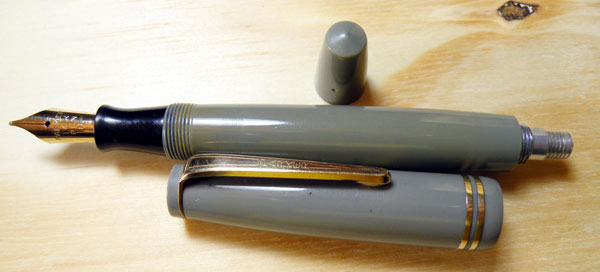
When you think of Parker Thrift-Time pens the Televisor Junior Mark II probably isn’t the first one to come to mind. It’s quite uncommon and this one wasn’t recognised by the seller, who listed it as a Challenger. There are resemblances, so it’s forgivable, I suppose, though the Televisor is an altogether better and more interesting pen.

In the 1930s – and for some time thereafter – international trade was restricted by tariffs and import duties put in place by national governments to protect their own industries. American pens were made very expensive in Britain by this policy, and to get around it Parker (and several other companies) set up production facilities in Canada, which as a Commonwealth country was not subject to these tariffs. Initially the Canadian plant assembled parts made in the USA but in time it became a manufacturing facility with some degree of design independence. The Televisor, in 1935, was the first wholly Canadian Parker. Instantly recognised as a high quality pen at a moderate price, the Televisors sold well in Britain. The pen was redesigned in 1938 as the Mark II and it remained in production for another two years.
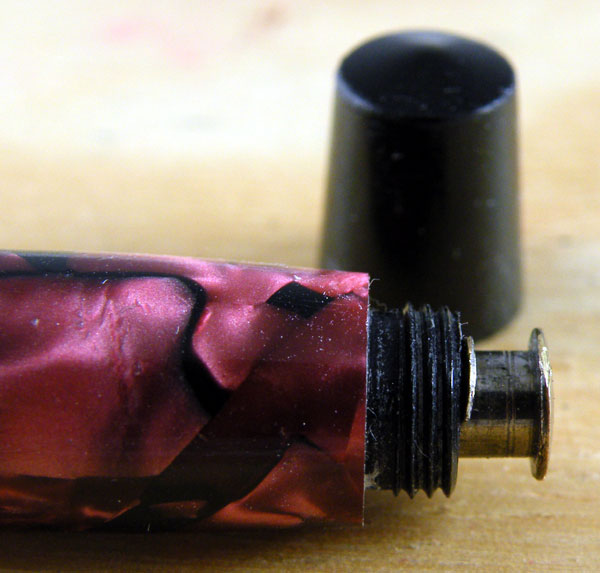
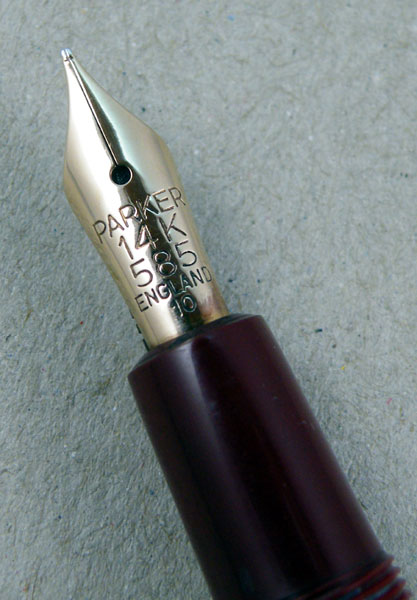
Though it is quite a small pen and was in the middle of the 1938 Parker price range, the Televisor is much sought after today because of its excellent build quality. Parker used its anchor bar in this pen, a clever three-piece pressure bar that transfers the back resistance to the rear of the pen instead of the section, obviating the need for a screw-in section. The section is transparent to allow the ink to be checked, a feature that was popular at the time.

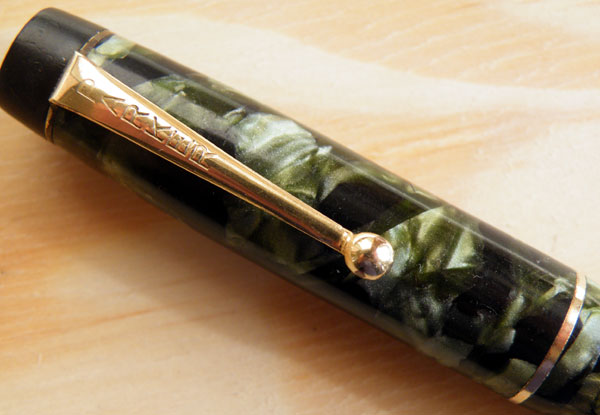
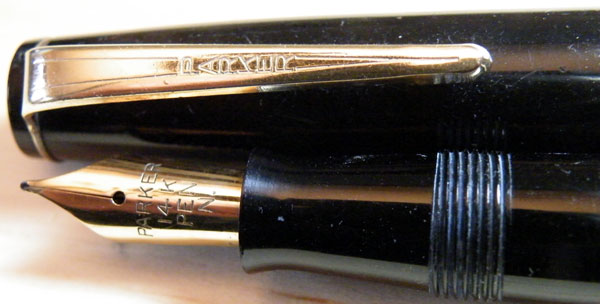
This example is in marbled burgundy, one of several colours the Televisor shared with the Challenger. With its gold-filled tapered clip and medium cap band, it makes a very handsome pen and it’s an excellent writer with some flexibility.


The English Duofold New Style

I don’t write about Parkers nearly often enough. Whether American, Canadian or English, Parkers up to – oh, around 1970, say – are among my favourite pens. Not to write with, particularly, as their mostly rigid nibs don’t suit me, though their balance and fit to the hand is superb. They’re a joy to work on, with their high quality, durability and great design. Also, I just admire them, whether it be a 1920s Duofold or a humble English Slimfold. They’re simply great pens and they ooze fitness for purpose and that restraint of design that makes every one a classic.

The reason I don’t write about them much is that I don’t handle them often these days. For many models, the price differential between unrestored and restored is too slender to repay my investment. Some of the other models, like the Duofold Senior, Maxima or New Style always seem to slip past me or I get outbid. But not this one:

The Duofold New Style was, I believe, the first Parker wholly designed and manufactured at Newhaven and it broke new ground for the model. Though still a button filler, the shape and style is a radical change from the previous Duofold line. It appears familiar to us today because, with small changes, it remained the shape of the English Duofold for many years, through a couple different filling systems – the Aluminium Filler and the Aerometric. It was immediately influential and remains so today.

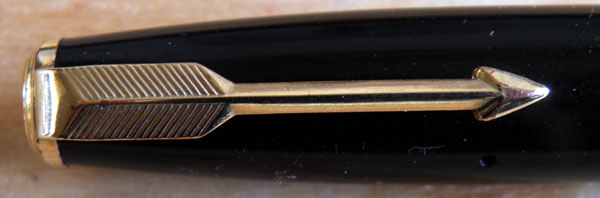
Looking at it, you know this is a pen to be taken seriously. The only hint of ostentation – and even that’s a very subtle one – is the double “jewel”. For a pen that’s more than 60 years old, it looks very modern. The best design is always timeless. The plastic of the barrel and cap has proved durable and it readily takes a shine. This well-used example has lost a little plating on the chevroned cap band, but otherwise it’s good. The blind cap still fits so perfectly that you have to look for the join.

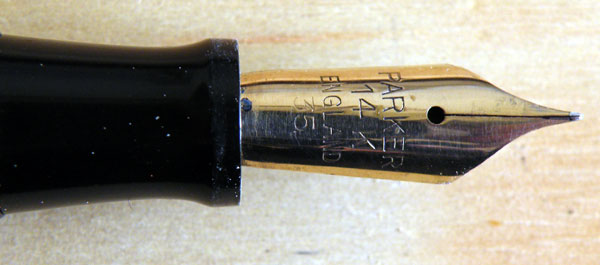
The only other indication that this pen cost quite a lot is the big lump of gold that is the nib. Durability is the watchword here too. Unless they have plummeted nib-first into the floor tiles, Duofold nibs rarely need tuning. That thick, rigid blade of a nib remains stable, and writes as smoothly today as it did in 1946. That’s the downside for me, in a way. If I ever get one with a bit of flexibility, it will become my daily writer.

The Parker Victory

There remains some debate over why Parker chose the name Victory for this series of pens. It is reasonable to assume that this was chosen as an aspirational name, looking forward to an allied victory in World War II. Against that, some have asserted that the first Victories were made as early as 1935, but this seems unlikely. Records appear to indicate that the first series began in 1941, and given what is known of Parker’s developing commercial relationship with Valentine at Newhaven, this seems to be the more convincing explanation.


From my own experience of selling Victories, interest is stronger in America than in Britain. Here, I believe, they are seen as cut-down, poor man’s Duofolds. That’s far from true, as they are clearly a separate design branch in their own right. They began looking somewhat Duofold-like, and the last, Aerometric version does resemble some of the lesser Duofold models, but in between the Victory develops into a unique and beautiful pen, practically and aesthetically as good as any pen produced by Parker at Newhaven.


The various versions take a little sorting out, and I’ve tried to make them easy to identify below. Unfortunately I don’t have photos of all the models.


Mark I
Mark I

1941 – 46

Not very common now, the Mark I is perhaps the most sought-after of the Victories, appearing in beautiful hatched and marbled patterns with a BHR clip screw and blind cap. The clip is of the Duofold ball-ended type and the cap has either one narrow cap band or none. These early Victories appeal especially to American collectors as they appear in colours that are not available in US-made Parkers.


1946 – 47

The Mark II is quite similar, but now the clip screw and blind cap are made from the same material as the rest of the pen, and it is more streamlined. These pens are self-coloured in burgundy, blue, grey, green and black. There are two slim cap bands on this model. The production run was short with the result that these pens are not especially common.


1947 – 48

The Mark III had a longer blind cap and a much shorter clip screw. It was offered in the same colours as the Mark II. It has two bands and a ball-ended clip. Again, because they were produced for a short period there aren’t many of these pens around.


Mark IV
Mark IV
Mark IV

1948 – 52

The Mark IV is often referred to as the “Victory AF” as it shared the aluminium filler with the Duofold. The clip had been redesigned to be more tapered, quite like the clip on the Challenger. This is a very aesthetically pleasing design, to my mind the most attractive of the self-coloured Victories. They’re probably the most common of the pre-aerometric Victories.


Mark V
Mark V

1953 – 1965

The Mark V is the final version of the Victory. Like the rest of the Newhaven Parkers, it’s now an Aerometric filler, and it’s insufficiently distinguished from the smaller pens in the Duofold range to attract much attention from collectors. It has a single chevroned cap band and appears in black, green, blue and burgundy.


Without exception, these are high-quality pens. They make excellent user pens and they are an interesting byway in Parker production. At the moment, they tend to sell for rather less than their true value. Snap them up while you can!


The Parker 51

One of the most popular pens of all time, the Parker 51 remained in production for over thirty years and sold in huge numbers. The barrel and hood were made of Du Pont Lucite, a tough early acrylic. The later Aerometric fillers are often ready to write without service even today. It is a tough, durable, practical pen which has an immensely strong following today. Many people wax enthusiastic about their 51s. Some get quite fanatical!

At this point, I should say that I’m not one of them. In the last two years, I’ve sold one Parker 51, and that was only because it had an oblique stub nib.

I have several objections to the Parker 51, and some of those would apply to the 61, the 21 and the various clones made by other manufacturers. First off, I dislike hooded nibs. Much of the beauty of a fountain pen, for me, lies in a well-designed exposed nib. Also, I dislike pens that taper towards the writing point. It feels like your fingers are slipping forward all the time, and it forces a strong and ultimately painful grip. This is a problem common to all pens of that shape, especially Parker’s flighter ballpoints. It’s possible to create a tapered pen with a good grip, like, for instance, the Sheaffer Balance. The Parker 51 is just plain ergonomically wrong.

The early ones are Vacumatics. I’m forced to say that the Vacumatic is an unfortunate filling system, an unnecessarily high-maintenance bulb-filler with a baroque complexity that adds no advantages to the simple original. Novelty was perceived to be a selling point in American pens in those years, and the consequence has been that we have an inheritance of grossly over-engineered filling systems that have a short time between failures and are finicky to repair. The later Aerometric is an infinitely superior filling system.

My oblique stub nib was a considerable rarity. Most Parker 51s, whether fine, medium or broad, have a rounded nib. Taken together with the nib’s stiffness and the relentlessly measured feeding of ink by the collector, the effect is very similar to writing with a ballpoint, hence, I believe, their popularity among those who have never used a traditional fountain pen with its beauties of line variation and shaded ink delivery.

Your view may vary, of course 🙂

English Duofolds

A few years ago, if you wanted an English Parker Duofold in good condition and working order you would have had to pay quite a bit. Not now. The market for these high quality pens seems to have fallen away. The Maxima and New Style models still sell well, but even the Seniors have dropped in price and you can have the standard Aluminium Filler or Aerometric Duofold for very little. If you ever fancied one, now’s the time!

I don’t know why this has happened. Maybe everyone who wanted an English Duofold has one now. Still, it’s strange. The build quality of these pens in unbeatable, they still look good because they were made from tough materials, the style is timeless and they’re great writers if you like a firm nib and a consistent line.

This isn’t a sales pitch, by the way. I more or less gave up on English Duofolds a few months ago, as it became hardly worth my while to restore them. I still sell the odd one, but these are ones I’ve picked up as part of a lot. You won’t see many in my listings.

Duofold Special

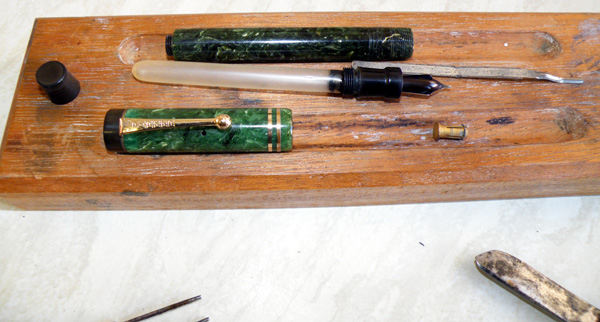
There are very few pens I don’t enjoy working on. There are some, however, that are an especial pleasure and this Duofold Special would be high on that list. Late twenties/early thirties Duofolds are at the very peak of quality. There is no skimping of effort to achieve the best possible result in the manufacturing process. Apart from the slight barrel discolouration due to the decomposition of the sac, and a little wear on the plating, this pen is almost like new and that’s because of the original attention to quality.

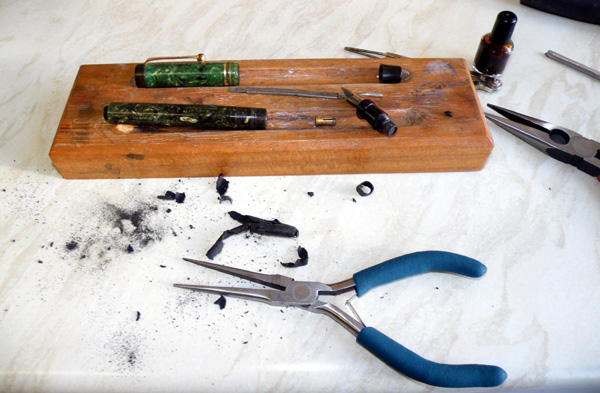
There’s a routine to restoring a pen – assess, disassemble, clean, assess again, re-assemble. The only part that needs replaced here is the sac. I use a silicone one to prevent any further discolouration of the jade. It’s important to clean the inside of the barrel thoroughly; any fragment of the old latex sac that remains will continue to discolour the barrel. As it’s a screw-in section, sac size is critical. It has to be as large as possible to contain the optimum amount of ink, but narrow enough to clear the walls of the barrel. Then it’s time for reassembly and a gentle polish, and the pen is ready for write-testing.

I have read that the Duofold Special, or JL (for Junior Long) as it’s also known, was not listed in Parker’s catalogues of the time, but was made to meet popular demand for a Duofold the length of the Senior and the thickness of the Junior. Actually, it’s a tiny bit shorter than the Senior and a little thicker than the Junior – but near enough! From the first black hard rubber model in 1922 the Special was very popular in Britain, and survives in moderately high numbers. This two-ring green jade version was made in 1928 and 1929, and is not so often seen.