The Dickinson Croxley

Several British pen brands were made by (or for) large stationery companies. Despite being a secondary enterprise for these manufacturers, quality was generally as high, or higher than that of the dedicated pen makers. John Dickinson was and remains one of the largest paper manufacturers, establishing paper mills at Croxley in 1830. They were long famed for their Croxley Script paper, which is no longer made, and the excellent Basildon Bond and economy Lion Brand which are still available. Gradually, over decades, they expanded into other related areas, going into fountain pen sales in the late nineteen thirties. Their pens are high quality writing instruments. They sold well and are common today, though they are somewhat underrated by buyers.

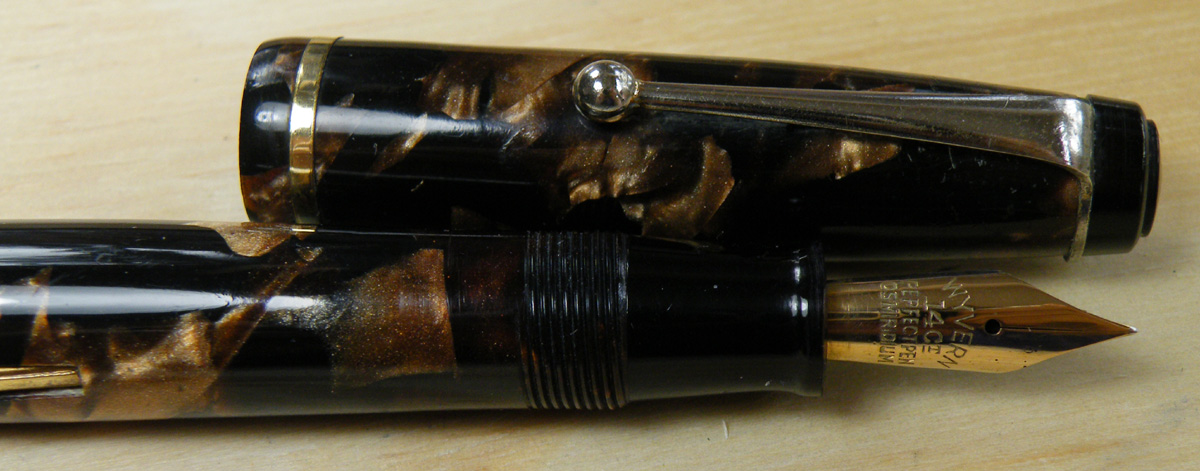
There is some doubt about how Croxley pens were produced. I have read that Dickinson established their own pen factory at Croxley, but this is disputed by others who say that the pens were made by De La Rue or Conway Stewart. The pens that De La Rue made for other companies tend to look like their own product range and usually the quality is not especially high. Looking at Croxley pens, one would have to say that there is no reason to doubt that they could have been made by Conway Stewart, but there’s no compelling evidence that they were, either. All I can say is that Croxleys are very well made, with parts that fit together securely and no distortion of the plastic. The plating of the metal parts is very good, better than that usually seen on either Conway Stewarts or non-Onoto De La Rues. The well-stamped nibs are excellent, often medium but not infrequently broad and usually with some flexibility.

Croxleys were only made for a short period and the product range is small. The earliest one I have seen is very much an example of the Standard British Pen (of which more on another occasion), straight-sided with a large BHR clip-screw, a ball-ended clip and a straight lever, looking very much like a Summit or a Mentmore Autoflow. The Croxley most usually seen is quite similar, but it has a handsome arrow clip which is echoed by an arrow-shaped lever. A balance-shaped pen with a smoothly curved clip and an arrow lever was also made. The pens come in black and the usual range of marbled patterns. There is also a plain-but-handsome desk-set which turns up once in a blue moon.

Lack of variety probably limits their appeal to collectors but they are durable and handsome and, above all, they are writers’ pens, up there with Swan, Waterman and Onoto in terms of writing pleasure.

Summit

Though their quality is consistently high Summits can usually be had for bargain prices. Partly, perhaps, that’s because they’re seen as quite dull. Their design, though practically and ergonomically excellent, was conservative. They’re most often seen in black chased celluloid and the nibs, though very good writers, are generally firm.

There’s more to the company than that, though. Just on the basis of the pens I’ve seen, Summit began life in the last years of the 19th century as, I believe, Curzon, Lang and MacGregor. Examples of their early output are rare now, but they marketed the Angloamer pen. In, perhaps, the early nineteen-twenties, the company became Curzon’s. Lang continued to manufacture the pens. They produced a range of handsome BHR flat-top lever fillers with riveted clips during the twenties and by the end of that decade had moved on to celluloid. Just before the Second World War the company became Summit. They produced many beautiful pens in lizard-skin patterns, in moire and in the full range of marbled celluloids. At the peak (I almost said summit!) of their popularity, from the thirties to the early fifties, they were a very big player indeed, as can be seen by the number of Summits that still appear on eBay.

Something that appears admirable in retrospect – though it was doubtless not done by intention – is the way the company ended. Faced with the post-war decline in sales due to the advent of the ballpoint, other companies reacted with unfortunate new designs and saved costs by reducing quality. Summit continued with its well-made, traditional design until 1954, then closed its doors.

From a collector’s perspective, the various versions of the company produced a range of pens over the years, many now rare and costly, some exceptionally beautiful. For the writer who likes a firm or only slightly flexible nib, the later Summits provide excellent, well-made, comfortable writing instruments.

Less Common British Pens – The Wyvern.

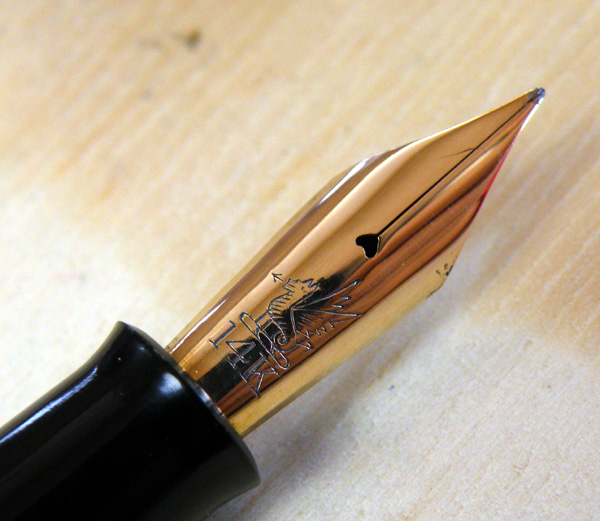
The Leicester Dragon on a Wyvern De Luxe Nib

Despite being one of the oldest British pen companies, and producing a variety of high-quality pens, Wyvern does not have a strong following these days. From the 1880s onwards, the company went through various stages of development, importing pens, buying them in from outside contractors, assembling pens from parts and finally going into full production. By the late nineteen-twenties they had their own nib plant and as well as producing their own-branded nibs bearing the Wyvern logo, they made nibs for other manufacturers and warranted 14ct gold nibs for the wider industry. You may have bought a Wyvern without realising it, as they made entire pens for other companies and produced a great many promotional pens.

An Early Fifties Wyvern De Luxe

Though not often seen now, their early eyedroppers and safety pens are excellent examples of the period. More commonly offered now are their pens from the nineteen-forties and fifties. These range from the Wyvern Perfect Pen – a good economy-priced student pen – through their larger numbered models like the 60c to the crocodile-skin, lizard-skin and pigskin-covered pens at the top of the range. These pens were highly esteemed and the company enjoyed royal patronage during this period. The weakness of the middle-range Wyverns lies in the gold plating, which is often little more than a gold-wash and wears away easily, especially on the clips. Their great strength are the nibs which are of consistently high quality and among the very best of the time. They are usually firm or semi-flexible, but the occasional full flex Wyvern turns up and is a true delight.

A "Perfect Pen" No 81. Low Cost With A Great Nib

An innovative and progressive company, Wyvern made such a wide range of pens over the decades of their existence that they offer good opportunities for the collector. For the writer looking for an excellent and characterful pen to use, Wyverns still offer great savings over comparable Swans and Conway Stewarts.

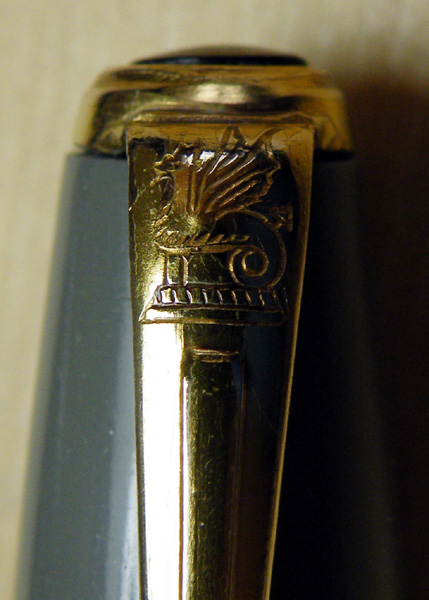
The Wyvern Logo on a 1950s Ambassador