Less Common British Pens: Kenrick & Jefferson

Kenrick & Jefferson pens exist, I believe, to remind me how much I don’t know. There are several K&J pens that I’ve seen photographs of but never handled. A picture may be worth a thousand words, but a pen in your hand speaks volumes.
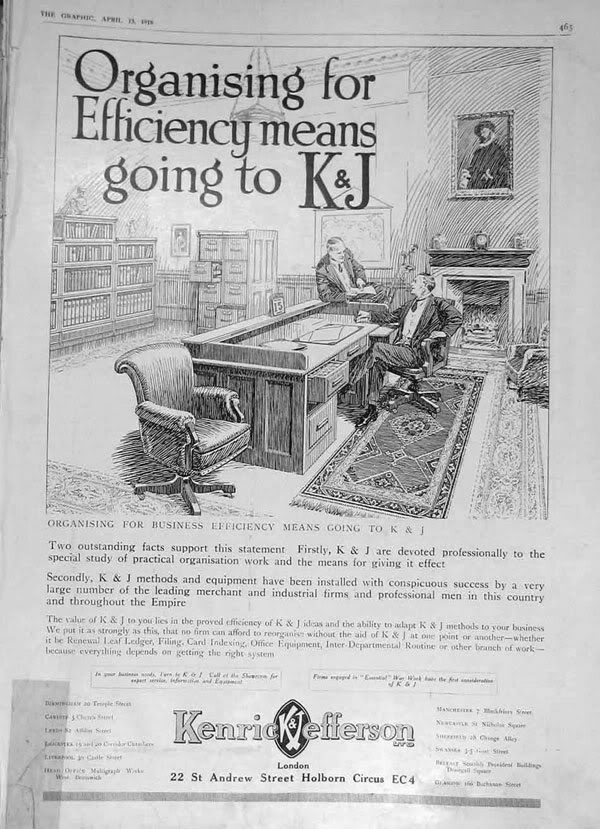
Kenrick & Jefferson, based in West Bromwich, were a large office supply company that provided everything from office furniture down to paper clips. A large part of their activity was the provision of pre-printed business forms for government, local government and business. Some of these forms had as many as twelve carbons, so it took firm pressure to leave a clear imprint on the bottom one. The pens they sold were designed with that in mind, with nibs as hard as nails. It is sometimes baldly asserted that Kenrick & Jefferson pens were made by Mabie Todd, but that’s only partly true. Some of their pens were certainly of Mabie Todd manufacture, others may have been, and some seem to have been made by other pen companies. I have a cap (but sadly that’s all) of a 1920s K&J pen that is essentially a top-of-the-range Swan, and it bears a Swan patent date on the clip. That’s one that certainly was made by Mabie Todd. Here’s another that may have been:
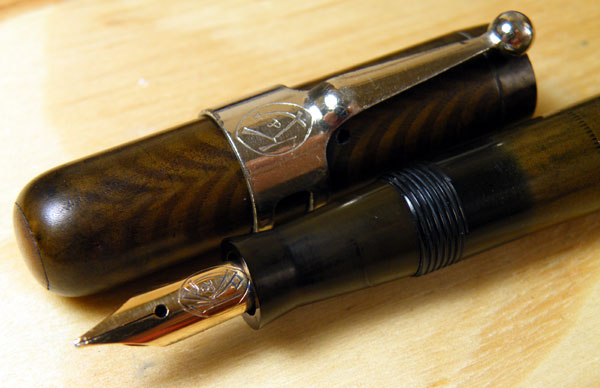
I would date this pen to the immediately post-World War I period, and it bears a strong resemblance to the early Swan Self-Fillers like the SF2. Mabie Todd never made a feed like this, however, and there is no reason to think the feed isn’t original to the pen.
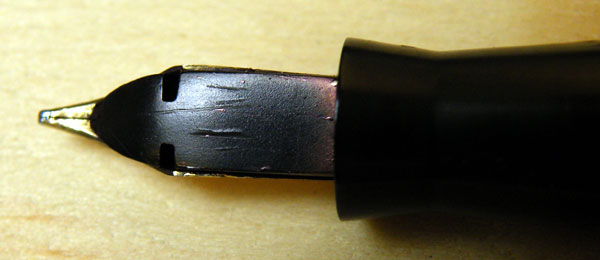
That doesn’t exactly remove the possibility that Mabie Todd made the pen; K&J may have had their reasons for specifying such a feed, but it does raise some doubts.
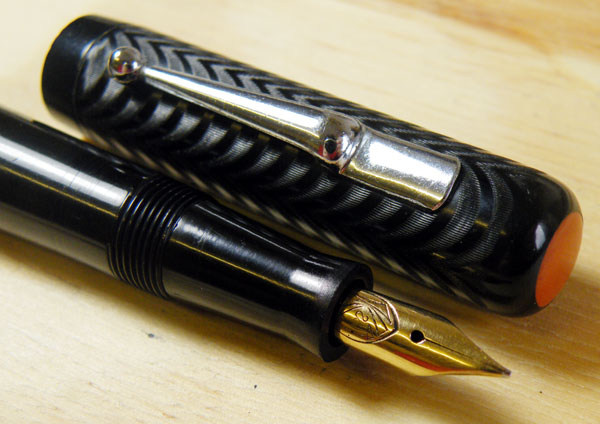
This pen is very Swan-like in its general appearance. The dimensions are a little different from the nearest Swan equivalent, which would be the SM2/100. This pen is noticeably thicker. The chased pattern is different too, but it does have a Mabie Todd-type ladder feed. The odds are good that Mabie Todd made this one.
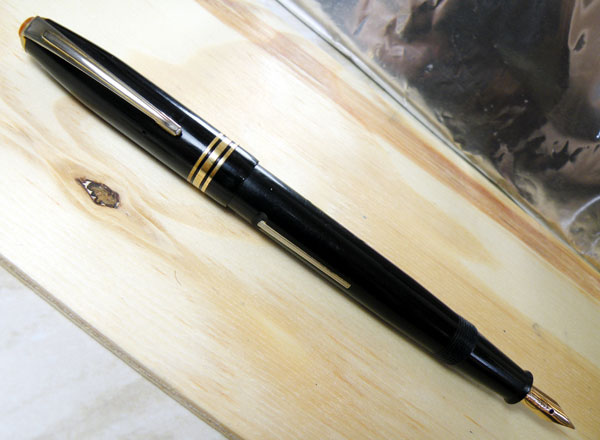
There’s a gap of many years to this next pen. Probably made in the early nineteen-fifties, this pen no longer resembles a Swan, not even the poor-quality Biro Swans that were being produced at this late date. Its general appearance and the almost complete loss of gold plating on the clip and lever looks like Wyvern’s work, but that’s only a guess. Plating loss aside, it’s still a very high quality pen.
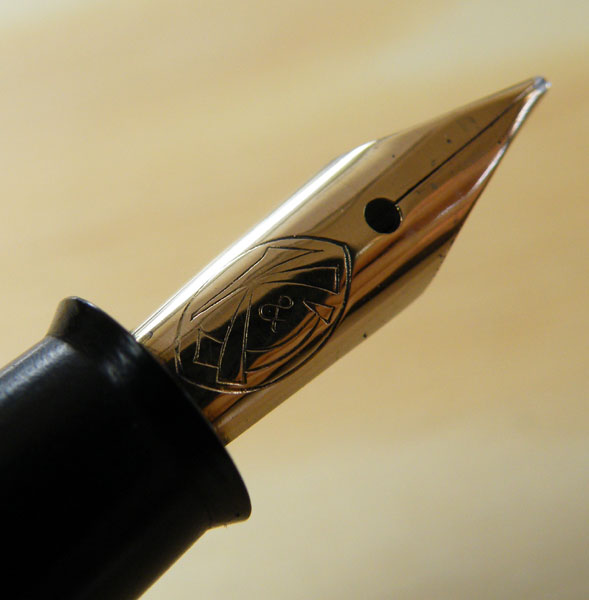
That’s about the limit of my knowledge of these intriguing pens. I don’t know whether Kenrick & Jefferson sold a range of pens at any one time, or whether they only ever had one on offer. They were consistently well made, they were always called “The Supa Pen” and they always bore an apricot-coloured top to the cap, or a similarly-coloured ring near the top of the cap. The company, which began in 1830, was largely bought out by a competitor in 1993. They retained production of envelopes, but that too disappeared in 1999. Sadly, there’s no mention of their pens in the existing archives.
Macniven & Cameron 308

Plagiarism has always been rife in the fountain pen industry. Sometimes it was mere emulation, but often the copying was close enough to lead to litigation. Perhaps no pen gave rise to as many copies as the Parker Duofold, both in the USA and abroad. Here’s a strange example:

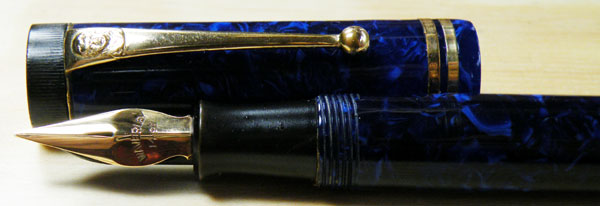
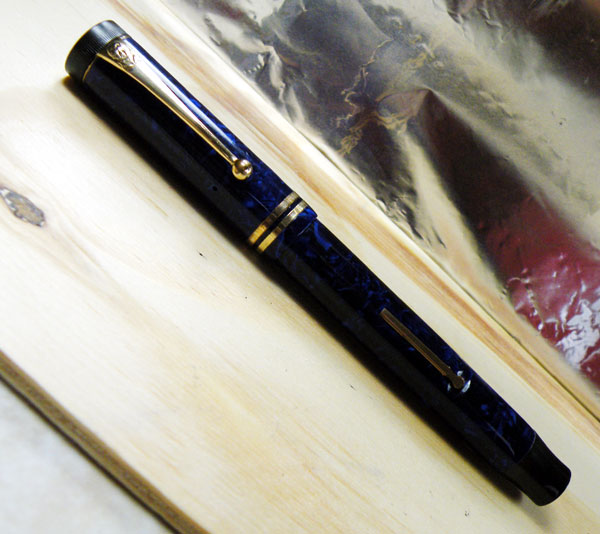
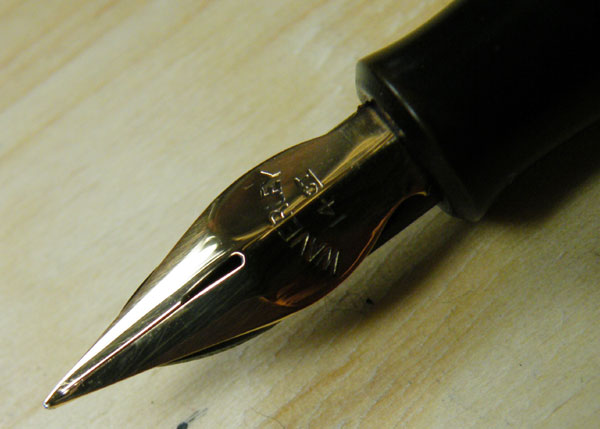
This is a Macniven and Cameron Waverley 308. It ticks just about all the Duofold boxes – size, proportion, milled clip screw, cap ring placement, even a Duofold-type blind cap on a pen that doesn’t need one because it’s a lever filler. Closed, it’s almost a lapis lazuli two ring Duofold of around 1928. Once you see the nib, of course, the game is up!

It’s strange that they should have copied the Duofold so closely, then made it instantly clear that it was a Macniven and Cameron by using their unique and characteristic leaf-shaped nib. They did make pens with more conventional nibs but chose not to use one here.

The biggest surprise about this pen is that M&C would choose to emulate anyone else. Always an individualistic company, they usually did things their own way, with little reference to what the rest of the industry was doing. Perhaps the chance to cash in on the Duofold’s popularity was too tempting, but pride made them use their own nib.

I came very close to keeping this pen. I admire lapis lazuli, the quality was impressive, the size and balance was right. And I love that Waverley nib! It was the nib that decided me against it, though, in the end, Unlike all the other Waverley nibs I’ve had, this one was rigid, perhaps in the best Duofold tradition. I couldn’t write well with it, so it had to go.

My apologies for the quality of these photographs. When I took these I was experimenting with artificial light and reflective metal foil. You can see how well it worked – all harsh contrast and heavy shadows. Oh well.

The Ingersoll No30

Ingersoll pens can be thoroughly confusing. For a start there were two American pen makers called Ingersoll, one producing the bakelite twist-filler dollar pens, the other Redipoint pens. US Ingersolls not infrequently found their way across the Atlantic and sometimes appear in eBay listings. Then there was a UK Ingersoll pen company, apparently independent of its US namesakes, producing very British-looking pens.

It has to be said that most British Ingersoll pens seem to have been aimed at the lower end of the market, often with steel nibs. I pass on these, but there are also occasional Ingersolls that are very much better quality, like this Ingersoll No30.

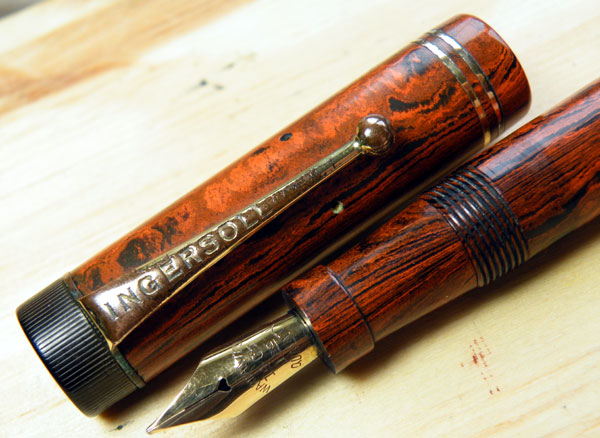
This is a big pen – 16.7cm posted – in an especially richly-coloured mottled hard rubber. The shape would suggest that it’s a mid-thirties pen, and it bears a strong resemblance to a variety of no-name hard rubber pens common at that time. The milled clip screw, especially, looks similar.

The barrel and particularly the section, with its pronounced step, look very like those of the MHR Burnham of the time. Perhaps the Ingersoll company bought in its pens from one of the majors, and Burnham looks like a likely candidate to me, though I have seen Wyvern suggested as a possible manufacturer of their later pens. All this is speculation. What is important, I think, is that beauty can appear in the most unexpected of places. It’s a pleasant surprise to find that a company I would normally give little consideration to produced such a gem as this one.

The Eversharp Kingswood Pen

For some years, I ignored Kingswoods. Somehow, in that echoing void I call my mind, I had confused Kingswoods with Queensways. The Queensway, it must be said, is a pen well worth ignoring, as it has all the writing capability and aesthetic appeal of a pointy stick. In truth, however, there is no connection between the two, except in my muddled inability to discern the difference between two royal titles. So I missed a lot of good pens for a while.

I’ve made up for it since and grab Kingswoods whenever I can. The pens are well made, decorative and bear an excellent Eversharp nib. In reality they’re a Parker production, made by them at Newhaven after they had bought up the remnants of the failed Wahl Eversharp company. At one time I thought Kingswoods had been created to use up an overstock of Eversharp nibs. I suppose that could be the case, but there must have been a tremendous amount of nibs as the Kingswood proved a good seller and survived long enough to go through a re-design.

Celluloid pens, they share the colours and pattern of the post-war Duofolds and Victories that were produced in Newhaven. The earliest, and most common, Kingswoods are only slightly streamlined and have a stepped clip. Like the later ones, they appear either with a plain or pierced cap band. The later, more torpedo-shaped pens also have a stepped clip, but now incorporating a shallow ‘S’-curve from front to back.

They have a tendency to lose the thin gold plating on clips and levers, though it usually remains on the rings rather better. This can be forgiven, I think, because of the superb Eversharp nib, still as fine an instrument as it was in the company’s glory years. The pens themselves are reliable and straightforward lever fillers. They will continue to give excellent service for many years to come.

Burnham

I have to confess that I’m not very well-informed about Burnham pens. This is because I suffered so many disappointments with them in the early years of my pen-buying that I’ve ignored them ever since. The post-war Burnhams were made in some of the most beautiful patterns ever produced, but they lacked durability due to a multiplicity of faults. Most appear to have been made from casein and many have suffered from the destructive cracking that material can be subject to. The material seems to accept stains readily, too. There are also shrinkage problems such as loose cap rings and ill-fitting caps. Conway Stewart pens were sometimes made of the same material but have survived the years much better. The gold plating on Burnhams is poor, too, being little more than a gold wash which is often entirely rubbed off clips and levers. Clips were fitted with a flat stud which seems to fail easily; many examples appear without clips.

Earlier Burnhams were rather better made, and the thirties range included a large mottled hard rubber pen with a washer-clip, elegant and well made. It is distinctly uncommon now, but the few examples I have seen have survived in good condition. Similarly-styled metal-covered pens were made in that period and they were quite robust too, but they are rare. The button-filler No 60 was a large and impressive celluloid pen and it turns up reasonably often, but it, too, suffers from poor plating, though not quite so bad as the later pens.

Burnham numbers can be confusing as they do not follow any logical sequence and were re-used for different pens. 1950s production included brightly-coloured pens with plated nibs, aimed at the school market, and calligraphic pens were offered too.

Given the variety of models and the beautiful colours, Burnhams are collectible, but because of their faults it pays to be a cautious buyer. There are good examples out there; try to ensure that those are the ones you buy. All post-war Burnhams are lever-fillers and repair is very straightforward. As the sections are screw-in, use a size smaller sac than you would use with a comparable push-in section, or you may end up with a twisted sac.

Oddities.

I picked this pen up this week.

I wasn’t sure what it was, other than that it was a very old Conway Stewart. The faint imprint helped a little and further investigation showed it to be a 206. I can’t find a start-date for its manufacture but it was on sale for Christmas 1928 priced at 10/6d without a clip and 11/6d with a rolled gold clip. This one was evidently bought without a clip and an accommodation clip was later fitted. Here it is posted:

That’s a strange nib! What is that thing?

Closer examination reveals it to be a Macniven & Cameron Waverley nib, with a strange device fitted over it. These things are sometimes referred to as over-feeds, but they don’t actually carry any ink supply. Rather, they prevent the ink in the nib and external part of the feed from drying out. They were not uncommon for a time; Mabie Todd also had a version.

The nib shouldn’t be in this pen, of course. It’s probably at least ten years older than the Conway Stewart, and was most likely fitted in an eyedropper filler. Looks like the first owner of this 206 damaged the nib and replaced it with the nib from his old pen.

I have yet to go to work on this pen, but I think I have a nib of the right date for it and maybe, some day, I’ll pick up a Waverley eyedropper that needs a nib. Wonderful thing to have, anyway.

Dismantling a Stephens Leverfill 76 today, I came upon an unorthodox repair! A strip of Elastoplast (If you’re American, think Band-Aid) had been used to attach a sac. It didn’t work, as was shown by the amount of ink that had permeated the Elastoplast and had coated the inside of the barrel. The nib was flattened, doubtless as a result of the pen being hurled at the wall in frustration! Some times I think, “I’ve seen it all now!” But no. I haven’t. Even more bizarre repairs will appear!

The Ty-Phoo Tea Pen

Someday, someone will write a history of the promotions of British tea companies – if someone hasn’t done it already, that is. Collectable cards of all kinds, die-cast car models, The Tetley Tea Folk, tea towels, ornaments – all sorts of things have been offered as inducements to choose one brand of tea rather than another. Perhaps tea companies feel that their products don’t stand out enough in their own right or maybe it’s that there are so many brands in the field. In any case, it’s an odd phenomenon, and it gave us the Ty-Phoo Tea pen, one of the more interesting good quality pens of the twenties and thirties.

The first one (so far as I can tell) was a black chased hard rubber lever filler with a threaded end to the barrel for posting the cap. This is the basic promotional pen of the time, adequately well made with a warranted 14ct nib, but it doesn’t stand out, and the threaded barrel end is almost a diagnostic sign for an economy pen. No-one appears to know who turned out these pens, ready to be stamped with the advertiser’s name. Not many of this first version of the Ty-Phoo pen survive. They’re actually pretty durable, so it’s reasonable to assume that this first promotion wasn’t all that successful and there were never very many of the BCHR Ty-Phoo pens.

Having had a re-think, Ty-Phoo ordered a much better pen, the mottled hard rubber one we are more familiar with.

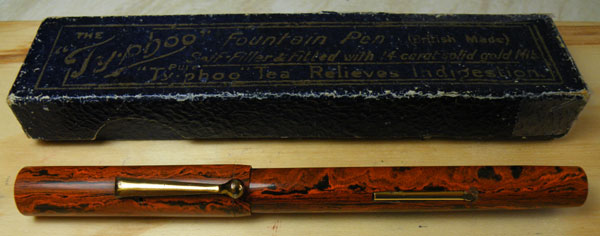
Though the trim is, I suspect, gold-tone rather than gold, in other respects this is a very high quality pen indeed. The design is good, the wood-grain MHR is pleasing to the eye, the machining and finish are first class and they have good warranted nibs. An altogether better pen than the first offering. Some claim that this pen was made by Conway Stewart, others suggest Wyvern as the manufacturer. I have to say that it doesn’t look like Conway Stewart work to me. Their associated pens always resemble their own output, and this pen is very different. Wyvern seems more possible, but the truth is that the manufacturer is unknown. Maybe I should say manufacturers, because there are minor differences between examples of this pen – different clips, slightly different sections and some boxes are blue, while most are orange.

Offered for two shillings and seven pence together with proofs of purchase of the tea, the market value of the pen was said to be eight shillings and sixpence. A real bargain, the offer was taken up with enthusiasm, as can be seen by the number of these pens still around after all these years.

Less Common British Pens: The Savoy

The Savoy pen remains a mystery to me – not that that’s a bad thing! It’s something to puzzle over in the hope that one day all will become clear.

They’re by no means common pens, but they happen along now and again. Most of those I’d seen, and all of those I’ve had until recently, were black celluloid pens with engine-chasing, very like Stephens, and often with a slightly crude-looking stepped clip. Due to the resemblance, I assumed that they came from the same manufacturer, namely, Langs.

Now, however, I hear that it is asserted (on what basis I know not) that Savoy was a sort of off-brand of De La Rue, created in the nineteen-thirties as a test-bed for new celluloid patterns. It’s true that some Savoys are in really nice colours, but not, so far as I have seen, ones that are so unusual that the manufacturer would want to keep at arm’s length from them by creating a new company to test the market. It would seem to be a way of ensuring that not many pens were sold. Also, the parent company wouldn’t gain the credit should one of these new patterns prove popular. And how does that explain the fact that most Savoys are black? I don’t say they couldn’t have been made by De La Rue but I remain unconvinced. They don’t look like De La Rue pens, but that’s not conclusive.

I also hear that Savoys might have been made by Valentine at Newhaven, in the pre-Parker days. That’s perfectly possible. Valentine made pens for many companies, and they had no real “house-style” of their own. The fact that Savoys don’t look like Valentines doesn’t matter. They would make any pen you wanted. The point is, though, that Valentine’s sub-contracting was for other pen companies, like Unique, for instance. If they made Savoys, who did they make them for? Was Savoy a stand-alone company? Was it a sub-brand of Valentine or De La Rue? What’s the story ? Enquiring minds wish to know.

Anyway, those Savoys that have passed through my hands have been well-made pens, usually with warranted 14ct nibs. As a brand, they have captured my interest. This is the only colourful one I’ve had:

Not one of the more exotic patterns, but an elegant large flat-top in a good conventional blue marble.

Osmiroid

The humble Osmiroid has a much longer ancestry than most fountain pens. It was made by EH Perry in the factory at Gosport. The company had been founded in 1918 by Edmund Perry, grandson of James Perry, a major figure in the development of practical steel nibs. Perry’s first steel nib patent dated back to 1830 and the company’s Iridinoid and Duragold nibs were a success for many decades.

The idea behind the Osmiroid, perhaps not surprisingly, was much more about nibs than pens. Steel nibs in a variety of calligraphic styles were united with screw-in feeds. Oblique (left and right) italic, copperplate, music nibs and many more were available individually. Quality of the nibs was very high. The intention was to provide school-children with excellent writing instruments at an affordable price. Calligraphers benefitted too!

The first pen, the Osmiroid 65, was almost an afterthought. A very basic lever filler, it was adequate for the purpose, though some of the colour mixtures it came in were unfortunate. Many of the 65s have not survived well. The early injection-moulded plastics used in their manufacture were subject to shrinkage over time, with the result that caps often no longer fit and other distortions have taken place. Not all are affected, but buy with care.

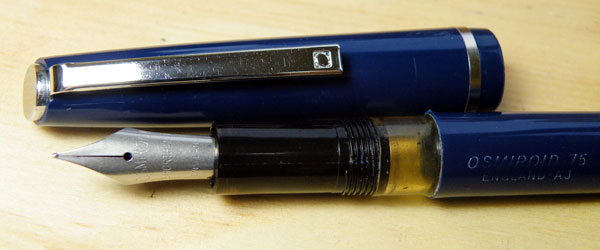
The next pen, the Osmiroid 75, was altogether better. Much less subject to deterioration (though it can happen) these self-coloured pens are excellent piston fillers, many still working today without any servicing. Together with a collection of nibs to suit your hand, the 75 remains one of the best calligraphy pens around.

The Osmiroid 75

Later, a different Osmiroid system was developed. The new units included nib, feed and section, which screwed into a cartridge pen. These are not interchangeable with the earlier nibs, and the quality is not so high.

Thankfully, the original Osmiroid nibs still appear on eBay quite frequently and some retailers still sell them. These nibs also fit Esterbrook J and SJ pens , and some post-war German piston-filler school pens.

Not a collector’s pen, the Osmiroid project was nonetheless a worthy one that gave a generation of children good pens with which to learn to write well, and remains a useful workhorse for calligraphers to this day.

Stephens Pens

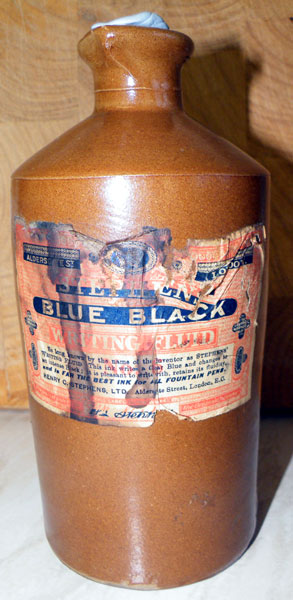
How old would you say that stoneware ink bottle is? I can’t say, though I do know that they were in use from around 1860, and might have continued to be made as late as 1950. What I can tell you is that there is blue/black ink in there that’s still perfectly usable! Though the label is damaged it can be seen that this ink was made by Stephens, and I would guess that it was probably a school ink bottle. They’re moderately common.

Stephens made ink from the middle of the nineteenth century and they were by far the most successful ink manufacturer, being seen as the automatic choice for schools, government offices and many businesses. They had their competitors, some very good, like Diamine, which is still around, Colliers and Watsons, both long gone.

It was not until the 1930s that Stephens put their name to a fountain pen. I believe all Stephens pens were manufactured by Langs, who also made the Summit and Savoy pens, and there is a strong resemblance between all of these pens, with their traditional lines, machined patterns and good quality build. Best known is the Leverfill range, issued with different levels of trim to suit different pockets. Most seen today are in black celluloid with an engine turned pattern, but marble-patterned examples in a variety of colours are not uncommon. Stephens clips appear in several shapes – tapered, stepped and in an arrow shape.

Stephens No 270 Lever Filler

Stephens also produced an excellent stud filler, a button-filler with a fixed plunger button. This efficient and durable filling system had been patented by Langs but was employed (so far as I know) exclusively in Stephens pens. It also came in a range of prices, from seven shillings and six pence to twenty-one shillings and was made in the same range of colours as the Leverfill. The nibs were either marked with the Stephens name or warranted 14ct.

Stephens 76 Stud Filler

I’m fond of Stephens pens, particularly the stud fillers. The nibs are good and often semi-flex. Many of them are broad. They’re reliable and comfortable to use.  The patterned examples and the stud fillers sell well, and there are quite a few Stephens collectors around who appreciate their quiet, unpretentious quality and the company’s long history.